

As of August 14, 2026. Every landlord knows vacancy costs money. Almost none has done the division — which is why units sit unlisted for "just another week" of painting, why photography feels like an expense instead of a trade, and why should-I-drop-the-rent gets decided on instinct. The math takes one minute: your rent divided by thirty is the floor, the loaded number is the truth, and once the day has a price, every downstream decision becomes arithmetic.
Watch what the number does to a turnover week. Without it: "should we repaint first?" is a taste debate, "is paid placement worth it?" is a hunch, and "maybe drop the rent" is a mood after a quiet weekend. With it: repainting is four days at your rate, the placement needs to save two days to clear, and the rent cut has a breakeven you can compute before feelings arrive. The number doesn't make the decisions — it makes them commensurable.
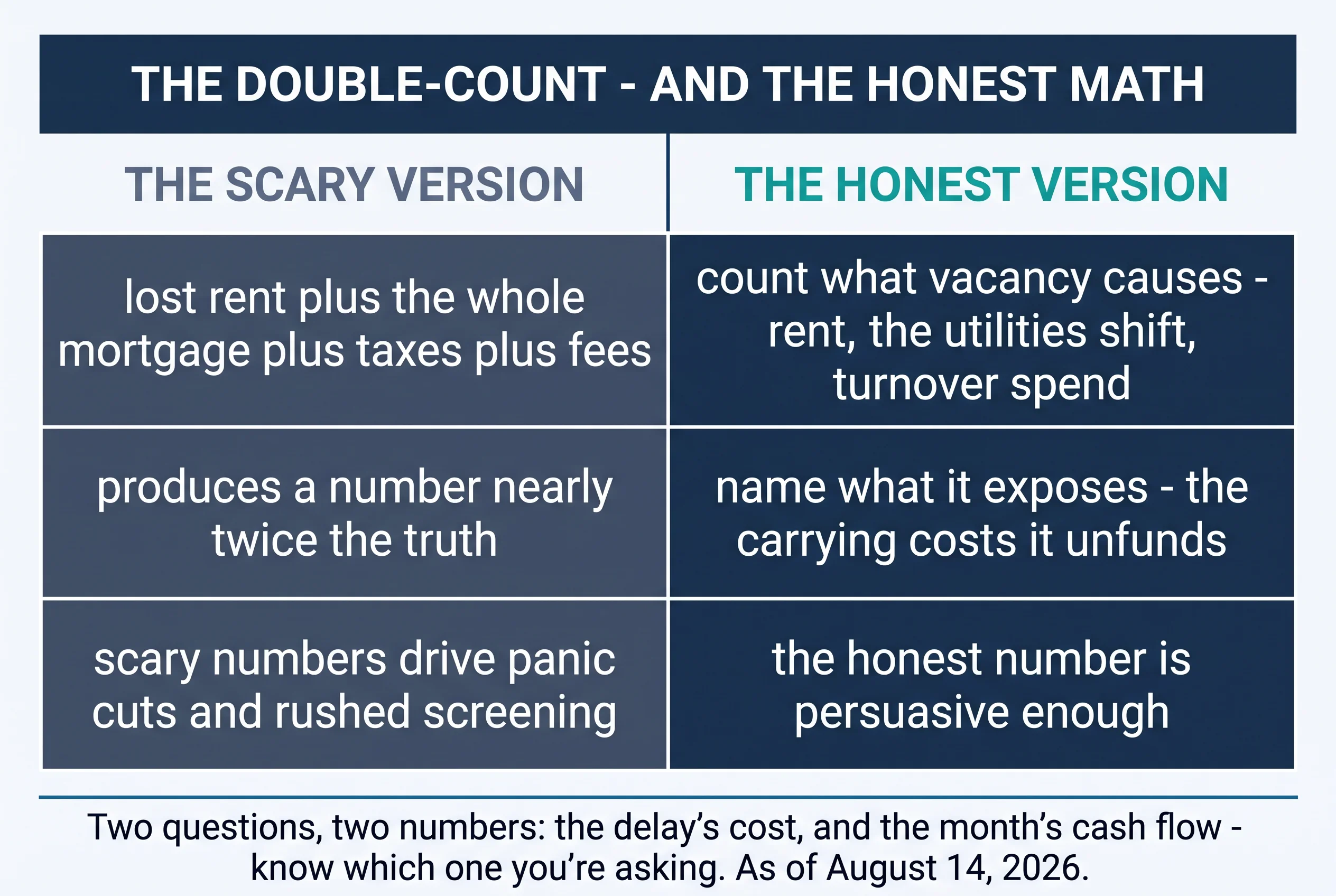
One warning before the worksheet: most vacancy math online produces a scarier number than the truth, by counting the mortgage twice. This page does the accounting honestly — because the honest number is persuasive enough.
The Vacancy Cost Worksheet
Your per-day number in five fill-in lines, the honest accounting, and the conversion formulas that end arguments — one page.
Get Free PDF →The naive number: rent divided by thirty
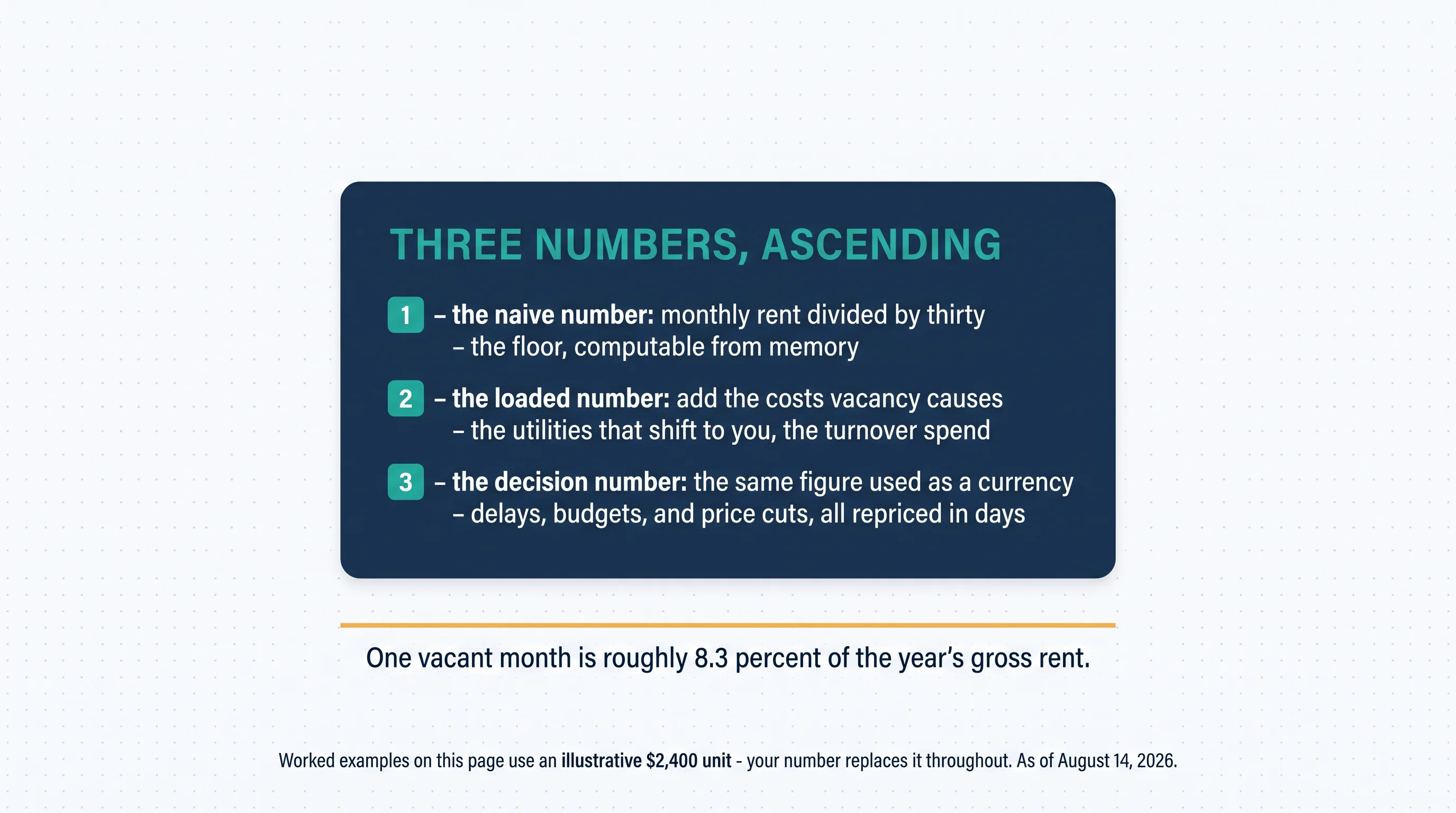
Start with the division you can do from memory. Take a $2,400-a-month unit — illustrative throughout this page, not an average; your rent replaces it everywhere — and divide by thirty: $80 a day. That's the floor: the revenue that doesn't arrive, priced daily. It understates the truth, because no bill has entered the math yet — but even the floor is enough to reprice most delays, which is why it's worth carrying in your head the way you carry the unit's address. Per-day beats per-month for decisions precisely because turnover choices arrive in day-sized pieces — nobody debates "a month of painting," but "four more days" sounds free until it's $344.
And seed the annual frame now, because it makes every later trade honest: one vacant month is roughly 8.3% of the year's gross rent. A landlord holding out three vacant weeks for $75 more a month is running that trade whether they've computed it or not — the arithmetic just makes it visible. Worked once: three vacant weeks at the loaded number is roughly $1,800; $75 more a month earns $900 a year — the hold-out needs two years at the higher rent just to claw back its own vacancy. Sometimes still worth it; never obvious.
The loaded number: the honest accounting
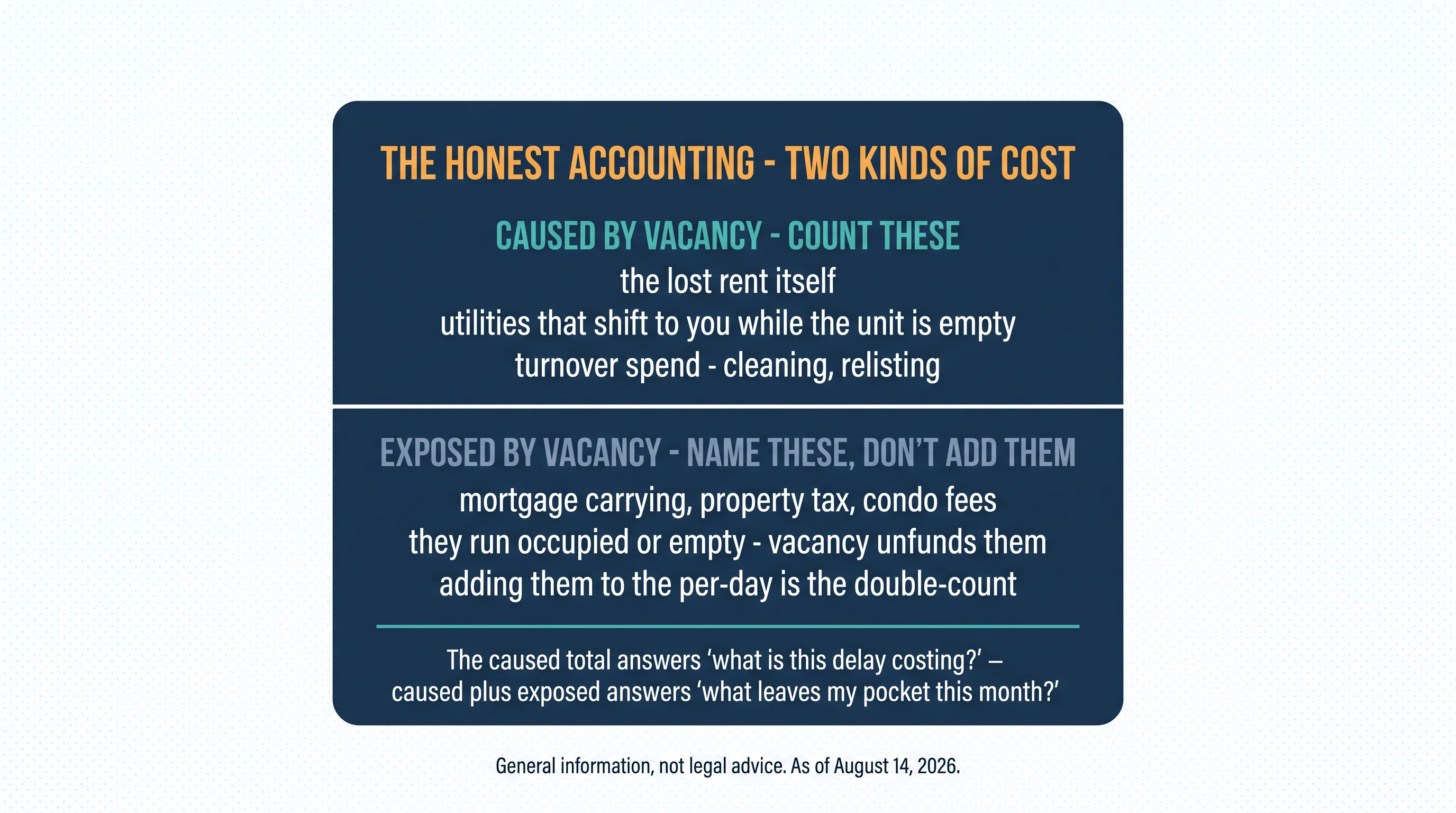
Vacancy's costs come in two kinds, and keeping them separate is the whole trick — because they answer different questions.
Costs caused by vacancy exist only because the unit is empty. The lost rent leads. Then the utilities shift: the tenant's hydro and heat accounts close, and the meters bill you — on the illustrative unit, call it $6–8 a day winter-weighted, but those are your bills and your number. Then the turnover spend: cleaning between tenancies, relisting costs, the small repairs that only happen at changeover — spread over the vacancy you expect, so a $300 turnover across a ten-day vacancy adds $30 a day (and shrinks as you fill faster, which is the right incentive built into the math). Stack the caused costs and the worked unit lands around $86–88 a day — the number this page will use for the conversions, with your own replacing it throughout. One conditional note belongs here: many insurance policies require notification once a unit sits vacant past around 30 days, and coverage terms can change — check your policy; this is general information, not legal advice.
Costs exposed by vacancy are different animals: the mortgage carrying cost, the property tax, the insurance base, the condo fees. They run whether the unit is occupied or empty — vacancy doesn't cause them; it unfunds them, which is why an empty month feels worse than the rent number alone suggests: those bills are suddenly paid from your pocket instead of the rent. Name them, list them beside the per-day — and don't add them into it.
That gives you the two-numbers frame: the caused total answers "what is this delay costing me?" — the decision question. Caused plus exposed answers "what leaves my pocket this month?" — the cash-flow question. Both are legitimate; confusing them is where vacancy math goes wrong.
The worksheet: your number in five lines
The download mirrors this walk, but the math fits in a margin: ① monthly rent ÷ 30 → ② plus the monthly utilities that shift to you ÷ 30 → ③ plus turnover spend ÷ your expected vacant days → ④ equals your loaded per-day number → ⑤ the exposed list, written beside it for the cash-flow view, never added in. Five lines, one evening, done for the year. And if you run more than one unit, run the lines per unit — the condo with fees-in-rent and the house with tenant-paid utilities produce genuinely different per-day numbers, and using one blended figure hides exactly the differences the decisions need.
The conversions: what a day buys

Here's why the number is worth computing: it converts everything into one currency, and priced decisions argue less.
The delay conversion. "I'll post it after the long weekend" is four days — about $344 on the worked unit. A week of paint-before-photos runs ~$600, which makes it the most expensive "nothing" in the turnover. None of this says don't paint; it says know the price of the sequencing, and notice how often the paint could have happened during the notice period instead [→ the launch sequence below].
The spend conversion. $200 of photography is about 2.3 vacant days — so if better photos fill the unit even three days sooner, they were free with change. The listing guide makes the craft case for the photos; this page prices it. The same division reprices ad budgets: a paid placement on the platform comparison's paid tiers earns its cost in a small handful of saved days or it doesn't — and now you can compute which.
The underprice breakeven — the question this piece exists to answer. "Should I drop the rent $50 to fill it faster?" Run the formula: (monthly cut × 12) ÷ your per-day cost = the days the cut must save to win. On the worked unit: $50 × 12 = $600, ÷ $86 = exactly seven days. The cut wins only if it fills the unit more than a week faster — and remember the cut also repeats for every year the tenancy renews at the lower base. Whether a cut actually accelerates filling is a pricing question in its own right; the pricing pillar in this series carries that method. This page's contribution is the breakeven that makes the conversation arithmetic. One honest limit: the formula prices the cut against vacancy, not against applicant quality — a price positioned right attracts the deeper applicant pool that makes screening's job easier, and that effect, though real, doesn't fit in a division. The number referees money-versus-days; judgment still owns the rest.
Compressing the right days
The cheapest days to save are the ones between move-out and listing-ready — because they're fully inside your control and cost full price. The compression levers are the series' first three guides in miniature: the launch sequence run during the notice period instead of after it (photos and cleaning booked for turnover week the day notice arrives) · listing before empty where showings allow · the platform mix matched to the unit type so the ad works its first weekend · and the response-speed habit, since enquiries decay by the hour, not the day. Same-day showings versus we'll-book-you-next-week is often the difference between filling this weekend and filling next — and "next weekend" now has a seven-day price tag you can read off your own worksheet.
For landlords — the pre-vacancy playbook: The day notice arrives, the clock starts. Book the cleaner and the photographer for turnover week now; draft the listing from the filed master now (the file-the-ad habit pays here); confirm what showings the departing tenancy allows. Done in the notice period, the unit lists the day it's ready instead of the week after — and the week you just saved has a price you now know.
For property managers: The portfolio version is a column, not a feeling: vacancy-days per turnover, tracked per door — and your per-day cost times your door count is the number that funds process improvements. A two-day average reduction across thirty doors pays for a lot of workflow; the wins come from systems (pre-booked vendors, templated listings, same-day enquiry response), not from anyone trying harder.
The counterweight: the days you don't compress
The per-day number comes with a boundary, and it's not optional: speed never overrides screening. A bad tenancy costs five to twelve months once arrears, process, and turnover are counted — and against that, no week of vacancy justifies rushed vetting. The division prices the empty days you control: turnaround, marketing, response time. It does not price down the diligence days that protect the next twelve months — the screening method owns those, and it runs at verification's speed, not vacancy's. The asymmetry is the argument: rushing turnaround risks nothing and saves real money; rushing screening saves three days and risks a year. The same arithmetic that argues for urgency on one side argues for patience on the other — that's not a contradiction, it's the point.
Operationally: compress move-out-to-listed and enquiry-to-showing as hard as the playbook allows; never compress application-to-decision below what verification actually takes. The per-day number is a tool for urgency in the right places — the discipline is knowing which places those are.
The Vacancy Cost Worksheet
Your per-day number in five fill-in lines, the honest accounting, and the conversion formulas that end arguments — one page.
Get Free PDF →Key takeaways
- Rent ÷ 30 is the floor — computable from memory, already enough to reprice most delays.
- The honest loaded number adds what vacancy causes (the utilities shift, turnover spend) and names — without adding — what it exposes.
- Beware the double-count: mortgage-plus-rent math produces a number nearly twice the truth, and scary numbers make bad decisions too.
- The conversions are the point: delays, spends, and price cuts all reprice in days once the day has a price.
- The underprice breakeven is a formula, not a feeling: (cut × 12) ÷ per-day = the days it must save to win — seven days on the worked unit.
- Compress turnaround and marketing days — never screening days: a bad tenancy costs 5–12 months.
One division, run once
The per-day number is the rare tool that costs a minute and works for a year: compute it, write it in the folder, and let it referee the turnover — the delayed listing, the photo budget, the price-cut debate, all settled by the same division. The launch sequence compresses the days; the platform mix and the listing craft fill them; the screening method spends its days deliberately. And the pricing decision the breakeven feeds belongs to the pricing pillar in this series. As of August 14, 2026.
Price the increase, not just the vacancy
Ontario's rent-increase math has rules of its own — the free calculator runs your guideline increase, dates, and notice timing in seconds.
Free forever • No signup required
Related resources
- How to Advertise a Rental Property in Ontario — the launch sequence that compresses the cheapest days.
- Where to List: 9 Sites Compared — the platform mix that fills each unit type fastest.
- How to Write a Rental Listing — the craft the photo-and-copy budget buys.
- How to Screen Tenants in Ontario — the days the division never compresses.
Frequently asked questions
How much does an empty rental unit cost per day?
Your monthly rent divided by thirty as the floor, plus the bills that shift to you while it's empty — on an illustrative $2,400 unit, roughly $86–88 a day in caused costs. Your rent, your bills, your number.
Should I include my mortgage in the vacancy cost?
Name it, don't add it: the mortgage runs occupied or empty — vacancy unfunds it rather than causing it. Adding it to lost rent is the double-count that makes online vacancy math scary and wrong.
Should I lower the rent to fill a vacancy faster?
Run the breakeven: (monthly cut × 12) ÷ your per-day cost = the days the cut must save to win. A $50 cut on the worked unit needs to fill the unit more than a week faster just to break even — and the cut repeats at renewal.
What costs continue when a rental sits empty?
Two kinds: caused costs (utilities now in your name, turnover spend) and exposed costs (mortgage, tax, insurance, condo fees — running regardless, now paid from your pocket instead of the rent).
Is it ever worth leaving a unit vacant?
For screening, always — a bad tenancy costs five to twelve months, and no week of vacancy justifies rushing verification. For holding out on price, run the 8.3%-per-month arithmetic against the increase you're waiting for.


