As of August 14, 2026. The question arrives as an advertising question — can I list my basement apartment? — but the honest answer runs upstream: you can advertise a basement apartment like any unit once it is a legal unit, and "legal" is a specific, checkable status, not a vibe. One distinction first, because two of our guides meet here: a licence asks whether you may operate; legality asks whether the unit may exist as a rental — different questions, different offices, and the ad answers to both.
This page walks the legality stack in order — zoning, the permit-and-Code path, inspection, electrical, registration — then the ad you've earned at the end of it, and the honest path for landlords partway through. It names the categories so you can have the right conversations; it is not a compliance checklist, and this is general information, not legal advice.
Why an advertising series cares this much about a permits question: because the ad is where an illegal unit becomes a public commitment. Every other risk in this topic needs an inspector or a complaint to surface it — the listing surfaces itself, timestamped, to everyone. Getting the unit's status right isn't a detour from the marketing; it's the marketing's foundation layer.
The Legal-Unit Checklist
The five layers tracked the only way that counts — who confirmed it, when, and under what reference number. A verification sheet, not a spec list.
Get Free PDF →What "legal" means: five layers, in order

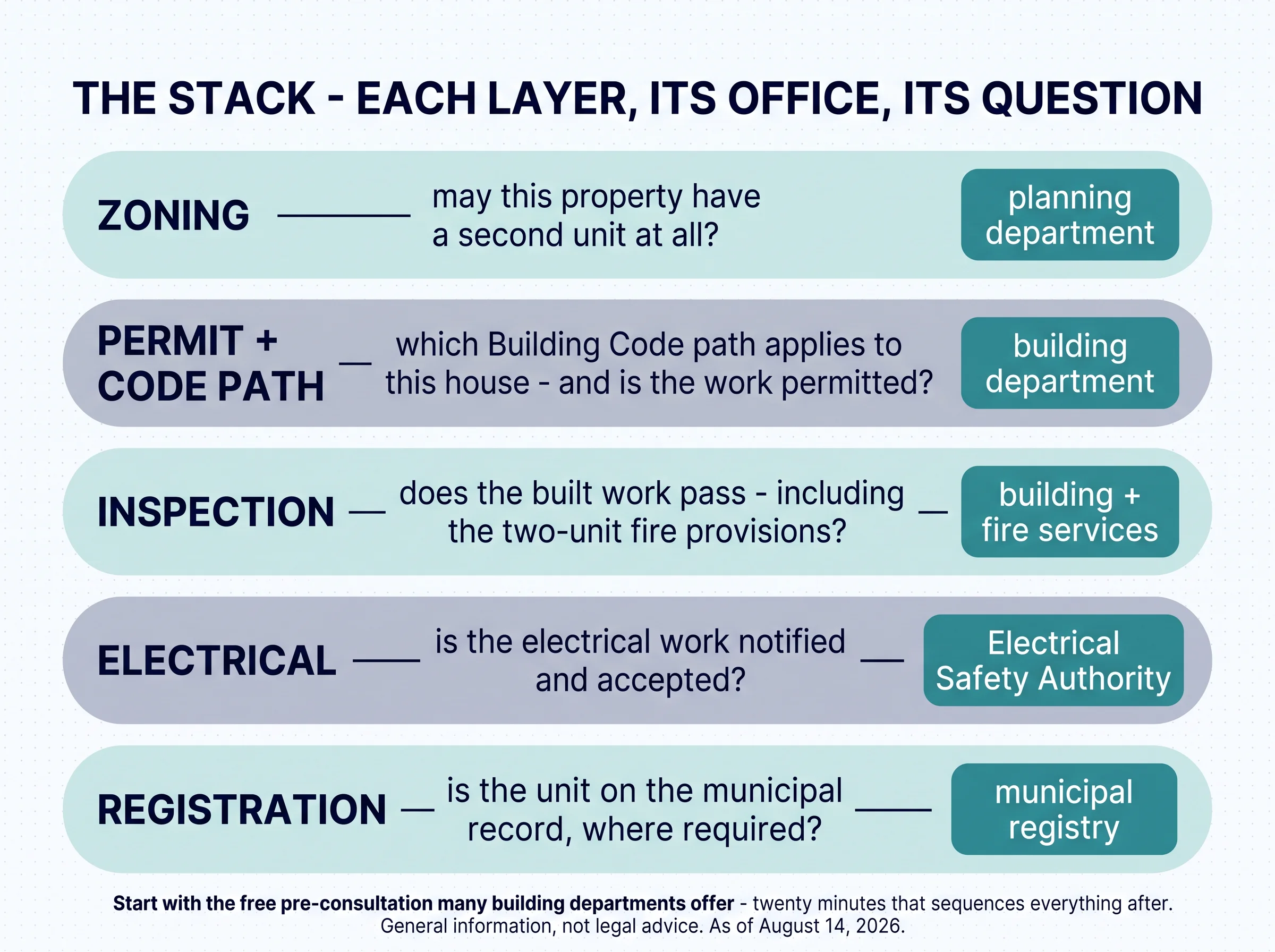
A basement apartment is legal when five things are true at once, and they close in order: the unit is ① allowed on the property (zoning permits a second unit there, with whatever parking, lot, and entrance conditions apply) · ② designed and built under permit, on the correct Building Code path for that house · ③ inspected and passed, including the Fire Code's two-unit provisions · ④ electrically approved — the Electrical Safety Authority's own notification-and-acceptance track, separate from the building permit, and the layer retrofits most often miss · ⑤ registered, where the municipality requires it.
Each layer has an office that answers, which is the stack's quiet gift: it's also the to-do list, pre-sequenced. Zoning comes first because nothing else matters if the lot can't have the unit; registration comes last because it records what the other four established. And the sentence that saves the most grief on this topic: a finished basement and a legal second unit are different things — the difference is the entire stack.
Zoning first: provincially enabled, municipally administered
The provincial frame opened the door: since 2019, most Ontario municipalities must permit at least one second unit inside a primary residence, and the Bill 23–era changes expanded as-of-right additional units in detached, semi-detached, and townhouse homes while trimming parking and charge requirements for them. But the door's exact shape is municipal — parking conditions, lot rules, entrance requirements, and registration all live in local by-laws, and they genuinely vary: Toronto requires two-unit registration; Barrie runs its own suite registration and, under its 2024 by-law, now permits up to four units per lot; smaller municipalities attach frontage and parking conditions of their own. Those are examples, not a tracker — the variance is the point: the same house, moved one municipal border over, can face a different parking requirement, a different registration regime, and a different timeline. Whatever a forum thread said about someone else's city is trivia about someone else's city.
Which makes the first move obvious and cheap: call your building department early. Many municipalities offer free pre-consultation, and twenty minutes at that counter sequences everything after — which Code path your house is on, what zoning says about your lot, and what registration will ask at the end.
For landlords — the pre-consultation, prepped: Bring the address, what exists today (finished? previously rented? any permit history you know of), and what you intend. Ask three things specifically: the permit and inspection history on file for the address, the zoning status for a second unit on your lot, and whether registration applies. Twenty minutes; it turns the stack from a maze into a sequence.
The codes and the inspection: categories, not a checklist
The inspection's territory has names: ceiling height, fire separation between the units, bedroom egress, interconnected smoke and carbon-monoxide alarms, a compliant entrance, kitchen and bath facilities, heating and ventilation. Knowing the names matters, because they're the agenda for every conversation with the building department. But here is this section's spine, and it deserves its own paragraph:
The biggest mistake on this subject is quoting one set of numbers as though it applies to every basement. The figures people trade online — the 1.95-metre habitable-room ceiling minimum, the 45-minute fire-separation rating — are what the conversation is about, not a checklist to self-certify against: existing houses frequently proceed under the Building Code's compliance alternatives for existing buildings, and the applicable numbers vary with the house and the path it's on. A unit added to a 1955 side-split and a unit designed into a new build answer to different requirements — the Code's provisions for existing buildings exist precisely so older houses can reach safety through routes their construction allows, which is good news for retrofits and fatal news for internet checklists. The office, not the article, is the authority — and that's not a disclaimer; it's how the system is built. This is general information, not legal advice.
Two structural notes complete the section. The ESA is its own track: electrical work is separately notified to and accepted by the Electrical Safety Authority — a passed building inspection doesn't cover it, and it's the layer most retrofits discover late. And a currency note: the Building Code was updated effective March 31, 2026, touching basement design temperature, insulation, and radon provisions for new work — one more reason the current answer lives at the counter rather than in any article, this one included.
Registration and proof: what counts, what doesn't

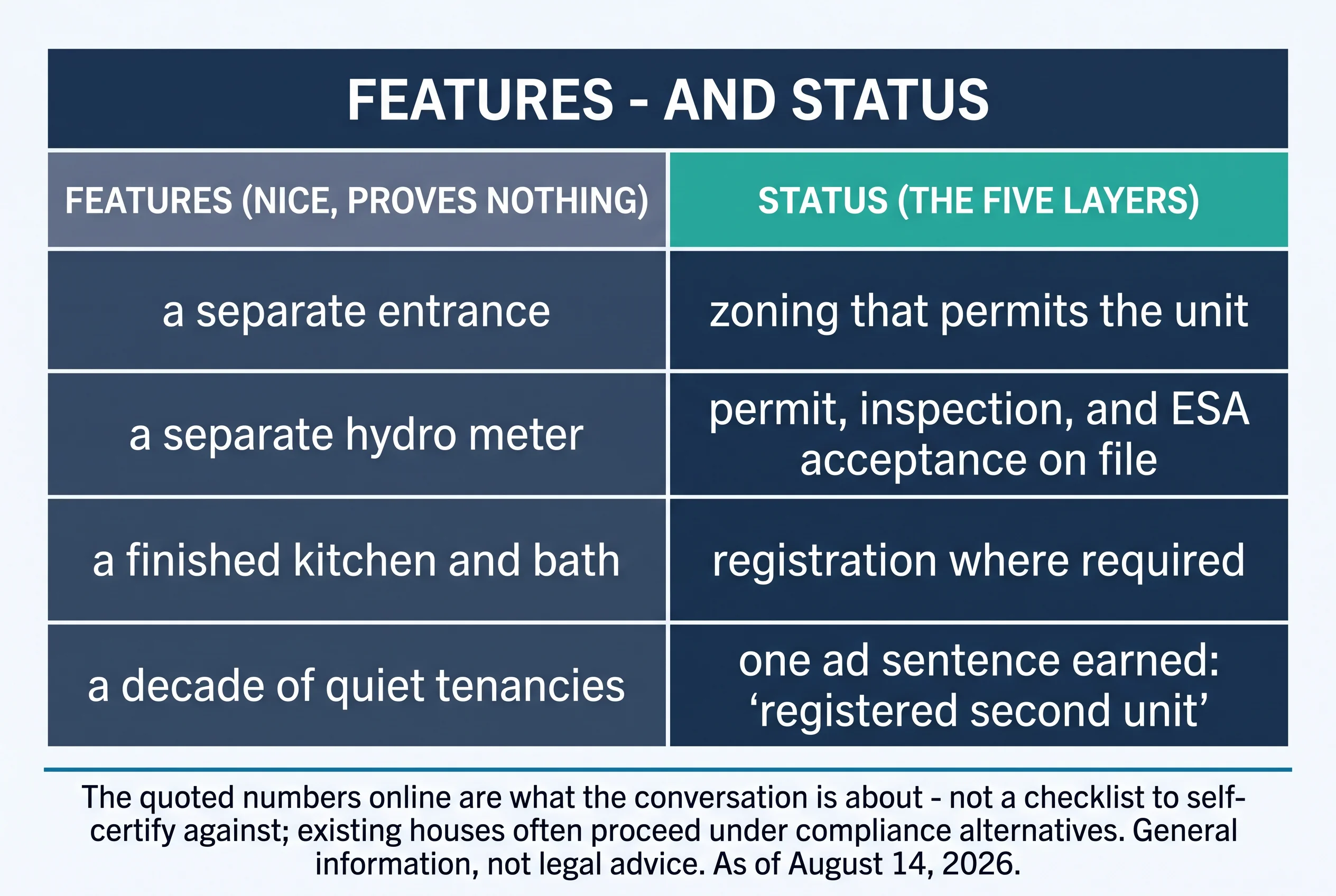
Registration, where it applies, is the municipal record that emergency services and enforcement work from — the last layer, and in registration municipalities, the one the ad will eventually cite. It's worth knowing what registration actually does beyond compliance: it puts the unit on the record emergency services respond from — a fire crew that knows a basement household exists at the address is not a bureaucratic nicety. Which brings the whole stack to its evidence rule, worth memorizing verbatim: a real-estate listing, a tax record, or a separate hydro meter is not proof of Building Code approval — and neither is years of being rented. The proof is the municipality's permit and inspection history, which the building department can pull for the address. Features are features; status is a file. Pulling that file is unglamorous and quick: the building department can search the address for permits and inspection outcomes, and the answer arrives as documents or their absence — either of which tells you exactly where on the stack you're standing.
And the sentence that governs inherited units: "it was like this when I bought it" transfers the problem, not the legality. The stack doesn't reset at a sale — it either exists in the file or it doesn't.
For landlords — buying a house with a basement unit: Ask for the permit and inspection history before closing. A rent roll is not legal status, a "currently tenanted legal suite" line in a listing is a claim rather than a file, and the evidence rule applies hardest at purchase — because the cost of making the unit right belongs in the purchase price, not in your first year of ownership.
The ad you've earned — and the one you haven't
Once the stack is done, the advertising question becomes wonderfully boring. The listing gets one quietly powerful sentence — "registered second unit," a verifiable fact where registration exists — and the rest is ordinary craft: the facts-first method, the basement template from the templates pack in this series (which carries this exact line with its own annotation: only where true), and the standard money line — first, last, key cost, nothing else. The ad-language guide in this series covers the rest of what any listing may and may not say.
What the ad never claims: the hedges. "Registration in progress." "Can be legalized." "Grandfathered." An ad claim is a fact or it's absent — and every hedge is an admission wearing marketing clothes. The earned sentence, meanwhile, quietly outperforms: basement searchers have read enough listings to know most ads say nothing about status — the one that states a verifiable registration is answering the question careful applicants were already asking, and it attracts exactly the tenants who check things.
Partway through: the honest path

Most guides say "make it legal" and stop. Here's the part for the landlord partway through. What partway can't do: advertise as if finished — "registration pending" invites applicants toward a unit that may not lawfully house them, and takes deposits against an uncertain date. What partway can do: treat the stack as the to-do list it is, let the pre-consultation sequence it, and close the layers in order — and closing them faster than sequential scheduling suggests.
And price the wait honestly. Finish-then-list costs weeks at your unit's per-day rate — the vacancy-cost piece in this series prices it exactly — and that number, real as it is, is smaller than the structural list above plus a tenancy you can't lawfully stand behind. Finish, then list: the boring answer, priced. There's an applicant's-eye version of the same argument: the tenants you most want — the ones who verify things — are exactly the ones a hedge repels and a completed file attracts. The honest path doesn't just avoid the downside; it selects for the applicant pool you were building the unit for.
The Legal-Unit Checklist
The five layers tracked the only way that counts — who confirmed it, when, and under what reference number. A verification sheet, not a spec list.
Get Free PDF →Key takeaways
- Legality is a five-layer stack — zoning, the permit-and-Code path, inspection, ESA electrical, registration — each with an office that answers.
- A finished basement and a legal second unit are different things; the difference is the entire stack.
- Don't self-certify from quoted numbers: existing houses proceed under compliance alternatives, and the office is the authority.
- Features aren't status: a separate entrance, a hydro meter, and years of rent prove nothing — the permit history proves it.
- The earned ad is one verifiable sentence — "registered second unit" — and no hedge ever substitutes.
- Partway through: finish, then list — the wait has a per-day price, and it's smaller than every alternative.
Five phone calls, one sentence
Strip the topic to its skeleton and it's five phone calls in the right order — planning, building, inspection booking, the ESA, the registry — each ending with a name, a date, and a reference number in your file. At the end sits the reward: a unit you can stand behind, an ad with one quietly verifiable sentence, and a tenancy that starts on lawful footing. The licensing question is its own guide; the advertising craft is the pillar's. This is general information, not legal advice — your building department and, where needed, a professional carry the specifics. As of August 14, 2026.
Ontario's landlord tools, free
Calculators and trackers built for Ontario landlords — termination dates, rent increases, and more. No account needed.
Free forever • No signup required
Related resources
- Do You Need a Licence to Rent Out Property in Ontario? — the operator question beside this unit question.
- How to Advertise a Rental Property in Ontario — the campaign the legal unit gets to run.
- How to Write a Rental Listing — the craft around the one earned sentence.
- First and Last Month's Rent — the money line every basement ad carries.
Frequently asked questions
How do I know if my basement apartment is legal?
Ask your municipal building department to pull the permit and inspection history for the address, and confirm registration where your municipality requires it. Duration of renting, a separate entrance, or a hydro meter prove nothing — the file proves it.
Can I advertise a basement apartment that isn't registered yet?
Where registration is required, no honest version of that ad exists — "registration in progress" isn't an ad claim. Finish the stack, then list; the wait is priced in vacancy days and it's the cheaper path.
What makes a basement apartment legal in Ontario?
Five layers in order: zoning that permits the unit, construction under permit on the correct Building Code path, passed inspections including the Fire Code's two-unit provisions, ESA electrical acceptance, and municipal registration where required.
Do the ceiling-height and fire-separation numbers online apply to my house?
Maybe — and that's the point: existing houses often proceed under the Code's compliance alternatives, so the applicable figures vary by house and path. Bring the question to the building department, not a checklist.
I'm buying a house with a basement apartment — what should I check?
The permit and inspection history, before closing. A rent roll is not legal status, and the cost of making it right belongs in the purchase price, not in your first year of ownership.