

You think you're choosing between two doors. The Income Tax Act disagrees about the arithmetic: the day you hand a tenant the keys, you are deemed to have sold your condo.
Not "as if." Deemed. Paragraph 45(1)(a) says you disposed of the property at fair market value and reacquired it the same instant. No buyer. No cheque. No closing. Possibly a tax bill.
Almost everything written about this question is a spreadsheet — cap rate against proceeds, rent against carrying costs, a number at the bottom. And almost everyone writing it is paid on one of the two doors. Meanwhile the actual fork has a deadline attached to a document that doesn't exist as a form, and nothing in your life will mention it.
So here's what this piece covers: what each of the three doors does — including the one nobody counts. What the Act does on the day your tenant moves in. The one-page letter that stops it, why no software will ever prompt you for it, and the thing that quietly cancels it. And what a deemed disposition does in a market that has fallen ten per cent in a year — which is not what any guide to this rule says, because they were all written when prices went up.
This article will not tell you whether to rent or sell. We can't, we shouldn't, and everyone who will is paid on one of the answers. What it will tell you is what each door costs, and when the clock starts.
The Letter With No Form Number: Your 45(2) Election Prep Sheet
The day you hand a tenant the keys, the Income Tax Act deems you to have sold your condo — and the only thing that defers it is a signed letter with no form number, due with that year's return. This prep sheet covers what the CRA says the letter must contain, the deadline nothing reminds you about, and the one claim that silently cancels it.
Get Free PDF →There are three doors, and all three are tax events
The question always gets posed as a binary. It isn't one.
There are three things you can do with a Toronto condo you've stopped living in, and the Income Tax Act has something to say about every one of them.
- Sell it. An actual disposition. Your gain is measured from what you actually paid, and the principal residence exemption may shelter it for the years you lived there.
- Rent it out. Paragraph 45(1)(a): a deemed disposition at fair market value. No buyer, no money, and a valuation date set by the calendar rather than by you.
- Leave it empty. No change of use, so no deemed disposition at all — and straight into Toronto's Vacant Home Tax.

That third door is the one nobody draws. "I'll just sit on it for a year and see" feels like the null option — the choice you make by not choosing. It is the only one of the three with a municipal tax pointed directly at it. The rate and the rules are Toronto's, they change, and they're covered properly in our guide to vacant home taxes by Ontario city. What matters here is simply that the door exists and isn't free.
What "change of use" actually means
This phrase is the whole article, so it's worth being precise about it.
The Act doesn't tax you for moving. It doesn't tax you for buying a place with your partner, or taking a job in Calgary, or deciding you'd rather not sell into a soft market. It taxes the change of use of the property.
Nothing physical happens. No brick moves. The unit is the same unit on Tuesday as it was on Monday. What changes is its status — from personal-use property to income-producing property — and the tax consequences follow the status, not the bricks.
That's an unusual way to think about a home, and it's the reason this catches people. You didn't do a transaction. You did a status change, and the Act treats a status change as a transaction.
The market, briefly, and then we'll leave it alone
You need the numbers to understand the section that follows. You don't need our opinion about them, and you won't get one.
- TD Economics reports that benchmark GTA resale condo prices fell 10% year-on-year in the first quarter of 2026 — in TD's words, "the sharpest drop since the market began correcting in 2023."
- TD's forecast is for further declines through 2026, a slower rate of decline in 2027, and prices "only returning to a sustained uptrend in 2028 — keeping this correction one of the longest on record," ending roughly 25–30% below the early-2022 peak.
- The average Toronto condo sold for $539,400 in May 2026, down 9.1% year-on-year (TRREB data). The benchmark peak, in early 2022, was in the mid-$700,000s.
- TRREB's Q1 2026 rental report shows condo rents fell across every bedroom type: one-bedroom $2,246 (down 4.1%), two-bedroom $2,939 (down 3.2%), three-bedroom $3,757 (down 2.7%), bachelor $1,821 (down 2.3%). There were 16,365 rental transactions against 24,012 listings.
One more thing about that TD report, because it matters more than the numbers in it. TD prints a line at the bottom saying the material "is not intended to be relied upon as investment advice or recommendations." A bank's economics team, publishing a forecast under its own name, declines to stand behind it as advice. We're going to quote that disclaimer and honour it. If TD won't tell you what to do with your condo on the strength of their own research, we're certainly not going to on the strength of theirs.
Who's talking: Almost everyone who publishes an answer to this question is paid on one of the doors. An agent earns a commission when you sell. A lender or a mortgage broker earns when you hold and rent. We earn on neither — we make software for landlords, and we'd rather you made this decision correctly than quickly. That's not virtue. It's just worth knowing who's talking when someone sounds confident.
What happens the day your tenant moves in
Here is the mechanism, from the CRA's own principal residence folio: if you have completely converted your principal residence to an income-producing use, you are deemed by paragraph 45(1)(a) to have disposed of the property — both land and building — at fair market value, and to have reacquired it immediately thereafter at the same amount. Any gain otherwise determined may be eliminated or reduced by the principal residence exemption.
Read that twice, because the second half is doing quiet work. You disposed of it. You reacquired it. At the same number. In the same instant.
A Toronto tax firm puts the sting better than the CRA does. Normally, when you owe capital gains tax on a sale, you pay it out of the sale proceeds — the money is right there. But a deemed disposition, they write, "would require the taxpayer to owe the same amount of tax but not have the actual profits from selling the home."
A tax bill with no transaction behind it. That's the thing to understand before anything else.
And the date isn't yours
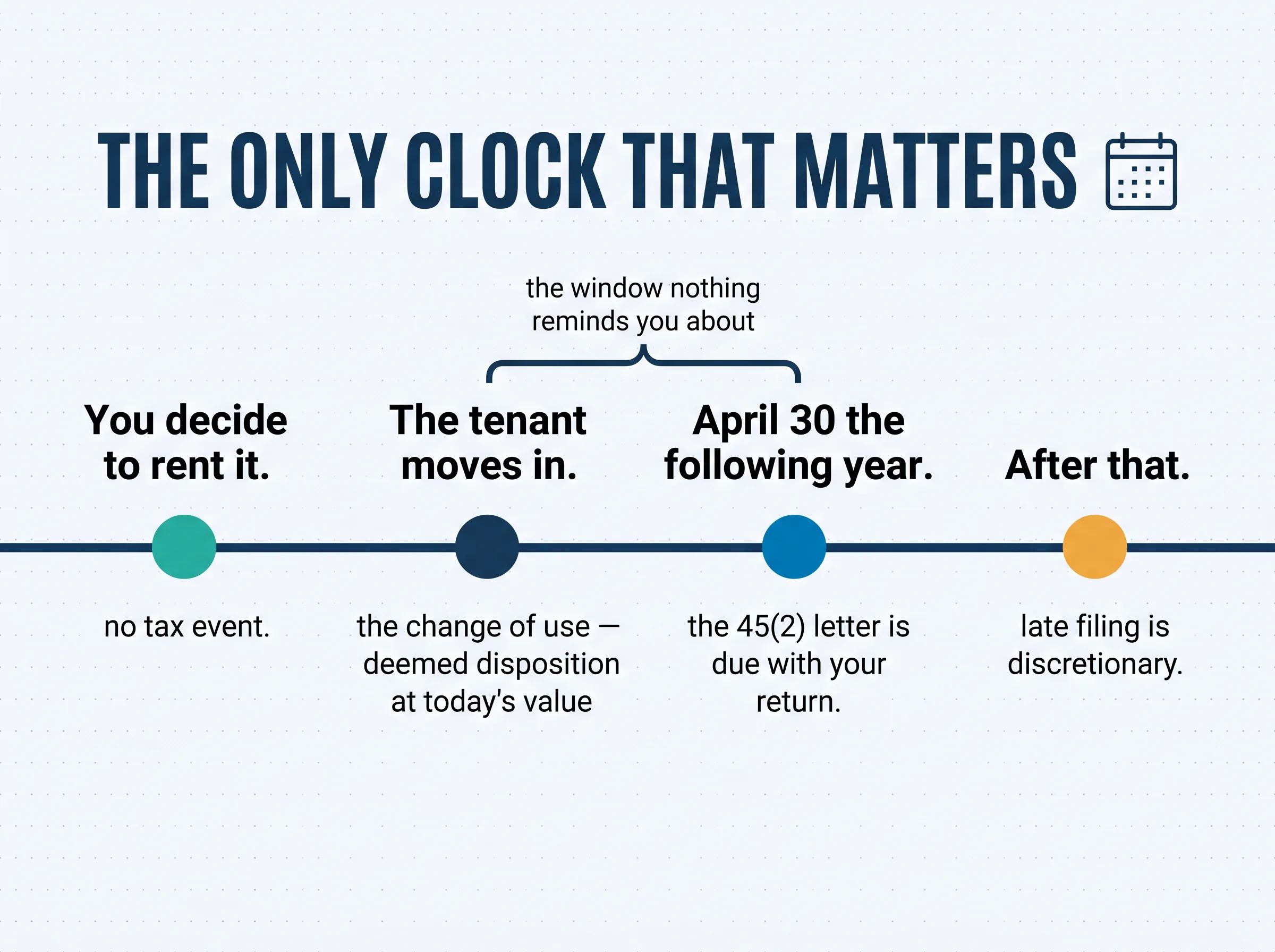
You don't get to pick when this happens. The change of use occurs when the use changes — the day your tenant takes possession. Not the day you decided. Not the day you listed it. Not the day you got around to telling your accountant.
Whatever the market says your unit is worth that week is your number, and it's your number for years afterward.
The fix, and why it's invisible
Subsection 45(2) lets you elect to be deemed not to have made the change in use. File it and the deemed disposition doesn't happen — not now, anyway.
Here's how you make it, in the CRA's own words: "attach to your income tax and benefit return a letter signed by you. Describe the property and state that you want subsection 45(2) of the Income Tax Act to apply."
That's the whole instruction. The folio says the same thing slightly more formally — the election "is made by means of a letter to that effect signed by the taxpayer and filed with the income tax return for the year in which the change in use occurred."
There is no form. There has never been a form. No number to search for. No wizard. No box to tick. No software will prompt you for it, because there is nothing for it to prompt — you cannot build a field for a document that has no identifier.
And the deadline is the filing due date for your return for that year: April 30, or June 15 if you or your spouse is self-employed. That's it. That's the whole clock, and it is the deadline nobody knows about.

Two rules that get welded together
You will read, in a great many places, that you can "file the election and rent it out for four years tax-free." That sentence fuses two separate rules and drops the condition on both. Pull them apart:
- The deferral is indefinite. The election runs until you rescind it or dispose of the property. There is no four-year limit on the deferral itself.
- The four years is something else entirely. It's about designating the unit as your principal residence for up to four years while it's rented out — which is a different question, with a different condition, and we'll get to why that condition matters.
Keeping those two straight is most of the value in this article.
The part nobody wrote down: a deemed disposition in a falling market
Every explanation of subsection 45(2) you will find describes deferring a gain. That's reasonable. They were nearly all written when Toronto condos went up, and when a property has gone up, a deemed disposition crystallizes a gain you'd rather not pay tax on yet.
Benchmark GTA condo prices are down 10% year-on-year, and TD doesn't expect a sustained uptrend until 2028. So run the same rule through this market instead, one step at a time.
One. You bought near the peak. The benchmark then was in the mid-$700,000s. The average Toronto condo sold for $539,400 in May.
Two. You move out and rent it. Paragraph 45(1)(a) deems a disposition at today's fair market value.
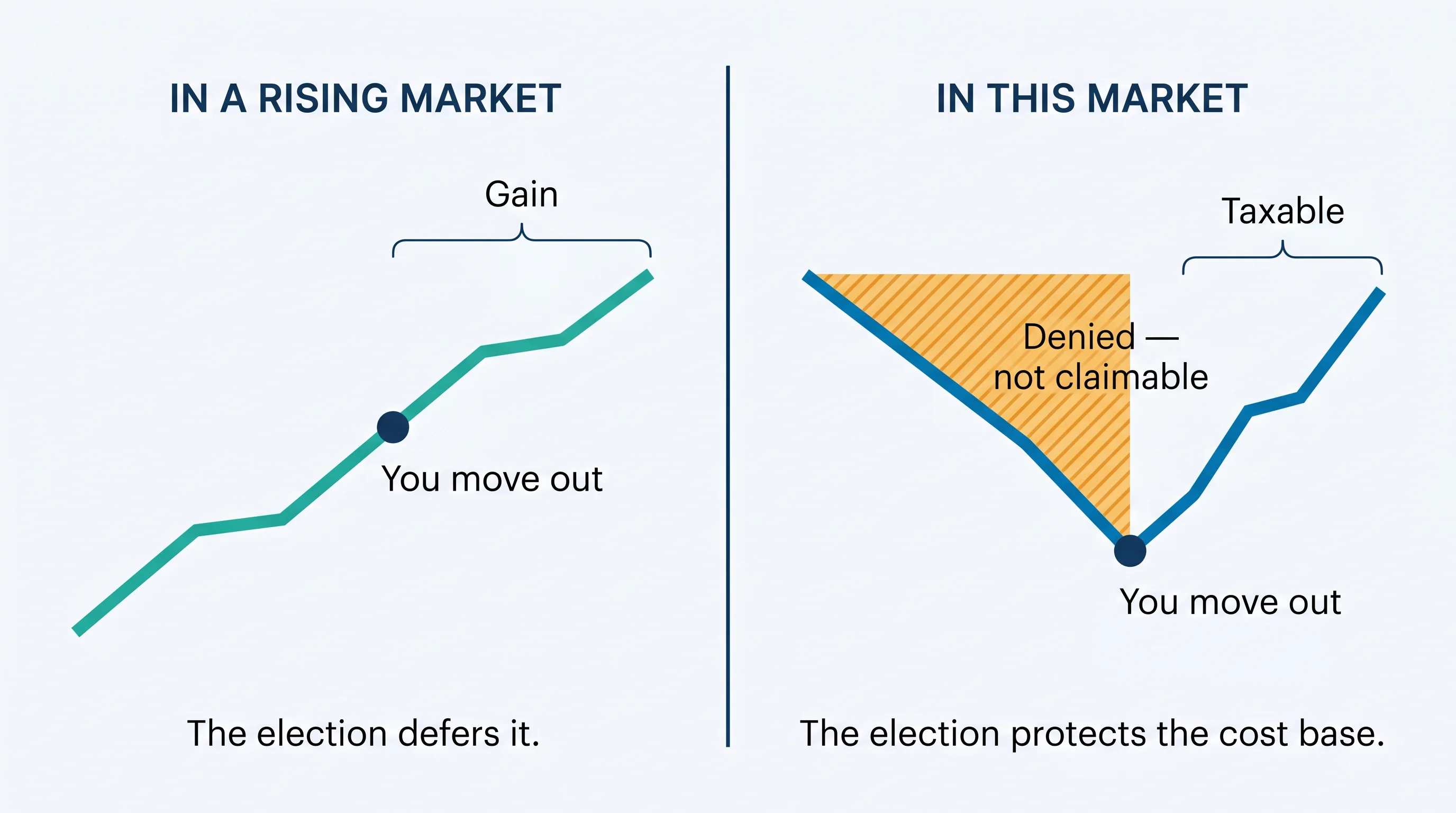
Three. So there's a loss, and at least you get something for it. There isn't, and you don't. A home you live in is personal-use property, and the folio is blunt about what that means: "a loss on the disposition of such a property… is deemed to be nil by virtue of subparagraph 40(2)(g)(iii)."
Four. A CRA interpretation removes the last bit of hope: "the CRA has no discretion concerning the tax treatment of a capital loss on personal-use property." And there is no provision that lets you carry such a loss forward against anything, ever.
Five. Your new adjusted cost base is the trough. Not what you paid — what it was worth on the day your tenant moved in.
Six. If the market recovers, that recovery is a taxable capital gain. On a condo that never made you a dollar.
The one-line version: you ate the drop, you can't deduct it, and you can be taxed on getting back to where you started.
So the election's purpose inverts
In a rising market, the 45(2) election defers a gain. In this market there is no gain to defer. What the election does instead is keep your cost base at what you actually paid, rather than letting it be written down to the bottom of a six-year correction — on a loss you were never allowed to claim in the first place.
That is a genuinely different job for the same rule, and it is the reason this article exists.

And now the other half, in the same breath
Everything above describes a mechanism. It is not a recommendation, and here is why it can't be one.
The election is not free. While it stands, you cannot claim capital cost allowance on the property — which is a real deduction against real rental income, every year, that you are giving up. A designation year is a scarce resource, and you may want those years for the home you just bought. And the whole calculation turns on numbers we cannot see: what you paid, what it's worth, what else you own, what you earn, how long you'll hold it, what happens in your life in 2029.
Whether that trade is worth it is a question for a chartered professional accountant, and it is genuinely a five-figure one. That isn't a hedge to keep us out of trouble. It's the actual answer. Anyone who tells you otherwise from a blog post — including this one — is guessing at your circumstances.
What's notable is how little company that observation has. Out of everything we reviewed writing this, exactly one source said the down-market part out loud: a CPA firm, writing in March 2026, noting that converting property "in a down market may create denied losses. Planning is critical." One. The tax writing has no market in it, and the market writing has no tax in it. The gap between those two bodies of work is where this section lives, and it's a strange gap to find in the middle of the most-discussed asset class in the country.
One more thing that's true, and isn't a reason to do anything
There's a loop running underneath all of this. Owners are choosing the rent door rather than sell into a soft market, which adds rental supply, which pushes rents down further. One market analysis describes it precisely: it's "a rational individual decision that, in aggregate, is putting further downward pressure on rents and investor cash flows."
Which means every reader of this article is one input into the thing making their own numbers worse. That's genuinely interesting, and we're not going to pretend it resolves into advice. You cannot make a housing market behave by choosing differently than your neighbours, and nobody should decide what to do with their home on the basis of an aggregate they can't influence.
The traps — and how to check us
1. Capital cost allowance doesn't restrict the election. It cancels it.
Say you do everything right. You file the letter, on time, with the correct wording. Three years later a new preparer does your return, sees a rental property, and claims capital cost allowance on the building — because that is what you do with a rental property.
The election is treated as rescinded on the first day of the year in which that claim is made. Which means the deemed disposition you were deferring happens, at that year's fair market value, retroactively to January 1 — and you find out about it much later, if at all.
2. "Four years tax-free" is a trade, not a gift
Go and read the definition of "principal residence" in section 54 of the Act. It permits the designation only where the property was designated by the taxpayer "and no other property has been designated for the purposes of this definition for the year."
One property per year. That's the antidote, and it's sitting in the statute the whole time.
So if you moved out of the condo and bought a house, those four years are already spoken for. You cannot designate both properties for the same years. The four years aren't free — they're traded against the exemption on your new home, and whichever one you designate, the other one is exposed for those years. One tax firm puts it plainly: filing the election "may restrict future exemptions on another home owned concurrently."
Everybody quotes the four years. The sentence that disarms it never travels with it.
3. "I moved for work, so I can extend it indefinitely"
This one is real. Section 54.1 can push past the four-year cap. It also has conditions that almost nobody repeats: the relocation must be an employment relocation of at least 40 kilometres, the employer must be at arm's length, and the property must subsequently become ordinarily inhabited by you during the term of that employment, or before the end of the year following the year that employment ends.
A CRA interpretation shuts the obvious workaround. A taxpayer asked whether he could move to a different house in the same metropolitan area instead of returning to the original one. The answer was no — section 54.1 requires that you resume, while employed with that employer, ordinary habitation of the housing unit the exemption was applied to. And the CRA added that someone who moves into the original house "for a few days before moving to a new house" would "probably not be considered to have resumed 'ordinary habitation'."
You have to actually move back in. Not gesture at it.
4. The late door has a gate, and it shuts on this article's reader
A late 45(2) election is possible — the Minister has discretion to accept one. But the practitioner guidance is consistent and it points one way: where multiple properties are owned, the CRA may treat a late election as retroactive tax planning and refuse it. Commentary from the Canadian Tax Foundation, citing a practitioner's conference paper, is blunt: such requests "are often rejected where multiple residences are owned… but are more likely to be accepted for a single residence."
Sit with who that describes. The person who moved out of their condo and bought somewhere else owns two properties. That's most of the people reading this. The relief is least available to exactly the population most likely to need it.
5. Nobody gets an appraisal, and the appraisal is the whole ballgame
Everything downstream hangs off one number: fair market value on the change-of-use date. Your deemed proceeds. Your new cost base. Whether there's a gain to shelter or a drop you can't claim. All of it.
In a market moving ten per cent a year, "I checked a listings site once" is not a number you can defend in 2031. A dated appraisal from a professional, taken at the time, is the cheapest insurance in this article by an order of magnitude — and it's the step everyone skips, because on the day your tenant moves in you are thinking about keys and paint, not about evidence.
6. How to check us — including the time we got it wrong
Researching this article, we told our editor that the 45(2) election couldn't be used for a partial change of use — the basement-suite case, where you rent out half the property and live in the other half. We had it from a professional tax publisher: the software vendor whose product Canadian accountants use to file returns.
It was wrong. Here's the CRA's own page: "Before March 19, 2019, you could not elect to avoid the deemed disposition that occurs on a partial change in the use of a property. However, starting on March 19, 2019… you can elect under subsection 45(2) or 45(3)."
The same publisher's page also discusses a 2016 amendment in the future tense, as something that will be brought in. An investment manager's guide, updated in 2025, still describes the 2019 change as a proposal.
The lesson isn't that the publisher is bad. They're a serious operation and most of what's on that page is correct. The lesson is that seniority isn't currency. The most professional source in the room can be the stale one, and there is no tier of source — not a bank, not a tax publisher, not a government summary page, and not us — that exempts you from checking.
There's a second kind of staleness in this piece's subject matter, and it's harder to see. The figure everyone quotes about Toronto condo investor cash flow — a precise percentage, a precise dollar amount, attributed to a major bank and a respected research firm — is drawn from a study conducted in 2023. It is being quoted in the present tense in 2026. Nobody is lying. The institutions are real, the research was real, and the attribution is correct in every article that repeats it. But the policy rate has roughly halved since then, rents have fallen, and prices have fallen. Every input to that number has moved, and the number hasn't.
Which grows the reader's test by one question. We've said before that the two things to ask of any claim are: can you click it, and can you look it up? Here's the third. When was it true?
A citation tells you where a number came from. It does not tell you when. Precision and provenance both survive staleness perfectly intact — which is exactly why staleness is the hardest failure of all to spot.
So: everything in this article, you can check. Paragraph 45(1)(a), subparagraph 40(2)(g)(iii), and sections 54 and 54.1 are on the Justice Laws website. Income Tax Folio S1-F3-C2 is on the CRA's. The TRREB rental report and the TD outlook are published under their own names. Go and read them. We'd rather be checked than believed.
What to actually do
None of these steps decide anything for you. They keep your options open and your evidence intact while you decide.
Before the tenant moves in:
- Get a dated professional appraisal at the change-of-use date. Everything else is measured from that number.
- If it's a condo, read the declaration first. Some declarations restrict leasing altogether, and that answer comes before every tax question on this page. Our guide to condo rentals in Toronto covers what the board can and can't do.
- If you're leaving Canada, check your position before you assume this election is available to you. Residency changes the answer, and our guide to being a remote landlord covers the rest of what changes with it.
In the year of the change:
- Diarise your T1 filing due date — April 30, or June 15 if you or your spouse is self-employed. That is the 45(2) deadline, and nothing will remind you.
- If you elect: a signed letter, describing the property, stating that you want subsection 45(2) to apply, attached to that year's return. No form. No number.
- Check what else you're designating before you count on four years of anything.
Every year after:
- Never claim capital cost allowance while the election stands. And tell your accountant the letter exists — they can't see it.
- Report the disposition when you eventually sell — Schedule 3, and Form T2091(IND) if you're not designating every year of ownership.
And the one that isn't a step: take all of it to a CPA before you file anything. Not as a disclaimer — as the answer. This article's job was to tell you that the decision has a tax event and a deadline inside it. Sizing that against your actual numbers is somebody else's job, and they should be looking at your return, not at a blog.
One last thing, and it belongs here rather than in a box. If you walk through the rent door, somebody lives there. Not a yield input, not a line in a model — a person whose home it now is, with rights under the Residential Tenancies Act that don't evaporate because your plans change. If you later decide to sell, those rights survive the sale and the buyer inherits them; that's what N12 notices exist to govern, and it's a serious process with real consequences for getting it wrong. Renting it out isn't a holding pattern. It's a tenancy.
The Letter With No Form Number: Your 45(2) Election Prep Sheet
The day you hand a tenant the keys, the Income Tax Act deems you to have sold your condo — and the only thing that defers it is a signed letter with no form number, due with that year's return. This prep sheet covers what the CRA says the letter must contain, the deadline nothing reminds you about, and the one claim that silently cancels it.
Get Free PDF →The mark that counts is the low one
You can see what you paid. You can see what it's worth today. The Act cuts a new mark at today's line, and from that moment on, that's the one that counts — unless you file a letter that doesn't have a number.
Three doors. Sell it and you have a real disposition. Rent it out and you have a deemed one. Leave it empty and the city has a tax with your name on it.
And four things are true regardless of which one you walk through:
- The change of use happens the day the keys change hands, not the day you decide.
- The deadline is that year's return.
- The loss on the way down isn't claimable — a home is personal-use property and the CRA has no discretion about it.
- Claiming capital cost allowance cancels the fix, retroactively, to January 1.
We're not going to tell you whether to rent or sell. We don't know your numbers, your timeline or your life, and the people who will tell you confidently are usually paid on the answer. What we can tell you is that the decision has a deadline inside it — and the day the tenant moves in is the day it starts.
If you walk through the rent door, the paperwork starts immediately
Tenon10 handles the part that comes after the decision — the Ontario Standard Lease, the LTB forms, the rent rules, the dates. Built for Canadian landlords with one unit or twenty-five.
Free • No signup required • Updated for the Bill 60 changes in force 21 Sep 2026
Related resources
- Condo Rentals in Toronto: Board Rules, Status Certificates and What Landlords Miss — before the tax question, the question of whether you're allowed to rent it at all.
- Vacant Home Taxes by Ontario City — door three, with the rates and the declaration deadlines.
- Being a Remote Landlord in Ontario — what changes when you're not in the country.
- CRA Audits of Rental Income — what gets looked at, and what to keep.
- The True Monthly Cost of Owning a Rental — the carrying-cost side, done properly.
- Becoming a Landlord in Ontario — if the rent door is the one you walk through.
- The Ontario Standard Lease 2026 — the document that starts the tenancy.
Frequently asked questions
Do I really owe tax just for renting out my old condo?
Possibly — and the mechanism surprises people. Under paragraph 45(1)(a) of the Income Tax Act, completely converting your principal residence to an income-producing use means you're deemed to have disposed of the property at fair market value and immediately reacquired it at the same amount. There's no sale, no buyer and no money, but there can be a tax bill. The principal residence exemption may reduce or eliminate the gain for the years you lived there. You can also elect under subsection 45(2) to be deemed not to have made the change in use. Both routes have conditions, and both are worth a CPA's time — this is not a question to answer from a blog, including this one.
What is the 45(2) election, and why has nobody told me about it?
It's an election to be treated as though the change of use never happened, which defers the deemed disposition until you rescind the election or sell. You make it with a signed letter attached to your tax return for the year of the change — the CRA's instruction is to describe the property and state that you want subsection 45(2) to apply. There is no prescribed form, and there never has been. That's the honest reason it gets missed: there's no number to look up and no software field to fill in. It's due with that year's return.
My condo is worth less than I paid. Can I claim the loss when I rent it out?
No, and this is the part that catches people. A home you live in is personal-use property, and the CRA's principal residence folio states that a loss on the disposition of such a property is deemed to be nil under subparagraph 40(2)(g)(iii). A CRA interpretation adds that the agency has no discretion about it, and there's no provision to carry the loss forward. The practical consequence is the one to understand: a deemed disposition in a down market can reset your adjusted cost base downward, so if values recover, the recovery can be a taxable gain. Whether an election helps in your situation is a question for a CPA.
Can I keep the principal residence exemption while I rent it out?
Partly, and the popular version of this is two rules welded together. The deferral from a 45(2) election runs until you rescind it or sell — indefinitely. The four years is a different thing: it lets you designate the unit as your principal residence for up to four years while it's rented. The catch is in the Act's own definition — you can only designate a property for a year if no other property has been designated for that year. So if you've bought another home, those four years are already claimed. Section 54.1 can extend the four years where an employment relocation of at least 40 kilometres is involved, but only if you eventually move back in.
What happens if my accountant claims CCA on the unit?
The election is treated as rescinded on the first day of the year in which the claim is made — which triggers the deemed disposition you were deferring, at that year's fair market value, usually without anyone noticing at the time. It isn't your accountant's fault; a letter with no form number doesn't show up in the software. If you've filed a 45(2) election, tell whoever prepares your return that it exists, in writing, every year.
About the figures in this article. Market figures are dated July 2026 and sourced to TRREB, TD Economics and Urbanation as noted; they move monthly, and forecasts are forecasts, not outcomes. The Income Tax Act changes too — confirm the current text of section 45 and the CRA's principal residence folio before acting on any of this. Nothing here is tax advice or investment advice, and nothing here recommends renting, selling or holding anything. A deemed disposition on a Toronto condo is a five-figure question, and it belongs with a CPA who has seen your numbers.


