

Every autumn, Ontario landlords look up the heating rule, find a confident page, and write the date on the calendar. This year a great many of them will write the wrong one.
Toronto's heating season used to run September 15 to June 1. Since April 30, 2025 it has run October 1 to May 15 — and a year after that change, property managers, HVAC contractors and at least one dedicated Ontario landlord guide were all still publishing the old window. Here's the part that should worry you more: that guide prints the correct dates on one of its pages and the old ones on another. It also announces that Ontario has no province-wide heating law at all, which the province's Maintenance Standards regulation has quietly contradicted since 2006.
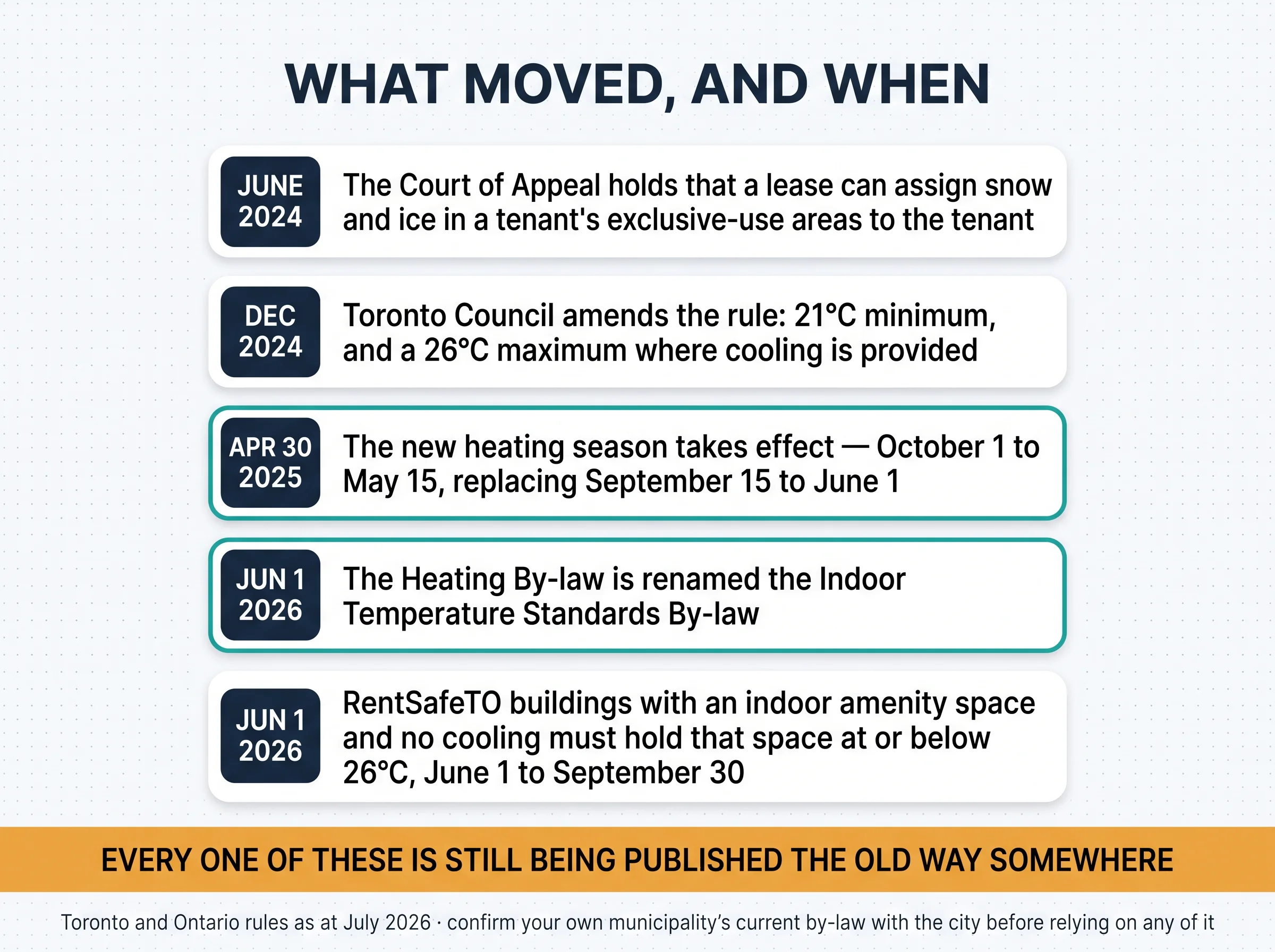
And it happened twice. In 2024 the Court of Appeal held that a lease can put snow and ice in a tenant's exclusive-use areas on the tenant. Eighteen months later, a law firm's blog post was still telling Ontario landlords it can't.
So this is a guide to what the province requires everywhere, what your city requires on top of that, the two dates that moved, who actually shovels, whose pipes those are, and why "the heating by-law" isn't called that any more. The useful fact isn't a date. It's that the answers move. Rules are current as at July 2026 — and the whole point of what follows is that you should check them again before you rely on them. This is general information for landlords and property managers, not legal advice.
The Ontario Winter Maintenance Checklist: 20 Steps Before Your Heating Season Opens
Toronto's heating season changed in 2025 and most guides still print the old dates. This checklist gives you the current numbers, the provincial floor underneath them, and the twenty things to do in one September morning — so January isn't when you find out.
Get Free PDF →There Is No Ontario Heating Law — There's a Floor and a Calendar
Start with the most confident wrong sentence in this category. A well-ranked Ontario landlord guide states, plainly and without qualification, that no province-wide heating law exists and that your obligations come from your municipality's property standards by-law.
That is wrong, and it's wrong in the direction that hurts. It tells a landlord in a quiet municipality that nothing binds them.
The province's Maintenance Standards regulation — O. Reg. 517/06, made under the Residential Tenancies Act — says otherwise. Section 15(1) requires heat to be provided and maintained so that the room temperature is at least 20°C. And it tells you exactly where to hold the thermometer: 1.5 metres above floor level and one metre from exterior walls, in all habitable space and in any area intended for normal tenant use — recreation rooms and laundry rooms included, locker rooms and garages excluded.
Now notice what isn't in that sentence. There is no date range. The provincial minimum doesn't come with a season attached. The seasons come from somewhere else entirely, which is precisely why so many people get this tangled.
Three provisions almost nobody prints
The regulation carries three rules that rarely make it into landlord content, and all three are useful.
- Section 15(2) — the carve-out. The 20°C standard doesn't apply to a rental unit where the tenant can regulate the temperature themselves and a minimum of 20°C can be maintained by the primary source of heat. Read the second half twice: capable is doing the work. Who holds the thermostat changes which rule you're under — but only if the system can actually deliver.
- Section 15(4) — portable heaters. A rental unit may not use portable heating equipment as its primary source of heat. That's a flat prohibition, with no exception for "just this winter" or "just until the furnace is fixed."
- Section 15(3) and section 17 — capability and repair. The complex must have equipment capable of holding the required temperature, and heating systems, chimneys, fans and pumps must be kept in a good state of repair and in a safely operable condition. A system that runs is not the same as a system that can hold 20°C in February.
There's a fourth worth knowing if your building burns fuel: section 18 requires a space containing fuel-burning heating equipment to have a natural or mechanical means of supplying combustion air. If you've ever enclosed a furnace room, that's the provision to look at.
Then the municipality goes on top
The province sets standards. Your municipality can set its own property standards by-law, and the large ones do. That's where the calendar lives — and where the numbers stop agreeing.
Toronto requires 21°C. Hamilton requires 20°C. Neither number is the provincial one and neither city's dates match the other's. The practical answer is not to pick one and hope: check both layers, and work to the higher duty, because that's the one that binds you in practice.

The Dates Moved
Here is the current Toronto rule: 21°C, from October 1 to May 15. City Council amended it in December 2024, and it came into force on April 30, 2025.
Here is the rule it replaced: 21°C, from September 15 to June 1.
And here is who was still publishing the old window well over a year later: a property manager's blog last October. An HVAC company. A real estate magazine. And the main heating page of a dedicated Ontario landlord guide, in April 2026 — a full twelve months after the change took effect.
We're not naming them, because the point isn't the pillory. The point is that you cannot tell. Every one of those pages is well-written. Every one of them is confident. None of them carries a signal that says "this is a year out of date."
The same site has it both ways
That last guide is the sharpest example in this whole file, and it's worth sitting with for a second. On one page it prints the old window. On another page — same site, same publisher — it prints October 1 to May 15, correctly. On one page it says no province-wide heating law exists. On another it says heat is a province-wide obligation.
One publisher. Two pages. Opposite answers, on both questions.
That's a different lesson from "some sources are wrong." It's that a source can disagree with itself, and the page doesn't tell you which one you landed on. No amount of careful reading protects you from that. The only thing that does is going to the primary text — the city's own site, or the regulation itself.

Why the change is so easy to miss
This is the honest part, and it's counter-intuitive. The old window was wider. September 15 to June 1 is a longer stretch than October 1 to May 15. So if you follow the stale dates, you heat for longer than required — you don't breach the heat rule at all.
Which means there's no complaint. No inspection. No ticket. Nothing whatsoever to teach you that you're reading a page that's a year out. The cost of the stale page isn't that it makes you late. It's that it makes you blind to what replaced it, which we'll come to at the end.
Hamilton is not Toronto
Sixty-odd kilometres down the QEW, the rule is 20°C from September 15 to May 15. Two weeks earlier than Toronto, and one degree cooler.
Now make it concrete. It's September 20th. One owner, two buildings — one in each city — and a cold snap comes through.
- Hamilton: five days into the heating season. The 20°C duty is live.
- Toronto: eleven days out. The 21°C duty hasn't started.
- The province: heat is understood to be a vital service on a calendar of its own, generally cited as running from September 1 — which would mean that clock has been ticking for nearly three weeks. (This one comes from secondary sources rather than the regulation text, so treat it as a reason to check, not a number to quote.)
One portfolio. Two calendars. One policy will not cover both.

The calendar, not the forecast
The best sentence in this whole category comes from that same guide with the stale dates — printed, as it happens, a few inches away from them:
"The bylaw doesn't care about the weather forecast. It cares about the calendar."
And the worked example is exactly right. It's April 20. It's 25°C outside. The boiler goes off to save on gas. Three days later a cold snap lands and the building drops to 16°C overnight. In Toronto the season runs to May 15 — that's a violation, on a spring day that felt like summer.
There's a nuance here, and it comes from the City itself: if the weather alone is genuinely holding the building at or above the minimum, you may turn the heat down or off. But that's a statement about the building's actual temperature, not about the date. Turning the system down while it stays ready to fire is not the same thing as shutting it off in April.
What enforcement actually looks like
In Toronto, urgent service requests — and no heat is the textbook example — are expected to be answered within 24 hours. Non-urgent requests get seven days. If a tenant calls 311 about no heat, the City aims to make contact within 24 hours itself.
On penalties, the City's own figures are the only ones worth repeating: on a summons and conviction, fines can reach up to $100,000, or $10,000 per day for each day a violation continues, plus a special fine for economic gains from the violation. You'll find other numbers elsewhere; they don't agree with each other, and they don't agree with the City. Use the City's.
But the fine isn't really the argument. A no-heat call at 11pm in January is a vital-services failure, a 24-hour clock, a cold tenant and possibly a hotel bill. The reason to do the walkthrough in September is that January is a bad time to find out.
The bright line
You cannot cut the heat over arrears where you pay for the fuel. Heat is a vital service, and no amount of money owing changes that. It isn't a negotiating position and it isn't a pressure tactic — it's simply not available.
There is one structural exception, and it's worth understanding rather than exploiting: the regulation's continuous-supply duty doesn't apply where the tenancy agreement makes the tenant responsible for the fuel or utilities and the supply has been discontinued because of their arrears. In other words, who pays decides who's protected — and if you're the one paying, you're the one who must keep it on.
Snow, Pipes, and the Other Rule That Moved
The orthodoxy still repeated across most Ontario landlord content goes like this: a lease clause can't make a tenant shovel, any such clause is void, and snow is always the landlord's problem.
That changed in June 2024.
In Crete v. Ottawa Community Housing Corporation, 2024 ONCA 459, the Ontario Court of Appeal held that a lease provision assigning snow and ice removal in a tenant's exclusive-use areas to that tenant is not inconsistent with the landlord's obligations under section 20 of the Residential Tenancies Act.
The split, plainly
Common areas — the landlord's. Shared walkways, parking areas, building entrances. That duty didn't move and isn't moving.
Exclusive-use areas — the tenant's, if the lease says so. A townhouse's own front steps. A private porch. A walkway used by one household and nobody else.
Same storm. Same hour. Same property line. Who must clear it depends on which square metre it landed on.

State the limit honestly
The older authority — a 2009 Court of Appeal decision — is what most pages still lean on for "a clause can't transfer snow, full stop." Both decisions come from the same court, and we're not going to tell you that one erased the other; that's a question for a decision you read yourself, not a blog post.
What we will stand behind is narrower and more useful: Crete is the current appellate statement on exclusive-use areas. If your understanding of Ontario snow law was formed before mid-2024, it's worth revisiting.
The example that's really about sources
In January 2026 — eighteen months after the Court of Appeal decided the point — a published law firm article told Ontario landlords that a lease clause cannot transfer snow removal duties, and that they would "remain legally responsible, regardless of what the lease says."
Nothing about that page looks wrong. It's well-written. It cites a real case, accurately. It's just out of date. Meanwhile a funded legal clinic — a free service, not a firm — had the point exactly right and had published a clear explanation of it.
That's the article in miniature. The authority of the source told you nothing. The date on it told you everything.
What to actually do about snow
The clinic's advice is the best in the file, and it's three steps:
- Define exclusive-use areas versus common areas in the lease. If nobody can tell which is which, the clause does nothing.
- Explicitly assign responsibility for snow and ice in the exclusive-use areas, if that's your arrangement.
- Write it as an "unambiguous, plain-language" maintenance clause — not buried, not lawyerly, not ambiguous.
That clause has to live somewhere legitimate, which means understanding what you can and can't add to the Ontario Standard Lease. And note this separately: your municipal sidewalk-clearing by-law is a different rule, with its own clock and its own fine. It isn't covered by anything in your lease. Look it up on your city's site.
Pipes — and a surprise from the tenants' side
The most balanced statement on frozen pipes in Ontario comes from a tenant advocacy group, not a landlord one. They address it as a myth: the belief that a tenant who was away over the holidays automatically owes nothing for a burst pipe. Their answer is blunt — "There are situations in which you might be responsible."
Their own worked example: a tenant is given a heater and asked to leave it running so the pipes don't freeze. They turn it off before leaving for the holidays, out of a reasonable fear of fire, and tell nobody. They come home to water everywhere. Had the landlord known the unit would be empty, they might have used different equipment, or come by to run hot water through the pipes.
A tenants' group conceding tenant responsibility carries more weight than any landlord source saying the same thing. And the fix is embarrassingly cheap: insulate the pipes on exterior walls and in unheated spaces, and send one email in December asking tenants to let you know about extended absences. That's it. That's the whole intervention.
A burst stack is also an insurance question, and a different one from a legal question — worth knowing what your landlord insurance actually covers before you need to find out.
And the counterweight
The same tenants' group is equally clear in the other direction: a tenant may never withhold rent, and risks eviction if they try. But where there's no heat and no response, alternate accommodation and compensation are live possibilities, receipts matter, and there are applications for it — a T2 where rights have been breached, a T6 for maintenance that's less urgent. Municipal property standards officers and the province's Rental Housing Enforcement Unit both move faster than a hearing does. If you'd like to understand the repair-enforcement side properly, we've covered the T6 application in its own guide.
It Isn't a Heating By-law Any More
On June 1, 2026 — six weeks before this was written — Toronto's Heating By-law was renamed the Indoor Temperature Standards By-law.
That is not a cosmetic change. It stopped being a winter rule. There is something faintly absurd about a guide called "winter-proofing" documenting a by-law that no longer thinks of itself as being about winter, and it's worth saying out loud rather than papering over.
The cooling duty you may not know you have
Where the landlord provides air conditioning, Toronto requires it to be operated from June 1 to September 30, holding a maximum of 26°C, and kept in good working order. That's not optional and it isn't weather-dependent.
You are not required to install cooling that isn't there. The City is explicit that it doesn't regulate indoor temperatures in apartment units without air conditioning. But if it's there, it runs — and removing a service you already provide can have rent consequences, so that's a conversation to have before you act, not after.
There's also a requirement that is six weeks old and essentially uncovered anywhere: from June 1, 2026, buildings registered with RentSafeTO that don't provide cooling but do have an indoor amenity space must keep that space at or below 26°C from June 1 to September 30. There's an exception where construction would be needed to meet it.
Here's where the stale page actually costs you
Reading a 2024 write-up of the Toronto heating by-law will not make you late on heat. We established that: the old window was wider.
What it does is make the cooling obligation invisible — because in 2024 it didn't exist. The error isn't in what the old page says. It's in what it can't say. That's the failure mode nobody watches for, and it's the reason "I looked it up once" is not a system.
Why it changed — and who it helped
The City's own explanation is straightforward, and worth reporting rather than arguing with: Toronto is seeing "more frequent and longer heat waves," and expects those risks to grow. That sentence is the City explaining why a heating by-law became a temperature by-law.
It's also worth knowing that the amendment wasn't only pitched as a tenant win. Under the old rule the minimum ran all the way to June, which could leave units uncomfortably warm in late May — and the councillor who championed the change noted it "allows them to turn AC on earlier without risk of a penalty." The change closed a late-May trap for landlords at the same time as it opened a summer duty.
Where this is going
Treat this as forecast, not fact. The direction of travel across Ontario appears to be from heating by-laws toward indoor temperature by-laws. Toronto has renamed its by-law and added an amenity-space duty. Mississauga is reported to cap at 26°C where cooling is equipped. Hamilton is reported to have consulted on a maximum-temperature by-law in early 2026 without enacting one. Ottawa is reported to have no cooling obligation at all.
Those last three come from secondary sources rather than the cities themselves — which, in an article about checking primary sources, is exactly the kind of thing we should tell you rather than dress up as a table. If any of them matters to a building you own, get it from the city.
The real lesson isn't a date at all. A landlord who learns "the heating season" as a fixed fact will be wrong again inside two years. Check it every August. Not once.
What To Actually Do
Seven moves, and the whole thing is a morning:
- Look up your city's current by-law — this year's version — for every city you own in. Toronto and Hamilton disagree on both the date and the degree, and they're an hour apart.
- Diarise the start and the end — Toronto October 1 to May 15, Hamilton September 15 to May 15 — and set the reminder for August.
- Know the provincial floor. 20°C under O. Reg. 517/06, measured 1.5 m up and 1 m from the exterior wall. Check whether the section 15(2) carve-out applies to your unit.
- Service the system before the season opens, confirm it can actually hold the minimum, and get any portable heater out of primary-heat duty — that one's a flat prohibition.
- Don't shut the boiler down on a warm April day. Turn it down, keep it ready. The by-law reads the calendar.
- Write the snow arrangement down properly. Define common versus exclusive-use areas in plain language, assign the exclusive-use areas explicitly, and keep clearing the common areas yourself.
- Insulate the exposed pipes and send the December email asking tenants to flag extended absences.
Quick win: the autumn walkthrough is one morning and one service call. Long game: a calendar you re-check annually, and a lease that says who does what. Everything else in this article is detail hanging off those two habits.
The Ontario Winter Maintenance Checklist: 20 Steps Before Your Heating Season Opens
Every step above, plus the four-city table, the provisions nobody prints, and a myth-versus-fact page you can hand to anyone who still thinks the season starts on September 15. Two pages. Free.
Get Free PDF →The Bottom Line
There is no single Ontario heating law. The province sets a 20°C floor with no dates on it. Hamilton opens its season on September 15 at 20°C. Toronto opens on October 1 at 21°C — and did not, until April 30, 2025. The snow rule moved in 2024. The by-law changed its name in June. Own buildings in two cities and you hold two calendars.
The temptation, having read all that, is to bookmark this page. Don't bookmark a page — bookmark the city's page, and read it again every August. Because the thing this article is really about isn't a date. It's that a confident, well-written, professionally published source can be a year out of date and give you no signal at all. One landlord guide has the new dates on one page and the old ones on another. A law firm was citing 2009 law in 2026. Nothing about either of them looks wrong.
The work is a morning in September. The reason to do it then is that January is a bad time to find out. A framework and a method — not legal advice.
Frequently Asked Questions
What temperature must an Ontario landlord keep a rental at?
It depends on your city — and there's a provincial floor underneath. Ontario's Maintenance Standards regulation (O. Reg. 517/06) requires heat sufficient to hold at least 20°C, measured 1.5 metres above the floor and one metre from exterior walls, in habitable space and in areas meant for normal tenant use like recreation and laundry rooms. Your municipality can require more, and the big ones do: Toronto requires 21°C; Hamilton requires 20°C. There's also a carve-out worth knowing — the provincial standard doesn't apply where the tenant can regulate the temperature themselves and the primary heat source is capable of holding 20°C. So the practical answer is: check your municipality's current property standards by-law, know the provincial floor sits underneath it, and remember that "no by-law in my town" does not mean "no obligation." Anyone who tells you Ontario has no province-wide heating rule is reading the wrong page.
When does heating season start in Toronto?
October 1, and it runs to May 15. This is the single most commonly wrong fact in Ontario landlord content. Toronto's heating season used to run September 15 to June 1; Council amended the rule in December 2024 and it took effect April 30, 2025. More than a year later, property managers, contractors and at least one dedicated landlord guide were still publishing the old window — and because the old window is wider, following it doesn't put you in breach of the heat rule; it just means you're heating for longer than required and reading a page that predates everything else that changed. Hamilton, for comparison, starts on September 15 at 20°C. If you own in both cities you are running two calendars. Look up your own municipality's current by-law each August rather than trusting last year's note.
Is the landlord responsible for snow removal in Ontario?
Partly — and the answer changed in 2024. In Crete v. Ottawa Community Housing Corporation, 2024 ONCA 459, the Ontario Court of Appeal held that a lease provision assigning snow and ice removal in a tenant's exclusive-use areas to that tenant is not inconsistent with the landlord's repair obligations under section 20 of the Residential Tenancies Act. The practical split: common areas — shared walkways, parking lots, entrances — remain the landlord's, while exclusive-use areas like a townhouse's own front steps can be the tenant's, if the lease says so clearly. Note the "if": this only works with an unambiguous, plain-language clause that defines which areas are which. Plenty of published guidance still says a clause can never transfer snow duties — that reflects the pre-2024 orthodoxy. And your municipal sidewalk-clearing by-law is a separate obligation with its own deadline.
Who pays when the pipes freeze?
Not always the landlord — and the most useful statement of this comes from a tenant advocacy group, not a landlord one. They address it as a myth: the belief that a tenant away over the holidays automatically owes nothing for a burst pipe. Their own example: a tenant given a heater and asked to leave it running to stop the pipes freezing turns it off over the holidays out of fire concerns, tells nobody, and comes home to water everywhere. Had the landlord known about the absence, they might have used different equipment or run hot water through the pipes. The lesson cuts both ways and the fix is cheap: insulate pipes on exterior walls and in unheated spaces before the freeze, and ask tenants in a December email to let you know about extended absences. A burst pipe is also an insurance question — check what your policy actually covers before you need it.
Does Toronto require air conditioning in rentals?
No — you are not required to install cooling that isn't there. But if you provide air conditioning, Toronto requires it to be operated from June 1 to September 30 and to hold a maximum of 26°C, and to be kept in good working order. There's also a newer requirement most landlords haven't seen: since June 1, 2026, RentSafeTO-registered buildings that don't provide cooling but do have an indoor amenity space must keep that space at or below 26°C from June 1 to September 30 (with an exception where construction would be needed). This is also why Toronto's Heating By-law was renamed the Indoor Temperature Standards By-law on the same date — it stopped being a winter rule. If your understanding of the by-law comes from an article written before 2025, the cooling side of it is simply invisible to you.
Ontario's rules move. Your software shouldn't make you chase them.
Tenon10 is built Canadian-first, with Ontario's rules in the code — the 2026 guideline, N1 and N2 timing, last-month's-rent limits, and 20+ LTB forms that fill themselves in. Start free.
Free • No signup required • Updated for the Bill 60 changes in force 21 Sep 2026
Related Resources
- Mold in an Ontario Rental: Who's Responsible, and How to Get It Fixed — the other maintenance duty that turns on who caused what.
- Landlord Insurance in Ontario: What's Standard, What It Costs, and Where the Gaps Are — because a burst pipe is an insurance question before it's a legal one.
- What You Can and Can't Add to the Ontario Standard Lease — where your exclusive-use snow clause has to live.
- The T6 Application: How Tenants Enforce Repairs at the LTB — the enforcement mechanism behind the repair duty.
- Is My Lease Legal? Common Ontario Lease Mistakes That Void Your Terms — an ambiguous maintenance clause is a clause that does nothing.
- Ontario Standard Lease 2026: The Complete Guide for Landlords — the document every clause in this article lands in.
- Property Management Software Ontario: What to Look for in 2026 — if you're diarising two cities' calendars by hand, this is the alternative.
- Becoming a Landlord in Ontario: The Complete First-Timer's Guide — the whole picture, if this is your first winter.
Rules dated July 2026, and written for an autumn read — check them again before you rely on them, because the point of this article is that they move. Toronto's heating season changed on April 30, 2025, and its Heating By-law was renamed the Indoor Temperature Standards By-law on June 1, 2026. Confirm the Residential Tenancies Act, O. Reg. 517/06 and O. Reg. 516/06 on Ontario's e-Laws, and confirm your own municipality's current property standards by-law with the city, before acting. This is general information for landlords and property managers, not legal advice.


