

A man in Montreal rented the same house for twenty years. In 2006 his landlord — a Canadian company — sold the place to one of its own shareholders, and nobody told him. In 2010 he signed a fresh lease naming her as his landlord. She wrote a Canadian address on it. She signed it in Italy.
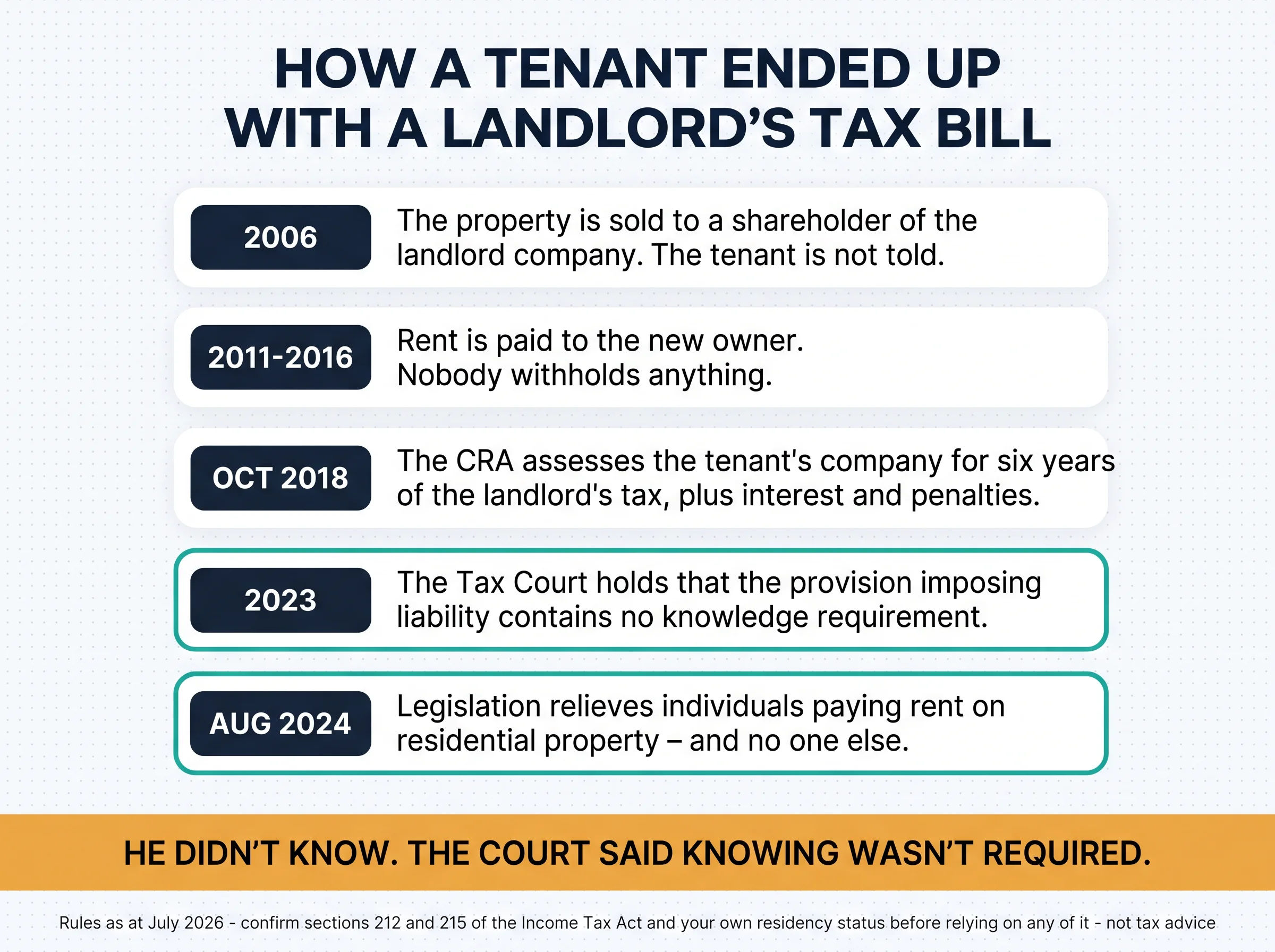
In October 2018, the Canada Revenue Agency sent his company a bill for six years of somebody else's tax, plus interest and penalties.
He had no idea his landlord had become a non-resident. He had no way of finding out. He argued that the provision making him liable must surely require him to have known. The Tax Court went back through the legislative history and found no knowledge requirement — there never had been one, and Parliament never added one. As for the Canadian address on his lease, the Court held he wasn't entitled to rely on it.
He wasn't the villain of that story. He was the tenant.
This is a guide for landlords, and that's exactly why it opens there. When you move away, almost nothing changes about your obligations to the person living in your unit — and quite a lot changes about what the Income Tax Act asks of them. Below: what actually shifts when you leave, the one subsection that fixes the whole problem, the form that moves your withholding off the gross, and the deadline that lands on your property manager rather than you. None of this is tax advice or legal advice, and no figure here should be relied on for your own filing — this is a map of the questions to take to a cross-border accountant before you go.
The Remote Landlord's Setup Checklist: 18 Things to Do Before You Leave
Moving away doesn't change one word of your obligations under the RTA — but crossing the tax-residency line can put 25% of your gross rent, and a six-year liability, onto your tenant. This checklist covers the eighteen things to settle before you go, in the order they need doing.
Get Free PDF →The RTA Doesn't Care Where You Live
Start with the half that surprises people by not changing.
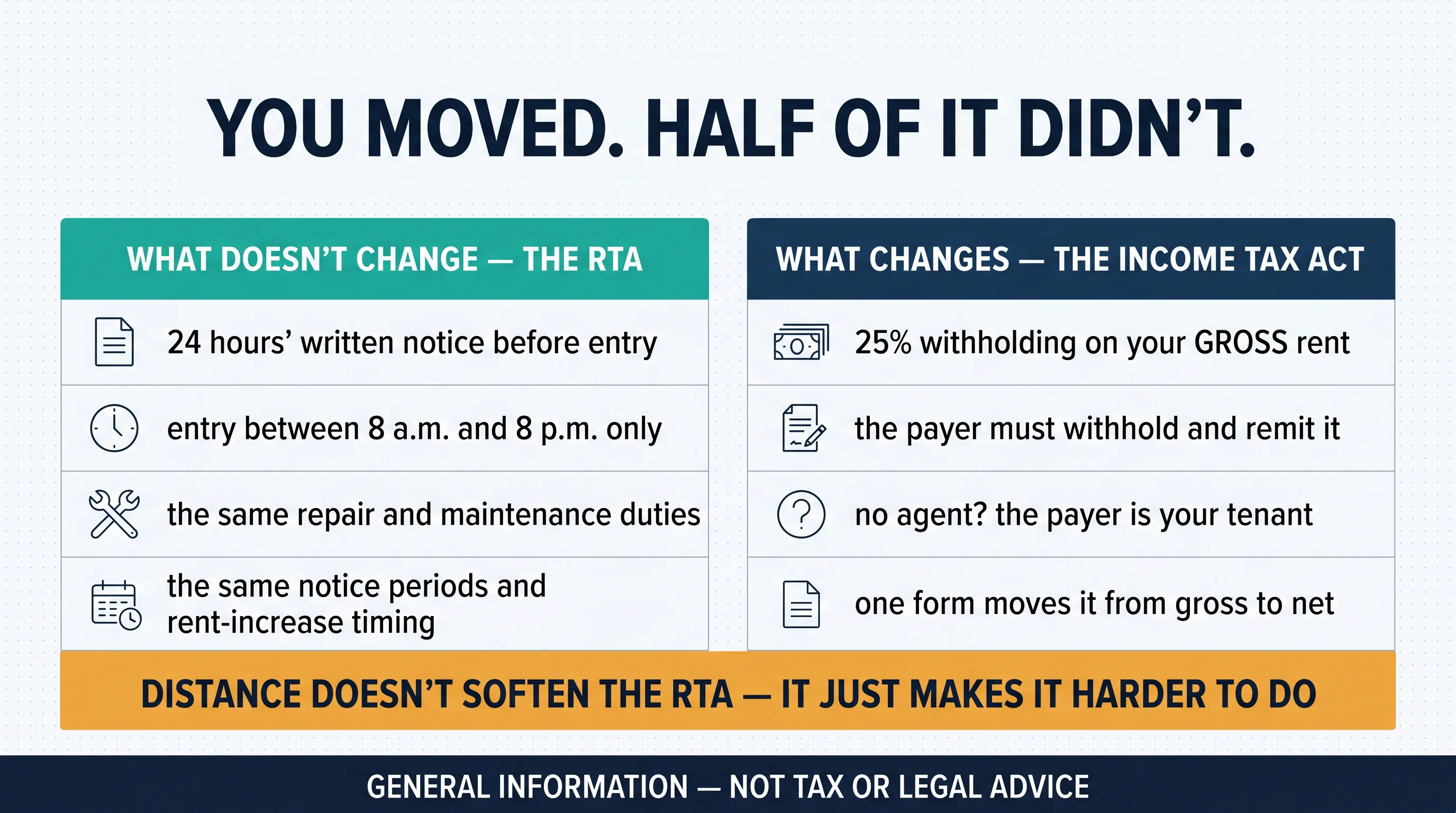
Distance does not soften the Residential Tenancies Act. Not one word of it. Your duties from Lisbon are identical to your duties from Etobicoke: the same entry rules, the same repair and maintenance standards, the same notice periods, the same rent-increase timing. The only thing that moves is how hard those duties are to perform.
That's worth sitting with, because the quiet assumption that distance loosens something is where most remote landlords get into trouble. It doesn't loosen anything. It just removes your ability to walk over and deal with it.
Entry, repairs and the boring machinery
The 24 hour notice of entry Ontario rules are unchanged by an ocean. Twenty-four hours' written notice. Entry between 8 a.m. and 8 p.m. And only for a reason the Act actually permits — entering for an unlisted reason, even with flawless notice, is still unauthorized entry. Your repair obligations are unchanged. Your maintenance standards are unchanged.
What changes is logistics. A furnace failing at 11 p.m. in February is a different problem when you're asleep in another hemisphere, and "I was abroad" has never been a defence to anything.
The most practical fact in this article, and it's deeply boring
Email service is not automatic.
Email becomes a permitted way of serving documents only where your tenant has consented to it in writing. The ontario standard lease has a place for exactly that, and there's a separate Consent to Service by Email form if you need one. Skip it, and a landlord eight time zones away is serving notices by courier and mail — which is not merely inconvenient. As the Landlord and Tenant Board puts it plainly: the method you use to serve documents will determine when the LTB considers them to be received.
Get that consent at lease signing. It costs ten seconds and there is no retrofit — you cannot go back and add it once a dispute has started.
Filing from abroad isn't the problem
The Tribunals Ontario Portal takes applications, evidence and status checks from anywhere with a connection. Nobody at the LTB cares what time zone you filed from.
Being served, and serving, is the problem. So is attending. So is getting a contractor into a unit inside a 24-hour window.
Which points at the answer this article keeps arriving at from different directions: you need a person on the ground. Not because the law requires one — it doesn't — but because the duties don't shrink to fit your postcode.
And a plan that doesn't survive contact with the rules
A lot of departing owners quietly assume they'll keep the condo, rent it out, and take it back for a few weeks a year when they visit. That plan runs straight into the n12 notice ontario rules. An N12 requires that the person moving in genuinely intends to occupy the unit as a residence for at least a year. Transient or occasional use — the classic pied-à-terre — doesn't meet that. Nor can a corporation claim own use; corporations don't live in units.
If you're coming back for good, that's a real conversation with its own notice periods and compensation rules. If you're coming back for six weeks, it isn't one.
What Changes Is the Tax — and It Lands on Your Tenant
Now the half nobody expects.
If you become a non-resident of Canada for tax purposes, paragraph 212(1)(d) of the Income Tax Act imposes tax at 25% of the gross rent paid for the use of your property. Not your profit. The gross. Before mortgage interest, before property tax, before repairs, insurance, condo fees or management fees. On a $3,000 unit that's $750 a month, and the Act is supremely uninterested in the fact that your mortgage payment is $2,600.
That much most people half-know. Here's the part they don't.
The Act doesn't send the bill to you
Section 215 puts the obligation to withhold and remit on the payer — and it does so, in the statute's own words, notwithstanding any agreement or law to the contrary. It doesn't matter what your lease says. It doesn't matter what you and your tenant agreed.
Absent a Canadian agent collecting your rent, the payer is your tenant.
And subsection 215(6) is unsparing about what happens when the payer doesn't withhold: that person is liable to pay as tax the whole of the amount that should have been withheld — on the non-resident's behalf — plus penalties and interest. The subsection does hand them a right to recover it from you afterwards. Consider, for a moment, what exercising that right looks like for an ordinary tenant whose landlord is in another country.

The case, told properly
Back to Montreal. The tenant signs a lease in 1996 with a Canadian corporation. In 2006 the company sells the house to one of its shareholders and he's never informed. In 2010 he signs a new lease naming her as landlord — Canadian address written on it, signed in Italy, with phone numbers in both Quebec and Italy. From 2011 to 2016 his company pays the rent. Nobody withholds anything, because nobody knows there's anything to withhold.
The Court found she was a non-resident on the evidence: she owned no other Canadian property, she filed no Canadian returns, and her phone and email were Italian.
His argument was the obvious one — surely liability requires knowledge. The Court reviewed the legislative history of the provision and found no knowledge requirement when it was introduced, and none added since. It also noted that when Parliament wants to condition liability on knowing something, it says so expressly elsewhere in the Act. On the Canadian address, the Court cited an earlier decision for the proposition that a statement of residency isn't conclusive and shouldn't be accepted without further inquiry.
On the due diligence question, be careful with what you read online, because plenty of summaries overstate it in both directions. The Court held that the general obligation to withhold can't be read as allowing a due diligence defence against the tax itself. A defence may have been available against the penalties and interest alone — but he hadn't established sufficient diligence to make it out. That's a narrower and more accurate statement than the flat "there is no due diligence defence" you'll see repeated in a lot of places.
Then the CRA did something remarkable
The case attracted attention, for obvious reasons — the idea that any renter in Canada could be assessed years later for a landlord's tax is alarming to roughly every renter in Canada.
So the CRA published a statement, on social media, saying that Canadian residential renters aren't expected to know their landlord's residency or withhold 25% of their rent.
That statement is still on the CRA's website today — sitting directly above the sentence that says the payer or agent must withhold 25% of the gross rental income. Both things, on one page.
The reconciliation is that the first was an administrative position and the second was the law. As one tax firm put it with some precision, the relief was not expressly grounded in the legislation. Draft legislation followed on August 12, 2024. It did not become law for a long time — more on that below. In the meantime, what stood between ordinary tenants and a retroactive assessment was a promise, not a statute.
The framing that matters
None of this is your tenant's homework.
They cannot see your tax residency. They cannot verify it. There is no registry to check and no box on any form that would tell them. When the machinery of Part XIII lands on a tenant, it lands on someone who had no realistic way of knowing it was coming and — on the authority above — no defence against the tax once it arrived.
Which is why the rest of this article isn't about protecting yourself from your tenant. It's about not doing this to them in the first place — and the mechanism that achieves it happens to protect you too.
The Fix Is One Subsection Deep
Everything above is the problem. Here is the answer, and it is almost embarrassingly small.
Subsection 215(3). Where an amount is paid or credited to an agent or other person for or on behalf of the person entitled to it, without tax having been withheld under 215(1), it is the agent who must withhold and remit — again, notwithstanding any agreement or law to the contrary.
Read that again with a rental in mind. If your tenant pays rent to a Canadian-resident agent — a property manager, for instance — then the agent carries the withholding obligation, and your tenant doesn't. The exposure moves off the person who cannot see it and onto a party who is paid to know.
That's it. That's the fix. It's one subsection deep, it's been in the Act for decades, and it costs a form.
A note on where you'll read about this
Search this topic and you'll notice something quickly. Nearly every page ranking on it is written by someone who would like to be your Canadian agent: property management companies, CPA firms, tax lawyers. Every article ends with a phone number.
And here's the uncomfortable thing — they're right. Check the sales pitch against subsection 215(3) and it says exactly what they say it says. Appointing an agent genuinely does move the obligation. The mechanism is real and the advice is sound.
The problem isn't that the facts are wrong. It's that you can't tell, from the page, whether "you need a Canadian agent" is a statement of law or the close of a sale — and the only way to find out is to go and read the section yourself. Which almost nobody does, because the section is not what ranks. Correct and motivated are not opposites. Here they happen to be the same thing. That won't always be true, and the page will never tell you which one you're reading.
The NR6, and what it actually buys you
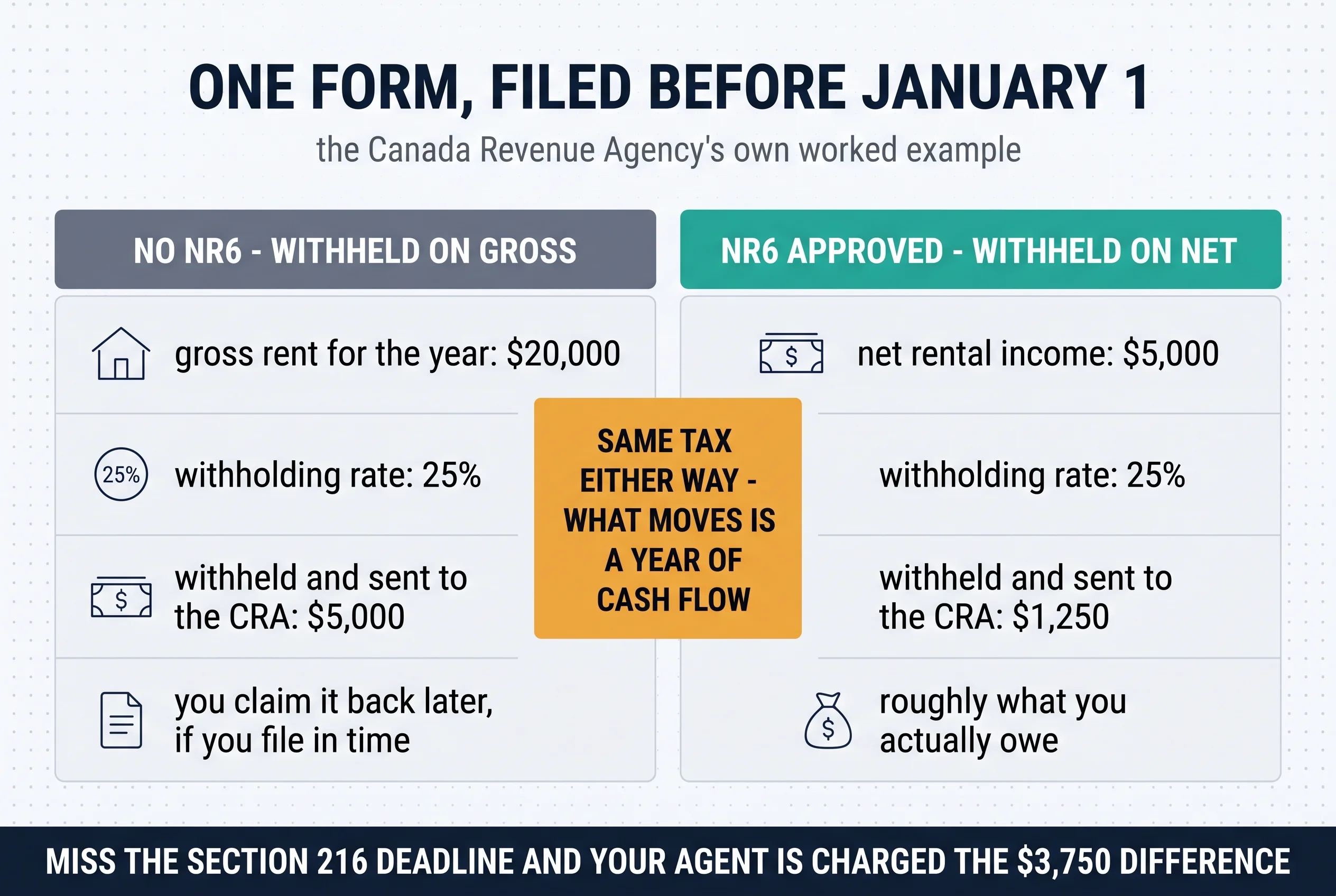
By default, the 25% comes off your gross. File Form NR6 — a joint undertaking between you and your Canadian agent — and once the CRA approves it, the withholding comes off your net instead.
The CRA's own guide works the example. Gross rent of $20,000 for the year, net rental income of $5,000 after expenses. Without an approved NR6, $5,000 gets withheld and sent to the CRA. With one, it's $1,250.
Use the CRA's numbers. Almost every other figure in circulation on this subject is somebody's marketing arithmetic.
Four dates, and one of them isn't yours to miss
- The NR6: on or before January 1 of the rental year, or before the first rent payment is due. It does not carry over — you re-file it every single year.
- Remittance: by the 15th day of the month following the month the rent was paid or credited.
- The NR4 slip: by March 31, reporting the gross rent paid to you and the tax withheld.
- The Section 216 return (Form T1159): generally within two years of the year-end — but where an NR6 was approved, within six months, which means June 30.
The three ways this can go
- Withhold on gross and file nothing. The 25% is your final Canadian tax on the rent. Simple, and usually expensive.
- Withhold on gross and file a Section 216 return. You report actual net income at graduated rates, and the excess withholding comes back as a refund — months later.
- NR6 plus a Section 216 return. Reduced withholding through the year, and a return that squares it up.
The final tax under options two and three is the same. What differs is whether you spend a year having lent the government money you were always going to get back.
The lease clauses that make this survivable
Two of them, and neither costs anything.
The first is the written consent to email service from earlier. The second comes from a law firm with nothing to sell you but advice: a residency-change notice covenant — you undertake to tell your tenant promptly if your tax residency changes. It matters because your status can shift mid-tenancy. Somebody who was resident when the lease was signed can be non-resident by year three, and there is no mechanism anywhere that would inform the person paying the rent. Both belong in the lease at signing; see ontario standard lease additional terms for what holds up and what doesn't.
Where the Relief Doesn't Reach
Which brings us to the legislation, and to a date worth writing down.
The draft rules released on August 12, 2024 added two subsections. Subsection 215(1.2) switches off the withholding requirement for an amount paid by an individual — other than a trust that isn't a graduated rate estate — to a non-resident as rent for a residential property. Subsection 215(1.3) then shifts the remittance obligation onto the non-resident landlord, where no agent is doing it already.
Those subsections received royal assent on March 26, 2026, as part of Bill C-15, and they are deemed to have come into force on the announcement date — August 12, 2024. They are in the consolidated Act now. You can go and read them.
Do the arithmetic on those two dates. For more than nineteen months, the CRA was administering a rule that was not law, and every individual tenant in Canada was relying on an administrative promise to stand where a statute eventually would.
There's a good side to the relief, too: it doesn't require the individual paying to be the one living there. A parent paying an adult child's rent is covered.
Three ways it's narrower than people assume
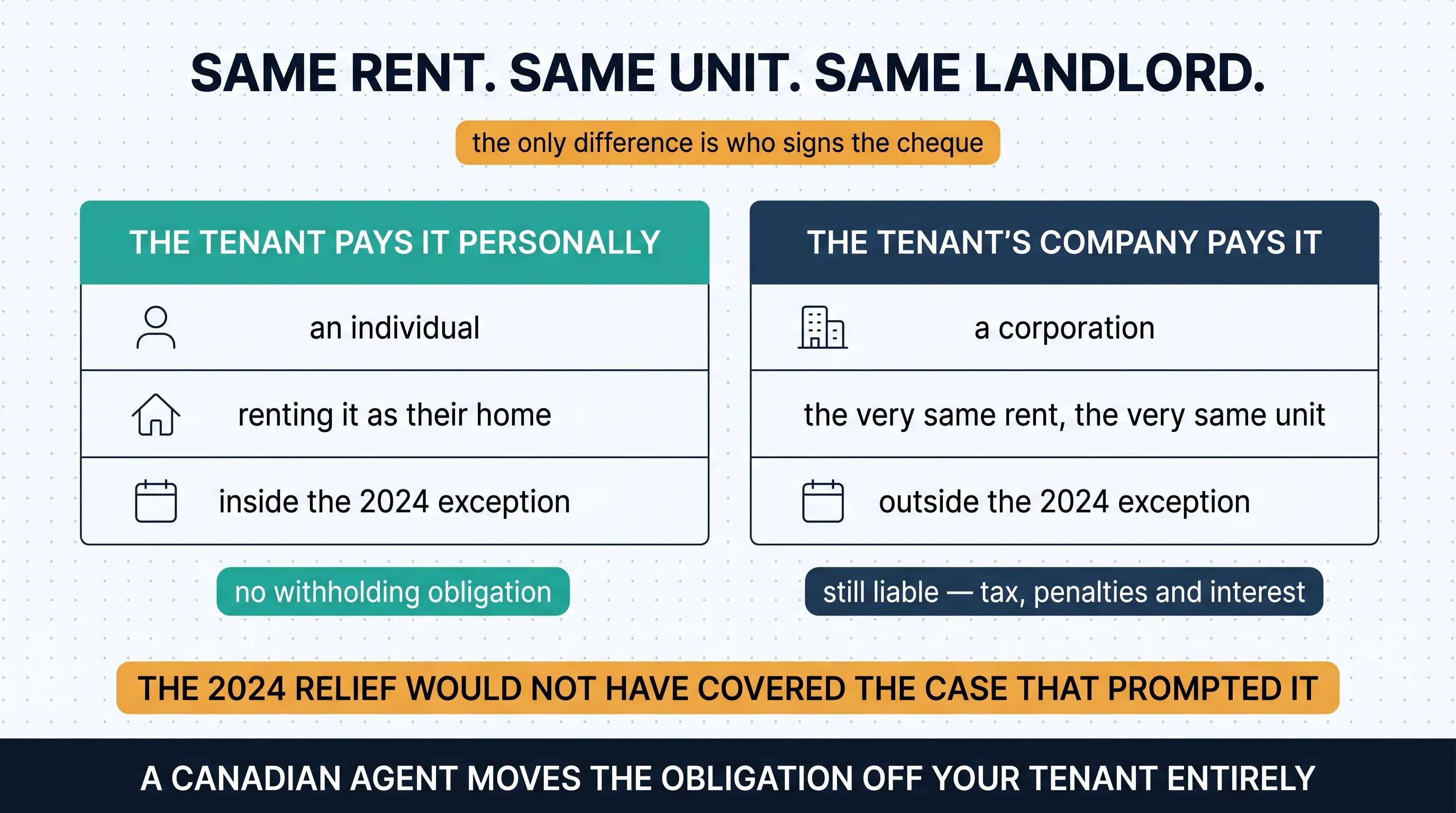
The exception only switches off subsection 215(1) where the payer is an individual. Which leaves fully exposed:
- Rent paid by a corporation.
- Rent paid by a trust that isn't a graduated rate estate.
- Commercial and other non-residential property.
And now the fact that should stop you.
The relief was written because of the Montreal case. It would not have saved the Montreal case. His rent was paid by his corporation, and the exception reaches only individuals. The legislation drafted in response to that taxpayer's situation would have left that taxpayer exactly where he was. It took the Canadian Tax Foundation to point that out, and almost nobody has repeated it since.
So here is the whole thing in one image. Same tenant. Same unit. Same landlord. Same rent, same month. He pays it from his personal account and he's relieved. He pays it through his company and he's liable for the tax, the penalties and the interest. The signature line on the cheque decides it.
The policy you cannot look up
One more, because it's the kind of thing that ought to be better known.
Miss the two-year window for the Section 216 return and the Act says you're liable on the gross. The CRA's stated practice, however, allows late filing on the net — except where the CRA has already advised you of your Part XIII responsibilities, has already begun action, or previously approved an NR6.
Two authors writing for the Canadian Tax Foundation went looking for that policy in the public record. They reported being unable to find any discussion of it in publicly available CRA documents, including the Audit Manual.
Sit with the shape of that. The difference between a $5,000 assessment and a $1,250 one can turn on an administrative practice you have no way of reading. And note the sting in the tail: filing an NR6 and then not filing the return is worse than never having filed the NR6 at all, because the NR6 year is one of the exclusions.
Where this is heading
The direction of travel is clear enough. The compliance burden has moved off tenants and onto landlords and their agents, and non-resident owners should expect more direct dealings with CRA systems rather than fewer — subsection 215(1.3) is precisely that, in statutory form.
Expect the residual exposure to concentrate exactly where the relief doesn't reach: corporate payers, commercial space, and arrangements with an agent in the middle who may not have read subsection 215(3) as carefully as they should have.
And take the meta-lesson seriously, because it's the most durable thing here. This area changed twice in under three years — a Tax Court decision in 2023, a legislative fix announced in 2024 that didn't become law until 2026, with an administrative promise holding the gap in between. If your understanding of it is more than a year old, it is probably wrong in a way that costs somebody else money.
Practical Takeaways
Seven moves. All of them happen before you go, which is the entire point — your tenant cannot do any of them for you.
- Get a written tax-residency determination from a cross-border accountant. First, not last. Everything else depends on the answer, and the test is a facts-and-circumstances one — not your citizenship, not your passport, and not your status under the RTA.
- Appoint a Canadian-resident agent. Subsection 215(3) moves the withholding obligation onto them and off your tenant. This is the single highest-value item in this article.
- File the NR6 before January 1, jointly with your agent, and put it in the diary every year — it does not carry over.
- File the Section 216 return on time — June 30 where you filed an NR6 — and tell your agent your filing date, because a late return is charged to them.
- Get the tenant's written consent to email service into the lease at signing. Ten seconds. No retrofit.
- Put a residency-change notice covenant in the lease. Your status can move mid-tenancy and nothing else will tell them.
- Line up a person on the ground who can attend, receive and act inside a 24-hour window.
Quick win: the consent-to-email box. Long game: an NR6 every year and a Section 216 return filed on time, indefinitely.
Where to go: a cross-border tax accountant first; the CRA's own T4144 guide for the section 216 mechanics; the Ontario Standard Lease for the consent box; the Tribunals Ontario Portal for anything at the Board. If you're new to the whole business, how to become a landlord in ontario is the ground floor. And because Part XIII sits alongside the ordinary rules on rental income, CRA rental income audit triggers is the sibling piece to this one.
The Remote Landlord's Setup Checklist: 18 Things to Do Before You Leave
Moving away doesn't change one word of your obligations under the RTA — but crossing the tax-residency line can put 25% of your gross rent, and a six-year liability, onto your tenant. This checklist covers the eighteen things to settle before you go, in the order they need doing.
Get Free PDF →The Work Isn't Remote
Moving away changes almost nothing about your obligations to your tenant, and almost everything about your tenant's obligations to the Canada Revenue Agency.
The Residential Tenancies Act travels with you, fully intact, and simply becomes harder to carry. The Income Tax Act doesn't travel at all. It stays exactly where the rent is handed over, and it attaches to whoever hands it.
A man in Montreal found that out in a letter, twelve years after a sale nobody told him about. He didn't know. The Court said knowing wasn't required. His lease said Canada; the Court said he couldn't rely on it. And the relief eventually written in response to his case wouldn't have covered his case.
None of it had to happen. One subsection puts the obligation on a Canadian agent instead of a tenant. One form filed before January 1 takes the withholding off your net rather than your gross. One box ticked at lease signing keeps your notices valid from eight time zones away.
The remote landlord's real work isn't remote at all. It's the paperwork you do before you leave — and the person it protects most has no way of doing any of it for you.
Rules dated July 2026. This area changed twice in under three years — a Tax Court decision in 2023, draft legislation in August 2024, and royal assent in March 2026 — so confirm the current text of sections 212 and 215 of the Income Tax Act, and confirm your own residency status with a cross-border tax accountant, before acting on any of this. Nothing here is tax advice or legal advice, and no figure in it should be relied on for your own filing.
Frequently Asked Questions
Do I have to tell my tenant I've moved out of Canada?
There's no line in the Residential Tenancies Act that says "notify your tenant you've emigrated." But the practical answer is yes, and the reason lives in the Income Tax Act rather than the RTA. If you become a non-resident for tax purposes, rent paid to you attracts a 25% withholding under Part XIII, and the person the Act makes responsible for withholding and remitting it is the payer — which, if nobody else is collecting your rent, is your tenant. In the 2023 Tax Court decision discussed above, a tenant was assessed for six years of exactly this, and the Court held that the provision imposing liability contains no knowledge requirement. He didn't know, and it made no difference. Tax firms recommend leases carry a covenant requiring the landlord to notify the tenant if their residency status changes. The better answer, though, is to appoint a Canadian agent so the question never lands on your tenant at all. Ask a cross-border accountant before you go, not after.
What is the 25% non-resident withholding tax, and who actually pays it?
Under paragraph 212(1)(d) of the Income Tax Act, rent paid to a non-resident for the use of property in Canada attracts tax at 25% of the gross — not the profit, the gross, before mortgage interest, property tax, repairs or management fees. The tax is the non-resident's liability, but section 215 makes the payer responsible for withholding it and remitting it to the CRA by the 15th day of the following month, "notwithstanding any agreement or law to the contrary." Where rent is paid to a Canadian agent — a property manager, for instance — the agent carries that obligation instead of the tenant. Where there's no agent, it historically fell on the tenant, which is how a tenant ended up personally assessed. Legislation that received royal assent in March 2026, retroactive to August 2024, now relieves individuals paying rent on residential property — but the relief is narrow, and whether it reaches your arrangement is a question for an accountant. This is general information, not advice.
What is an NR6 and do I really need one?
Form NR6 is a joint undertaking between a non-resident landlord and their Canadian agent. Once the CRA approves it, the agent can withhold 25% of your net rental income — after expenses — instead of 25% of the gross. The CRA's own guide illustrates the gap: on gross rent of $20,000 with net of $5,000, an approved NR6 means $1,250 withheld instead of $5,000. The tax you ultimately owe is the same either way; what the NR6 buys is a year of cash flow rather than an interest-free loan to the government that comes back months later. Two catches. It must be filed on or before January 1, or before the first rent payment is due, and it does not carry over — you re-file every year. And if you file an NR6 and then file your Section 216 return late, the CRA charges the shortfall to your agent, plus interest. In the CRA's example, that's $3,750.
Does the Residential Tenancies Act change if I live outside Canada?
No. This surprises people, and it's the assumption that causes the most avoidable trouble. Your obligations are identical whether you're in Etobicoke or Dubai: 24 hours' written notice before entry, entry only between 8 a.m. and 8 p.m. and only for a permitted reason, the same repair and maintenance duties, the same rent-increase timing, the same notice periods. The only thing distance changes is how hard those duties are to perform. Two practical consequences follow. First, get your tenant's written consent to service by email at lease signing — email isn't an automatically permitted method without it, and the method you use determines when the Board treats a document as received. Second, have a person on the ground who can actually attend. Filing from abroad is easy; the Tribunals Ontario Portal doesn't care where you are. Receiving, serving and showing up are the hard parts.
Can I evict my tenant so I can use the condo when I'm in Toronto?
Almost certainly not, and this is a common plan that doesn't survive contact with the rules. An N12 requires that the person moving in — you, or a qualifying family member — genuinely intends to occupy the unit as a residence for at least a year. Transient or occasional use, the classic pied-à-terre or a few weeks each summer, doesn't meet that. Nor can a corporation claim own use; corporations don't live in units. The Landlord and Tenant Board treats intent as a live question of fact, notices served without genuine intent get dismissed, and a bad-faith notice exposes a landlord to serious consequences. If your plan is to come back and live in the unit full-time, that's a different conversation with its own notice periods and compensation rules — start with our N12 guide and get advice before serving anything.
Your paperwork should work from anywhere
Every Ontario LTB form, filled in properly, with the service record to prove it — from whatever time zone you happen to be in.
Free • No signup required • Updated for the Bill 60 changes in force 21 Sep 2026
Related Resources
- CRA Audits of Rental Income: What Triggers Them, and How to Stay Audit-Ready — the sibling to this piece. Part XIII is one layer; this is the rest of what the CRA looks at.
- Ontario Standard Lease 2026: The Complete Guide for Landlords — where the consent to email service actually lives.
- What You Can and Can't Add to the Ontario Standard Lease — before you draft that residency-change covenant.
- The 24-Hour Notice of Entry Rule in Ontario — unchanged by distance, and easy to get wrong from far away.
- Ontario N12 Notices: A Complete Guide to Own-Use Tenancy Endings — before you plan your return.
- Ontario Rental Law Changes 2026: Bill 60 and Bill 97 — the provincial rules that moved while you were away.
- Property Management Software Ontario: What to Look For in 2026 — records you can reach from another continent.
- Landlord Insurance in Ontario — the other thing that behaves differently once you're not living there.


