

Open two tabs about Hamilton's rental market and you can read, in the same week, that rents are up 12.9% — and that they're down 5.1%. Both numbers are real. Neither is lying. And if you can't explain why, you're not ready to underwrite a Hamilton deal. The city's market has split by segment more than by geography — premium single-family rentals in Ancaster and Dundas run under 2% vacancy while new downtown towers sit north of 6% — and its public data disagrees loudly enough that any headline average will steer you wrong in one direction or the other.
This guide sorts the noise the way an investor should: the reconciliation of the conflicting numbers (each one's measurement universe), the two-rents turnover math, eight neighbourhoods across three locally documented plays — cash flow, tenant quality, commuter growth — the basement-suite conversion economics, and the Hamilton homework: licensing areas, permit clocks, and old-stock diligence. Plus the download this piece was built around: a deal-analyzer workbook, because in this city the only number you should trust is the one you computed from your own comps. Figures are current as of July 2026 and refreshed quarterly; market data, not investment advice.
The Hamilton Rental Deal Analyzer: Underwrite With Your Own Comps
The fill-in workbook for Hamilton buyers in a market whose data disagrees with itself — enter your own last-30-day comps, build a never-mix-universes rent roll, and see the paper cap rate against the honest one with years 1–3 capex and the conversion clock priced in.
Get Free PDF →Four Numbers, Four Universes: Reading Hamilton's Conflicting Data
Here are the four claims you'll actually meet, side by side, each dated and attributed. +12.9% year over year — one local operator's turnover-rent series, meaning new leases signed on their own managed stock. −5.1% year over year to a $1,992 median two-bedroom — citywide asking rents across all listings, April 2026. $1,795 average, down 3% — a different listing basket weighted toward apartments, June 2026. And roughly $1,700 — CMHC's two-bedroom figure, which measures what sitting tenants actually pay, most of them under rent control.
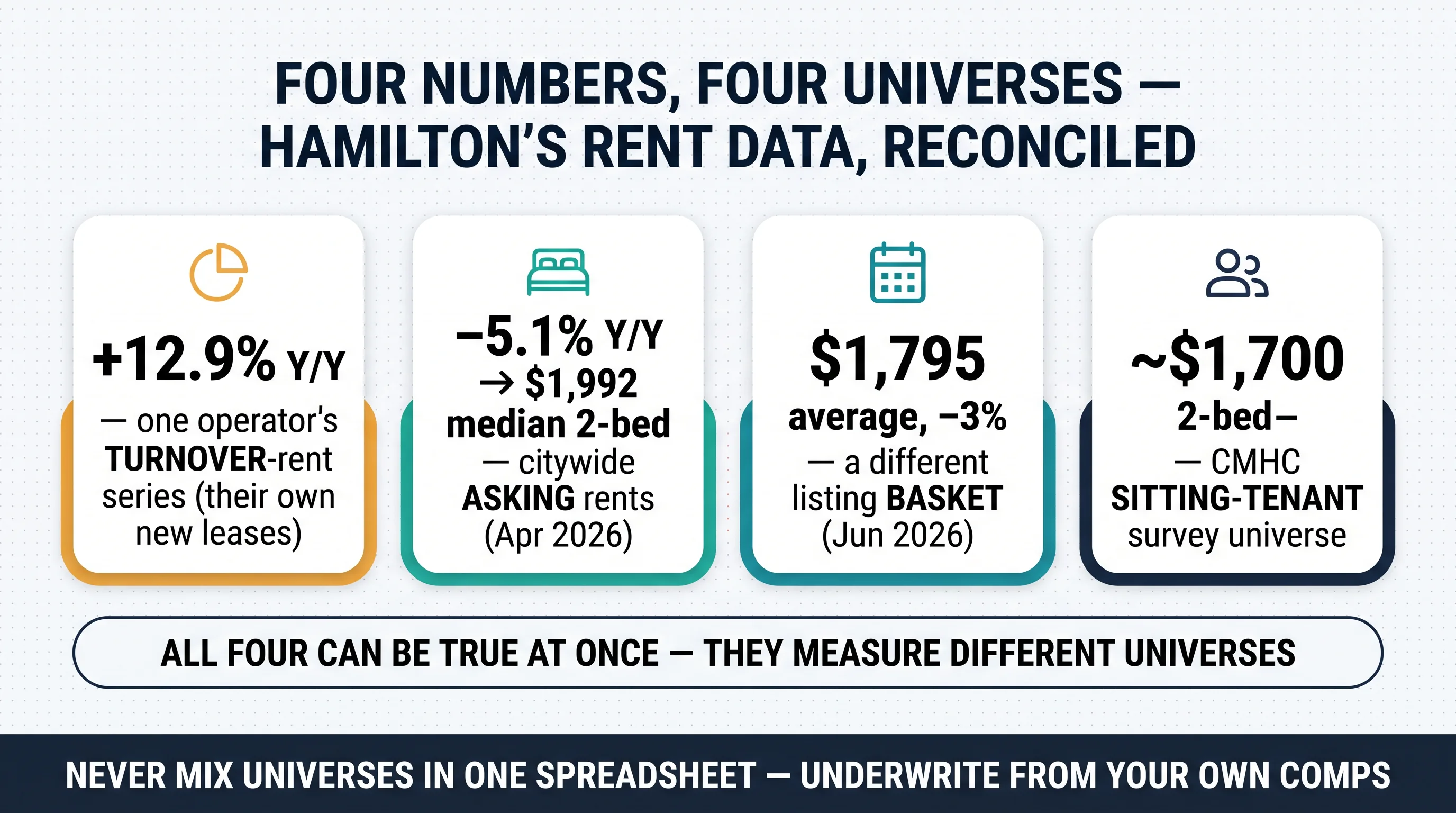
The resolution isn't to pick a favourite — it's to see that turnover rents, asking rents, basket averages, and sitting-tenant surveys measure different universes, and all four can be true at once. The reframe that makes you a better underwriter: not "which number do you believe" but "which universe does each number measure." For direction of travel, anchor to CMHC's outlook: vacancy rising into 2026 and moderating in 2027, rent growth around 2% per year, and supply absorption estimated around 2028 — a softening that is supply-led, with roughly 4,200 purpose-built units under construction and about 1,400 delivering in 2026, including named projects like the 261-unit building at 500 Upper Wellington and the 126-unit Kiwanis development on Upper Wentworth. It's the same two-rents mechanics our average rents by bedroom guide teaches province-wide, and the same yield logic in our cap rates and average rents guide.
One bonus lesson straight from the wild: published Hamilton guides circulate the wrong 2026 rent increase guideline — you'll see 2.5% in print; the province says 2.1%. Verify every rule against its source, the same way you verify every rent against your own comps. Our complete 2026 rent increase guide has the real machinery.
The Segment Split: Where Hamilton Is Tight and Where It Isn't
Citywide vacancy is 3.6% per CMHC's 2025 survey — and nearly meaningless on its own. The segmentation, per local operators: premium single-family rentals in Ancaster, Dundas, and Waterdown run under 2%; older walk-up apartments run 4–6%; new downtown condo towers sit above 6%. The segmentation is the market. The two rents follow the same logic: CMHC's sitting-tenant ~$1,700 against asking rents of ~$1,992–$2,086 — a smaller gap than Ottawa or Toronto, same mechanics, with the full asking ladder running about $1,599–$1,753 for a one-bedroom and $2,600–$2,650 for a three-bedroom, and the city's cheapest asking pockets (Stinson, Landsdale, Gibson) around $1,500.

The demand engines are diversified in a way few mid-size cities can claim: GTA migration (Hamilton is the region's affordability valve), McMaster and Mohawk, a hospital sector that ranks among the region's largest employers, the industrial base — and the infrastructure thesis, with the LRT under construction and GO expansion east toward Confederation. The engine-matching method is exactly the one our Ottawa neighbourhoods guide runs on the capital, and it's why Hamilton holds its place in our best Ontario cities ranking. One illustrative composite shows the operator practice worth copying: a Corktown condo priced at 2022 memory sits 45 days; repriced within 3% of last-30-day comps and marketed on day one, it leases in two weeks — local managers report a ~14-day median lease-up on units priced right, and their line is worth framing: your unit is worth what the market pays today.
Eight Neighbourhoods, Three Plays
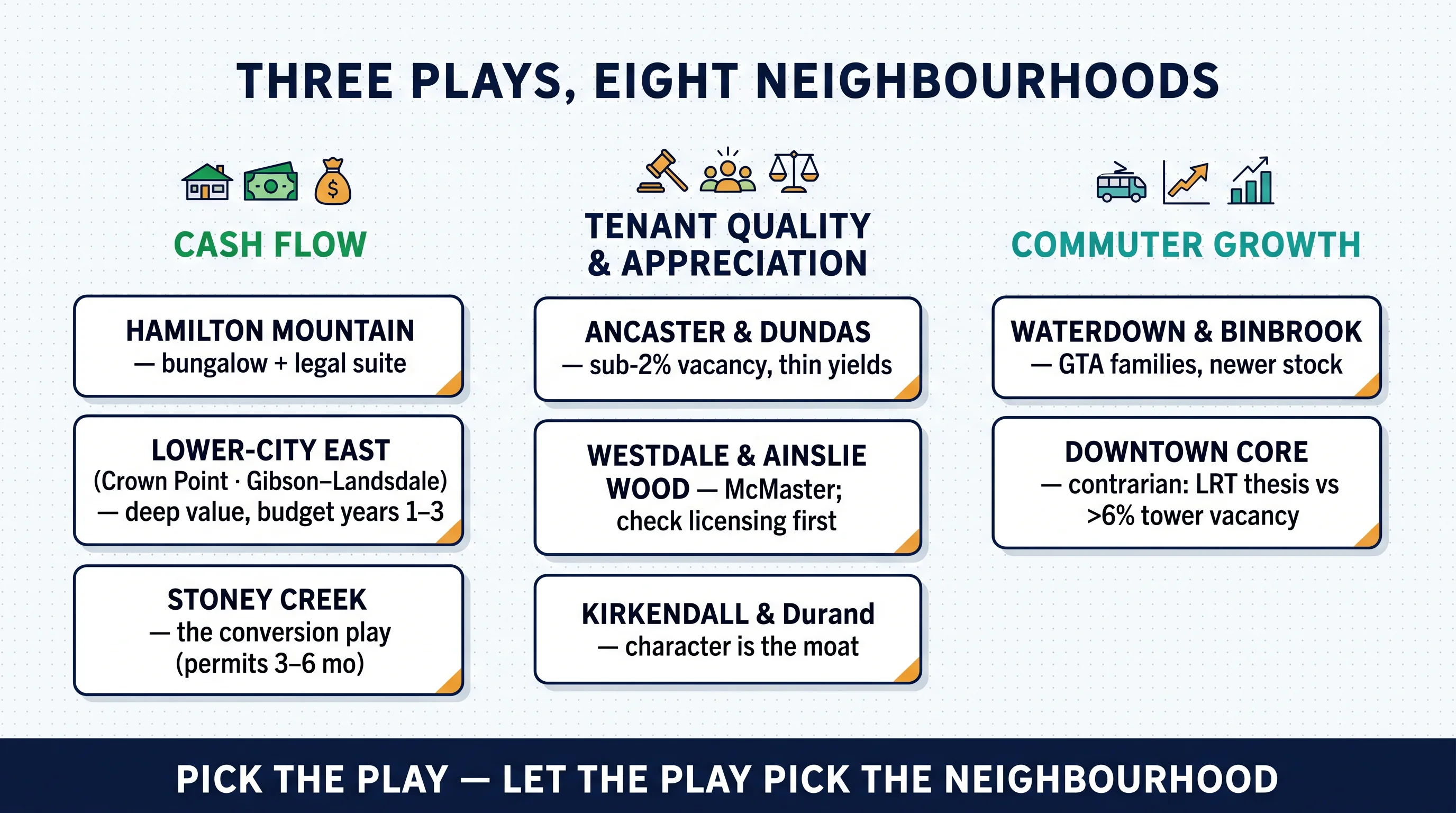
Hamilton's investment map sorts into three locally documented plays. Pick the play; let the play pick the neighbourhood.
The cash-flow play
1. Hamilton Mountain — the workhorse. Brick bungalows and side-splits, family and service-sector tenants, a locally quoted average two-bedroom around $2,050 — and the classic move: the bungalow with a legal basement suite. Yield with moderate complexity.
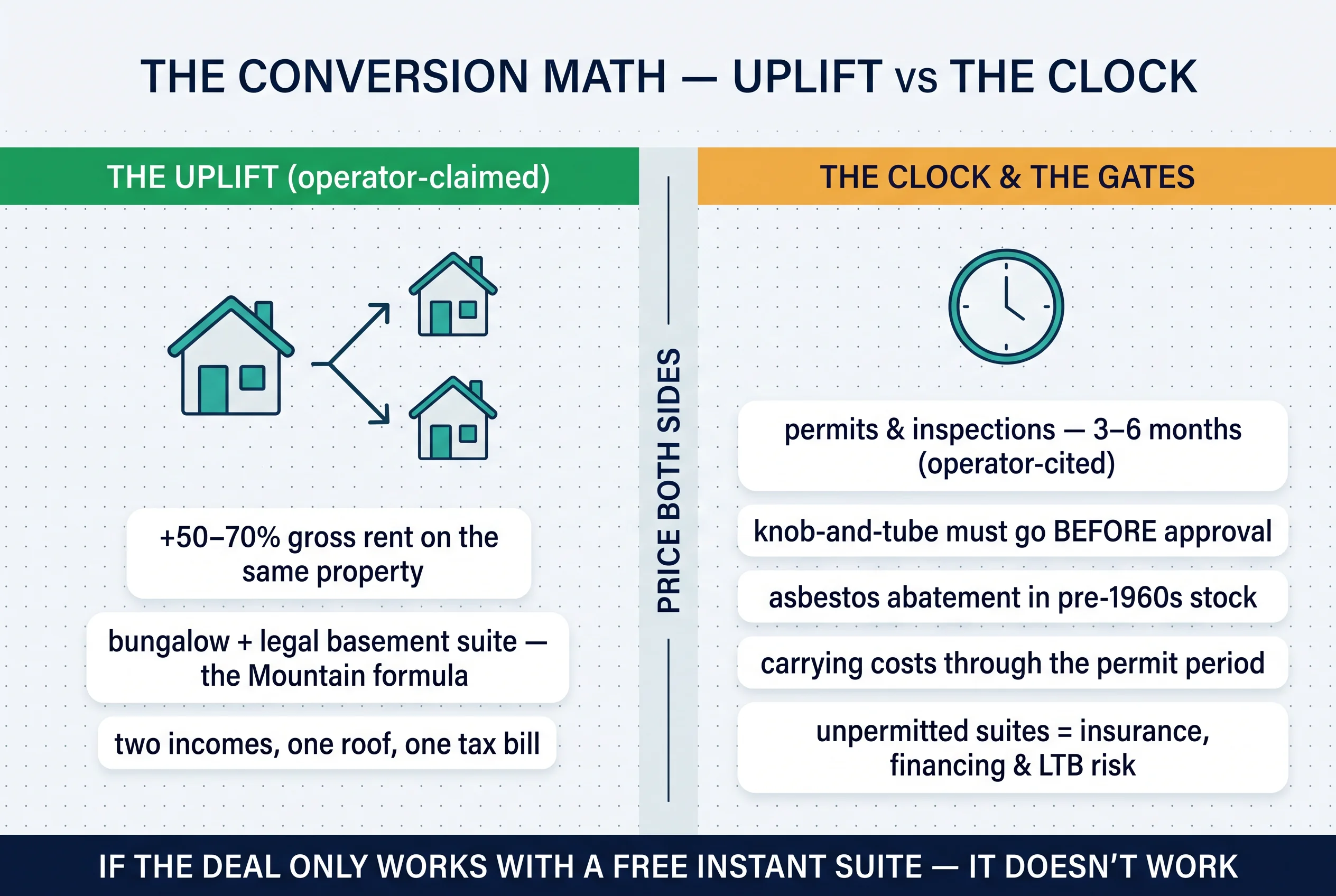
2. Stoney Creek — the conversion play. Detached and semi-detached stock that supports legal basement-suite conversions — operators claim 50–70% more gross rent on the same property. The honest clock: permits and inspections run 3–6 months per those same operators, and pre-1970s knob-and-tube wiring must be replaced before approval. Red Hill and QEW access now; Confederation GO coming.
3. Lower-city east (Crown Point, Gibson–Landsdale, Homeside) — deep value, eyes open. Entry prices run 25–40% below comparable Mountain or Stoney Creek two-units while rents don't fall proportionally — hence the region's best headline yields, with operators quoting up to ~5.8% gross on small multifamily. The ledger: pre-1960s stock means knob-and-tube, asbestos, and deferred capital work are common. The local advice worth taking literally: budget realistically for the first three years. Screening matters more here than in the suburbs.
The tenant-quality & appreciation play
4. Westdale & Ainslie Wood — the McMaster play. The most consistent student and academic rental market in the city, hospital adjacency, and premiums for legal multi-unit configurations — with two entry requirements before any offer: zoning, and whether the address sits in a rental-licensing area. The 2026 asterisk: student segments carry policy-shock exposure — Ottawa's Sandy Hill taught that lesson when temporary-resident inflows collapsed, and our Ottawa guide tells it in full.
5. Ancaster & Dundas — the quality end of the barbell. Highest prices, compressed cap rates (~4.2% quoted by operators), sub-2% vacancy, long tenures. Thin yield, durable demand.
6. Kirkendall & Durand — the character-professional play. Century homes near Locke Street, walkability, professional tenants. The moat is character — because the downtown towers above 6% vacancy are the competition for anything commodity, and a fourth identical one-bedroom is exactly what not to bring to that fight.
The commuter-growth play
7. Waterdown & Binbrook (and Flamborough) — the family-commuter pair. Newer stock — which means the post-November-2018 rent-control exemption is common, so sort every unit by regime before projecting increases — GTA-relocator tenants, long tenures, car-dependent living.
8. Downtown core (Beasley, Corktown) — the contrarian play. The LRT and West Harbour redevelopment thesis set against today's >6% new-tower vacancy: a trade for patient capital that prices the lease-up era honestly, not a momentum ride. Honourable mention: Grimsby, the wine-belt east, with entry pricing similar to east Hamilton.
The Hamilton Homework: Licensing, Permits, and Old Stock
Three layers of homework travel with a Hamilton purchase. First, rental licensing areas: the city has operated a rental-housing licensing pilot in wards around McMaster and the Mountain — before any offer, check whether the address falls in a licensing area and what a licence requires, and confirm the program's current status at hamilton.ca, since municipal programs evolve. Second, the conversion checklist: permits and inspections (operators cite 3–6 months), electrical (knob-and-tube blocks suite approval and complicates insurance and financing), and asbestos in pre-1960s stock — abatement belongs in the budget, not the surprise column, and an unpermitted suite is a liability wearing a yield costume.
Third, the Ontario base that travels province-wide: the 2.1% guideline for 2026 on Form N1 with 90 days' notice; the post-November-15-2018 exemption served on the N2; the standard lease; last-month's-rent-only deposits; no late fees; the $20 NSF cap — all documented in our Ontario LTB forms hub. Above-guideline application machinery exists for documented capital work. And the meta-rule this city teaches better than any other: verify every number — rent or regulation — against its source. If you're earlier in the journey, our first rental property guide and the complete first-timer's guide to becoming a landlord in Ontario cover the fundamentals, and the Toronto neighbourhoods guide runs this same method on the province's biggest market.
Practical Takeaways
- Sort every statistic by its measurement universe — turnover, asking, basket, survey — before it enters your spreadsheet.
- Underwrite with your own comps — last 30 days, same sub-market, same unit type. The workbook does the math.
- Pick your play — cash flow, tenant quality, or commuter growth — and let it pick the neighbourhood.
- Price the conversion clock — permits, rewiring, inspections — into year one, or the uplift was fiction.
- In old stock, budget the first three years honestly — roof, panel, abatement.
- Check licensing areas and zoning before the offer, not after.
- Re-read this page next quarter — absorption is a 2027–2028 story, and the figures refresh with the data.
The Hamilton Rental Deal Analyzer: Underwrite With Your Own Comps
The fill-in workbook for Hamilton buyers in a market whose data disagrees with itself — enter your own last-30-day comps, build a never-mix-universes rent roll, and see the paper cap rate against the honest one with years 1–3 capex and the conversion clock priced in.
Get Free PDF →Measure It Yourself
Hamilton in 2026 is a segmented market wearing a contradictory headline — tight where premium single-family and long-tenure families live, soft where new towers and old walk-ups compete, and noisy enough in its public data that the only trustworthy number is the one you measured yourself. The plays are documented: cash flow on the Mountain and in the east end, conversions in Stoney Creek done legally and on the real clock, students done properly in Westdale, quality in Ancaster and Dundas, patience downtown. The homework is knowable: licensing areas, permit clocks, old-stock diligence, and the regime sort on every unit. Figures July 2026, refreshed quarterly, with CMHC's absorption story running into 2027–2028; market data, not investment advice. Measure it yourself — then run the operation as carefully as you ran the analysis.
Buy It With Your Own Numbers. Run It With Real Ones.
Rent collection with instant receipts, per-unit books, and Ontario's rules built into every workflow — free for up to 3 units on Tenon10.
Free plan available • Tenants always free • Ontario compliance in code
Related Resources
The Cities & Markets series: Best Ontario Cities to Buy a Rental Property — where Hamilton sits in the provincial picture · Cap Rates & Average Rents Across Ontario Cities · Average Rents by Bedroom — the two-rents method, city by city · Best Ottawa Neighbourhoods and Best Toronto Neighbourhoods — the engine-matching method in two very different cities.
The rules underneath: Ontario Rent Increases 2026: The Complete N1 Guide · the N1 form and N2 for exempt units · the rent increase calculator · the Ontario LTB forms hub.
Getting started: Buying Your First Rental Property in Ontario · Becoming a Landlord in Ontario: The First-Timer's Guide.
Frequently Asked Questions
Where should I buy a rental property in Hamilton?
Pick your play first, because Hamilton's neighbourhoods sort cleanly into three locally documented strategies. For cash flow: Hamilton Mountain's bungalow-plus-basement-suite formula and the lower-city east end's deep-value duplexes, where entry prices run 25–40% below comparable Mountain properties and operators quote the region's best gross yields. For tenant quality and appreciation: Ancaster, Dundas, and Westdale, where premium single-family vacancy runs under 2% and tenures are long, at compressed cap rates. For commuter growth: Waterdown, Binbrook, and Stoney Creek, riding GTA migration and the GO expansion. Each play carries its own homework — old-stock capex in the east end, permit clocks on conversions, licensing checks near McMaster — and in a market whose public data openly disagrees with itself, the neighbourhood matters less than the discipline: underwrite from your own comps, not a citywide headline. Market data, not investment advice.
Is east Hamilton a good place to buy a rental property?
It can deliver the region's best headline yields — if you buy it with the first three years priced in. Entry prices on two-unit properties in the lower-city east run 25–40% below comparable Mountain or Stoney Creek equivalents while rents don't fall proportionally, which is why operators quote gross cap rates up to about 5.8% on small multifamily there. The honest ledger: much of the stock is pre-1960s, so knob-and-tube wiring, asbestos, and deferred capital work are common — local managers' advice is to budget realistically for the first three years of ownership, and tenant screening matters more than in the suburbs. A duplex whose spreadsheet shows a 5.8% yield but whose panel, roof, and abatement turn year one cash-flow negative is still a fine buy — if that's the deal you knew you were making. Walk it with a contractor, price the capex, and the east end rewards discipline.
Why do Hamilton rent statistics contradict each other?
Because they measure different universes — and once you see that, the contradictions dissolve. In the same season you could read that Hamilton rents rose 12.9% (one property manager's turnover-rent series: new leases signed on their own managed units) and that two-bedroom asking rents fell 5.1% to a $1,992 median (a citywide scrape of all listings), while another platform showed a $1,795 average on a different property basket, and CMHC's survey — which measures what sitting tenants actually pay, most of them under rent control — projected roughly $1,700 for a two-bedroom. All four can be true simultaneously. The practical rule: never mix universes in one spreadsheet. Underwrite sitting units at survey-style rents, vacant units at current asking from your own last-30-day comps, and treat any single headline — up or down — as a description of its universe, not of your building.
Is a basement suite conversion worth it in Hamilton?
The uplift is real and so is the clock. Local operators report that converting a detached or semi in areas like Stoney Creek into a legal two-unit adds 50–70% more gross rent on the same property — which is why the bungalow-plus-suite formula is the Mountain's classic play. The gates to price in: conversion permits and inspections typically run three to six months per local operators, pre-1970s houses often need knob-and-tube wiring fully replaced before a secondary suite is approved, and unpermitted suites create insurance, financing, and LTB problems that erase the uplift. Run the math with the conversion costs and the permit-period carrying costs inside year one — if the deal only works with a free instant suite, it doesn't work. Done legally, the conversion is one of Hamilton's most reliable value-adds; done informally, it's a liability wearing a yield costume.
What rules should Hamilton landlords check before buying?
Three layers. First, the Ontario base that travels province-wide: the 2.1% guideline for 2026 on Form N1 with 90 days' notice for rent-controlled units, the post-November-15-2018 exemption for newer stock (Form N2 territory), the standard lease, last-month's-rent-only deposits, no late fees, and the $20 NSF cap — and note that published guides circulate wrong guideline numbers, so verify against the province. Second, the Hamilton layer: the city has operated a rental-housing licensing pilot in wards around McMaster and the Mountain, so check whether your address falls in a licensing area and what a licence requires — confirm the program's current status at hamilton.ca — and treat zoning and permit requirements for any multi-unit plan as pre-offer diligence. Third, the building layer: in older stock, electrical, asbestos, and fire-separation requirements determine whether your rental plan is legal at all. Rules change; check the sources at purchase and again at each turnover.
This article presents Hamilton rental market data current as of July 13, 2026 and is refreshed quarterly; CMHC's outlook has supply absorption running into 2027–2028, so figures will move. It provides market information for educational purposes, not investment, legal, or tax advice. Figures are drawn from CMHC (2025 Rental Market Survey; 2026 Housing Market Outlook), listing-platform asking rents (April–June 2026), and Hamilton market participants; cap rates, conversion uplift, permit timelines, lease-up medians, and segment vacancy splits are operator claims, presented as such — verify against your own quotes and comps. Confirm the City of Hamilton's rental-licensing program status at hamilton.ca and all zoning and permit requirements with the city before purchasing, and consult licensed professionals — realtor, inspector, electrician, accountant, lawyer — before making investment decisions.


