

London gives Ontario investors something Toronto can't: homes 40 to 50% cheaper, with local operators quoting gross cap rates of 6 to 7%. But the same duplex can be a great buy or a mediocre one depending on a single question most out-of-town buyers never ask — which school does it serve? London is really two student markets wearing one city's name. Western University's roughly 34,000 students pull demand into Old North, Masonville, and Richmond Row at a premium; Fanshawe College pulls a different, more affordable, more international tenant pool into the north and east ends. Buy near the wrong campus expecting the other one's rent and the pro forma breaks.
Layer on London's near-top-of-province property-tax rate — a cheap home is not a cheap tax bill — and the value market needs more discipline than its price tags suggest. This guide sorts London the way an investor should: the two-university split, the value-plus-tax math, eight neighbourhoods across three plays (student, cash-flow value, family-commuter), and the London homework — the campus match, the tax bite, old-stock diligence, and the regime sort. Figures are dated July 2026 and refreshed quarterly; this is market data, not investment advice.
The London Rental Neighbourhood Scorecard: Match the Campus, Price the Bill
The fill-in scorecard for London buyers — match every candidate address to the right campus, rank the three plays, and compute the real dollar tax bill before the cheap sticker fools you.
Get Free PDF →Two Universities, Two Markets: London's Signature Split
London's rental demand splits cleanly by institution, and the split decides everything downstream. Western University, with roughly 34,000 students, drives Old North, Masonville, and Richmond Row, where campus-proximity units command a 15–25% premium over citywide and per-room rents near campus run about $600–900. Fanshawe College — rapidly expanding, with heavy international enrolment — drives a different, more affordable tenant pool in the north and east ends, at lower achievable rents and different property price points.

So the useful question isn't "is London good for student rentals" — it's "which institution does this address realistically serve, and does its tenant pool and achievable rent match my pro forma." Western and Fanshawe are not interchangeable on price, tenant profile, or turnover, and a spreadsheet built on one campus's rents applied to the other's property will be wrong. There's a 2026 asterisk that makes the discipline matter more: international-student-visa changes have softened student demand, and CMHC explicitly flags Southwestern Ontario running the higher end of its 3–5% vacancy band because the region leaned hardest on non-permanent residents. This is the Ottawa Sandy Hill lesson our Ottawa neighbourhoods guide tells, in London dialect — price near-campus units to today's comps, not to 2022 memory. And keep the two rents in separate universes, the way our rents-by-bedroom guide teaches: CMHC's sitting two-bedroom sits near $1,500, while asking runs $1,800–$2,200 (against Toronto's $2,700–$3,100).
The Value Market — and Why Cheap Isn't Cheap
The value case is real and worth stating plainly: London homes run roughly 40–50% below comparable Toronto properties — an average around $640K and a benchmark near $562K as of spring 2026 — local operators quote gross cap rates of 6–7% (among the higher big-city quotes in the province), and 2026 is a buyer's market with elevated inventory that hands buyers negotiating leverage. Those are market-participant figures, so verify them against your own analysis, but the direction is clear: London is Southwestern Ontario's affordability play.
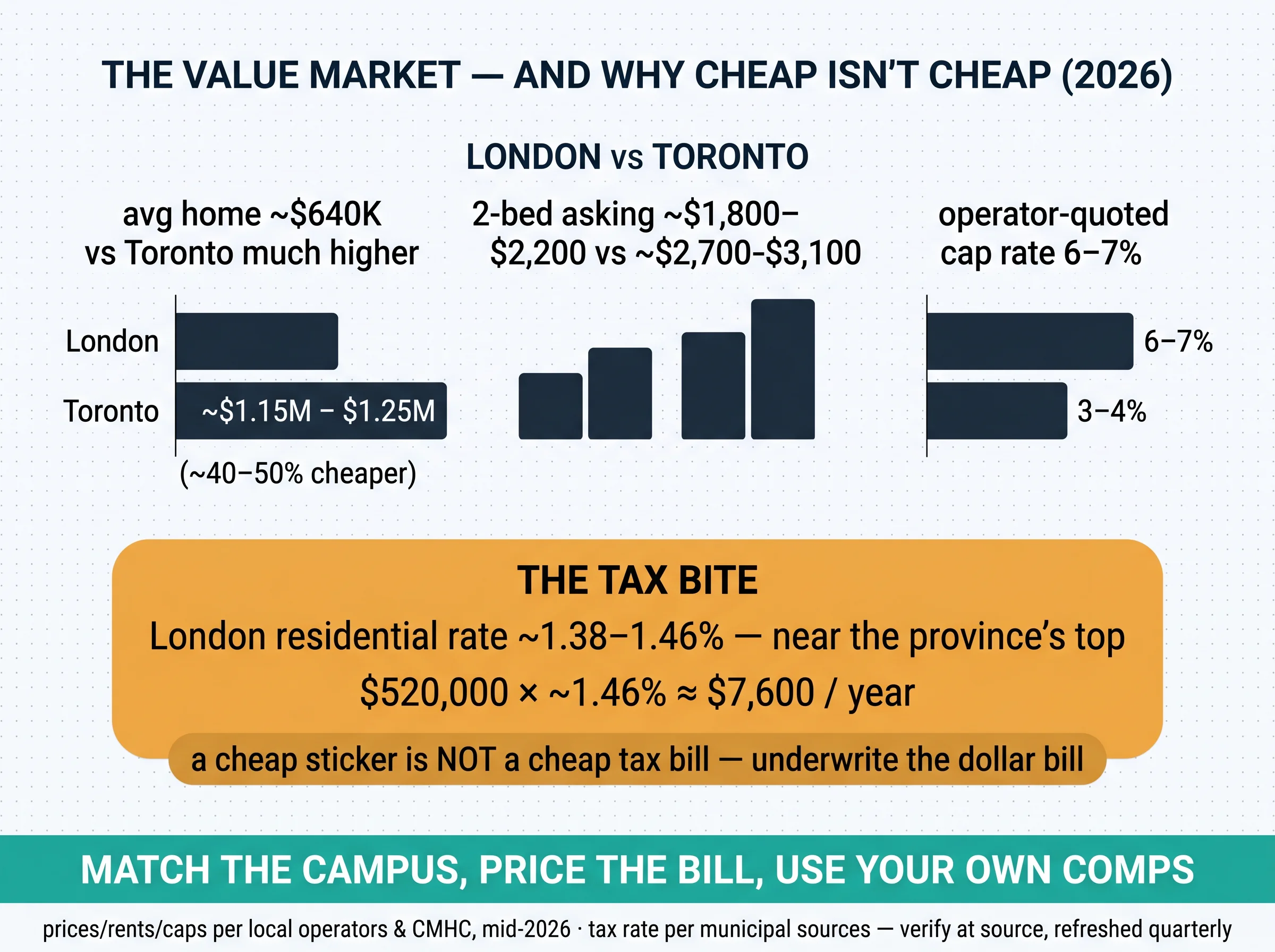
Here's the discipline the price tags don't advertise. London's residential property-tax rate runs about 1.38 to 1.46% — near the top of the province. So the cheap sticker hides a real dollar bill: on a $520K duplex, a roughly 1.46% rate is about $7,600 a year, which is subtracted in net operating income and meaningfully dents that 6–7% cap. The rate-versus-bill lesson from our property-tax rates guide bites hardest exactly here, where homes are cheap and rates are high — underwrite the dollar bill, not the sticker, the same way you'd feed the tax line into a cap-rate calculation. Under the value sits a genuinely diversified engine: Western and Fanshawe, London Health Sciences Centre and St. Joseph's (a healthcare hub that anchors stable year-round demand), GTA-spillover and remote-work migration, and downtown purpose-built construction. A younger-skewing city rents at higher rates structurally, which is part of why London earns its place in our best Ontario cities ranking.
Eight Neighbourhoods, Three Plays
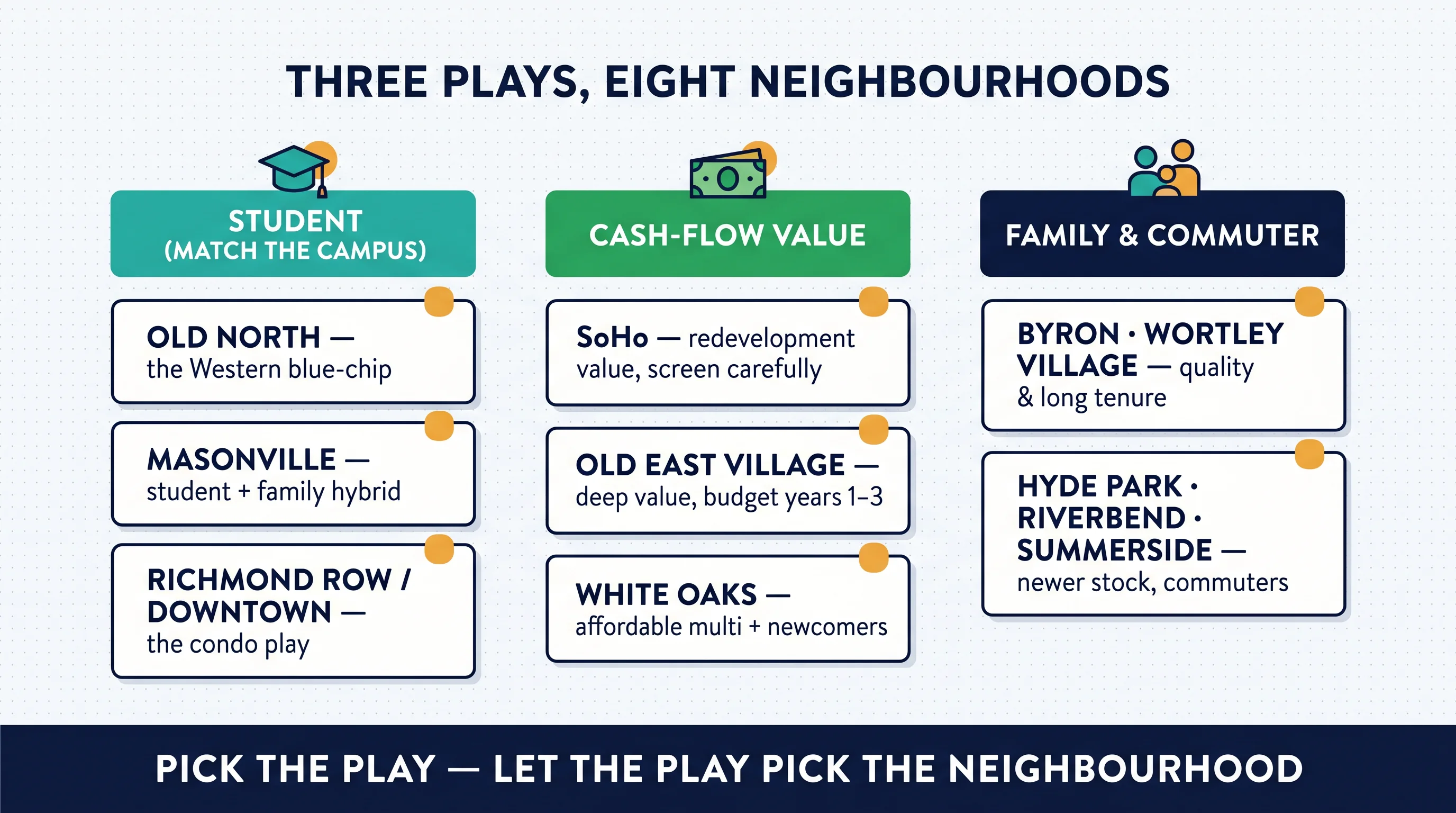
London's investment map sorts into three plays. Pick the play; let the play pick the neighbourhood.
The student play — match the campus
1. Old North — the Western blue-chip. Victorian and Edwardian character between downtown and Western's Richmond Gates, walk to campus and St. Joseph's, Gibbons and Doidge parks; the premium student-plus-faculty pocket where character is the moat. Higher entry, and the old stock means knob-and-tube and capex diligence — the Hamilton lesson in London dialect.
2. Masonville / North London — the hybrid. Borders Western's north edge and University Hospital; Masonville Place, top-rated schools (Masonville Public ranks in Ontario's top ~2%), strong transit. It serves both a student pool and a family/empty-nester pool — versatile, but pricier north-end entry.
3. Richmond Row / Downtown — the condo play. The Richmond-and-Dundas transit hub, Victoria Park, nightlife, and heavy new-condo development at more competitive pricing than the north end. Serves upper-year students and young professionals — but watch new-tower lease-up, since CMHC flags newer builds running the highest vacancy.

The cash-flow value play
4. SoHo — the redevelopment-value play. South of downtown, redeveloping, downtown proximity without the price tag, a younger demographic arriving. Budget entry with upside — but earlier-innings, so screen carefully and budget capex.
5. Old East Village / Hamilton Road — deep value, eyes open. Some of the city's most affordable stock and a creative community in OEV; London's version of Hamilton's lower-city east — best headline yields, oldest stock, budget the first years, and screening matters more.
6. White Oaks — affordable multi and newcomers. South London; 1970s–80s homes, high-rise apartments, and townhouse complexes around the White Oaks Mall transit hub; popular with newcomers and families; workable cash flow with older-apartment diligence.
The family & commuter play
7. Byron / Old South & Wortley Village — the tenant-quality play. Byron: family-oriented, Boler Mountain and Springbank, low crime, character homes. Wortley Village: a walkable heritage "main street" with professional tenants. Long tenures, thin-yield and durable-demand — London's Ancaster-and-Dundas analogue.
8. Hyde Park / Riverbend / West 5 / Summerside — newer stock, commuters. Northwest and southeast growth corridors with newer builds (post-November-2018 exemption common, so regime-sort every unit), West 5's sustainability focus, and Summerside's Highbury highway access for out-of-town commuters, drawing GTA-relocator families. Honourable mentions: Lambeth on the edge, and affluent Sunningdale in the north.

The London Homework: Campus Match, Tax, and Old Stock
Three pieces of homework travel with a London purchase. First, match the campus before the offer — confirm which institution the address realistically serves and what its tenant pool actually pays, because the wrong assumption is the most common London mistake. Second, the rules layer: London doesn't run a broad rental-licensing regime the way Hamilton's pilot does, but student-heavy areas near Western and Fanshawe draw property-standards attention, so confirm London's current rental-housing and property-standards rules — and any near-campus requirements — at london.ca before you offer, since municipal programs evolve.
Third, the tax and the old stock: put London's roughly 1.38–1.46% rate into the dollar bill, not the sticker, and in older near-campus homes budget electrical (knob-and-tube), permits, and deferred capex. And the Ontario base travels province-wide: the 2.1% guideline for 2026 on Form N1 with 90 days' notice, the post-November-15-2018 exemption served on the N2, the standard lease, last-month's-rent-only deposits, no late fees, and the $20 NSF cap — all in our Ontario LTB forms hub. Note the meta-rule this topic keeps teaching: some published London guides circulate the wrong guideline (you'll see 2.5%; it's 2.1%), so verify every number against its source, with the current machinery in our 2026 rent increase guide. If you're earlier in the journey, our guides to buying your first rental and becoming a landlord in Ontario cover the fundamentals, and the Hamilton guide runs the same old-stock diligence.
Practical Takeaways
- Match the campus first — Western premium or Fanshawe affordability — and let it pick the neighbourhood.
- Underwrite the dollar tax bill, not the cheap sticker — London's rate is near the province's top.
- Pick your play — student, cash-flow value, or family-commuter.
- Use your own last-30-day comps, and keep each rent headline in its own universe (sitting vs asking).
- In older near-campus stock, budget the first years honestly — wiring, permits, capex.
- Sort every unit by rent-control regime (pre- vs post-November 2018) before projecting increases.
- Re-read next quarter — student policy and the supply wave keep moving, and the figures refresh.
Quick win: run one candidate address through the neighbourhood scorecard tonight, campus match and tax bill included. Long-term: the discipline compounds every year you hold.
The London Rental Neighbourhood Scorecard: Match the Campus, Price the Bill
The fill-in scorecard for London buyers — match every candidate address to the right campus, rank the three plays, and compute the real dollar tax bill before the cheap sticker fools you.
Get Free PDF →Match the Campus, Price the Bill
London in 2026 is Southwestern Ontario's value-and-two-universities market — homes 40 to 50% cheaper than Toronto with operator-quoted 6 to 7% caps, but the yield only shows up if you match the campus, price the near-top-of-province tax into the dollar bill, and read the student-policy softening honestly. The plays are clear: student in Old North, Masonville, and Richmond Row; deep value in SoHo, Old East Village, and White Oaks; family and commuter stability in Byron, Wortley Village, and the newer northwest and southeast corridors. The homework is knowable: the campus match, the tax bite, old-stock diligence, the regime sort. Figures July 2026, refreshed quarterly; market data, not investment advice — match the campus, price the bill, then run the operation properly.
Match It, Price It, Then Run It Properly
Rent collection with instant receipts, per-unit books that track the deductible property-tax line, and Ontario's rules built into every workflow — free for up to 3 units on Tenon10.
Free plan available • Tenants always free • Ontario compliance in code
Related Resources
The Cities & Markets series: Best Ontario Cities to Buy a Rental Property — where London sits in the provincial picture · Property Tax Rates Across Ontario Cities — the rate-vs-bill method that makes London's tax bite real · Cap Rates & Average Rents and Average Rents by Bedroom · the sibling city guides for Ottawa, Hamilton, and Toronto.
The rules underneath: Ontario Rent Increases 2026: The Complete N1 Guide · the N1 form and N2 for exempt units · the rent increase calculator · the Ontario LTB forms hub.
Getting started: Buying Your First Rental Property in Ontario · Becoming a Landlord in Ontario: The First-Timer's Guide.
Frequently Asked Questions
Where should I buy a rental property in London, Ontario?
Start by matching the campus, because London is really two student markets in one city. For student rentals: Old North and Masonville serve Western University's roughly 34,000 students at a 15–25% premium, while the north and east ends serve Fanshawe College's more affordable, more international tenant pool — and the two are not interchangeable on rent or tenant profile. For cash-flow value: SoHo, Old East Village, and White Oaks offer the city's most affordable entry, where local operators quote the higher end of London's 6–7% cap-rate range, with older-stock diligence as the trade-off. For family and long tenure: Byron, Wortley Village, and the newer northwest and southeast corridors. Whichever play you pick, underwrite the dollar property-tax bill rather than the cheap sticker — London's rate runs near the top of the province — and use your own comps, not a citywide headline. Market data, not investment advice.
Is London, Ontario a good place to buy a rental property?
It can be, with two disciplines the price tags don't advertise. The case is real: homes run roughly 40–50% below comparable Toronto properties, local operators quote gross cap rates of 6–7%, and 2026 is a buyer's market with elevated inventory that gives you negotiating leverage — all supported by Western, Fanshawe, a major hospital sector, and steady GTA-spillover migration. The two disciplines: first, London's residential property-tax rate is near the highest among Ontario's big cities (around 1.4%), so a cheap home is not a cheap tax bill, and the annual dollar amount can meaningfully dent that 6–7% cap; second, the student segment carries policy-shock exposure — international-student-visa changes have softened demand, and CMHC flags Southwestern Ontario running higher vacancy for exactly that reason. Underwrite the dollar bill, match the campus, price the softening honestly, and London rewards the discipline.
Is a student rental near Western University a good investment?
It's London's highest-demand rental segment and its most policy-exposed one — both at once. Western's roughly 34,000 students anchor a genuinely deep rental market in Old North, Masonville, and Richmond Row, where campus-proximity units command a 15–25% premium and per-room rents near campus run about $600–900. But the same international-student-visa changes softening demand across Southwestern Ontario land hardest on the student segment, so a near-campus unit that leased in a week in 2022 may sit longer in 2026 — price to today's comps, not to peak-year memory. Two more cautions: much of the near-campus stock is older, so budget for wiring, permits, and deferred capital work; and the academic calendar drives turnover, so coordinate leases around it. Done with eyes open, the Western market is deep and durable; done on 2022 assumptions, it disappoints.
What's the difference between buying near Western versus Fanshawe?
They're different markets, and mixing them up is the most common London investing mistake. Western University draws a larger, higher-paying student and faculty pool into Old North, Masonville, and Richmond Row, commanding the 15–25% campus premium and the higher per-room rents. Fanshawe College, in the north and east ends, draws a more affordable, heavily international tenant pool, with correspondingly lower achievable rents and different property price points. Neither is better as an investment — but the tenant profile, the achievable rent, the turnover pattern, and the entry price all differ, so a pro forma built on Western rents applied to a Fanshawe-area property (or vice versa) will be wrong. Confirm which institution an address realistically serves before you write an offer, and build the numbers on that campus's actual comps.
What rules should London landlords check before buying?
Three layers. First, the Ontario base that travels province-wide: the 2.1% guideline for 2026 on Form N1 with 90 days' notice for rent-controlled units, the post-November-15-2018 exemption for newer stock (Form N2 territory), the standard lease, last-month's-rent-only deposits, no late fees, and the $20 NSF cap — and note that some published London guides circulate the wrong guideline figure, so verify against the province. Second, the London layer: the city doesn't run a broad rental-licensing regime the way Hamilton's pilot does, but student-heavy areas near Western and Fanshawe draw property-standards attention, so confirm London's current rental-housing and property-standards rules at london.ca, and treat any near-campus requirements as pre-offer diligence. Third, the building layer: in older near-campus stock, electrical, permits, and fire-separation requirements determine whether your rental plan is legal at all. Rules change; check the sources at purchase and again at each turnover.
This article presents London rental market data current as of July 14, 2026 and is refreshed quarterly. It provides market information for educational purposes, not investment, legal, or tax advice. Figures are drawn from CMHC (2025 Rental Market Survey; 2026 Housing Market Outlook) and local market participants; cap rates, per-room rents, price discounts, and the campus premium are operator claims, presented as such — verify against your own comps and quotes. Confirm London's current rental-housing and property-standards rules at london.ca, the 2026 rent guideline and exemptions with the Province of Ontario, and the property-tax rate with the City of London before relying on them, and consult licensed professionals — realtor, inspector, accountant, lawyer — before making investment decisions.


