

A condo that listed for $525,000 at Toronto's 2022 peak is on the market today around $399,000 — and most of the landlords looking at it are asking the wrong question. Toronto isn't one rental market. It's four districts and 158 neighbourhoods, with a $500–800 monthly spread on essentially identical one-bedrooms — and in 2026 the real question flipped from "which condo tower" to "which lot, on which corridor, with how many units on it."
The neighbourhood lists you'll find elsewhere are buyer-lifestyle guides and realtor forecast pages. None of them score zones the way a landlord has to: by strategy fit, tenant profile, achievable rents in both rent series, and the density toolkit the city quietly handed property owners while everyone watched condo prices fall. This is the landlord's map — six zones strategy-matched with sourced-and-dated figures, the EHON multiplex rewrite of what a Toronto lot can earn, the Toronto-only rules stack (MLTT, VHT, licensing), and honest verdicts, including the pockets where the answer is "not at that price." It sits on the Ontario cities scorecard and pulls its yield language from the cap-rate data page. General information, not investment advice — every figure carries its date.
The Toronto Block Test: 20 Due-Diligence Checks Before You Buy in Any Neighbourhood
Run any Toronto pocket — Scarborough to the core — through the landlord's due-diligence sequence: both rent series, the density toolkit, the Toronto rules stack, and the offer math, before a dollar moves.
Get Free PDF →The 2026 Toronto Frame: The Correction, the Window, and the Flip
The correction, at street level. Toronto condos sit roughly 25% below their 2022 peak — the $525K-to-$399K listing isn't an outlier, it's the pattern — and the sellers are disproportionately investor-owners whose 2020–22 purchase math broke when rates rose and rents softened. The buyers are end-users and disciplined landlords, negotiating like it's a buyer's market because it is one: sellers accepting around 96% of asking, home inspections back in offers, closings running as long as 120 days. Detached homes average $1.3–1.6 million citywide, with the Bank of Canada holding at 2.25% since its April 29 decision. If you're new to the purchase process itself, our first rental property guide covers the mechanics this piece assumes.
Rents, in both series. Asking rents — the fast, noisy series — are falling: Toronto's all-type average sat at $2,411 in July 2026 (Zumper), down 4% year-over-year, with one-bedroom askings off 6.5% and two-bedrooms off 9.1% through the most recent annual data. The occupied-stock series — what sitting tenants actually pay — runs near $2,046 for a two-bedroom (CMHC, October 2025), and citywide vacancy printed 3.0%, the loosest since the pandemic. The convergence we documented on the data page is happening at home: askings falling toward occupied averages. And underneath both series sits the spread this article exists to map — $500–800 a month between suburb and core on comparable one-bedrooms.
The window has an expiry date. Condo starts have collapsed, and what isn't breaking ground now doesn't arrive as supply for three to four years — meaning today's soft rents and buyer-friendly mechanics are cyclical, not permanent. Treat that as a reason for discipline rather than hurry, and treat forecasts with dates attached: a December 2025 guide confidently projected 4–6% rent growth for 2026 with "no signs of cooling," and the market falsified it within months. Undated numbers are rumours; dated wrong numbers are warnings.
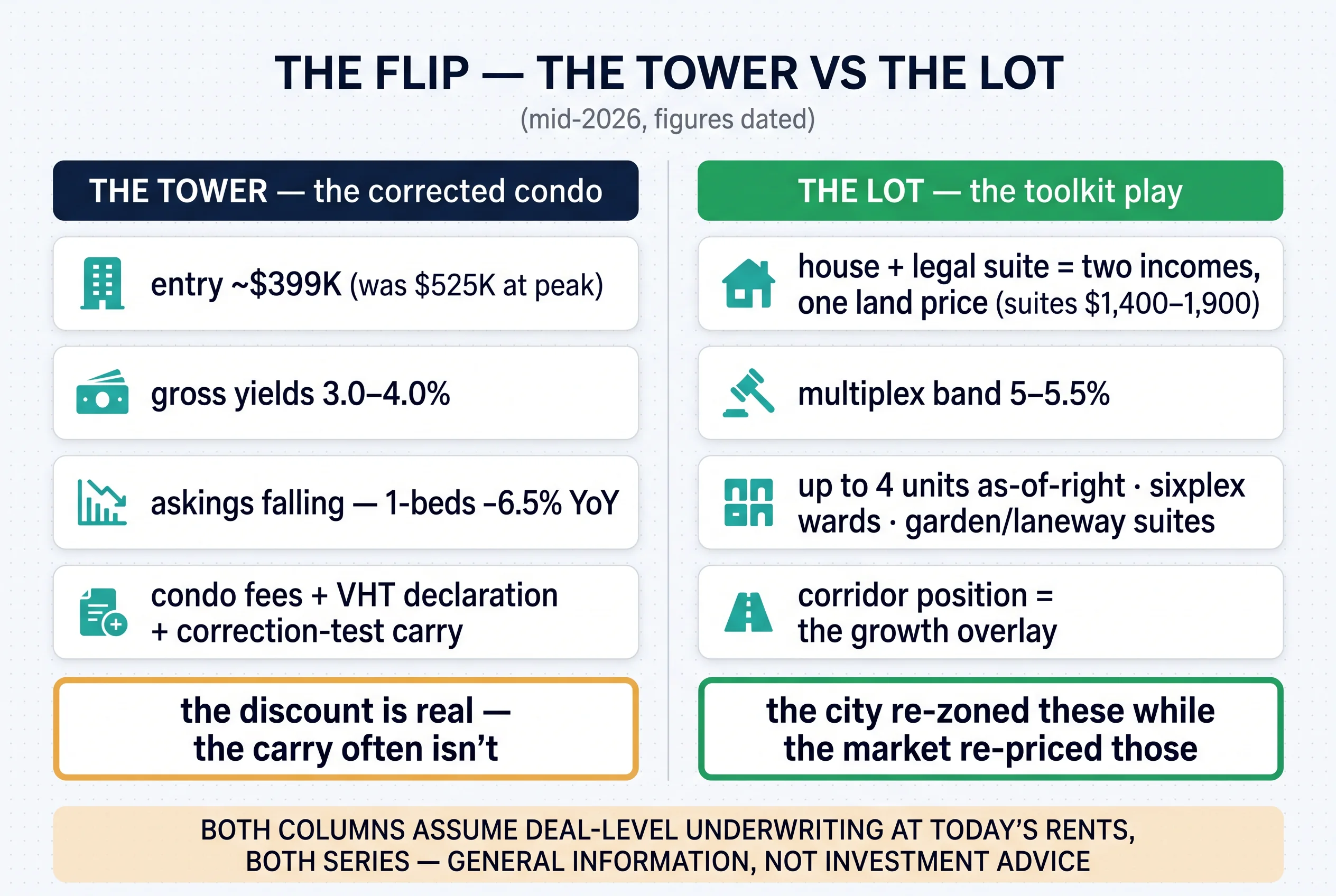
And the flip this whole piece is built on: with downtown condo gross yields compressed to 3.0–4.0% and the classic $800K-condo carry math broken, Toronto's 2026 landlord opportunity moved from the tower to the lot. Multiplex zoning, sixplex wards, garden and laneway suites, and legal citywide rooming houses changed what an ordinary residential lot can lawfully earn — the details of which are a section of their own below, and the legal backdrop of which (including this year's provincial changes) lives in our 2026 rental law guide.
The Zones: Six Areas, Matched to Strategy
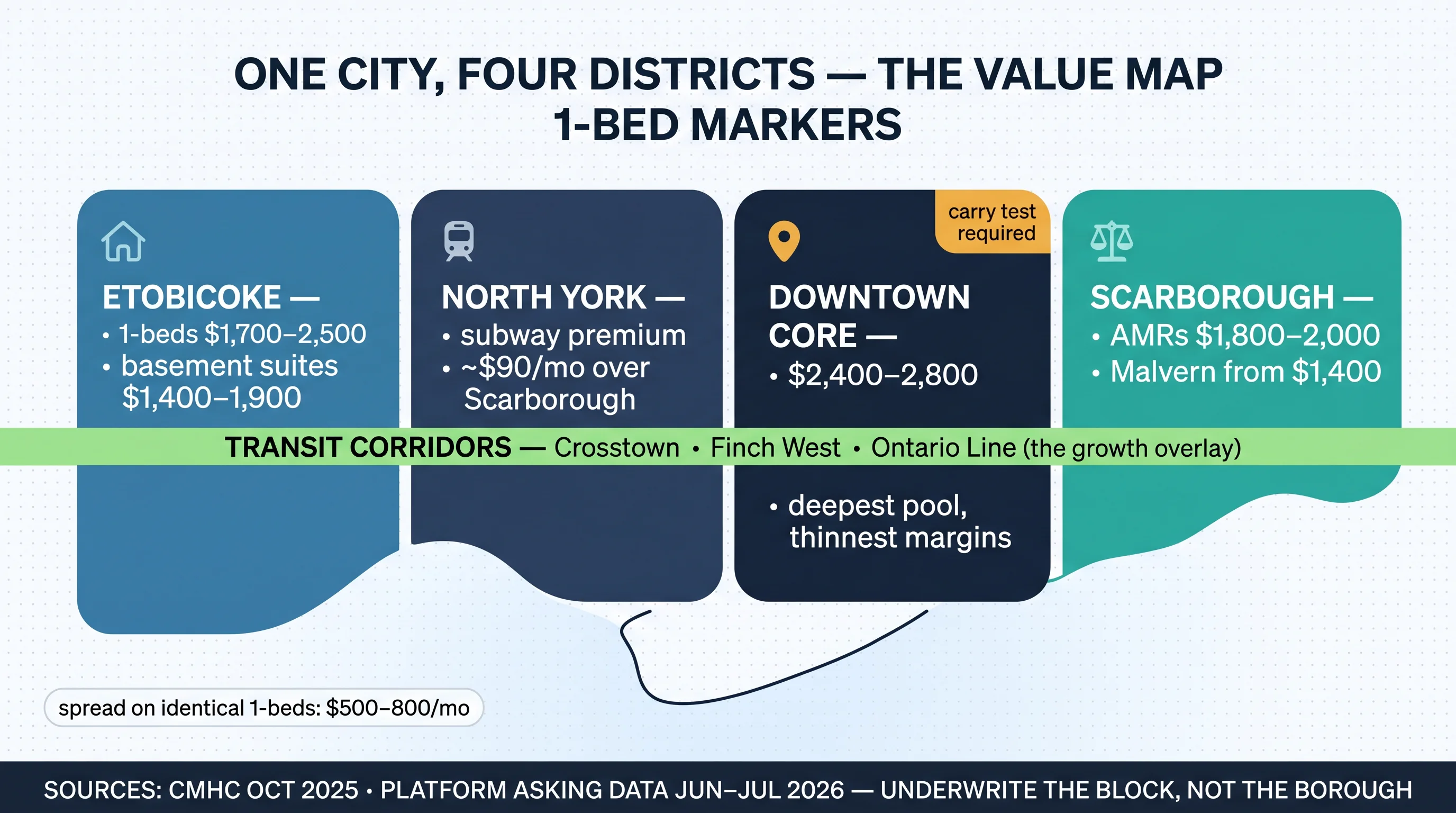
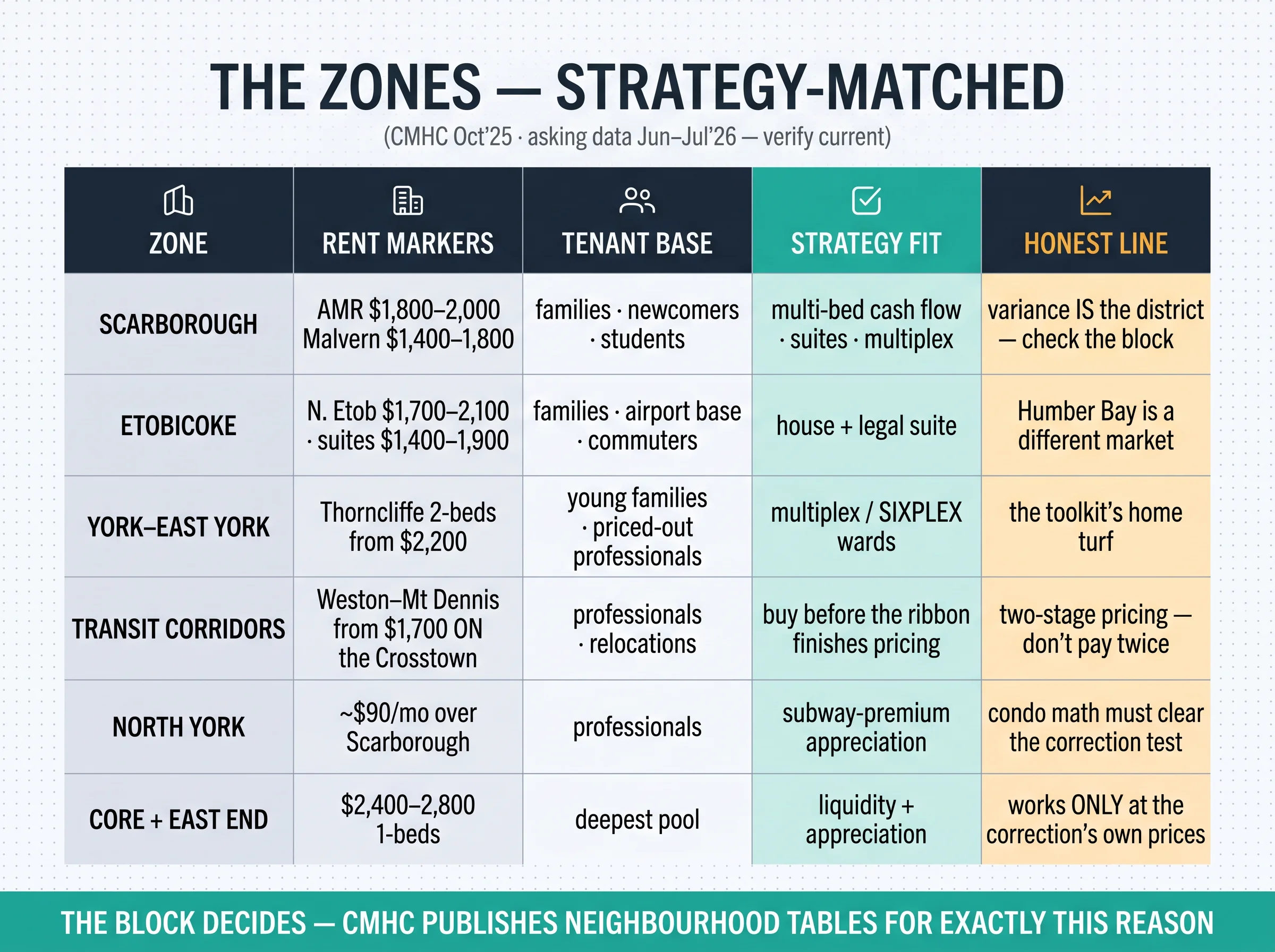
Scarborough — the cash-flow district. District average market rents run $1,800–2,000, with pockets like Malvern listing one-bedrooms at $1,400–1,800 — against the city's most accessible entry prices. The tenant base is durable and multi-generational: families, newcomers, and students around UTSC and Centennial, favouring multi-bedroom layouts over polished studios. Subway-extension connectivity is improving the long-term story, and gentrifying pockets are gaining. The honest line: variance is the district's defining feature. Conditions change block by block, which is exactly why CMHC publishes neighbourhood-level rent and vacancy tables for Toronto — pull the exact zone before you offer. Strategy fit: multi-bed cash flow, legal secondary suites, multiplex conversions.
Etobicoke — the secondary-suite district. North Etobicoke one-bedrooms run $1,700–2,100, and the real story is inside the detached stock: legal basement suites renting $1,400–1,900 — a second income on the same land price. Long Branch (one-beds $1,900–2,200, with a GO station inside the neighbourhood), New Toronto, and Alderwood are the value pockets; Humber Bay Shores is a different, premium condo market and should be underwritten as one; Rexdale lists from $1,600 on the strength of the Pearson employment base. Strategy fit: house-plus-legal-suite, duplex conversion.
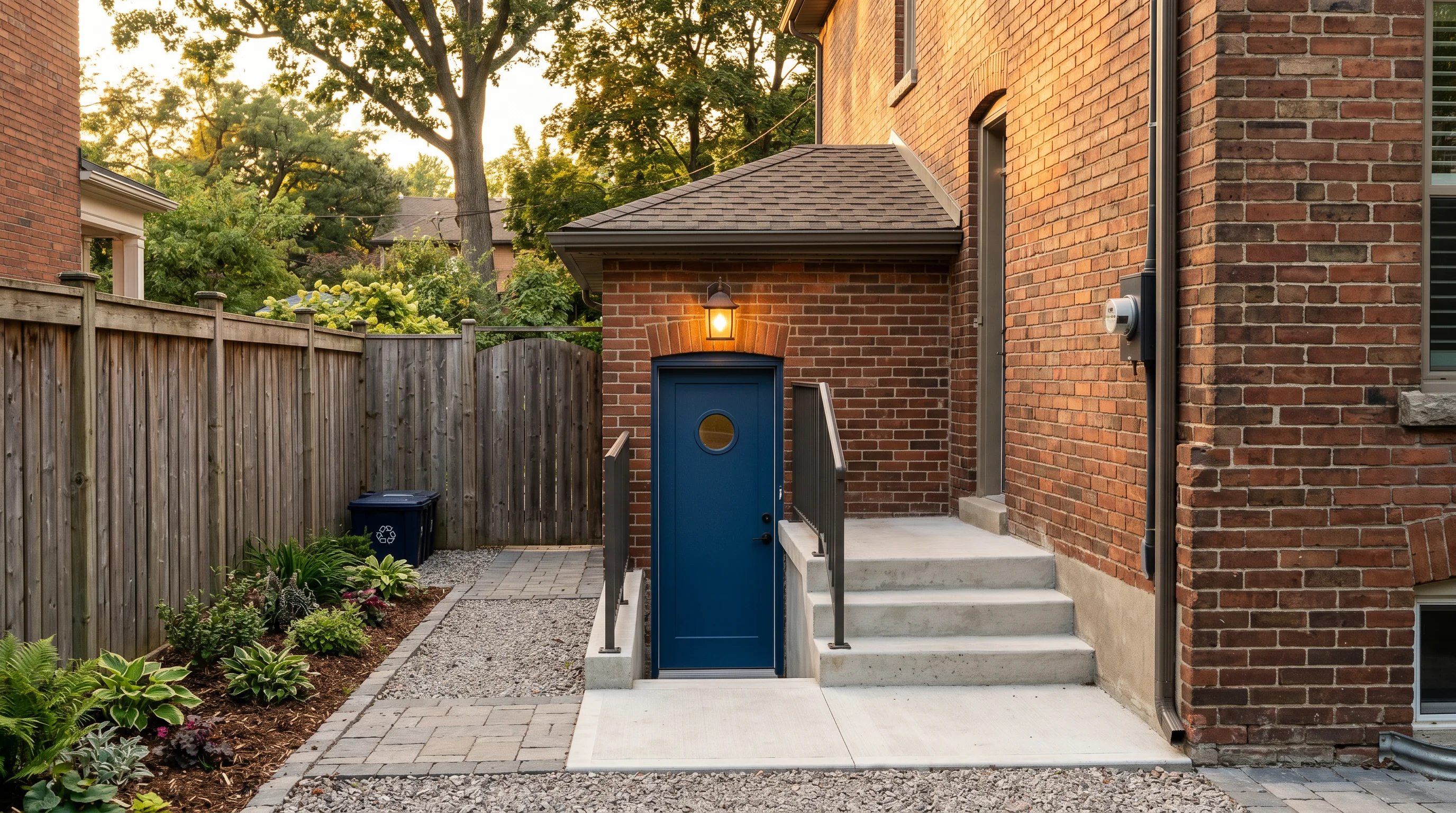
York–East York — the gentrification corridor. Close-to-downtown pricing at a discount, with East York, Corso Italia, and Oakwood all named among the city's gentrifying areas, Thorncliffe Park's family two-bedrooms from $2,200, and — decisively for landlords — the sixplex-approved wards concentrating here. Tenants: young families and professionals priced out of the core. Strategy fit: multiplex and sixplex plays on wide lots. This is the density toolkit's home turf.
The transit corridors — the growth overlay that crosses every district. Weston–Mount Dennis lists one-bedrooms from $1,700 on the Eglinton Crosstown; the Finch West LRT turned Elms–Old Rexdale from an overlooked edge market into a connected growth zone with a transit score of 78; the Ontario Line path is repricing blocks along its route. Corridors price in two stages — announcement and opening — and the discipline is not paying twice for the same premium. (A dedicated transit-line guide is coming in this series.)
North York — the subway premium. About $90 a month above Scarborough on comparable one-bedrooms, with newer condo inventory clustered at redevelopment nodes and a professional tenant base. It's the appreciation-lean district — and any condo purchase here must clear the same correction test as downtown's.
Downtown core and the East End — the liquidity tier and the character tier. Core one-bedrooms rent at $2,400–2,800 to the deepest tenant pool in the country with the fastest re-leasing — and yields compressed to match, which is why this is where the negative-carry stories live. Leslieville and the East End offer walkable character stock, freeholds, and boutique condos for the strategy that wants both. The honest verdict on the whole tier: the $399K condo works only where the carry clears at today's rents — the correction is the entry, not the thesis.
Two composites make the map concrete. The $399K question: an investor buys the corrected condo for the discount — and at roughly $2,100 achievable rent, condo fees, and today's financing, the carry still runs negative; the same capital as a down payment on a Scarborough semi with a legal basement suite carries positive. The discount was real; the thesis was the lot. The corridor buy: a landlord picks up a tired Weston–Mount Dennis bungalow at pre-opening pricing on the Crosstown, adds a garden suite under the citywide permissions, and holds two incomes on a lot the transit map is still repricing. Both are illustrations, not recommendations — the yield bands they lean on are tabulated, with dates, on the data page, and the financing ladder behind them lives in the portfolio-scaling guide.
The Density Toolkit: What a Toronto Lot Can Earn Now
This is the section other neighbourhood lists don't write, and it's the one that changed the answer key. Under the Expanding Housing Options in Neighbourhoods (EHON) program, Toronto permits multiplexes — up to four units — as-of-right on residential lots citywide, with sixplexes approved in designated wards and an opt-in path for others, plus garden suites and laneway suites permitted across the city. Separately, multi-tenant (rooming) houses are now legal citywide under a licensing framework: licence, per-unit standards, inspections, renewals — a high-yield strategy with real compliance overhead. Verify the current program status, ward lists, and licensing requirements for any specific address at toronto.ca before an offer depends on them; these programs evolve.
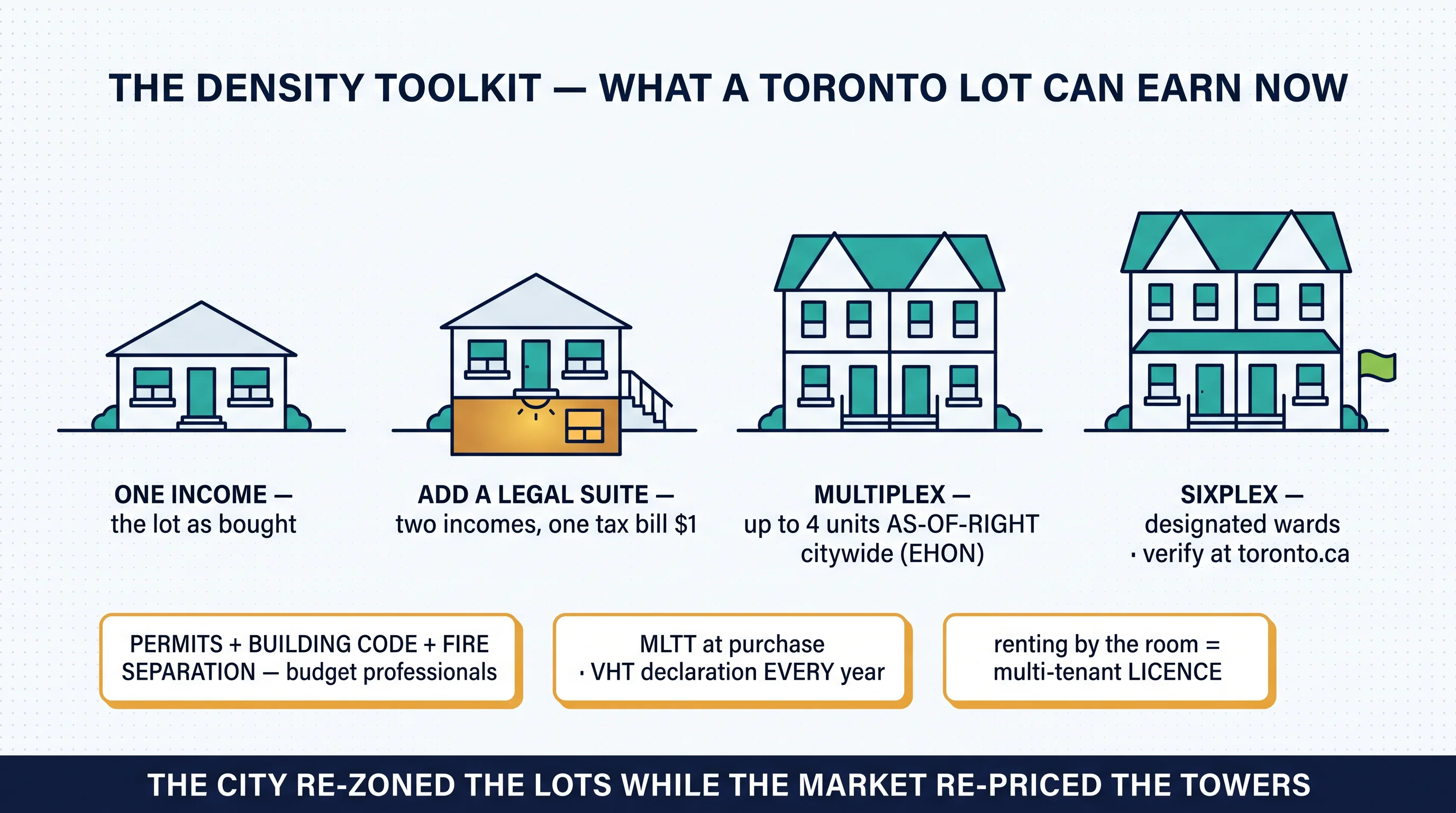
The conversion math, taught honestly: a detached house with a legal basement suite is two incomes on one tax bill; a multiplex conversion moves a lot from condo-tier yields (3.0–4.0%) toward the small-multiplex band (5–5.5%) documented on our data page. And the caveats carry equal weight with the upside: conversions run through permits, the Ontario Building Code, fire separation, egress, and electrical requirements — budget professionals, not YouTube. A suite that isn't legal isn't an income; it's a liability with a tenant in it, and the duty to repair applies regardless of what the renovation cost. The sixplex-ward composite shows the disciplined version: a buyer prices an East York wide lot on today's duplex income and holds the sixplex zoning as a free option — sensible precisely because the today-income math already worked.
On top of the toolkit sits the Toronto rules stack, and it belongs in your offer price, not your closing surprise. At acquisition: the Municipal Land Transfer Tax — Toronto's second land-transfer tax, which the 905 doesn't charge. Annually: the Vacant Home Tax declaration, filed by every residential owner whether the property is occupied or not. By use: the multi-tenant licence if you rent by the room, and the short-term rental registry constraining Airbnb math (our short-term rental guide covers that layer). And the province-wide rule most often misstated: units first occupied on or before November 15, 2018 are guideline-capped — 2.1% for 2026 and 1.9% for 2027, served on an N1 per our 2026 rent-increase guide — while later-occupied units are exempt and use the N2. The exemption removes the cap, not the rules: the 90-day notice and the 12-month rule bind every increase on every unit, and market comps bind harder than either in a falling-asking year.
The Window: How to Act in It
The next 12–24 months, dated rather than predicted: completions from the last construction cycle are still landing, which keeps asking rents soft through 2026; behind them waits the three-to-four-year gap from collapsed starts; the corridors open in stages; and EHON expansion votes are upside optionality on lots that already work. The buyer-friendly mechanics — inspections, long closings, 96%-of-asking — won't outlive the supply gap.
The positioning considerations that follow from the map — considerations, not advice: underwrite at today's asking with a haircut and check both series; price the full Toronto stack into every offer; prefer lots with toolkit optionality (suite potential, multiplex width, corridor position) over single-use premium; run corridor buys on today's income rather than the ribbon-cutting's; and re-check EHON status for the specific address before any conversion-dependent bid. Then run the operation like the numbers deserve: vacancy weeks are the silent killer in a 3.0% market, and our turnover system, software guide, and records discipline are how the block's numbers survive contact with reality. Dedicated Toronto guides on multi-tenant licensing, condos, and the transit lines are coming in this series.
Practical Takeaways
- Pick the strategy, then the district, then THE BLOCK — and pull CMHC's neighbourhood table over any listicle, including this one.
- Run both rent series for the exact pocket: asking with a haircut for revenue, occupied averages for reality.
- Price the Toronto stack into the offer: MLTT at purchase, VHT declarations annually, licensing by use.
- Prefer toolkit lots — suite potential, multiplex width, corridor position — over single-use premium.
- Verify EHON/sixplex status for the specific address at toronto.ca before any conversion-dependent bid.
- State the unit's rent-control position (pre/post November 15, 2018) before projecting growth — 2.1%/1.9% on controlled stock, N2-with-rules on exempt.
- Re-run the numbers at every data release and before every offer.
Quick win tonight: pull the CMHC neighbourhood-level table for one target pocket and compare it against the asking listings you've been screenshotting. Long-term: build the conversion bench — designer, permit expediter, Code-literate contractor — before you find the lot that needs them. The buyer with the bench moves in weeks; the buyer without it watches the option expire.
The Toronto Block Test: 20 Due-Diligence Checks Before You Buy in Any Neighbourhood
Run any Toronto pocket — Scarborough to the core — through the landlord's due-diligence sequence: both rent series, the density toolkit, the Toronto rules stack, and the offer math, before a dollar moves.
Get Free PDF →The Block Decides, Not the Borough
Toronto isn't one market, and 2026 isn't one opportunity. Scarborough sells cash flow with variance; Etobicoke sells the basement-suite economy; York–East York sells the gentrification corridor and the sixplex wards; the transit map sells two-stage growth; North York sells the subway premium; and the core sells liquidity at yields that only clear at the correction's own prices. Over all of it sits the flip that matters: the city re-zoned its lots while the market re-priced its towers — and the landlords who win this window will be the ones who bought blocks and optionality, priced the Toronto stack honestly, and held every rent number to its series and its date. The block decides, not the borough. General information, not investment advice — bring your broker, your planner, and your own numbers.
Whichever Pocket Wins, the Operating Layer Is the Same
The Ontario Standard Lease, every LTB form with guided wizards, the rent-increase and termination calculators, and collection rails that build your ledger from day one — free on Tenon10.
Free • No signup required • Updated for the Bill 60 changes in force 21 Sep 2026
Related Resources
The Cities cluster: the Best Ontario Cities scorecard this map plugs into · the cap-rate and rent data page behind every yield figure here · coming in this series: the Toronto multi-tenant licensing guide, the condo-investment deep dive, and the transit-line corridor guide.
Buying and scaling: Becoming a Landlord in Ontario · Buying Your First Rental Property · How to Scale a Rental Portfolio · Pre-Construction Condos as Rentals.
The rules in the math: Rent Increases 2026 (N1 Guide) · Rent Increases 2027 · Ontario Rental Law Changes 2026 (Bill 60 & 97) · Short-Term Rentals in Ontario · The Ontario Standard Lease.
The operating layer: Tenant Turnover: Reducing Vacancy Days · Rent Collection at Scale · Property Management Software · CRA Audits of Rental Income · Maintenance Standards · Landlord Insurance.
Forms and tools: the Ontario LTB forms hub · Standard Lease · N1 and N2 · the rent increase calculator and termination date calculator.
Frequently Asked Questions
Can you still cash flow on a rental property in Toronto in 2026?
Yes — but almost never in the segment most people shop. Downtown condos carry gross yields around 3.0–4.0%, and at current prices with 2.25%-era financing the carry usually runs negative; that math is why investor-owners are supplying the listings. Where the numbers work is on the lot side: a detached or semi with a legal basement suite (suite rents run $1,400–1,900 across Etobicoke's established stock, with similar bands in Scarborough), small multiplexes trading in the 5–5.5% band, and multi-bed layouts serving family and newcomer tenants in the value districts. The structural reason is simple — two or more incomes on one land price, inside the detached stock Toronto has now zoned for up to four units as-of-right (and six in designated wards). Every figure here is as of mid-2026 and neighbourhood-specific: run the exact pocket's rents in both series (asking with a haircut, CMHC occupied for reality), price the Toronto stack (MLTT, VHT, licensing), and let the block's numbers — not the city's headlines — make the call. General information, not investment advice.
Is Scarborough good for rental property investment?
Scarborough is Toronto's cash-flow district by the numbers — district average market rents around $1,800–2,000, one-bedrooms in pockets like Malvern from $1,400–1,800, the city's most accessible entry prices, and a durable tenant base of families, newcomers, and students around UTSC and Centennial — with subway-extension connectivity improving the long-term story. The honest caveat is that variance is the district's defining feature: conditions change block by block, and a citywide or even district-wide average will mislead you in both directions. That's precisely why CMHC publishes neighbourhood-level rent and vacancy tables for Toronto — pull the exact zone before you offer, walk the block at different hours, and underwrite the specific address's achievable rent rather than the borough's reputation. For strategy fit: Scarborough rewards multi-bedroom cash-flow layouts, legal secondary suites, and multiplex conversions under the citywide four-unit permissions more than it rewards single condo units.
What did Toronto's multiplex and sixplex zoning actually change for landlords?
Under the Expanding Housing Options in Neighbourhoods (EHON) program, Toronto now permits multiplexes — up to four units — as-of-right on residential lots citywide, with sixplexes approved in designated wards and an opt-in path for others, plus garden suites and laneway suites permitted across the city. For a landlord, that rewrites what a lot can earn: a bungalow that was one income can lawfully become two (suite), three or four (multiplex), or — in the right ward — six, moving the property from condo-tier yields (3.0–4.0%) toward the small-multiplex band (5–5.5%). Two disciplines keep the opportunity honest. First, "permitted" isn't "free": conversions run through permits, the Ontario Building Code, fire separation, egress, and electrical requirements — budget real professionals. Second, verify the current rules for the specific address at toronto.ca before any conversion-dependent offer, because ward lists and program details evolve. Many buyers now price lots on today's income and treat the zoning as a free option — a sensible frame, provided the today-income math already works.
Should I buy a Toronto condo now that prices have corrected?
The correction is real — condos sit roughly 25% below their 2022 peak, and units that listed at $525,000 then can list around $399,000 now — but the discount and the broken carry math arrived together: rents softened most in exactly the segment that corrected most, so a cheaper condo at today's achievable rent, condo fees, and current financing can still run cash-flow-negative. The honest test: underwrite at today's asking rents with a haircut (Toronto one-bed askings average around $2,480 and have been falling ~6.5% year-over-year), add fees and a realistic vacancy allowance, and see whether the carry clears — the correction is an entry price, not a thesis. Where condos can fit: appreciation-and-liquidity strategies with strong reserves, an eye on the 3–4-year supply gap from collapsed condo starts, and buildings whose fee history and reserve funds survive diligence. Where they don't: cash-flow-first plans that the lot-side strategies (suites, multiplexes) serve better. And date everything — a December 2025 guide forecast 4–6% rent growth for 2026 "with no signs of cooling," and the market falsified it within months.
What extra rules apply to landlords inside Toronto compared to the rest of Ontario?
Toronto layers its own stack on top of the provincial framework, and it belongs in your purchase math. At acquisition: the Municipal Land Transfer Tax — a second land-transfer tax that applies inside Toronto but not in most surrounding municipalities, which changes the Toronto-vs-905 comparison on identical prices. Annually: the Vacant Home Tax declaration, which every residential owner must file whether the property is occupied or not — missed declarations carry real costs. By use: the multi-tenant (rooming house) licensing framework now applies citywide if you rent by the room (licence, per-unit standards, inspections, renewals), and the short-term rental registry constrains Airbnb strategies. And province-wide but often misstated: units first occupied on or before November 15, 2018 are guideline-capped — 2.1% for 2026 and 1.9% for 2027, served on an N1 — while later-occupied units are exempt and use the N2; the exemption removes the cap, not the rules — the 90-day notice and 12-month rule bind every increase, and three published guides currently circulating a "2.5%" guideline are simply wrong. Verify municipal specifics at toronto.ca; they evolve.
This guide provides general information about Toronto rental neighbourhoods and municipal programs as of July 13, 2026 and is not investment, legal, financial, or tax advice. Market figures are attributed to their sources (CMHC, TRREB-derived reporting, and named platform reports) as of the dates shown and change continuously; municipal programs including EHON, the Vacant Home Tax, and multi-tenant licensing evolve — verify current requirements at toronto.ca and ontario.ca. Consult a licensed real estate professional, mortgage broker, planner, lawyer, and accountant about your specific situation before purchasing, financing, converting, or leasing a rental property.


