

Toronto has one of the lowest property-tax rates in Ontario — about 0.77%. Windsor's is among the highest, somewhere near 1.8 to 2.1% depending on which source you read. So Toronto is the cheaper place to own, right? Wrong — and the gap between "lowest rate" and "lowest bill" is exactly where investors lose thousands of dollars a year without noticing.
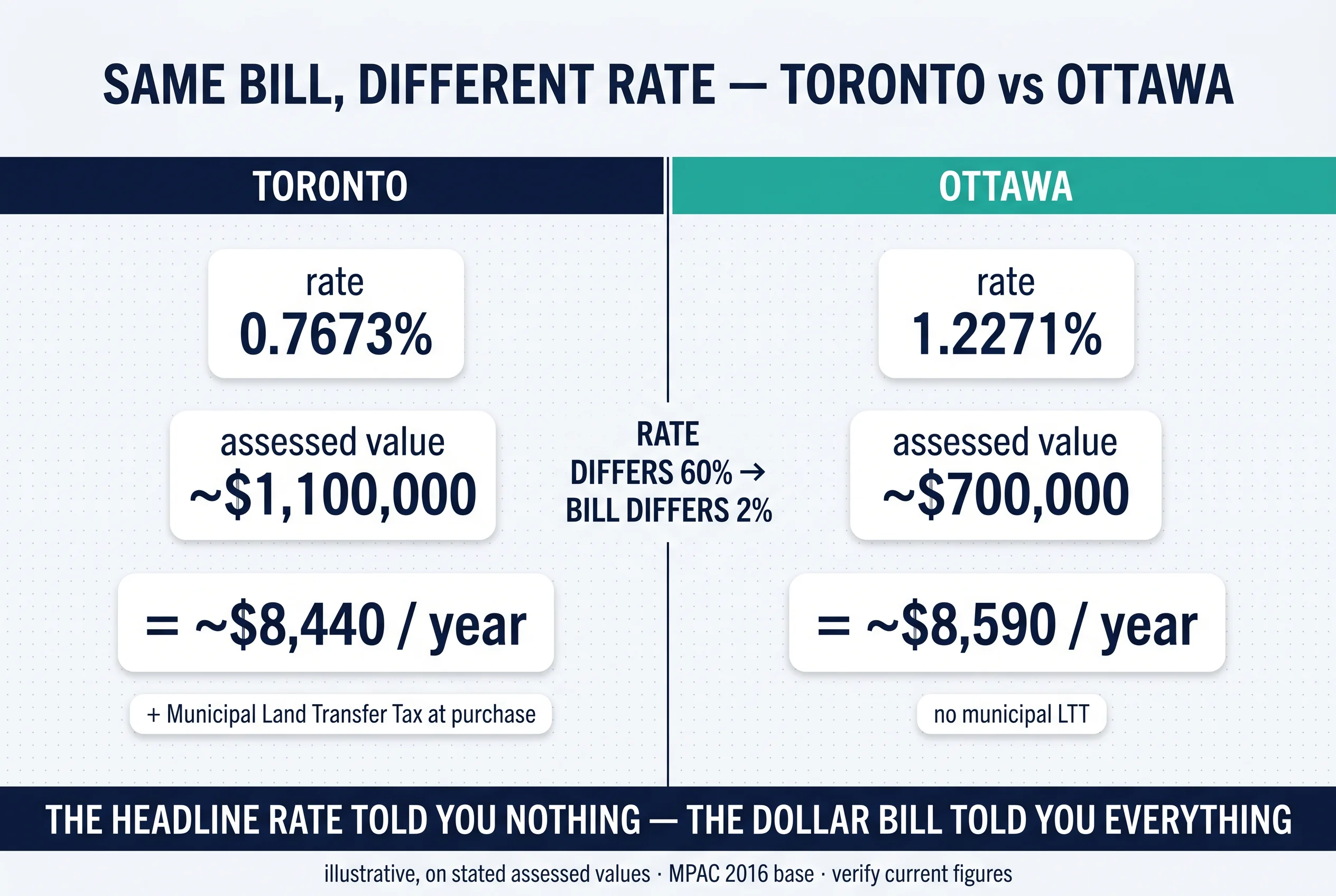
The headline rate is the number that fools people. Toronto's low rate lands on a high assessment; a higher-rate city lands on a cheaper home. Rate and assessment base move inversely, so Toronto's roughly 0.77% on an $1.1M home (about $8,440 a year) lands within a whisker of Ottawa's roughly 1.23% on a $700K home (about $8,590). Rank cities by the percentage and you're reading the wrong column entirely. This guide ranks the major Ontario cities by 2026 residential rate, shows why the dollar bill matters more than the rate, explains why your MPAC assessment is frozen at a 2016 value, flags the reassessment trap that catches renovators, and turns the whole thing into a line in your underwriting — including the part principal-residence owners never get: on a rental, property tax is deductible. Rates are current as of July 2026 and refreshed as municipalities finalize; this is market data, not tax or investment advice — verify against your city's bylaw.
The Ontario Property Tax Comparison Worksheet: Rank by the Bill, Not the Rate
The fill-in worksheet that turns property tax from a footnote into a line you underwrite — compute the real dollar bill for every city on your shortlist, catch the reassessment traps, and claim the deduction your principal residence never gave you.
Get Free PDF →The 2026 Rate Ladder: Lowest to Highest
Here is the 2026 residential ladder — combined municipal and education rates, each one worth verifying at the city's own tax bylaw. At the floor sit Markham (~0.70%) and Toronto (0.7673%), with Mississauga and Caledon around 0.77–0.80% and Brampton near 0.96%. The middle band runs Ottawa at 1.2271%, the Kitchener–Guelph cluster around 1.10–1.14%, Hamilton near 1.20% (its 2026 budget proposed a roughly 4.25% increase — confirm the final figure), Barrie ~1.21%, Oshawa and Kingston in the 1.30–1.36% range, London around 1.38–1.46%, and St. Catharines and Peterborough near 1.44%. At the top: the northern cities (Sudbury, North Bay, Sault Ste. Marie, Thunder Bay) run 1.54–1.59%, and Windsor anchors the ceiling near 1.81–2.09%.

The tracked-major average is about 1.19%, and the spread from bottom to top is roughly threefold. That range is real, but it comes with a source-of-truth lesson: the comparison sites disagree at the margins. Windsor gets quoted at both 1.81% and 2.09%; Mississauga at both 0.77% and 1.03%, depending on whether the site folds in Peel Region's upper-tier levy. Neither is lying — they're aggregating differently, and they lag as cities finalize budgets through the spring. The city's own tax bylaw settles it every time, so treat any comparison table (including this one) as the starting point and confirm the number at the source before it goes in a spreadsheet. This is the property-tax companion to our guide on where to buy across the province, our cap rates and average rents breakdown, and the city-level deep dives on Ottawa and Hamilton.
Why the Low Rate Isn't the Low Bill
The mechanism is simple once you see it. Your tax is your assessed value multiplied by the combined rate. A city sitting on an enormous, high-value assessment base — Toronto — can fund its services at a low rate, while a city with cheaper homes and a narrower base needs a higher rate to raise comparable revenue per household. So the rate alone tells you almost nothing about the bill. It tells you how the city funds itself, not what you'll pay.
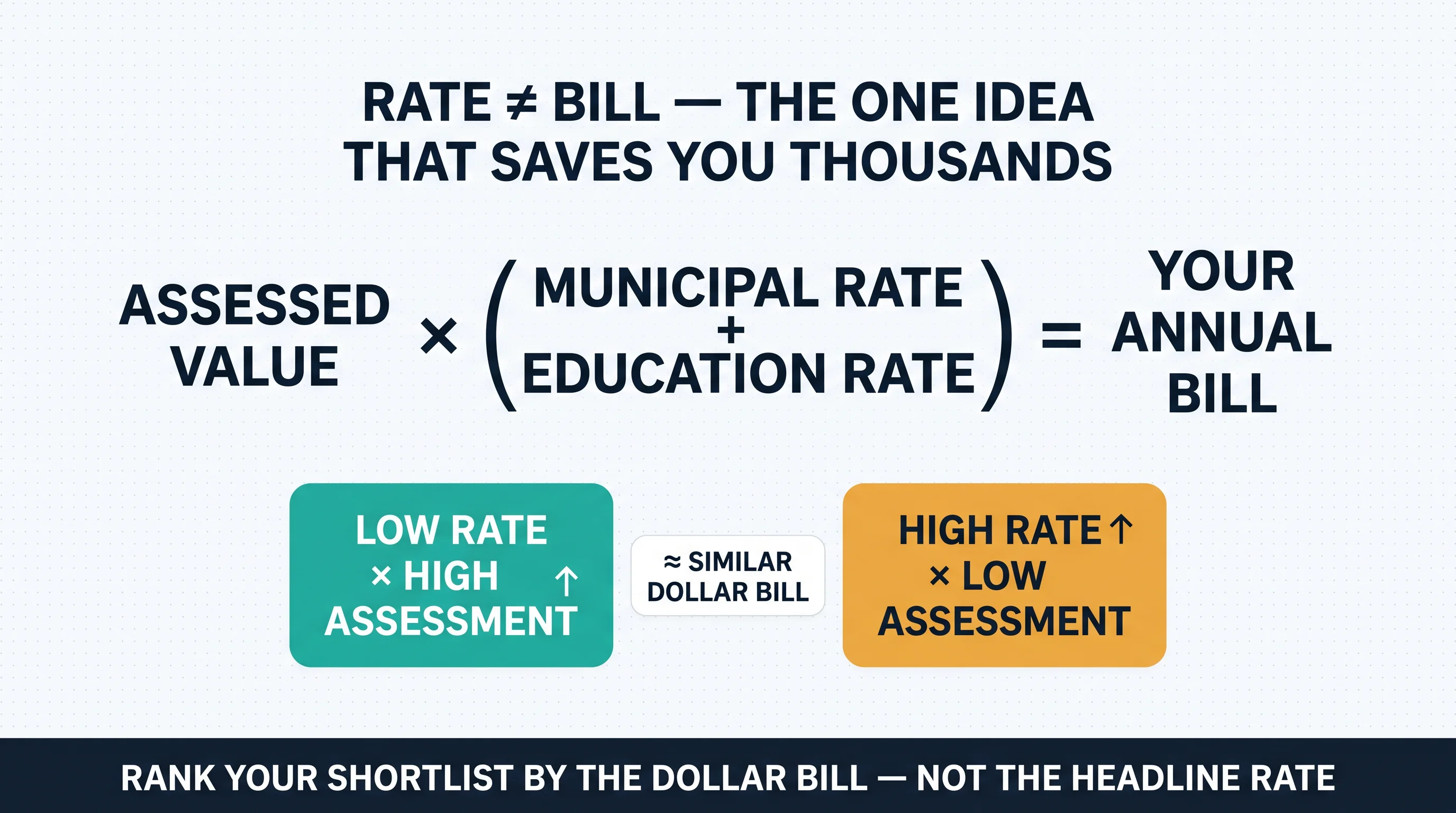
Three worked examples make it concrete. Near-equal bills: Toronto's 0.7673% on an $1,100,000 home is about $8,440 a year; Ottawa's 1.2271% on a $700,000 home is about $8,590 — the rate differs 60%, the bill differs 2%. The reversal: on MPAC's own 2016 average assessments, a Toronto home at $770,000 × 0.688% works out to about $5,298, while an Oshawa home at $356,000 × 1.561% comes to about $5,557 — the cheaper city with the higher rate lands the higher bill. The flip side: hold the assessment constant at $600,000 and the rate does bite — roughly $4,600 in Toronto, $7,360 in Ottawa, $8,770 in London. That last example is the one people cling to, but it hides the trap: assessments are never actually constant across cities, which is precisely why you underwrite the dollar bill on the real assessed value, not the percentage.
This is why property tax belongs inside the cap-rate conversation, not beside it — it's subtracted from net operating income, so a tax swing moves the yield directly. The cap rates and average rents guide shows the mechanics; here it's enough to know that the dollar bill, not the rate, is what lands in NOI.
MPAC, the Frozen 2016 Base, and the Reassessment Traps
The biggest live misconception in this whole topic: your assessed value is not your market value. MPAC still assesses every Ontario property on the January 1, 2016 base year — the province-wide reassessment has been postponed repeatedly — so your assessed value is a 2016-era figure, and the gap between it and today's market price has widened enormously. Notices only reissue when a property changes hands or is materially altered. That single fact resolves the question every new owner asks when they compare their bill to a neighbour's.
The system is designed to be roughly revenue-neutral, which trips people up. When assessments rise across the board, rates are adjusted down to raise the same budgeted revenue — so a rising assessment doesn't automatically raise your bill. Your bill climbs in two situations: when your city's budget grows (many did for 2026 — Mississauga by about 5.21%, Hamilton's proposed increase near 4.25%, Halton around 4.75%), or when your specific property is reassessed higher than average. And that second one is the investor's trap: additions, new builds, and legal basement-suite conversions all trigger a reassessment.
Property Tax in the Pro Forma: The Investor's Angle
Property tax is a top-three fixed operating expense, and on a $600K rental the annual bill swings from roughly $4,600 to $8,800 depending on the city — a difference big enough to move the cap rate by 50 to 100 basis points, because it's subtracted in NOI. That's not a footnote; it's a line you manage. And there's a line most owners miss entirely.
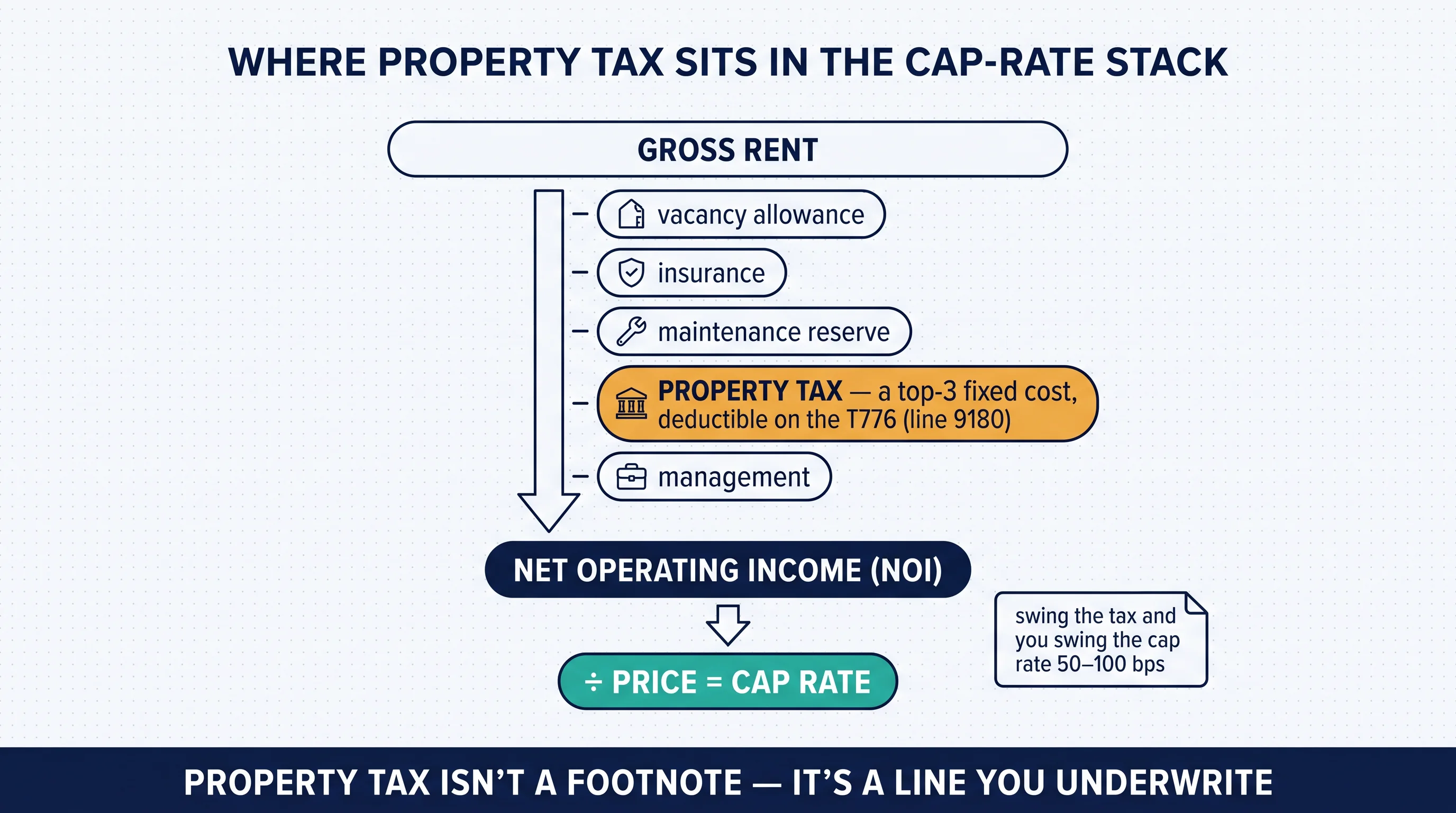
On a principal residence, property tax is not deductible. On a rental, it is — it's a line on the T776 (line 9180), the same form that captures every other rental expense. First-time investors who spent years unable to write off the tax on their own home are often surprised to learn the same bill becomes a legitimate deduction on the rental. This is general information, not tax advice: our guide to the T776 form walks through where property tax and everything else goes, our piece on CRA audits of rental income covers keeping it documented, and a licensed accountant should confirm how it applies to you.
Two more items for the underwriting column. Toronto layers a Municipal Land Transfer Tax (roughly 1–2.5% on purchase) on top of the provincial land transfer tax — no other Ontario city charges it. It's a closing cost, not a property tax, but it belongs in the true-cost math of the "low-rate" city. And if you're underwriting a small apartment building, note that properties of seven-plus units may fall in a multi-residential tax class that's rated differently than residential — check the class before you model the deal. If you're early in the journey, our guides to buying your first rental property and becoming a landlord in Ontario put these costs in context.
Practical Takeaways
- Rank your shortlist by the dollar bill, never the headline rate.
- Get the actual assessed value — not the list price — and multiply by the city's current combined rate.
- Verify every rate at the city's own tax bylaw. Aggregators lag and round differently.
- Treat the MPAC assessment as a 2016-base number, not market value — and know it re-rates on sale or material change.
- Budget the reassessment into any conversion or addition.
- Put property tax on the T776 as a deductible rental expense — the one your principal residence never gave you.
- Fold the Toronto MLTT (or its absence elsewhere) into the closing-cost column.
Quick win: run your top two candidate cities through the comparison worksheet tonight, on real assessed values. Long-term: the dollar bill compounds inside the cap rate every year you hold.
The Ontario Property Tax Comparison Worksheet: Rank by the Bill, Not the Rate
The fill-in worksheet that turns property tax from a footnote into a line you underwrite — compute the real dollar bill for every city on your shortlist, catch the reassessment traps, and claim the deduction your principal residence never gave you.
Get Free PDF →Rank by the Bill, Not the Rate
Ontario's residential property-tax rates span roughly threefold — from Markham and Toronto near 0.7% to Windsor near 1.8–2.1% — but the rate is the number that misleads. Because rate and assessment base move inversely, the lowest-rate city is routinely not the lowest-bill city, and the only figure that belongs in your underwriting is the dollar bill on the actual assessed value. Add the frozen-2016 MPAC base, the reassessment-on-improvement trap, and the deductibility a rental unlocks, and property tax stops being a footnote and becomes a line you manage. Rates as of July 2026, refreshed as municipalities finalize; market data, not tax or investment advice — verify at your city and confirm with a professional.
Track the Deductible Line From Day One
Per-unit books that keep property tax, insurance, and every T776 expense organized all year — with Ontario's rules built in. Free for up to 3 units on Tenon10.
Free plan available • Tenants always free • Ontario compliance in code
Related Resources
The Cities & Markets series: Best Ontario Cities to Buy a Rental Property — the provincial overview this tax data feeds · Cap Rates & Average Rents Across Ontario Cities — where the tax bill lands in the yield · Average Rents by Bedroom · Best Ottawa Neighbourhoods and Best Hamilton Neighbourhoods — the conversion-reassessment tie lives in the Hamilton guide.
The tax and money side: The T776 Form: How to Report Rental Income — where property tax gets deducted · CRA Audits of Rental Income — keeping the deduction documented · Landlord Insurance in Ontario — another fixed line in the pro forma.
Getting started: Buying Your First Rental Property in Ontario · Becoming a Landlord in Ontario: The First-Timer's Guide · the Ontario LTB forms hub.
Frequently Asked Questions
Which Ontario city has the lowest property tax rate?
Among major municipalities in 2026, Markham and Toronto sit at the bottom — roughly 0.70% and 0.7673% respectively — with Mississauga, Caledon, and Brampton close behind. But "lowest rate" and "lowest bill" are different questions, and conflating them is the most expensive mistake in this whole topic. Toronto's low rate applies to some of the highest assessed values in the province, so the actual dollar bill on a Toronto home often rivals or exceeds the bill in a higher-rate city with cheaper housing. On top of that, Toronto layers a Municipal Land Transfer Tax on purchases that no other Ontario city charges. If you're choosing where to buy a rental, rank your shortlist by the projected annual dollar bill on the actual assessed value — not by the headline percentage — and verify the current rate at the city's own tax bylaw, because comparison sites lag and round differently. The rate is a starting point, not an answer.
Why is Toronto's property tax rate so low if the city is expensive?
Because rate and assessment base move inversely, by design. A municipality sets its rate to raise the revenue its budget needs from its total assessment base — so a city sitting on an enormous, high-value base like Toronto can fund its services at a low rate, while a city with cheaper homes and a narrower base needs a higher rate to raise comparable revenue per household. The low rate isn't a discount; it's arithmetic. And it doesn't make the bill low: Toronto's roughly 0.77% applied to a high assessed value produces an annual bill that lands close to Ottawa's roughly 1.23% on a considerably cheaper home. The lesson for investors is to stop reading the rate as a measure of affordability. The rate tells you how the city funds itself; the dollar bill — rate times your actual assessed value — tells you what you'll pay.
Is property tax deductible on a rental property in Ontario?
Yes — on a rental property, municipal property tax is a deductible operating expense, reported on Form T776 (Statement of Real Estate Rentals, line 9180) against your rental income. This is one of the most valuable distinctions between owning a rental and owning your home: on a principal residence, property tax is not deductible at all, so first-time investors are often surprised to learn the same bill they could never write off on their own house becomes a legitimate expense on the rental. The deduction applies to the tax for the period the property was earning or available to earn rental income, and like all rental expenses it needs to be documented. This is general information, not tax advice — our guide to the T776 form walks through where property tax and every other rental expense goes, and a licensed accountant should confirm how it applies to your specific situation.
How is property tax actually calculated in Ontario?
Your annual property tax is your MPAC assessed value multiplied by the combined tax rate, where the combined rate is the municipal portion (set by your city's budget) plus the provincial education portion (set by Ontario, roughly consistent province-wide). The critical wrinkle is the assessment: MPAC still bases assessed values on January 1, 2016 — the province-wide reassessment has been postponed repeatedly — so your assessed value is a 2016-era figure, not today's market value, and the gap between the two has grown substantially. Because the system is designed to be roughly revenue-neutral, a rising assessment doesn't automatically mean a rising bill: if all assessments rise together, rates are adjusted down to raise the same budgeted revenue. Your bill actually climbs when your city's budget grows (many did for 2026), or when your specific property is reassessed higher than average — which happens on a sale, an addition, a new build, or a legal suite conversion.
Does a low property tax rate mean I should buy in that city?
No — property tax is one input to a rental deal, not the deciding one. It's an important input: on a mid-priced home it can swing several thousand dollars a year between cities, and because it's subtracted from net operating income, it moves your cap rate by a meaningful margin. But a low-tax city with a hot, expensive price base can easily produce a higher dollar bill — and a worse yield — than a higher-tax city with cheaper homes and stronger rent-to-price ratios. The right way to use this guide is to compute the actual dollar tax bill for each candidate property, drop it into your full pro forma alongside rent, financing, insurance, and capital costs, and compare the deals on cap rate and cash flow. The city with the lowest tax rate wins only if everything else is equal — and in real markets, it never is. Market data, not investment advice.
This article presents Ontario property tax information current as of July 14, 2026 and is refreshed as municipalities finalize their 2026 rates, which happens on municipal timelines (budgets are due April 30). Rates are aggregated from municipal sources and CTV News reporting; because comparison sites lag and round differently, verify every rate against your city's own tax bylaw and confirm assessed values with MPAC before relying on them. Worked examples are illustrative and use stated assessed values on the MPAC 2016 base. This is general market information for educational purposes, not tax, legal, or investment advice; property-tax deductibility on the T776 applies to rental (not principal-residence) property, and a licensed accountant, lawyer, or realtor should confirm how any of this applies to your specific situation.


