

Ottawa just did something it hadn't done in almost fifty years: it built rental housing faster than any year in living memory. 4,646 purpose-built rental units were completed in 2025 — a multi-decade high, with roughly 4,200 more forecast for 2026 and nearly 11,000 under construction — in what CMHC called the largest rise in new rental supply in the city in almost half a century. Vacancy eased. New towers started offering free months. And the neighbourhood you pick suddenly started mattering more, not less.
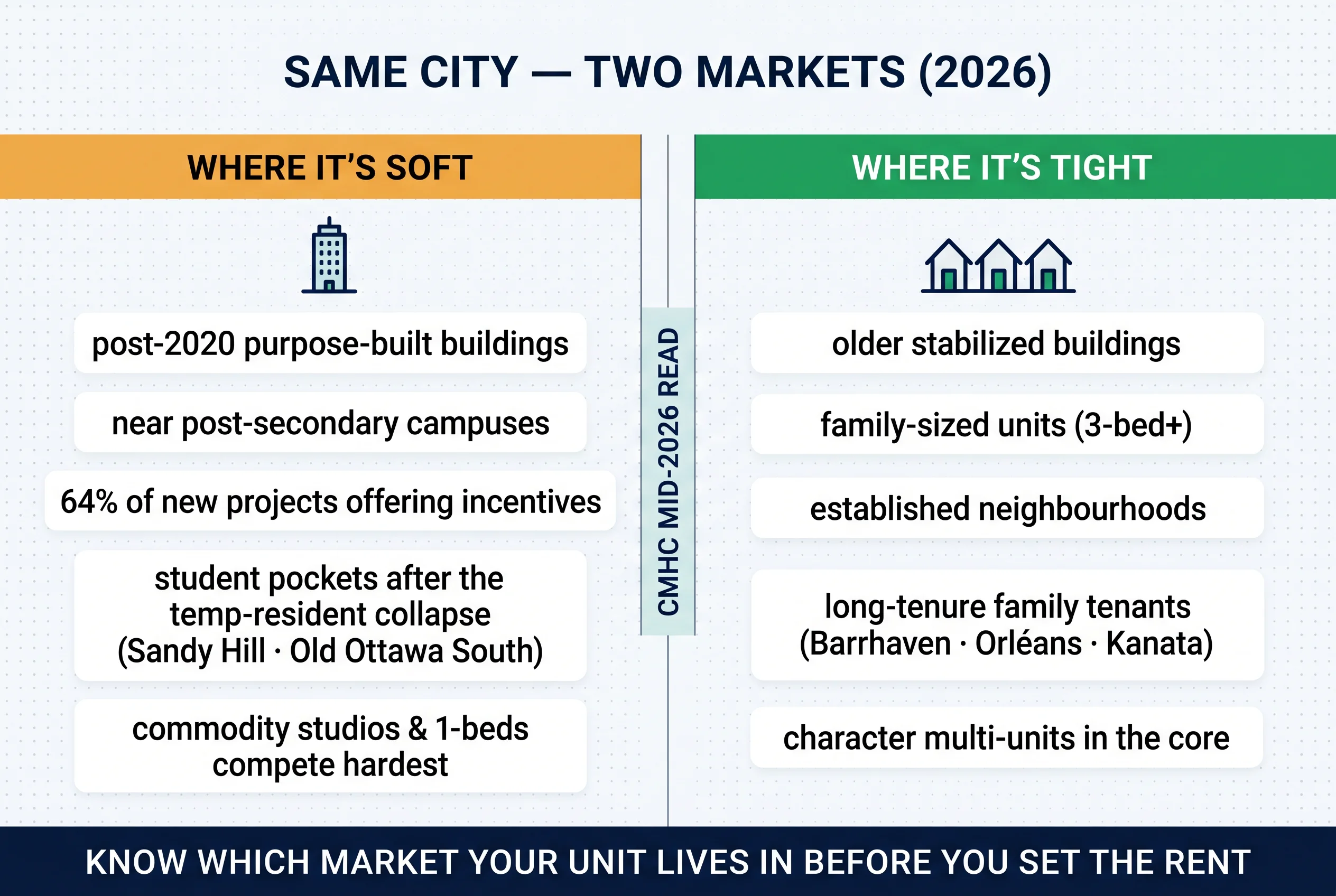
Here's why: in a supply wave, "Ottawa's average" is a trap. The market split. Post-2020 buildings near campuses are soft; older stabilized buildings and family-sized units are as tight as ever. Buy the average and you underwrite the wrong universe. This guide reads the capital the way an investor should — as several demand engines sharing a postal code: federal, tech, student, transit, family — and walks eight neighbourhoods with a strategy tag on each, the two-rents turnover math, the honest caveats, and the Ottawa-specific homework: the Vacant Unit Tax, zoning, and the new-build rent-control exemption. Figures are current as of July 2026 and this page is refreshed quarterly. Market data, not investment advice — the goal is to match a neighbourhood to your strategy.
The Ottawa Neighbourhood Scorecard: Match the Block to Your Strategy
The pre-offer worksheet for Ottawa rental buyers — name your demand engine, underwrite both rents, price the repairs, and clear the Ottawa-specific homework (VUT declaration, zoning, rent-control regime) before you sign anything.
Get Free PDF →The Supply Wave: Ottawa's Market Weather in 2026
Start with the weather system every Ottawa decision now sits inside. Urbanation's Q4-2025 report counted 4,646 purpose-built completions in 2025, with construction starts at a four-year high (4,765) and 10,807 units under construction at year-end — and roughly 4,187 more completions forecast for 2026. The wave isn't done landing; that's exactly why this page carries a quarterly refresh.
Two vacancy numbers describe the result — and both are true. CMHC's October-2025 survey, which measures the whole purpose-built stock, moved from 2.0% to 2.7%. Urbanation's Q4-2025 read of stabilized new buildings — the towers actually doing the competing — sat at 3.5%, with 64% of new projects offering incentives, up from 43% a year earlier, and average rents easing to $3.24 per square foot. Different universes, one lesson: the pressure is concentrated where the new supply is.
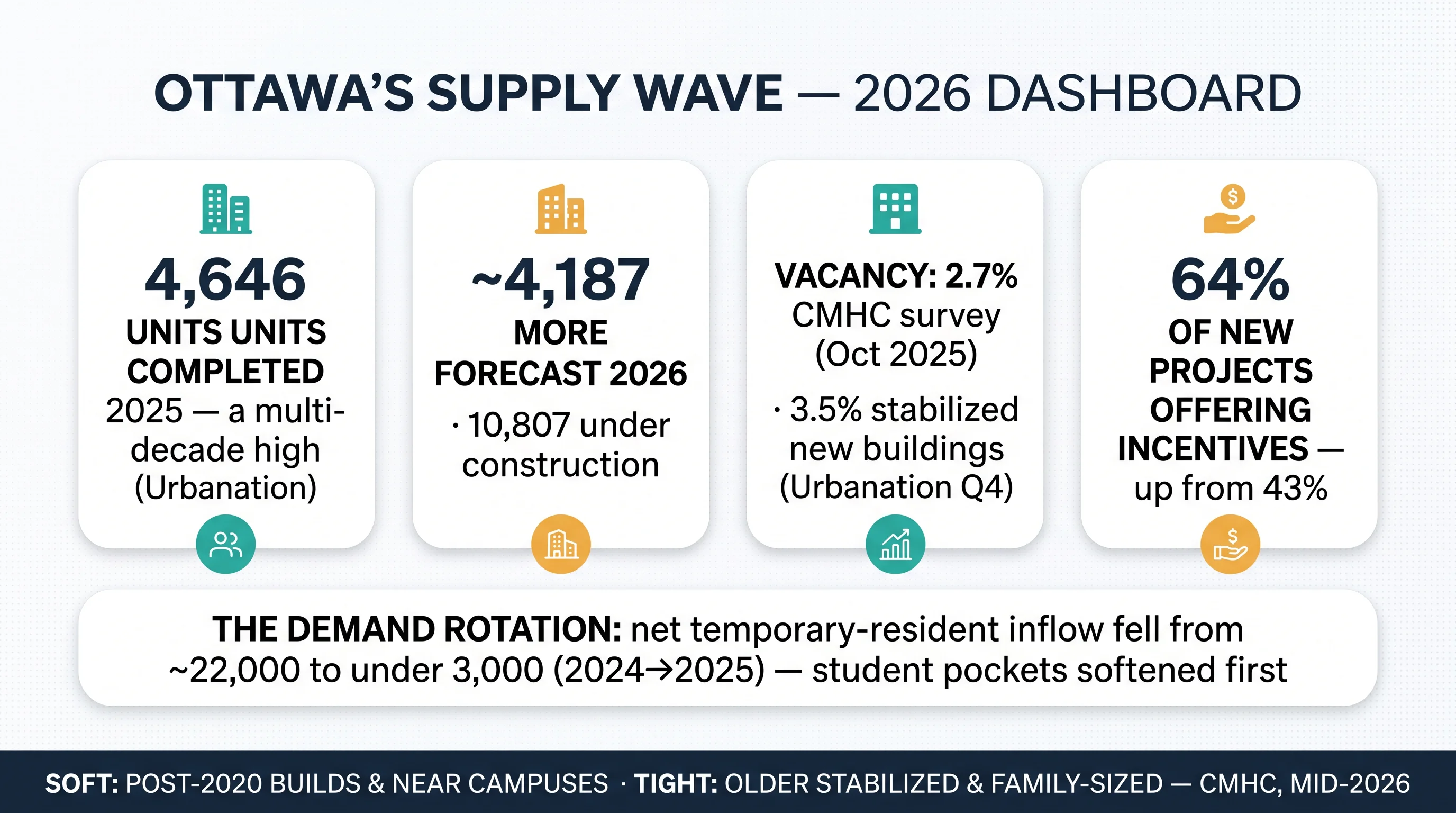
The demand side rotated at the same time. Net temporary-resident inflows fell from roughly 22,000 to under 3,000 between 2024 and 2025 on tighter international-student policy, per Marcus & Millichap's Q1-2026 analysis — which is precisely why the softness landed first in university-adjacent pockets like Sandy Hill and Old Ottawa South — while federal downsizing put an asterisk on the city's famously stable anchor employer. And then there's the sentence that matters most, from CMHC's own mid-2026 update: vacancies concentrate in post-2020 buildings and near post-secondary institutions, while older stabilized buildings and family-sized units remain tight. That one line is the whole neighbourhood game this cycle — and it's why Ottawa still ranks where it does in our guide to the best Ontario cities to buy a rental property, and why its cap rates behave the way our cap rates and average rents guide describes.
The Two Rents — and the Turnover Math
Every Ottawa buyer eventually notices two rent numbers that seem to contradict each other. CMHC's surveyed average two-bedroom rent is about $1,800; asking rents on vacant two-bedrooms run about $2,395–$2,400 in mid-2026. Neither is wrong. The survey captures sitting tenancies, many held below market by rent control; asking rents are what a vacant unit resets to, because Ontario allows vacant units to re-price to market. The full mid-2026 asking ladder: studio ~$1,575 · one-bedroom ~$1,900–$1,950 · two-bedroom ~$2,395–$2,400 · three-bedroom ~$2,650, with the citywide all-types average around $2,100 — the bedroom-by-bedroom logic our average rents by bedroom guide walks across every major Ontario city.

The underwriting rule that falls out of this: a building full of long-tenure tenants is priced off the left number and resets toward the right one only at turnover. Run both. Never model every unit at asking. And know the regime split that makes the gap possible: units first occupied on or after November 15, 2018 are exempt from Ontario's rent increase guideline — more of Ottawa's stock than you'd think, given the build-out — while everything older is capped at the guideline, 2.1% for 2026, served on Form N1 with 90 days' notice. Our complete 2026 rent increase guide covers the mechanics, and exempt units use the N2 instead. One illustrative composite: a sitting-tenant duplex at survey-average rents turns over one unit, and the vacant-unit reset closes half the gap in a single lease. That's the turnover math — and it's also why tenure quality, not just tenure length, belongs in your diligence.
Eight Neighbourhoods, Eight Strategies
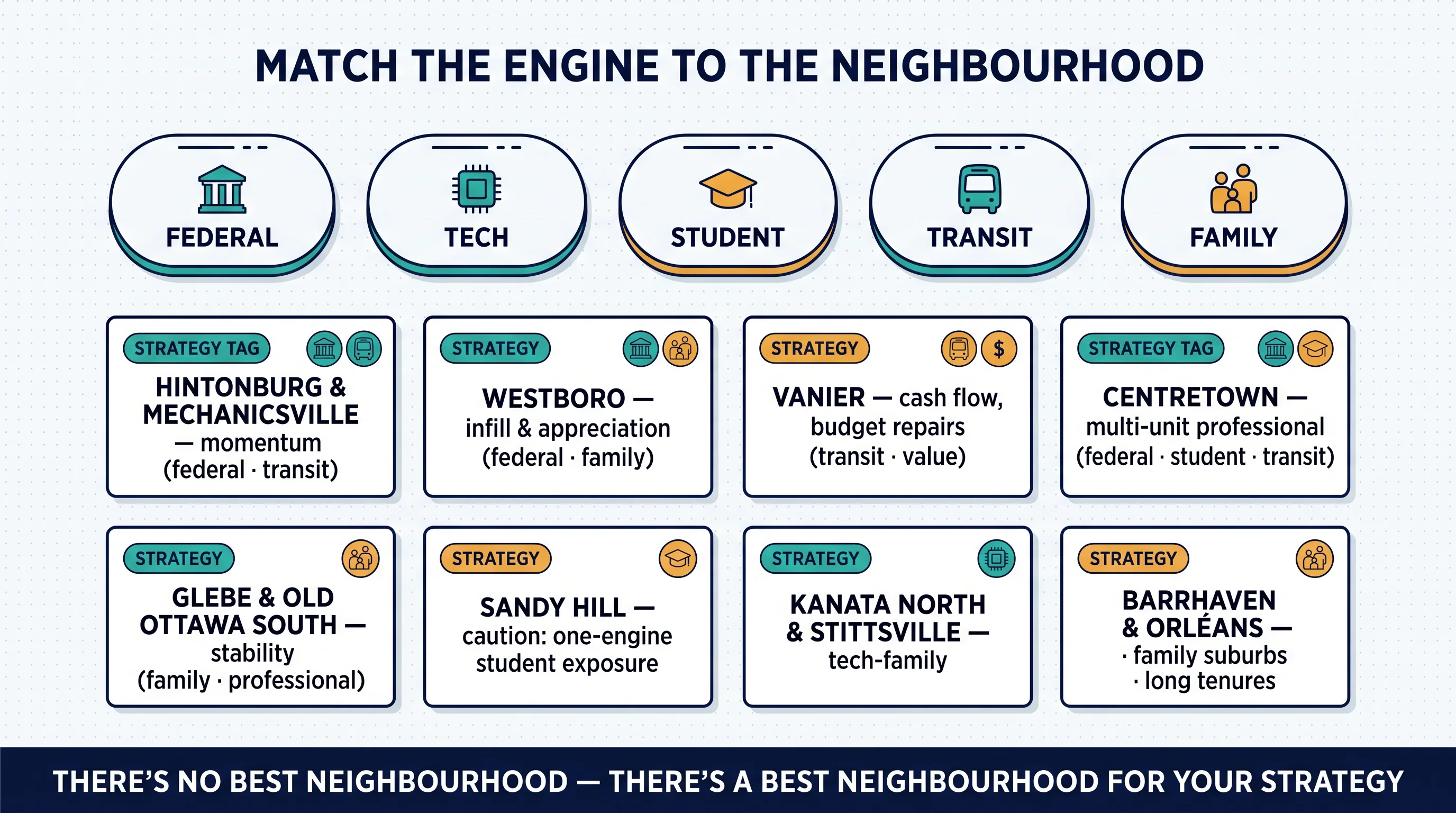
There's no best neighbourhood — there's a best neighbourhood for your strategy. Here are eight, each with its engine and its honest caveat.
1. Hintonburg & Mechanicsville — the momentum play
Walk score 88, bike score 97, roughly 66% renters, median age 36.5 (Ottawa Neighbourhood Study figures) — a walkable Wellington West arts district with the Tunney's Pasture federal campus next door supplying stable, well-paid tenants. The duplex stock is scarce but renovatable. The honest read: the discovery phase is over and gentrification is largely priced in, so you're buying demand durability, not a lottery ticket.
2. Westboro — the infill & appreciation play
High rents, low vacancy, strong resale — and expensive to build. The locally documented strategy is 3–6-unit infill or buy-hold-renovate on existing duplexes and fourplexes, a market-participant view straight from the investors doing it. Roughly 52% renters, older median age, deep amenity base.
3. Vanier — the cash-flow play, caveats first
Vanier's cap rates run above the city average — because prices are depressed, by reputation and by condition. Local investment analysis puts the neighbourhood's rental stock at roughly twice the citywide likelihood of needing major repairs. Demand is steady, entry prices are low, parking is easier than the core, and Vanier North has drawn redevelopment interest. Budget the roof, the panel, and the foundation — or the cap rate is fiction.
4. Centretown — the multi-unit professional core
Legal triplex and fourplex stock, zoning that permits multi-unit, and tenants who walk to work — uOttawa, the LRT, and the public service on foot. Professional and furnished demand run deep. The exposure: this is the closest quarters any established stock keeps with the incentive-offering towers, so character and unit quality are the moat. A fourth identical studio is exactly what not to bring to this fight.
5. The Glebe & Old Ottawa South — the stability play
Long-tenure professional tenants, Lansdowne and Bank Street, durable demand — at expensive entry and thin yields. Old Ottawa South carries the university-adjacency asterisk this cycle, sitting close enough to Carleton that the student softness brushed it.
6. Sandy Hill — the caution entry, on purpose
Structurally deep demand — uOttawa, embassies — that inherited a policy shock overnight: the temporary-resident collapse landed here first, and vacancy rose. The lesson this entry exists to teach: a one-engine neighbourhood inherits that engine's policy risk. Experienced student-housing operators with turnover discipline can still run it well; first-timers should understand exactly what they'd be signing up for.
7. Kanata North & Stittsville — the tech-family play
The tech-park anchor — locally cited employers include Shopify, Nokia, and Microsoft offices — plus schools and family housing stock. Local market participants note the peripheral suburbs out-appreciated the Byward Market in recent cycles, and property managers claim suburban gross yields of 5–7% against 4–6% downtown — treat both as market-participant claims, not gospel. Car-dependent; the tech engine is genuine single-sector exposure, cushioned by federal commuters.
8. Barrhaven & Orléans — the family-suburb pair
Newer stock — which means the post-November-2018 exemption is common here, so know which regime each unit is in before projecting increases — with the LRT's eastern extension strengthening Orléans, and the tenant profile CMHC keeps calling tight: families, in family-sized units, staying years. This is where the illustrative pair of composites lives: the two-towers problem (a 2024-built downtown studio underwritten at 2023 rents meets a 2026 lease-up across the street offering two months free) against the family-unit contrast (the same dollars into a three-bedroom in an established pocket rents in a week).
Honourable mentions: Carlington (the Civic hospital campus and Algonquin College, at low entry prices), Little Italy (Carleton and Dow's Lake), and the Byward Market — where local analysis notes a two-bedroom rent premium of about 26% over the city median against slower appreciation than the peripheral suburbs: the contrarian's trade-off in one block. If you're earlier in the journey, our first rental property guide and complete first-timer's guide to becoming a landlord in Ontario cover the buying and operating fundamentals this article builds on — and our Toronto neighbourhoods guide applies this same engine-matching method to a very different city.
The Ottawa Homework: VUT, Zoning, and the Rules Underneath
Three pieces of homework travel with every Ottawa purchase. First, the Vacant Unit Tax: Ottawa taxes residential units left vacant more than 184 days in the prior year — historically at 1% of assessed value — and requires an annual occupancy declaration from all residential property owners, not just those with empty units. Miss the declaration and even a fully tenanted property can be deemed vacant until you fix it. Put the declaration on your compliance calendar the day you close, watch the 184-day line on long renovations and extended turnovers, and confirm the current rate, exemptions, and deadline at ottawa.ca, since the city updates the program's details.
Second, zoning: conversions and additional units are parcel-specific in Ottawa, and the bylaws are strict — verify the zoning before underwriting the fourplex plan, not after the offer. Third, the Ontario base that travels with the province: the standard lease, a last-month's-rent-only deposit, no late fees, the $20 NSF cap, and the guideline machinery from earlier — all of it documented in our Ontario LTB forms hub, and all of it applying in Ottawa exactly as it does everywhere else in the province.
Practical Takeaways
- Name your demand engine before you name your neighbourhood — federal, tech, student, transit, family. The engine decides your vacancy risk.
- Underwrite both rents — sitting and asking — and model turnover honestly, unit by unit.
- Know each unit's rent-control regime — pre- or post-November 15, 2018 — before projecting a single increase.
- In the core, avoid commodity — character, quality, or family-size beats a fourth identical studio competing against incentive towers.
- Price Vanier's repairs into Vanier's cap rate — a 7% on paper that lands at an honest 5% is fine only if you bought it as a 5.
- Put the VUT declaration on your annual calendar the day you close, and watch the 184-day line on long vacancies.
- Re-read this page next quarter — the wave is still landing, and the figures refresh with the data.
The Ottawa Neighbourhood Scorecard: Match the Block to Your Strategy
The pre-offer worksheet for Ottawa rental buyers — name your demand engine, underwrite both rents, price the repairs, and clear the Ottawa-specific homework (VUT declaration, zoning, rent-control regime) before you sign anything.
Get Free PDF →Same City, Different Levels
Ottawa in 2026 is a supply wave breaking unevenly over a multi-engine city — soft where new towers and student pockets stack, tight where families and older stabilized buildings live. There is no best neighbourhood; there's a best neighbourhood for your strategy: momentum in Hintonburg, infill in Westboro, cash flow with a genuine repair budget in Vanier, professional multi-unit in Centretown, stability in the Glebe, discipline-only in Sandy Hill, tech-family in Kanata, and long tenures in Barrhaven and Orléans. The homework is knowable — both rents, the regime sort, the zoning check, the VUT declaration — and the data has a schedule: figures current as of July 2026, refreshed quarterly, with the next full refresh at CMHC's December survey. Market data, not investment advice — underwrite your own deal, and then run the operation as well as you ran the analysis.
Buy the Block. Then Run It Right.
Ontario's rules built into every workflow — rent collection with instant receipts, per-unit books, and compliant notices — free for up to 3 units on Tenon10.
Free plan available • Tenants always free • Ontario compliance in code
Related Resources
The Cities & Markets series: Best Ontario Cities to Buy a Rental Property — where Ottawa sits in the provincial picture · Cap Rates & Average Rents Across Ontario Cities · Average Rents by Bedroom — the two-rents math, city by city · Best Toronto Neighbourhoods — the same method, a different city.
The rules underneath: Ontario Rent Increases 2026: The Complete N1 Guide · the N1 form and N2 for exempt units · the rent increase calculator · the Ontario LTB forms hub.
Getting started: Buying Your First Rental Property in Ontario · Becoming a Landlord in Ontario: The First-Timer's Guide.
Frequently Asked Questions
Where should I buy a rental property in Ottawa?
Start with your strategy, not a street name, because Ottawa is several rental markets sharing one skyline. If you want momentum and a deep renter pool, Hintonburg and Mechanicsville pair a walkable arts district with federal tenants from Tunney's Pasture. If you want appreciation and can build, Westboro's infill economics are the locally documented play. Cash-flow buyers look at Vanier — with a genuine repair budget, because its above-average cap rates partly reflect stock condition. Multi-unit investors work Centretown's legal triplexes; stability buyers pay up for the Glebe; families-and-long-tenures buyers go to Barrhaven, Orléans, or Kanata. In 2026's supply wave, the one thing not to buy is the citywide average: post-2020 buildings near campuses are competing with incentive-offering towers, while family-sized units in established neighbourhoods stay tight. Market data, not investment advice — match the engine to your plan.
Is Vanier a good place to buy a rental property?
It can be — for the investor who prices it honestly. Vanier's cap rates run above the city average, which is exactly why it attracts cash-flow buyers: entry prices are low, rental demand is steady, parking is easier than the core, and Vanier North has drawn redevelopment interest. But those cap rates exist partly because the neighbourhood's rental stock is roughly twice as likely to need major repairs as the city-wide average, per local investment analysis — so the roof, the electrical panel, and the foundation belong in your underwriting, not your surprise column. A 7%-on-paper cap rate that lands at an honest 5% after capital work is still a fine deal if you bought it as a 5. Walk it with a contractor, budget the repairs up front, and Vanier rewards the disciplined; skip that step and the spreadsheet was fiction.
How does Ottawa's rental supply wave affect landlords?
Unevenly — and that's the point. 2025 delivered Ottawa's largest rise in new rental supply in almost fifty years (4,646 purpose-built completions, with roughly 4,200 more forecast for 2026), easing CMHC's surveyed vacancy from 2.0% to 2.7% and pushing stabilized new-building vacancy to about 3.5%, with 64% of new projects offering incentives. If you own — or plan to buy — a newer studio or one-bedroom downtown, you're competing directly with those towers and their free months, so realistic pricing and fast turnovers matter more than in the tight years. If you hold family-sized units or older stabilized stock in established neighbourhoods, CMHC's own mid-2026 read says your segment remains tight. Same city, two different markets: know which one your unit lives in before you set the rent, and re-check quarterly — this page refreshes with the data.
Do Ontario rent increase rules apply to new Ottawa buildings?
Only partly — and in Ottawa the split matters more than most cities because so much stock is new. Units first occupied for residential purposes on or after November 15, 2018 are exempt from Ontario's annual rent increase guideline, so a landlord there can raise rent by any amount with proper notice (Form N2 territory), subject to the once-per-12-months and 90-day rules. Everything older is guideline-capped: 2.1% for 2026 on Form N1 with 90 days' written notice. This is also why Ottawa's "two rents" gap exists — CMHC's surveyed average two-bedroom (~$1,800) reflects sitting tenancies held under control, while asking rents on vacant units run around $2,395–2,400, because Ontario lets a vacant unit reset to market. Before you underwrite any Ottawa building, sort every unit by regime and by tenure; our 2026 N1 guide and rent increase calculator do the mechanics.
What is Ottawa's Vacant Unit Tax, and does it affect landlords?
Ottawa levies a Vacant Unit Tax on residential units left vacant for more than 184 days in the previous calendar year — historically at 1% of assessed value — and, critically, it requires an annual declaration of occupancy status from all residential property owners, not just those with empty units. That declaration is the part landlords actually trip on: miss the deadline and a fully-tenanted property can be deemed vacant until you fix it, with the tax and the appeal hassle that follows. Normal rentals with tenants in place aren't the target — the tax aims at units sitting empty — but long renovation vacancies, extended turnovers, and between-strategies holding periods can stray into the 184-day zone. Put the declaration on your annual compliance calendar the day you close, document occupancy as you go, and confirm the current rate, exemptions, and deadline at ottawa.ca, as the program's details are updated by the city.
This article presents Ottawa rental market data current as of July 13, 2026 and is refreshed quarterly, with the next full refresh scheduled for CMHC's December 2026 Rental Market Survey. It provides market information for educational purposes, not investment, legal, or tax advice. Figures are drawn from CMHC (Rental Market Survey, October 2025; Mid-Year Rental Market Update, 2026), Urbanation (Q4 2025), listing-platform asking rents (mid-2026), Marcus & Millichap (Q1 2026), and local market participants; yield and appreciation claims from property managers and agents are their views, not ours. Verify Ottawa's Vacant Unit Tax rate, exemptions, and declaration deadline at ottawa.ca, confirm zoning with the City of Ottawa before purchasing, and consult licensed professionals — realtor, inspector, accountant, lawyer — before making investment decisions.


