

Every property management fee conversation in Canada starts from the same two numbers — 6 to 12 percent of monthly rent collected, with the national average sitting near 8 to 10 [2026 national pricing guides] — and nearly every expensive mistake happens after that sentence ends. Because the percentage was never the price. The price is a system: a fee model (how the base charge is computed), a base scope (what that charge actually covers), and an add-on stack (everything billed beside it, from tenant placement to maintenance markups). Read all three together and the market's ranges mean something; read only the headline and an advertised 8% can quietly run 18 to 22% effective once the stack is counted [Calgary firm pricing guide, May 2026].
This guide serves both sides of the same table. If you run a management firm, it's the craft of pricing deliberately — cost-up math, model choice, and a full schedule you can publish. If you own rentals, it's the discipline of reading a quote professionally — the questions that identify a model in one phone call and the one-sheet arithmetic that exposes the real cost. One note before the numbers: every range in this article is observed market data, gathered from 2026 industry pricing guides for evaluation purposes — these are not recommendations, and every firm sets its prices independently. A recurring example carries the math throughout: a $2,200-a-month rental, the kind of unit most Canadian landlords actually own.
The PM Fee Quote Reader & Schedule Builder: Add Up the Whole Table
A 19-point, both-sides checklist for Canadian property management pricing — landlords get the quote decoder and the effective-rate math that exposes what an 8% headline really costs; property managers get the cost-up logic and the full-schedule builder that turns transparency into a sales asset. The percentage is the headline. The schedule is the price.
Get Free PDF →The number everyone quotes — and what it actually buys
Start with the frame, properly labelled. Full-service residential management across Canada typically runs 6–12% of monthly rent collected, with the national average close to 8–10%; flat-fee arrangements, where they exist, cluster around $100–$300 per month [2026 national pricing guides]. On our recurring unit — $2,200 a month — that's $132 to $264 per month for core management, roughly $1,600 to $3,200 a year. Hold that phrase, core management, because it's carrying more weight than it looks.
What the base fee typically buys, as a market norm: rent collection, tenant communication, maintenance coordination, routine inspections on a stated cadence, and financial reporting. What it typically excludes: leasing a new tenant, major projects, and representation at the Landlord and Tenant Board [Ontario fee guides, 2026]. That excluded list is not fine print — it's the second half of the price, and this article spends a full section on it.
The context under every schedule matters to both audiences. Canadian property management is a $10.7 billion industry across 36,011 firms (IBISWorld, May 2026), and it's an industry under cost pressure: 93% of firms report rising operating expenses in Buildium's 2026 North American survey. Fees are where that pressure meets the client — which is exactly why how a firm prices, and how visibly, tells you more about it than the number itself.
And for owners weighing the fee at all, frame the question correctly from the start. On our unit, 10% is about $2,640 a year — and the honest comparison isn't that number against zero, it's that number against what self-managing actually costs you: the hours, the 11 p.m. calls, the distance if you don't live nearby, and the price of the mistakes you'd make that a specialist wouldn't. For some owners the math says hire; for plenty of hands-on locals it says keep it. Either answer is respectable — but only if it came from arithmetic rather than a reflex about whether 10% "sounds like a lot."
The three models — and the incentive each one buys
Before any number matters, identify the model, because each one is a different bargain about risk.
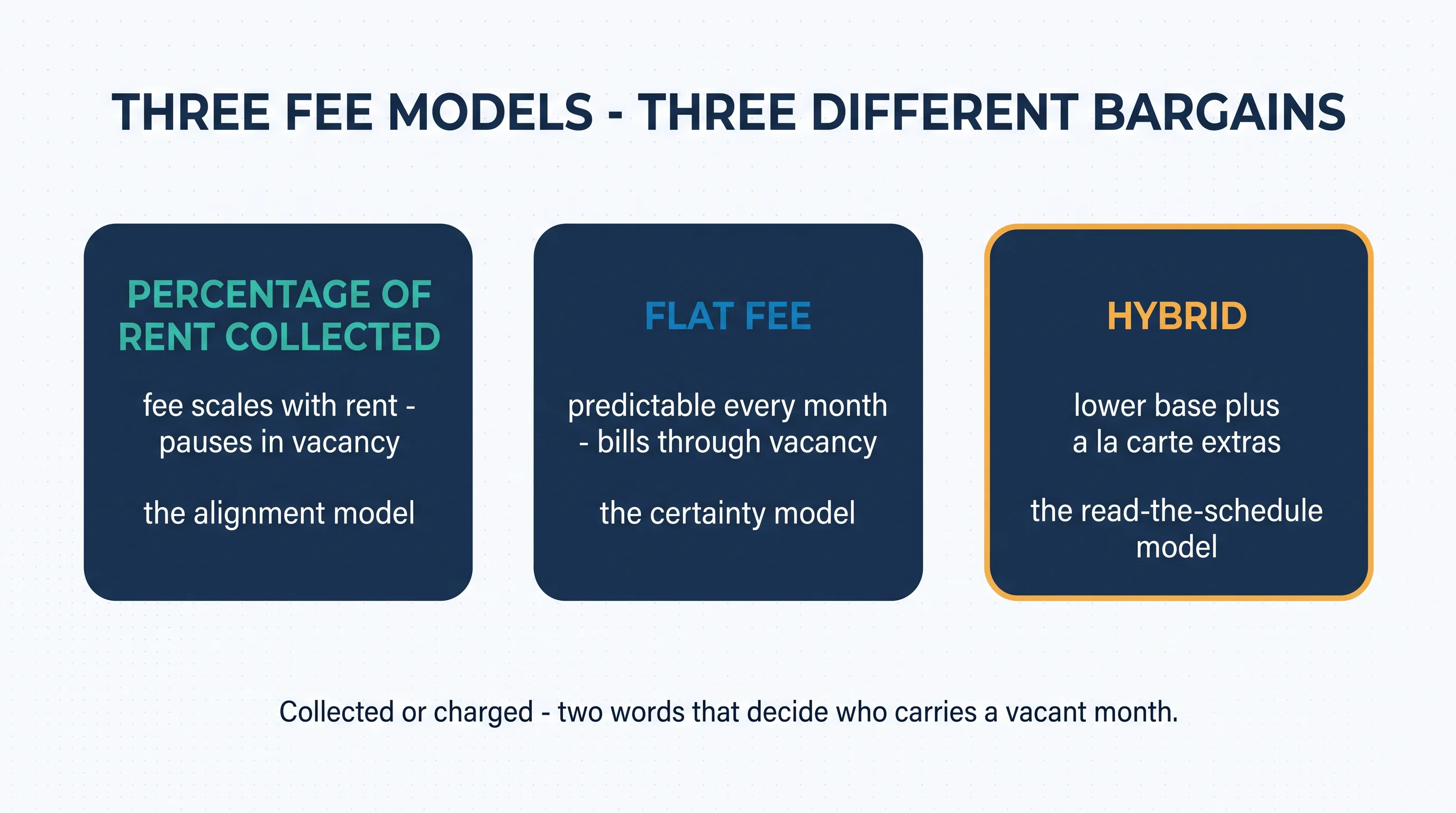
Percentage of rent collected is the dominant Canadian model, and its logic is genuine alignment: the fee scales with the rent, and — because it's computed on rent collected, not rent charged — it generally pauses when the unit sits empty. "We get paid when you do" is a real incentive structure, not a slogan: a vacancy costs the manager income too, which puts real urgency behind the listing, the showings, and the turnover work [2026 national pricing guides].
Flat fee is the certainty model: the same invoice every month, easy to budget, often attractive on higher-rent units where a percentage would run large. Its trade-off is the mirror image — it typically bills through vacancy, and it doesn't share the manager's fortunes with yours. That's not a flaw; it's a different bargain, and for some owners the predictability is worth it. Hybrid models — a lower base plus à-la-carte items — split the difference, and they're the structure where reading the full schedule matters most, because the base tells you the least.
The two words that decide everything sit in the contract: collected or charged. A composite from our files — ours, not a reported case — makes it concrete. Two identical units go vacant the same month. The first is managed on percentage-of-collected: the fee pauses, and the manager has the listing photographed and live within days, because empty costs them too. The second is on a flat arrangement: the invoice arrives as usual — exactly as the contract, fairly and openly, said it would. Neither owner was cheated. Only one of them chose their vacancy treatment on purpose.
For landlords: Three questions identify any fee model in one phone call. Percentage of what — rent collected, or rent charged? What happens in a vacant month — does the fee pause or continue? And what's not in the base fee — because the exclusions define the base more than the inclusions do.
What the market actually charges: the 2026 tables
One disclaimer prints with these tables, on purpose: the ranges below are observed market data from 2026 pricing guides, provided for evaluating quotes — they are not recommendations, and every firm prices its services independently, as its own business decision. With that said, here is what the guides report.
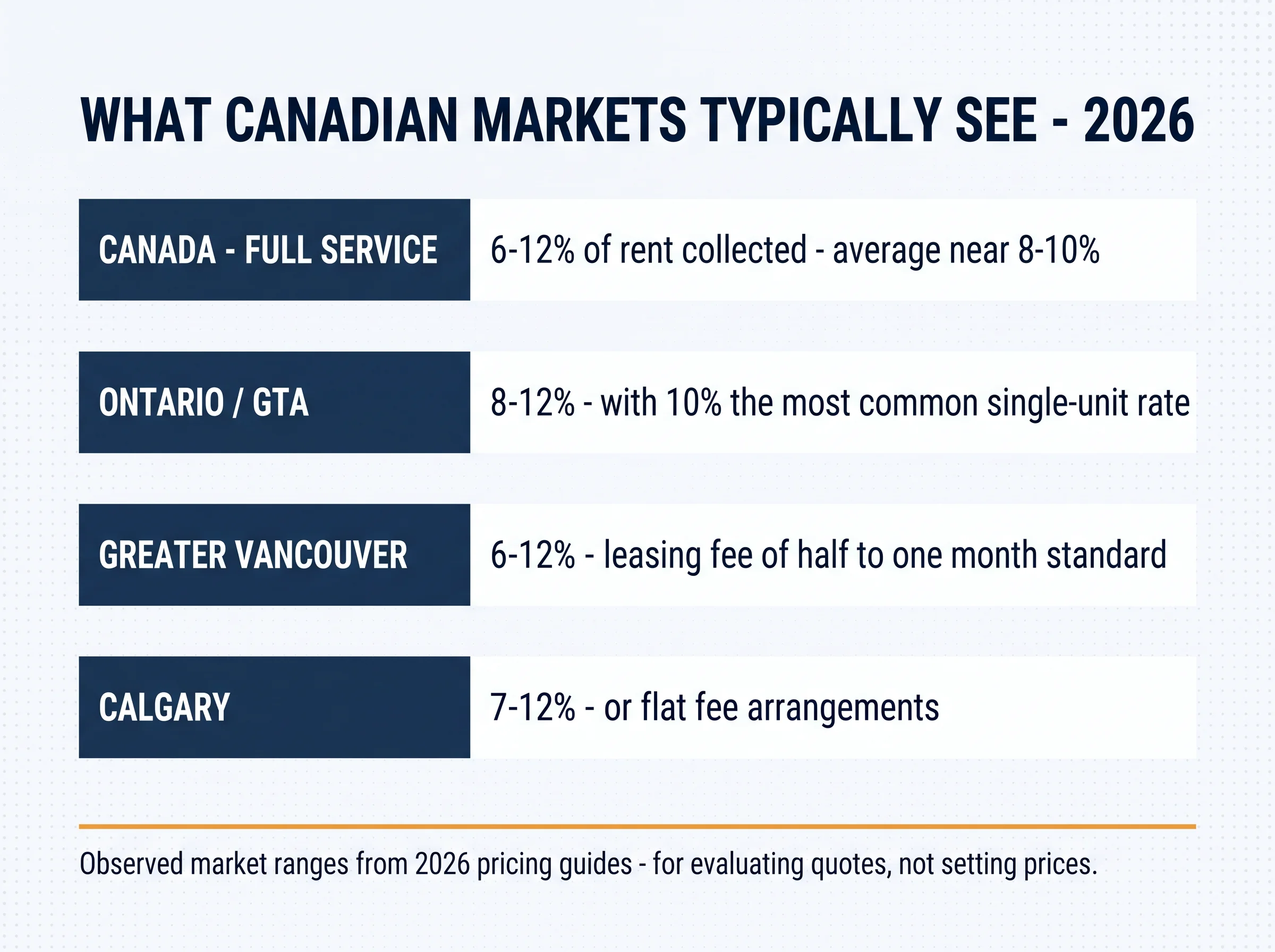
Ontario residential management typically runs 8–12%, with 10% the most common GTA/Toronto rate for single-unit residential [Ontario fee guides, 2026]. Greater Vancouver reports 6–12%, with a leasing fee of half to one month's rent standard on placement, and tax applying on top [Vancouver firm guide, Mar 2026]. Calgary shows 7–12% on the percentage model, with flat arrangements around $150–$250 per month and hybrids present [Calgary firm pricing guide, May 2026]. Nationally, flat fees cluster at $100–$300.
Run the recurring unit through those bands and the overlap becomes concrete: at $2,200 a month, the observed ranges put core management around $176–$264 monthly in the GTA's typical band, $132–$264 in Vancouver's, and $154–$264 on Calgary's percentage model — before any city's placement norms enter. The monthly spread between markets is smaller than the spread between models within one market, which is the practical takeaway: shop the structure harder than the city average.
Notice how much the regions rhyme: the percentage model dominates everywhere, and the spreads overlap heavily. What actually changes by province isn't the fee math — it's the compliance overlay around the work. Our national licensing map covers which provinces license rental management directly; in Ontario, where the manager operates as a registered brokerage, the remuneration must be spelled out clearly in the representation paperwork, and rents collected for owners move through proper trust handling — our Ontario trust accounting guide covers that discipline in depth. One more line for both sides: GST/HST applies on management fees, and how to structure around taxes is a conversation for an accountant, not a blog.
The 2026 market context sharpens all of it. CMHC's mid-year read has major markets supply-heavy and favouring tenants (June 2026), and the GTA's condo pipeline keeps growing — 24,012 condo rental listings in Q1 2026, up 6% year over year (TRREB). Longer vacancies make the collected-vs-charged distinction worth real money, and more single-unit investors shopping for leasing help makes quote-reading a mainstream skill this year, not a specialist's.
Where Tenon10 fits: Whether you self-manage or hire out, the record layer underneath is the same: per-unit ledgers, findable documents, and rent tracked cleanly month over month. Tenon10 is that Canadian-first layer — and to be precise about comparisons, it's tooling under a landlord or a manager, not a management service; its plans live on the pricing page, in a different comparison entirely.
The add-on stack: the second half of every real price
Now the excluded list gets its section, because this is where quotes actually diverge.
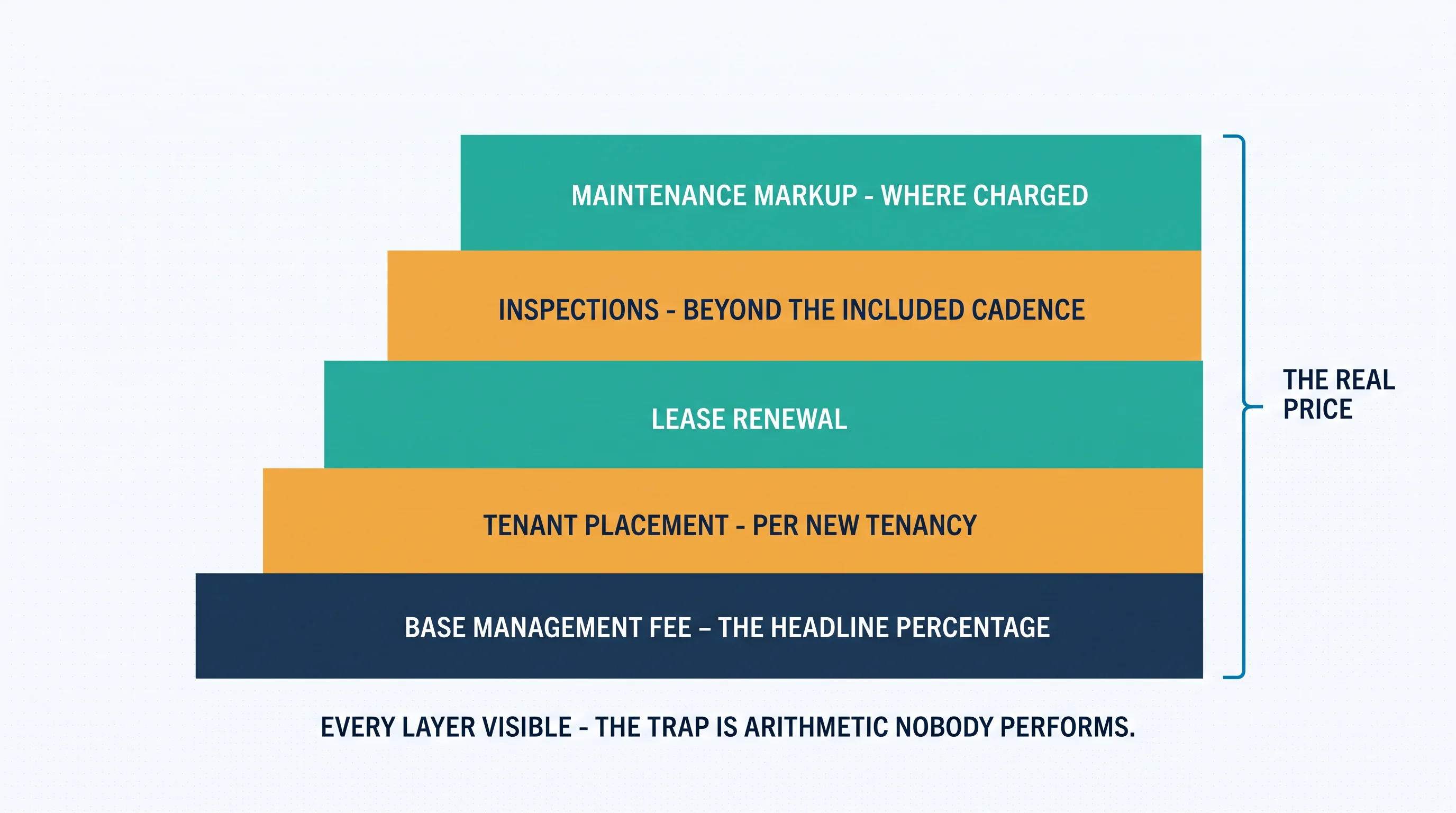
The stack, item by item, from the 2026 guides: tenant placement at 50–100% of one month's rent, charged per new tenancy — the single biggest add-on, and the one turnover multiplies. Lease renewal around $150–$300 where charged. Inspections around $75–$150 per visit beyond the included cadence — annual or semi-annual visits commonly sit in the base, while move-in and move-out reports are often extra. And a maintenance coordination markup of roughly 10–20% on contractor invoices, where the firm charges one [Calgary + national guides, 2026].
Here's the honest read, both directions: none of these is a scam when disclosed. Placement is discrete, real work — advertising, showings, screening, executing the lease — and charging for it separately is a legitimate structure. A markup on coordinated maintenance is a priced service: someone sourced the contractor, supervised the job, and stands behind it. Undisclosed is the only dirty word in this section. The fee that appears on an invoice without having appeared on a schedule is the one that ends relationships.
One quieter failure deserves naming: scope creep billed as extras. The base fee's description said "maintenance coordination"; eight months in, coordinating a furnace replacement arrives as a billed extra because it was "a project." Sometimes that's legitimate — major projects genuinely sit outside most base fees — and sometimes it's the base scope being re-read at invoice time. The cure is the same document as always: a schedule that defines where "coordination" ends and "project" begins, in writing, before either side needs the definition.
And run the turnover math once, because it reorders priorities: on our $2,200 unit, one full-month placement fee is $2,200 — more than two full percentage points of annual management fee ($528 per point per year). One extra turnover costs more than the difference between an 8% firm and a 10% firm. Which means retention is a pricing strategy — for owners choosing firms, and for firms designing schedules — and in a tenant-favouring year, our lease renewal guide's territory is where the money actually is.
The effective-rate trap: why an 8% quote can cost 19%
This is the section that pays for the article. Take our $2,200 unit — $26,400 in annual rent — through two quotes.
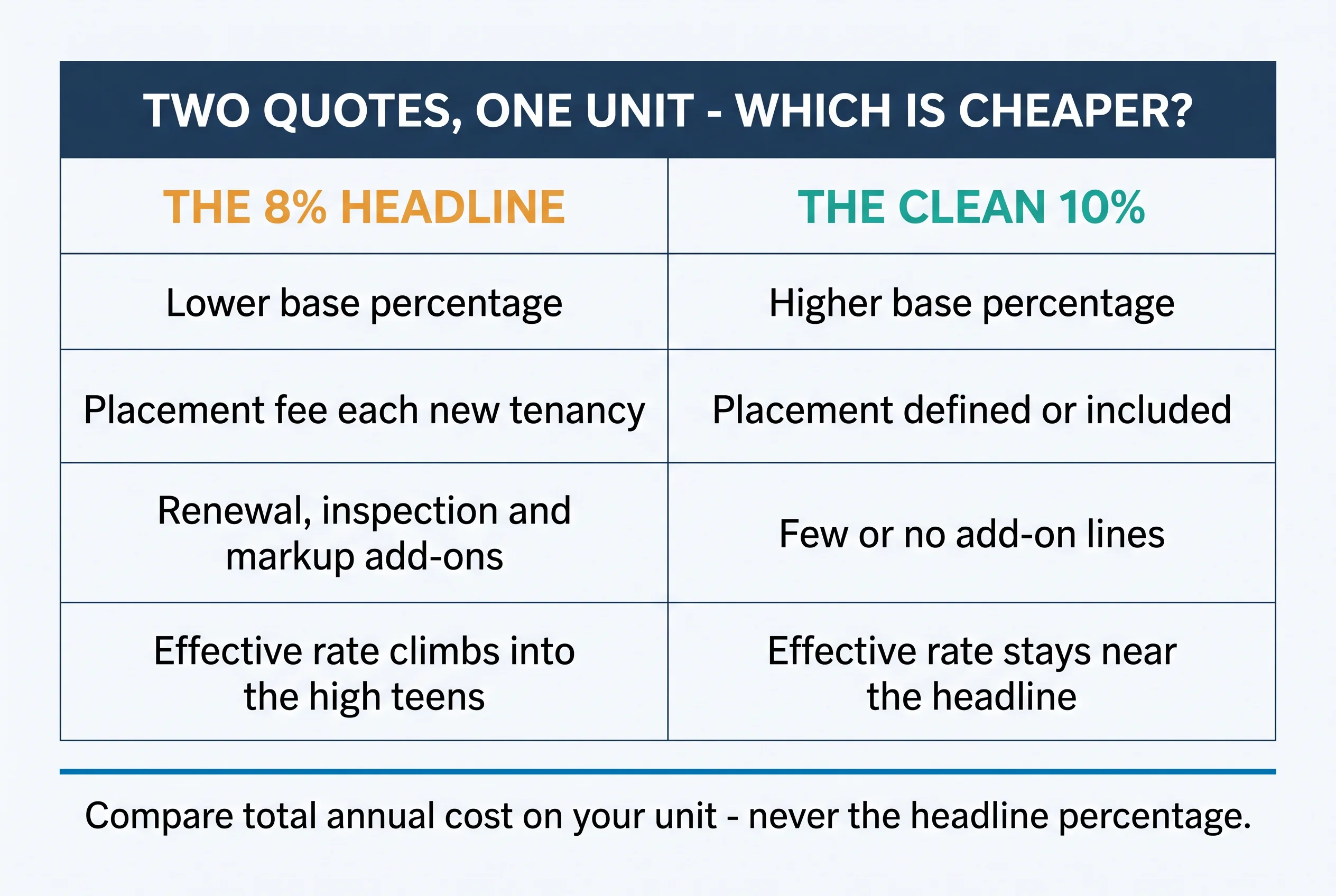
Scenario A — the 8% headline, in a turnover year. The base runs 8% of rent collected; with one vacant month, that's about $1,936. Add one placement at a full month's rent: $2,200. Add move-in and move-out reports billed at the guide rates: roughly $250. Add a 15% coordination markup on a $2,500 repair year: about $375. Annual total: roughly $4,760 — an effective rate near 18% of annual rent, from a quote whose headline said eight. The Calgary pricing guide's own arithmetic reaches the same place: a firm advertising 8% can cost 18–22% effective once all fees are stacked — which is why its bluntest sentence deserves quoting in spirit everywhere: always compare total annual cost, not headline percentage [Calgary firm pricing guide, May 2026].
Scenario B — the clean 10%. The base runs 10% of collected — about $2,420 in the same turnover year — with placement defined up front at half a month ($1,100) and no further add-on lines. Annual total: roughly $3,520, an effective rate near 13% — meaningfully cheaper than Scenario A despite the "more expensive" headline. And the gap widens in good years: in a no-turnover year, B settles toward its headline while A's inspection and markup lines keep arriving. The higher percentage was the lower price. It usually is, whenever the stack is tall enough.
A composite from our files — ours, not a reported case — is the same math with a face on it: the 8% that cost 19%. An owner collects three quotes, picks the lowest headline, and feels shrewd. Placement lands in March, the renewal fee in a neighbouring unit in June, billed inspections in April and November, markups through a rough plumbing summer. The month-twelve spreadsheet tells the story the quote didn't — and the owner's complaint isn't really the money. It's that nobody handed them the whole table.
The defence is one sheet of arithmetic: all fees ÷ annual rent = the effective rate — computed per quote, on your unit's rent and your realistic turnover, before signing. Ten minutes, once, against a year of surprises.
There's a tenant-facing corollary worth one paragraph, because transparency is an ethic or it isn't. Second Nature's 2026 survey found only 37% of tenants read their full lease — which means the few charges tenants can lawfully face need to be explained plainly at signing, not discovered later in a dispute. The same clarity that wins owner-clients keeps tenant relationships out of adjudication rooms; a firm that's transparent in only one direction isn't transparent, it's selective.
For property managers: The transparency pitch is the whole play. Publish the entire schedule, then walk every prospect through total annual cost on their own unit — before they ask. It's the registry logic of our brokerage work applied to money: the firm that volunteers its whole price wins against the firm that hopes nobody adds it up.
Pricing deliberately, reading professionally: the 2026 playbooks
The manager's playbook starts with cost-up math, not market-down math: your hours per door, systems, insurance, licensing where it applies, and tooling — priced as your own independent business decision. Then choose the model that fits your portfolio's rent band and vacancy profile; write the full schedule, every line a number or "not charged"; publish it; and sell two things — the alignment story your model genuinely earns, and the transparency itself. With 93% of firms feeling cost pressure [Buildium 2026], the honest responses are efficiency and deliberate pricing. Quiet add-on stacking is also a response; it's the one that ends relationships.
The efficiency route is real, not rhetorical: 58% of firms in the same survey now use AI somewhere in the operation, and the broader tooling shift — automated rent tracking, self-serve owner reporting, maintenance workflows — is precisely how a firm absorbs rising costs without quietly re-pricing them into the stack. A manager whose systems get cheaper per door each year can hold a clean schedule while competitors' schedules sprout lines; our guide to evaluating property management software covers what that tooling layer should actually do.
A final composite — ours — shows the upside: the firm that published everything. A mid-size manager prints its complete schedule on one page and opens every pitch by computing total annual cost on the prospect's own unit. It loses the bargain hunters immediately — they leave for lower headlines — and wins the five-year clients almost by default, because it's the only quote the owner could actually add up. Transparency worked as a filter, and the filter was the point.

The landlord's playbook runs in order: full written schedule first; the total-annual-cost sheet on your rent and realistic turnover; the collected-vs-charged check; the vacancy-billing check; the markup-disclosure check; then compare totals — never headlines — and finish with references, plus the public registry check where the firm operates as a brokerage. If you're weighing hiring against self-managing at all, our first-timer's landlord guide carries the DIY side of that math; the honest comparison is your time, distance, and error rate against the effective rate you just computed.
When you reach the reference calls, ask about money mechanics, not vibes: Did line items ever appear that weren't on the schedule? How were markups documented? What happened to the fee during their last vacancy? Three owners answering those three questions tell you more than any brochure — because the schedule you were shown and the invoices they received are either the same document or they aren't.
The year ahead points one direction: with costs still climbing, expect more hybrid menus and more à-la-carte unbundling — which makes quote-reading discipline more valuable every quarter, not less. The schedule-first habit is the one 2026 skill that appreciates.
Where Tenon10 fits: Every playbook in this article runs on records: rent tracked per unit and per month, expenses filed where year-end can find them, documents attached to the tenancy they belong to. Tenon10 keeps that layer clean for Canadian landlords and the firms they hire — with Ontario's rental compliance handled in-product on the tenancy side. See plans
The PM Fee Quote Reader & Schedule Builder: Add Up the Whole Table
A 19-point, both-sides checklist for Canadian property management pricing — landlords get the quote decoder and the effective-rate math that exposes what an 8% headline really costs; property managers get the cost-up logic and the full-schedule builder that turns transparency into a sales asset. The percentage is the headline. The schedule is the price.
Get Free PDF →Key takeaways
- The schedule is the price; the percentage is the headline. Total annual cost is the only comparable number.
- Identify the model first: percentage of what — and what happens in a vacant month. Collected or charged decides who carries the empty weeks.
- Inventory the stack: placement, renewal, inspections, markups — every line a number or "not charged," in writing, before signing.
- Compute the effective rate on your unit: all fees ÷ annual rent, at your realistic turnover — per quote, on one sheet.
- Managers: cost-up first, publish everything, sell the alignment. Transparency is a filter that keeps the clients worth keeping.
- Landlords: compare totals across quotes forced to show full schedules — and remember one avoided turnover beats two points of fee.
- Owner-side costs stay owner-side. Tenant charges are never the pricing model.
Add up the whole table
Property management pricing looks like one number and is actually a system — a model, a scope, and a stack — and nothing about the real cost hides. Every line is visible on a proper schedule; the trap was only ever arithmetic nobody performed. For managers, 2026 rewards the firm that prices deliberately and shows its whole table first. For landlords, ten minutes with a calculator turns three incomparable headlines into three comparable totals. The percentage was never the price. The schedule is the price — and everyone negotiates better the moment it's in writing.
Know your numbers before the quote arrives
Tenon10 keeps rent, expenses, and tenancy records clean per unit — the Canadian-first foundation under every fee conversation, whether you self-manage or hire it out.
Free plan available • Tenants always free • Contact us for firms
Related resources
- Property Management Software in Ontario — evaluating the tooling layer on its own comparison
- Lease Renewal Strategies in Ontario — where the retention math lives
- Is My Lease Legal? — including what tenants can and can't be charged
- Becoming a Landlord in Ontario — the self-managing side of the hire-or-DIY math
Frequently asked questions
What percentage do property managers charge in Canada?
Full-service residential management typically runs 6–12% of monthly rent collected, with the national average near 8–10%, per 2026 industry pricing guides. But the headline percentage is only part of the cost — the add-on schedule decides the rest, so compare total annual cost across quotes, never the percentages alone.
What does a property management fee include?
The market norm for the base fee: rent collection, tenant communication, maintenance coordination, routine inspections on a stated cadence, and financial reporting. Leasing a new tenant, major projects, and LTB representation are typically extra — which is why the written schedule matters more than the base rate.
Do property managers charge when the unit is vacant?
It depends entirely on the model. Percentage-of-rent-collected fees generally pause in a vacant month; flat fees generally bill through it. Neither is wrong — but the contract's exact wording decides, so read for "collected" versus "charged" and confirm the vacancy treatment before signing.
Why do property managers charge a leasing fee?
Placement is discrete, real work — advertising the unit, running showings, screening applicants, and executing the lease — typically billed at 50–100% of one month's rent per new tenancy. Frequent turnover multiplies it, which is why what a firm does to keep good tenants matters as much as what it charges to find them.
How do I compare property management quotes?
Demand the full written fee schedule from each firm — every line a number or "not charged" — then price every line on your unit's actual rent and realistic turnover, compute all fees ÷ annual rent for each quote, and compare those effective rates. Ten minutes of arithmetic is the whole method.


