

Ask ten Ontario property managers whether they need a licence and you'll hear the same confident sentence: "Ontario has no property management licence." It's true — and it has probably created more accidental lawbreakers than any other true sentence in this industry. Because Ontario never wrote a property management statute. It wrote something broader: a definition of trading in real estate that catches anyone leasing property for other people as a business, and a regulator — RECO, the Real Estate Council of Ontario — with a public registry, a rulebook that follows your lease client from the first showing, and, starting this October, annual financial filings signed by a real human being.
The law behind all of it is TRESA — the Trust in Real Estate Services Act, 2002 — and the people registered under it are registrants, working inside brokerages accountable through a broker of record. This guide walks the whole map: who actually needs registration (a three-bucket triage), what a brokerage is once you're inside one, how leasing work runs under TRESA's current rules, and the money-and-filings interlock that 2026 made unavoidable. It's written for both sides of the management agreement — the build-map for managers, and for landlords, the cheapest due diligence in real estate: a two-minute registry check.
The Ontario PM Registration Decision Checklist: Are You Carrying Others?
A 19-point checklist for Ontario property managers and the landlords who hire them — the honest activity inventory that decides whether you're trading in real estate, the brokerage build if the answer is yes, the leasing compliance sequence from the RECO Information Guide onward, and the money-and-filings discipline that October 2026 makes mandatory. Framework, not guesswork.
Get Free PDF →'No PM licence' — true, and misleading
TRESA is consumer-protection legislation, and it governs one activity: trading in real estate. It replaced the old Real Estate and Business Brokers Act — REBBA — with its most significant reforms, known as Phase 2, taking force on December 1, 2023. RECO administers and enforces it as a delegated authority on the province's behalf, and the foundational rule is short: registration is mandatory to legally trade in real estate in Ontario.
"Trading" is the load-bearing word, and it's wider than selling houses. Advertising rental units, showing them, negotiating tenancies, and executing leases — for other people, as a business — is trading. That's the mechanism by which a province with no "property management licence" still ends up requiring many property management firms to be registered brokerages: not because a PM statute says so, but because the leasing half of the job is real estate trading, and trading needs registration. The manager who only heard the first half of the sentence never sees it coming.
Three boundary lines keep the map honest. Managing a condominium corporation — the building entity itself — belongs to an entirely separate regulator, the CMRAO, with its own licences. Housing co-operatives live under their own statute and their own universe of rules. And nationally, Ontario is the outlier our licensing map has tracked across the cluster: British Columbia licenses rental property management outright through BCFSA, and Alberta routes it through RECA — Ontario alone reaches the same work through the trading definition instead of a dedicated licence.
Why does the half-sentence persist? Partly because it's genuinely true, and partly because the internet keeps answering the wrong question. Search "property management licence Ontario" and the top answers correctly say none exists — while the question that actually matters, does my leasing work make me a trader, rarely gets asked at all. The founders who get caught aren't reckless; they did their research and their research answered a different question.
The scale of the question is not small. Canadian property management is a $10.7 billion industry across 36,011 firms (IBISWorld, May 2026), and the client base whose work forces the registration question is growing on its own: TRREB logged 24,012 condo rental listings in Q1 2026, up 6% year over year — tens of thousands of investor-owned units, most of them leased by somebody other than the owner.
The three buckets: who needs registration
Everything in this section is a framework for understanding the landscape — not legal advice, because the line calls genuinely depend on facts. With that said plainly, the terrain sorts into three buckets.
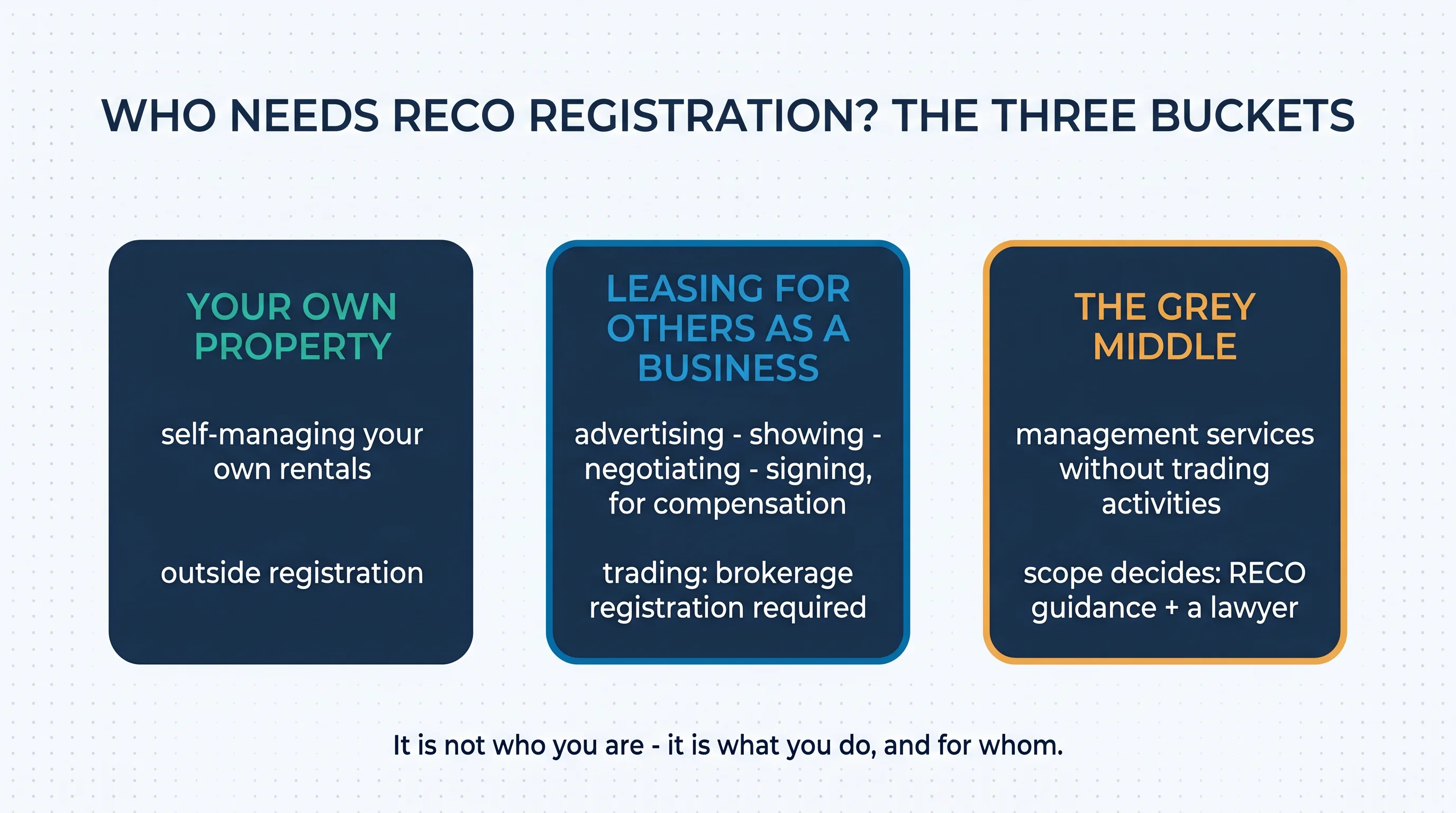
Bucket one: your own property. Owners dealing with their own units — including every self-managing landlord in the province — sit outside registration. Renting out your own basement apartment is not trading in real estate; neither is showing your own condo or signing your own lease. If you're becoming a landlord for the first time, registration is one worry you don't have.
Bucket two: leasing for others as a business. Advertising units you don't own, showing them, negotiating tenancies, and signing leases for owner-clients, for compensation — that's the trading pattern, and it requires a RECO-registered brokerage. This is where most full-service property management firms live, because full-service management almost always includes the leasing work.
Bucket three: the grey middle. Some management services involve no trading activities at all — coordinating maintenance, running inspections, collecting rent under a tenancy that already exists. Whether a particular mix of services crosses into trading is the classic scope-of-services question, and the deciding factors are always the same three: which activities, for whom, and for what compensation. The honest answer for anyone in this bucket is that the line call belongs to RECO guidance and a lawyer — with the scope of services written down either way. Firms that deliberately split registered leasing services from contracted management services exist, and the operative word is deliberately: in writing, with counsel, not by vibes.
A composite from our files — ours, not a reported case — shows how bucket three quietly becomes bucket two. A handy condo investor starts leasing a unit for a friend. It goes well. Five friends becomes fifteen owner-clients; there's a fee now, and a listing template, and a showing routine. Nobody set out to break anything — but advertising, showing, and signing for others, for compensation, is an unregistered trading pattern of exactly the kind RECO takes complaints about and investigates. The fix, when it came, wasn't a clever workaround: it was registration or restructuring, decided with counsel.
For landlords: The two-minute check. RECO's registry is public and searchable at reco.on.ca — before any manager signs leases on your behalf or holds a dollar of your money, look them up. Registration status is the single best predictor of every other discipline a firm will bring to your property.
Inside a brokerage: broker of record, registrants, and PRECs
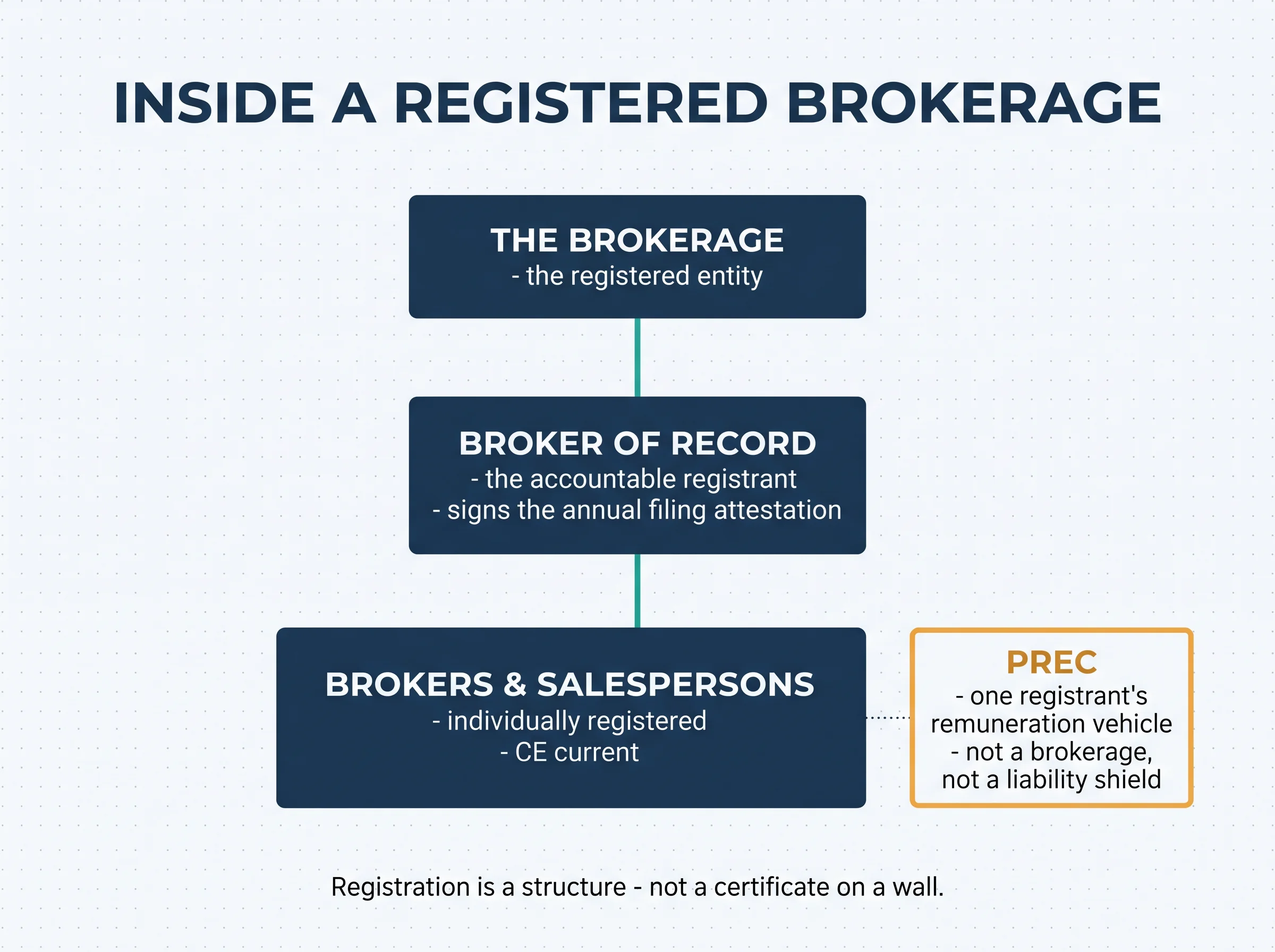
If the triage says yes, the destination is a structure — not a certificate on a wall. At the top sits the brokerage, the registered entity that holds the trade files, the trust money, and the accountability. Inside it, one registrant carries a special weight: the broker of record, the person accountable for the brokerage's compliance and supervision — and, as of this fall, the person whose signature carries the attestation on the brokerage's annual financial filing to RECO. Below and around them work the brokers and salespersons, each individually registered, alongside staff who handle the non-trading work.
Getting in is an education path, not a form: the salesperson pre-registration program, then registration, then post-registration requirements — with a separate broker program above it for those who'll carry the broker class — and mandatory continuing education forever after. Registration also brings the mandatory insurance program with it: consumer deposit insurance behind the money brokerages hold, errors and omissions coverage behind the work, and commission protection behind the remuneration. Those are the categories; RECO's fee schedule carries the current amounts, and they change, so we won't print numbers here.
One structure deserves its own honest paragraph because it gets misdescribed constantly: the PREC, or personal real estate corporation. A PREC is a remuneration vehicle for one registrant — exempt from registration itself because it trades only by providing its controlling registrant's services to the brokerage, with the brokerage paying that registrant's remuneration into the corporation. What a PREC is not: it cannot carry on business as a brokerage, it cannot advertise itself as one, and it is not a liability shield — professional obligations and RECO discipline attach to the registrant personally, incorporated or not. Whether one makes financial sense for you is a tax question, and tax questions go to an accountant.
The rulebook itself sits in a short stack worth having on the shelf: TRESA 2002, O. Reg. 567/05 (the General regulation), O. Reg. 579/05 (education, insurance, and records), and the regulation behind the Information Guide — the document the next section turns on.
Plan the build in real time, not wishful time. Month one is the activity inventory and the counsel conversation. If the triage says register, the education-and-registration path is measured in months, not weeks — which is why the sensible founder starts the records discipline, the trust-grade money habits, and the written scope agreements on day one, before the registration lands. Nothing about doing the operational work properly has to wait for a certificate; only the trading does.
Where Tenon10 fits: Whichever bucket you land in, the discipline underneath is the same: organized records, per-tenancy files, and money movements you can trace. Tenon10 is that general layer — Canadian-first property and tenancy records with Ontario rental compliance built in — the foundation under a well-run operation. (RECO filings and brokerage compliance obligations remain yours and your accountant's; we're the records under them.) Contact us
Leasing under TRESA: rules that follow the client from the first showing
Sales agents got two years of retraining when TRESA's Phase 2 landed. Leasing desks, in our observation, are still catching up — and the rules apply to them with exactly equal force. Four beats matter most.
The Guide comes first
Per RECO's own FAQ, the RECO Information Guide must be provided and explained before providing any services or assistance to prospective lease clients — residential and commercial alike. Not at signing. Not with the lease package. Before services begin. It's the single most-missed TRESA obligation in leasing practice, precisely because it feels like a sales-side formality — and it isn't one. If a prospective landlord client walks into your office asking you to lease their condo, the Guide conversation happens before the listing does.
Client or self-represented — nothing between

Phase 2 abolished the old middle category: per RECO's bulletin on customer relationships, new customer agreements ended, and everyone in a trade is now either a client under a representation agreement or a self-represented party — an SRP. In leasing terms, the owner is typically the brokerage's client, and the applicant who shows up to view the unit is commonly an SRP. That makes the disclosure discipline a showing-room skill, not a paperwork skill: the SRP must genuinely understand that nobody in the room is acting for them, and a registrant can assist an SRP only while representing a client in the transaction. The showing is where that conversation happens — not the signing table.
The paper
Representation agreements under TRESA are held to a clear-and-complete standard: the services, their limits, and the remuneration spelled out — and the expiry date displayed prominently on page one, initialled by the client. Where a brokerage would represent more than one client in the same trade, written consent from every client is required before proceeding — multiple representation is a consent event, never a default. One further model deserves a careful sentence: TRESA contemplates a designated-representation approach as well — confirm its current status with RECO before building anything on it.
Advertising
RECO's advertising bulletins hold listings and marketing to a plain standard: accurate and not misleading, with consent before identifying parties — and in many cases specific properties — connected to a transaction, and online claims that are factual and verifiable. For a leasing operation that lives on listings, this is daily-practice law, not fine print.
Made concrete: the listing that says "steps from the subway" when it's a twenty-minute walk is a TRESA problem before it's a marketing problem; the celebratory post about a just-leased unit that identifies the building and the new tenants needed consent it probably never collected; and the "top-rated leasing team" claim needs to be factual and verifiable the day RECO asks. A leasing desk publishes more marketing in a month than a sales team does in a quarter — the exposure scales the same way.
A second composite — ours again — shows how the whole section fails at once. A registered brokerage builds a property management division; the division treats the Information Guide as a sales-side form and never adds it to the leasing workflow. Eighteen months later a single tenant complaint puts the division's files in front of RECO — and the same defect sits at the front of every lease file the desk ever opened. Nothing dramatic went wrong; one workflow step was missing everywhere.
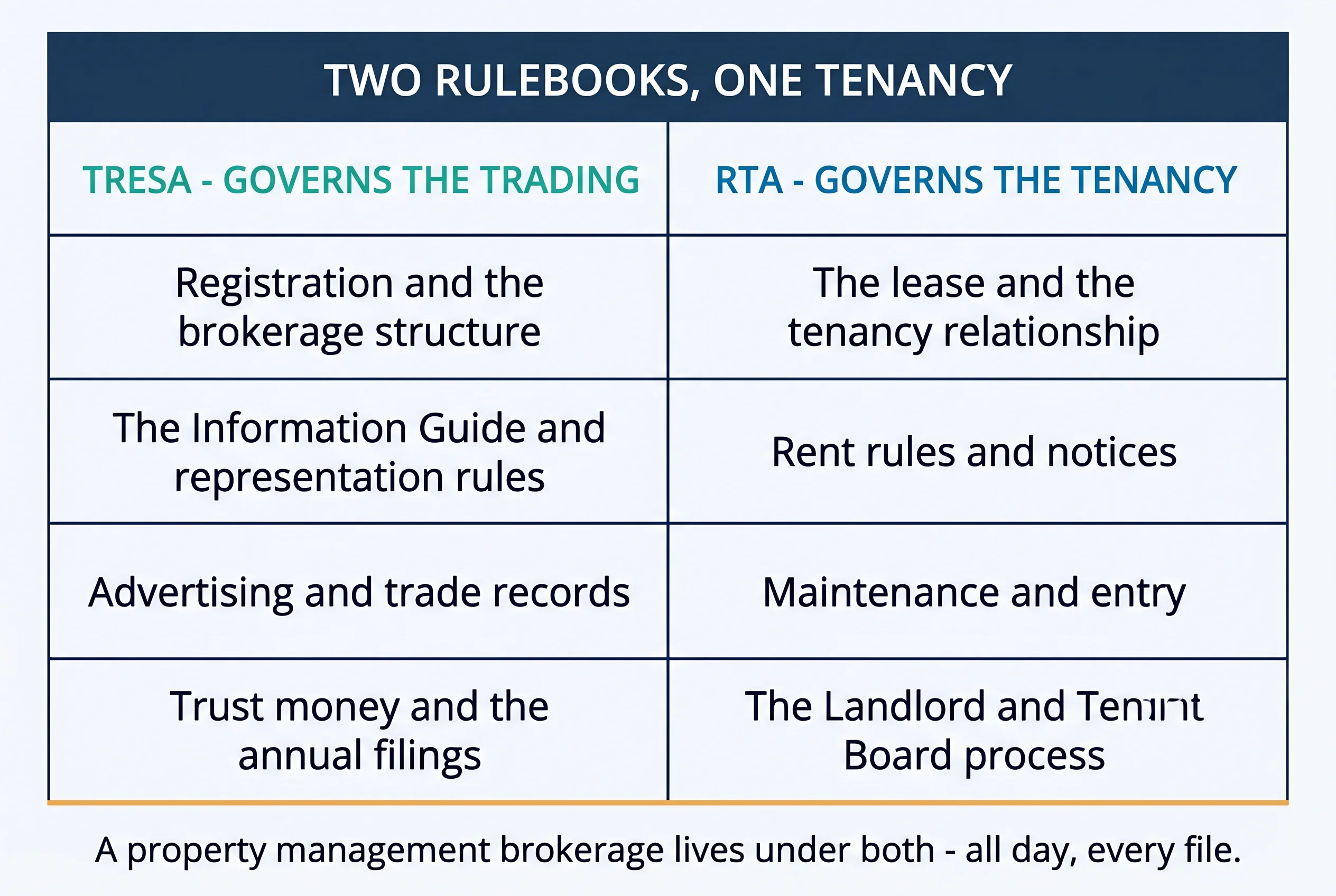
One more orientation matters before the money: TRESA is only half the law a PM-brokerage lives under. TRESA governs the trading; the Residential Tenancies Act governs the tenancy itself — the lease, the rent rules, the notices, the LTB. The N4 you serve, the L1 or L2 you file: that's RTA machinery, and our landlord guides cover it form by form. Two rulebooks, one tenancy, all day, every file.
The money and the filings: the 2026 interlock
Money a brokerage holds for others — deposits, rents collected for owner-clients — lives in trust, held apart from the firm's own funds and tracked to a standard where every dollar answers to a ledger. The full record discipline behind that sentence is its own subject, and our Ontario trust accounting guide covers it in depth; here, the summary is one line: trust money is the client's money, temporarily in your custody, provable at all times.
What's new is who checks. Annual financial filings to RECO take effect October 1, 2026, with the first deadline October 30, 2026 — and each filing carries a broker-of-record attestation, a named human certifying the brokerage's financial discipline. Monthly trust-reconciliation reporting is planned for 2027. Behind the deposits sits RECO's consumer deposit insurance, and into this system file the brokerages serving Ontario's 110,000+ registrants. The direction of travel is unmistakable: money discipline is moving from something a brokerage privately maintains to something it regularly proves.
Enforcement matured alongside. Since Phase 2, RECO can levy administrative penalties directly and issue compliance orders, with raised maximum penalties and published discipline decisions — meaning less-serious violations no longer wait for a full tribunal process to carry consequences. The risk math on casual non-compliance changed in 2023; the filings regime is about to make the change legible in every brokerage's October.
There's a second onboarding path this section speaks to directly: the established sales brokerage adding a property management division. The registration question is already answered — but the compliance questions multiply, because leasing files, owner-client trust money, and long-running management relationships live differently than transaction files. The move for that firm is a leasing-compliance audit this quarter — Guide workflow, representation paper, advertising consents, trade-file completeness — and filing readiness now, because the October attestation will certify the new division's discipline along with everything else.
The year ahead — and the landlord's two-minute check
The watch list from mid-July 2026 is short and concrete. The first annual filings cycle lands October 30 — the moment the new regime stops being an announcement. The 2027 monthly trust-reporting build-up follows behind it. The representation-model question flagged in the paper section sits with RECO. And TRESA itself keeps evolving — the industry's association is already lobbying for a third phase of reforms — so the rulebook a brokerage learned in 2023 is not the last version it will learn.

The market context makes registration a commercial asset, not just a legal status. Operating costs keep climbing and technology adoption keeps accelerating across the industry (Buildium's 2026 North American survey has 93% of firms reporting rising expenses and 58% using AI somewhere in the operation) — and in a supply-heavy year, with CMHC's mid-2026 read showing major markets favouring tenants, owners outsource leasing precisely because units are harder to fill. Demand is shifting toward leasing help that is registered, visible, and checkable — because that's what nervous owners in a soft market buy.
For landlords: What an unregistered manager actually costs you: no RECO accountability channel when something goes wrong, no brokerage insurance program behind your deposits, no registry record to check and no discipline history to read. None of that is visible on the day you sign the management agreement — all of it is visible in a registry search that takes two minutes and costs nothing.
Where Tenon10 fits: Registered or bucket-one, the operational spine is identical: clean tenancy records, findable documents, traceable money movement, and Ontario's rental compliance handled in the software — guideline math, the right notices, the LTB forms for the RTA side of every file. That's the layer Tenon10 provides, for landlords self-managing and for the firms they hire. See plans
The Ontario PM Registration Decision Checklist: Are You Carrying Others?
A 19-point checklist for Ontario property managers and the landlords who hire them — the honest activity inventory that decides whether you're trading in real estate, the brokerage build if the answer is yes, the leasing compliance sequence from the RECO Information Guide onward, and the money-and-filings discipline that October 2026 makes mandatory. Framework, not guesswork.
Get Free PDF →Key takeaways
- Inventory your activities honestly, in writing: advertise, show, negotiate, sign — for whom, and for what compensation. The answer decides everything downstream.
- Triage the buckets: your own property is outside; leasing for others as a business needs a brokerage; the grey middle goes to RECO guidance and a lawyer, with the scope written down.
- If you register, build the structure: broker of record named and genuinely supervising, insurance in force, education and CE current.
- Put the Information Guide into the leasing workflow — provided and explained before services, every lease client, residential and commercial.
- Get the paper right: representation agreements with the expiry prominent on page one and initialled; written consent from every client before any multiple representation.
- Run the money to trust-grade standard and calendar October 30 — the attestation certifies the year behind it.
- Landlords: check the registry before the management agreement, not after — it's two minutes, it's free, and it predicts everything else.
Are you carrying others?
Ontario never wrote a property management licence — it wrote a better question. Row yourself across and you're a traveller; carry others for coin and you're a ferry, and ferries are built, registered, and inspected differently for good reason. For a manager, the honest sequence is the inventory, the triage, and — if the answer is yes — building the brokerage properly, because the alternative isn't a clever position, it's a consumer-protection gap with your name on it. For a landlord, it's simpler still: the registry is public and the check takes two minutes. The firms that win the next decade of Ontario property management won't be the ones that found the line. They'll be the ones that built visibly on the right side of it.
Build on the right side of the line
Tenon10 keeps tenancy records, documents, and Ontario rental compliance organized the Canadian-first way — the operational spine under landlords and the firms they hire. Managing at scale? Let's talk.
Free plan available • Tenants always free • Contact us for firms
Related resources
- L1 vs L2 LTB Applications — the RTA-side machinery every PM-brokerage still runs
- The N4 Notice in Ontario — the arrears notice, form by form
- Income Verification for Self-Employed Tenants — the leasing desk's screening companion
- Becoming a Landlord in Ontario — the bucket-one path, end to end
- Property Management Software in Ontario — evaluating the tooling under a practice
- External: RECO (reco.on.ca) — the public registry, the TRESA FAQs, and the bulletins this article summarizes
Frequently asked questions
Do property managers need a licence in Ontario?
There's no PM-specific licence — but leasing property for others as a business is trading in real estate under TRESA, which requires registration with RECO through a brokerage. Self-managing your own property doesn't require registration at all.
Can I lease apartments for someone else without a licence?
Doing it as a business — advertising, showing, negotiating, and signing for compensation — is the trading pattern that requires registration. One-off or grey-area situations are exactly what RECO guidance and a lawyer are for; the line call shouldn't be made by guesswork or forum consensus.
What is a self-represented party under TRESA?
Someone in a transaction who isn't any brokerage's client. Registrants must make sure an SRP understands that nobody is acting for them, and can assist an SRP only while representing a client in the same transaction — a conversation that belongs at the showing, not the signing.
What does a broker of record do?
The broker of record is the registrant accountable for the brokerage — supervision, compliance, trust oversight, and, since October 2026, the attestation on the brokerage's annual financial filing to RECO. It's the accountability centre of gravity in the structure.
Is my property manager registered with RECO?
Find out in two minutes: RECO's registry is public and searchable. Check before your manager signs leases or holds your money — registration brings RECO's accountability channel and the mandatory insurance program with it, and its absence removes both.


