

As of July 29, 2026. Ontario doesn't have a renoviction licensing law — it's growing a renoviction template. Hamilton wrote the first draft, in force January 1, 2025. Toronto ordered a "Hamilton-style" version and made it heavier, live since July 31, 2025. London took its own copy. And Ottawa joined this month, 21–5, with a twist nobody else tried — the building permit before the notice itself — effective January 1, 2027.
What's converged is the spine: seven days from the N13 to a municipal licence application, everywhere the template has landed. What's diverged is everything a landlord actually budgets and a tenant actually receives: fees, proofs, protections, enforcement, even the order of permit and notice. This tracker puts the three regimes side by side, dated cell by cell — and it will grow as the table grows rows.
The Three-City Renoviction Licence Comparison
All six dimensions side by side — deadlines, fees, verification, tenant protections, enforcement, and each city's distinctive — every cell dated, on one landscape page, maintained as the regimes evolve.
Get Free PDF →The template, and how it spread
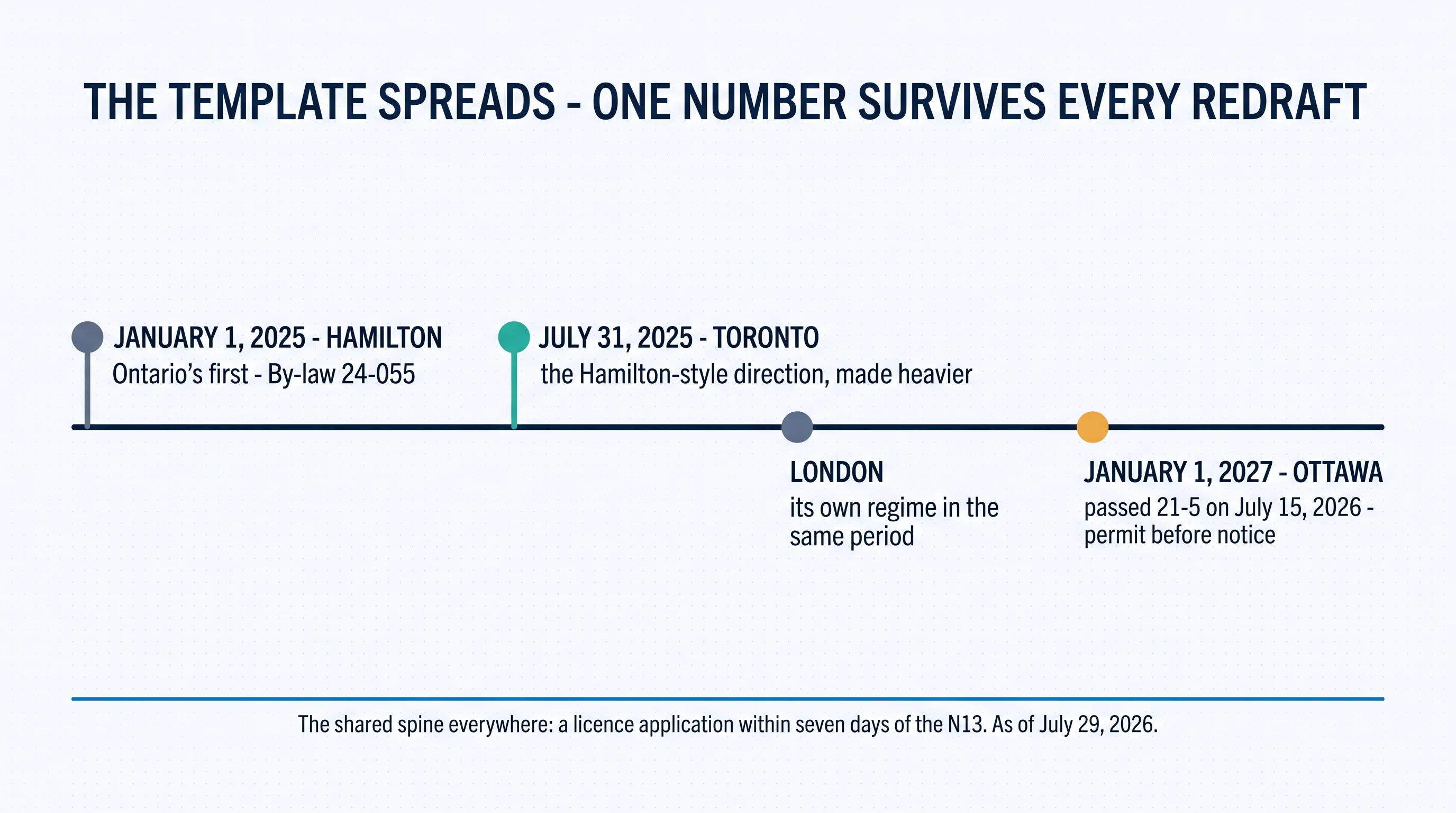
The diffusion is documented in the councils' own paper. Hamilton passed Ontario's first regime — By-law 24-055 — effective January 1, 2025. Toronto's June 2024 council direction literally instructed staff to draft a "Hamilton-style" bylaw; it was adopted November 14, 2024 and came into force July 31, 2025. London developed its own regime in the same period. And Ottawa's review studied the earlier models before council passed its version 21–5 on July 15, 2026, effective January 1, 2027. Council by council, one number survived every redraft: seven days.
The copying is rational, not lazy. A council that borrows a working template inherits a legal framework already stress-tested against the provincial-jurisdiction question, a fee logic already defended in another chamber, and a staff report half-written by precedent. That's why the diffusion accelerated — Hamilton's draft took years, Toronto's took months, Ottawa's review moved from direction to bylaw in eighteen — and why the next adopter will likely move faster still.
What drove it, printed with the honesty the source reports themselves kept: N13 notice counts rose steeply — Hamilton reported a 983 per cent increase between 2017 and 2022, and provincial analyses found roughly a 300 per cent rise with Toronto highest. Those are counts of notices, not adjudicated findings of bad faith — the underlying reports say as much — and the councils legislated on the pattern, not the proof. That honesty matters in both directions: it means nobody should read the licensing regimes as a finding that most renovation evictions were bad-faith — and it means nobody should dismiss them as baseless, either, because a 983 per cent rise in any legal notice is a pattern a council is entitled to regulate around while the adjudicated truth catches up.
All three worked inside the same legal box: eviction law is provincial and exclusively the LTB's, so a city can't veto a notice — but it can license the work, regulate the paperwork, and mandate the information that travels with a notice. Each city used that space differently, and the differences are the rest of this piece.
Hamilton — the first draft
By-law 24-055 requires the licence application within 7 days of issuing the N13, at $715 per unit with a $125 annual renewal — renovations running past a year renew the licence, and a late reinstatement fee may apply. The application needs an engineering report proving vacant possession is necessary, and penalties for violations range from $500 to $50,000 depending on the entity.
The quiet innovation is enforcement. Hamilton's regime runs primarily on complaints — and when one arrives, officers may request the relevant files from the Landlord and Tenant Board and compare them against the city's own records to find violations. That cross-referencing just became easier for everyone, incidentally: LTB final orders became public data this month — the same comparison Hamilton's officers run is now available to tenants, journalists, and any other city considering the template.
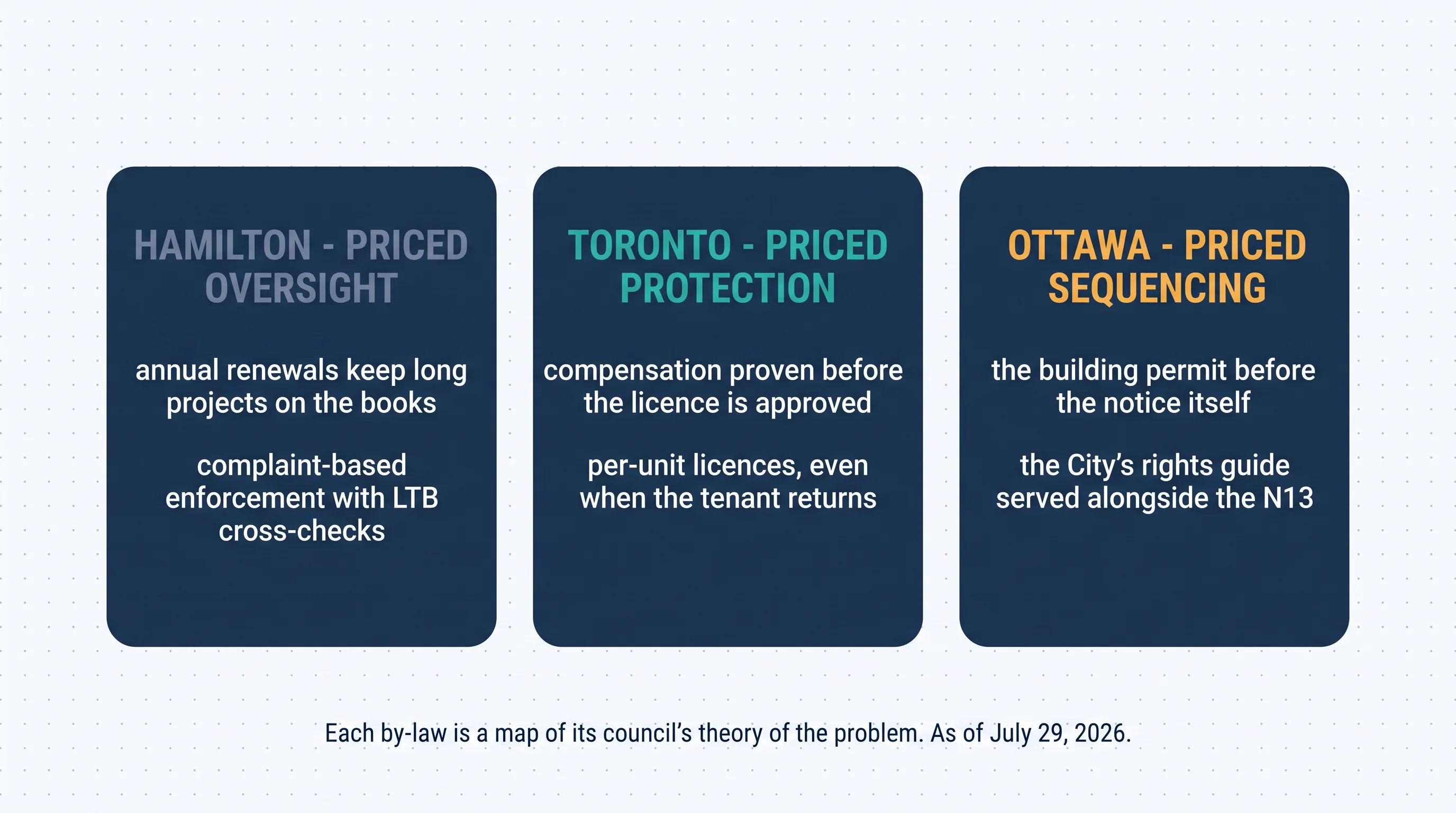
The distinctive read: Hamilton priced ongoing oversight. The renewal cycle keeps long renovations on the city's books year over year — a project that drifts doesn't drift out of view. Worked practically: a gut renovation that slips from ten months to fourteen crosses a renewal boundary — the $125 renewal (and the late reinstatement fee, if missed) is trivial money, but the renewal event is the point: it forces the file back onto someone's desk, the city's and yours, at exactly the moment schedule drift begins threatening the tenant's return timeline.
Toronto — the heavier copy
Bylaw 53-2025 charges $700 per unit — and it's a separate licence for each unit where an N13 has been issued. Demolitions are excluded, and the scope note that surprises people most: the licence is required even if the tenant intends to return. The trigger is the notice for work requiring vacancy, not the tenant's decision about coming back. The logic is worth seeing: the bad-faith pattern the bylaw targets often begins with an assurance of return that later evaporates, so a regime keyed to the tenant's stated intention would exempt exactly the files it most wants to see. Keying to the notice closes that door.
The sequence runs notice-first: the N13 is delivered, then the licence application follows within 7 days — supported by building permits and a certified architect or engineer verifying the renovation genuinely requires vacancy — and the city notifies the tenant once it receives a complete application.
The mechanism that defines Toronto's version: the tenant-protection plan is a licensing precondition. For a returning tenant, the landlord arranges temporary alternate accommodation or pays monthly rent-gap compensation; for a tenant not returning, roughly three months' rent plus a one-time moving allowance — and proof of compensation must be submitted before the licence is approved. Compliance first, licence second — the usual enforcement order, inverted.
The teeth: fines up to $1,000 for missing the seven-day deadline and up to $10,000 per day for continuing offences, with the city able to inspect while the work is underway.
💡 For landlords: Toronto budgeting is per-unit and front-loaded — the fee, the professional's letter, and the compensation all price into the project before the licence exists. Model the whole stack before serving the N13, because the bylaw won't let you sequence it later.
Ottawa — the reordered newest
The compressed version — our full Ottawa guide shipped this morning: passed 21–5 on July 15, in force January 1, 2027, licence application within 7 days of issuing the N13 — and two features no other city tried. First, the building permit must be obtained before the notice is issued — the only regime that reorders permit-before-N13, moving the whole project calendar earlier. Second, a city-produced tenant education guide is served alongside the notice itself — every renovation eviction arriving with its own instruction manual. The city is copied on the notice, unit information accompanies the application, and the fee is TBD — committee-stage reporting described it as free; confirm on ottawa.ca as the administrative details publish.
The distinctive read: Ottawa priced sequencing. Where Toronto front-loads compensation, Ottawa front-loads the permit.
The table — and the routing matrix
Everything above, in one view — the reason this page exists, and the version we maintain as the regimes evolve:
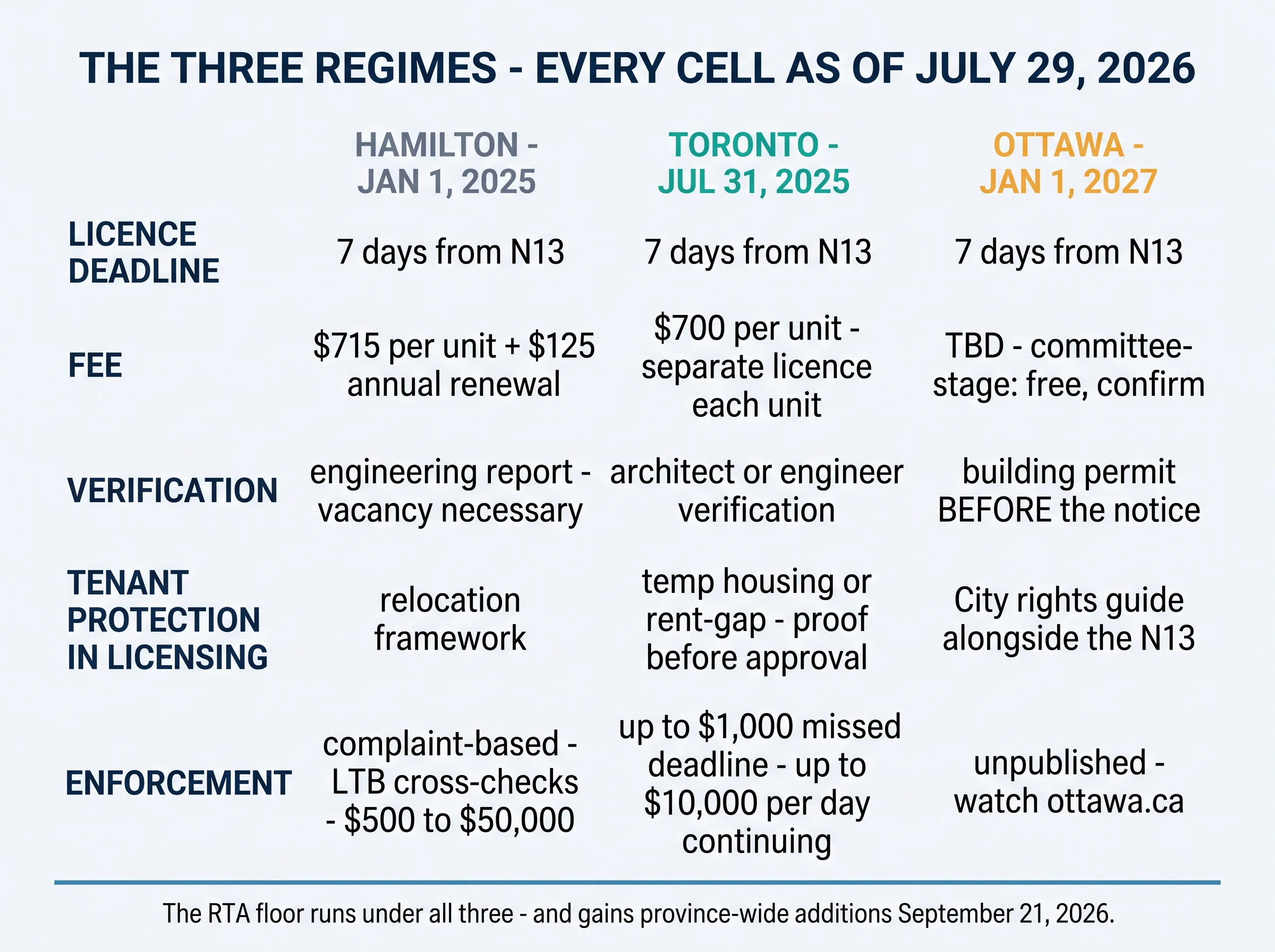
The routing rule for anyone operating across city lines: which rulebook binds is a function of where the unit sits times when you serve. Worked through: a Hamilton unit served in August 2026 runs Hamilton's regime plus today's RTA — with September's provincial additions arriving mid-process, so the timeline estimates should be drafted before they're mandatory. A Toronto unit with a returning tenant prices the rent-gap-versus-temporary-housing choice before the N13, because it's a precondition of the licence, not an aftermath. An Ottawa renovation planned for spring 2027 starts with the permit now — the notice waits.
The matrix has a records corollary: because the rulebook varies by city and date, the compliance file is the only portable proof of having gotten it right. A landlord who can produce the permit date, the notice date, the licence application date, and the compensation trail can answer any of the three cities — and the LTB — from one folder. A landlord who can't is reconstructing chronology from memory in whichever forum asks first.

💡 For property managers: Template the compliance file per city, once — the three checklists differ enough that one generic N13 file fails somewhere: Hamilton's wants the engineering report and the renewal calendar; Toronto's wants the professional's verification and the compensation proof; Ottawa's will want the permit date ahead of the notice date. The comparison PDF above carries all three side by side for exactly this.
And the three distinctives, as a map of three councils' minds:
The floor underneath — and what to watch
Under all three regimes, everywhere in Ontario, runs the one layer no council wrote: the RTA. Its N13 baseline — 120 days' minimum notice, the right of first refusal exercised by the tenant's written notice, compensation of one to three months' rent by building size, the rent cap on return — applies in every city, licensed or not. And on September 21, 2026, that floor gains its own renoviction teeth province-wide: mandatory timeline estimates, completion notification, a minimum 60-day window for the tenant's return, and the automatic assumption against a landlord who doesn't follow them — the second Bill 60/97 wave our capstone covers. One reading of the whole table from the tenant's chair: the cities aren't granting new rights so much as making existing ones harder to lose — Hamilton by keeping a record, Toronto by collecting the money up front, Ottawa by delivering the instructions with the notice. Municipal licences sit on top of that floor; the LTB alone decides the eviction itself, in every city, always.
Watch how the layers will interact after September: the provincial automatic-assumption rule turns missing paperwork into a presumption against the landlord at the Board — and the municipal regimes, whatever else they do, generate paperwork: permits, professional letters, compensation proofs, licence dates. A landlord compliant with their city's licence will, almost incidentally, hold most of the file the provincial rules reward; the regimes reinforce each other from opposite directions, which may prove to be the template's quietest strength.
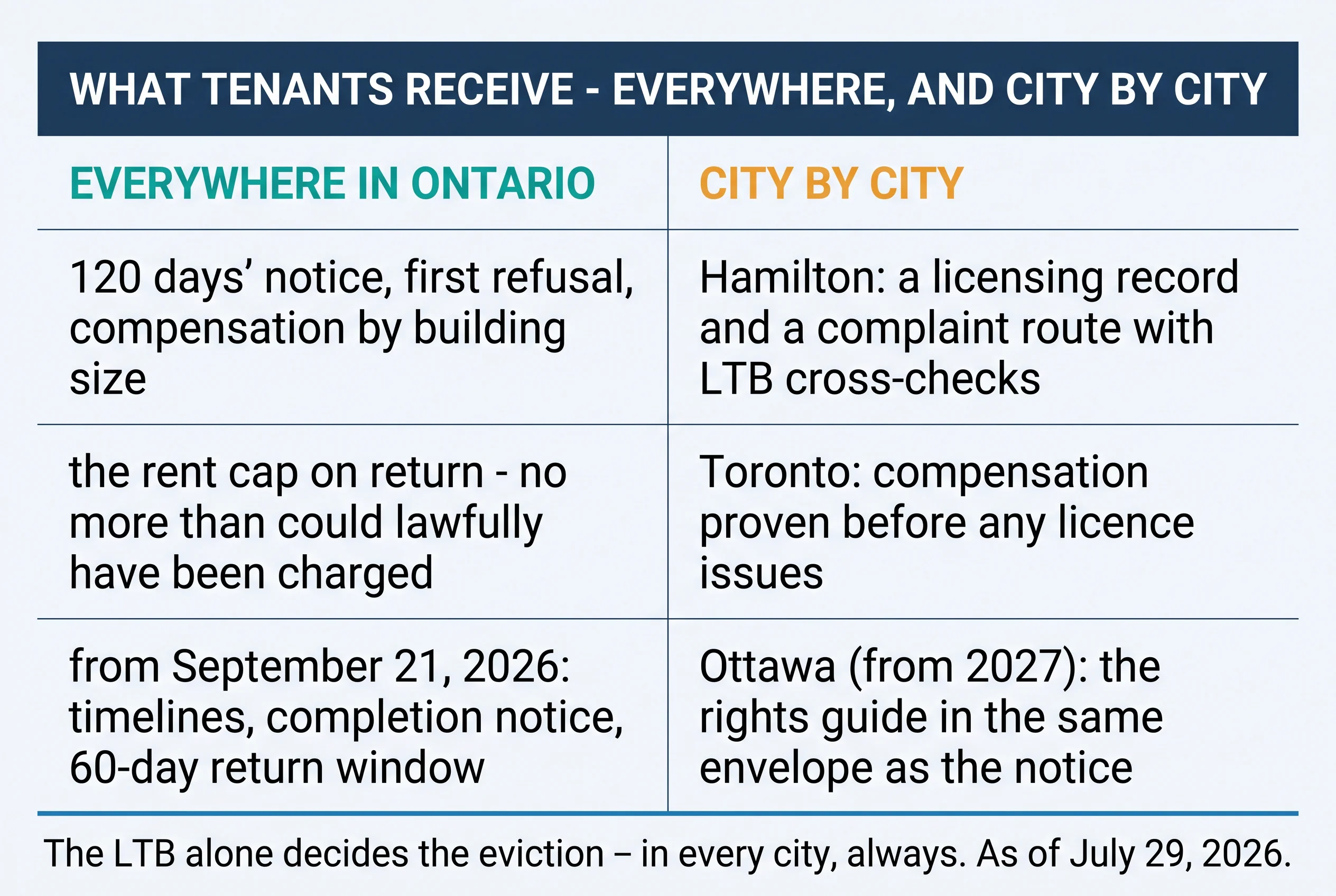
💡 For tenants: Your provincial rights travel with you to every city on this page — the notice period, the first refusal, the compensation. What the city adds depends on where you live: in Hamilton, a licensing record you can ask about and a complaint route; in Toronto, compensation that must be proven before any licence issues; in Ottawa from January, the city's rights guide arriving in the same envelope as the notice — and its absence being a signal in itself. If an N13 arrives, start with our N13 guide, put your first-refusal intention in writing early, and know the LTB — not the city — decides any dispute.
What to watch — the cells most likely to change: Ottawa's administrative details (fee schedule, penalties, application process) landing on ottawa.ca before January; the September provincial layer arriving everywhere; and new adopters — London's regime already runs, and more councils are reading the same template. This tracker is maintained; the cells will move. And when the next council adopts, the template predicts the shape of its bylaw before the staff report is written: a seven-day licence clock, a professional-verification requirement, a tenant-information mechanism, and one local twist — because every adopter so far has kept the spine and signed its own name on exactly one feature.
💡 The constant across all three cities is the file: notices with computed dates, service records, compensation paper trails — whichever city's layer applies, the file is what both the city and the Board read. That's what Tenon10's wizards and ledgers build as you go. Free for up to 3 units, tenants free on every tier. Create a free account or see current plans.
The Three-City Renoviction Licence Comparison
All six dimensions side by side — deadlines, fees, verification, tenant protections, enforcement, and each city's distinctive — every cell dated, on one landscape page, maintained as the regimes evolve.
Get Free PDF →Key takeaways
- Three Ontario cities license renovation evictions — Hamilton (January 2025), Toronto (July 2025), Ottawa (January 2027) — with London a fourth adopter: no single law, a spreading template.
- The spine converged: seven days from the N13 to the licence application, in all three.
- Everything else diverged: $715 plus renewals versus $700 per unit versus TBD; engineer letters versus permit-first; Toronto's compensation-proven-before-approval standing alone.
- The RTA floor runs under all of it everywhere — and gains its own renoviction teeth province-wide on September 21, 2026.
- Multi-city operators: the rulebook is where-the-unit-sits times when-you-serve — template the file per city.
- No city can stop an eviction — the LTB decides; the bylaws license, document, and compensate around it.
The table will grow rows
Three councils, three theories of one problem: Hamilton priced oversight, Toronto priced protection, Ottawa priced sequencing — and all three agreed, independently, that seven days was the number. That's what a template looks like while it spreads: a shared spine, local variations, and a growing list of councils reading each other's drafts. The provincial floor strengthens in September everywhere; Ottawa's cells fill in before January; and somewhere in Ontario, another committee is probably scheduling the staff report right now. This tracker is maintained for exactly that reason — as of July 29, 2026, revised as the regimes evolve.
Whichever city — the file is the constant
Notices as guided wizards, service recorded, compensation trails assembled as you go — the N13 file that satisfies whichever rulebook applies. Free for up to 3 units.
Free for up to 3 units • Tenants always free • See current plans
Related resources
- Ottawa's Renoviction Bylaw — the full deep-dive on the newest regime.
- Bill 60 and Bill 97, Six Months In — the provincial floor and September's additions.
- N12 vs N13 Notices — the provincial baseline every regime builds on.
- The Municipal Landlord Licensing Tracker — the separate long-term licensing regimes, city by city.
Frequently asked questions
Which Ontario cities require a renovation licence?
Hamilton (since January 1, 2025), Toronto (since July 31, 2025), and Ottawa (from January 1, 2027) — with London also operating its own regime. Each city's rules differ; the shared element is a licence application within seven days of issuing the N13.
How much does a rental renovation licence cost?
Hamilton: $715 per unit plus a $125 annual renewal if work runs past a year. Toronto: $700 per unit, with a separate licence for each unit. Ottawa: to be confirmed — committee-stage reporting described it as free; watch ottawa.ca as the administrative details publish.
Do I need the licence if my tenant plans to return?
In Toronto, yes — the bylaw applies whenever an N13 is issued for work requiring vacancy, even if the tenant intends to return. Check each city's scope rules; the trigger everywhere is the notice, not the tenant's decision.
What happens if I miss the seven-day deadline?
It varies by city: Toronto's fines start at up to $1,000 for the missed deadline and reach up to $10,000 per day for continuing offences; Hamilton's penalties range from $500 to $50,000 by entity; Ottawa's enforcement details are unpublished. In every city, the deadline runs from issuing the N13 — diarize it at service.
Do these bylaws override the provincial rules?
No — they layer on top. The RTA governs every renovation eviction everywhere in Ontario (120 days' notice, first refusal, compensation), gains province-wide additions on September 21, 2026, and the LTB alone decides disputes. The municipal licences regulate the work and the paperwork around the eviction, not the eviction itself.


