Picture two houses on the same street in the same Ontario town. Same rent. Same tenant. Same landlord living upstairs. In the first house, the tenant has the full protection of the Residential Tenancies Act and the Human Rights Code — rent control, notice rules, the Landlord and Tenant Board, protection from discrimination, all of it. In the second house, neither statute applies to that tenant at all. Not weakened. Not modified. Absent.
The difference between the two houses is a kitchen.
House hacking — living in one part of a property while renting out another — is sold everywhere as a financing strategy: buy more house than you could carry alone, rent the basement or the spare room, and let the numbers work. In Ontario, it is a legal decision before it is a financial one, and almost everything that ranks when you search the term is American — FHA loans, owner-occupied multifamily rules, statutes that do not exist here. By the end of this guide you'll know which side of section 5(i) your arrangement falls on, why "exempt" is not the good news it sounds like, what the Human Rights Code does and doesn't do in a shared home, and the three conditions that decide whether renting part of your house costs you your principal residence exemption when you sell.
We'll take it in order: what house hacking actually is here, the kitchen test, what replaces the Act when it doesn't apply, the Code, the tax, the uncomfortable thing all three tests have in common — and how to check every word of this without trusting us.
The House Hack Cash-Flow Worksheet (Ontario Edition): Know Your Legal Status Before You Count a Dollar
A free Excel worksheet that makes you answer the question every house hacker skips — does the RTA even apply to your tenant? — before it lets you touch the cash flow. Includes the legal-status checklist, a monthly cash-flow calculator, and the tax corner with the one line we deliberately left out.
Get the Free Worksheet →House hacking is a legal decision wearing a financial costume
Strip the branding away and house hacking is simple: you live in one part of a property and rent out another part. A spare room. A finished basement. The second unit of a duplex. The other half of a semi. People have been doing this in Ontario for a century; the only new thing is the name.
The name, unfortunately, came with baggage. Most of what you will read about house hacking is American content built on American financing and American landlord-tenant law, and none of it is the law here. We're going to say that once and move on — but if the article you read last week mentioned FHA loans, it was not written for you.
One more boundary, stated plainly: this article does not touch financing. Not because the mortgage doesn't matter — it matters enormously — but because how a lender treats an owner-occupied rental is a regulated conversation to have with a licensed mortgage professional, and this piece is about the statutes. What we can tell you is everything that happens after the keys are yours.
The market you'd actually be renting into
It's worth knowing the conditions before the law. Per CMHC's mid-year update (June 2026), vacancies are currently highest in buildings completed after 2020 and in units near post-secondary institutions, while older, stabilized buildings and family-sized units remain tight. New units are taking longer to fill — sometimes months — and landlords are competing with incentives CMHC describes as reaching "as high as several months of free rent." For a room or a basement in an ordinary house, you are mostly competing against that older, tighter segment — but you are still setting a price into a softening market.
To give the softness a scale: in Toronto, per CMHC's October 2025 survey, a new tenant signing on a one-bedroom purpose-built apartment paid an average of $2,073 a month, while a sitting tenant in the same unit type paid $1,711 (CMHC Rental Market Survey, October 2025, Toronto CMA). That gap between a new lease and an ongoing one is the entire economics of Ontario rent regulation in two numbers — and it narrows when markets soften, because asking rents fall while sitting rents don't.
Now the caveat nobody prints. The country's main rental dataset does not measure the kind of unit this article is about. CMHC's Rental Market Survey covers purpose-built apartments; its secondary-market survey covers rented condominium apartments. Basement apartments and rooms in houses — the actual house-hacking stock — are not in it. The survey is also annual: collected each October, published each December. Anything you read today about "current" rents in this segment is either a nine-month-old snapshot of a different market, or somebody's guess.
And one line about why any of this exists: CMHC expects household formation through 2026 to be led by younger people renting "amid economic uncertainty and lower costs compared to ownership." The same pressure that produces the house hacker produces their tenant. Keep that in mind; it comes back at the end.

The kitchen decides: section 5(i)
Here is the entire pivot of Ontario house hacking, in the statute's own words. Section 5(i) of the Residential Tenancies Act, 2006 says the Act does not apply to:
"living accommodation whose occupant or occupants are required to share a bathroom or kitchen facility with the owner, the owner's spouse, child or parent or the spouse's child or parent, and where the owner, spouse, child or parent lives in the building in which the living accommodation is located."
Read it slowly, because there are two conditions and both are required. First: the occupant must be required to share a bathroom or a kitchen — either one is enough — with the owner or those specific listed family members. Second: that person must actually live in the building. If both are true, the tenant in your spare room is not a "tenant" under the Act at all. No standard lease requirement, no rent increase guideline, no N-forms, no Landlord and Tenant Board.
The mistake almost everyone makes — and it cuts against you
The most common belief in this space is that any shared kitchen removes RTA protection. It does not, and the error costs landlords, not tenants. As a June 2026 legal explainer puts it: sharing facilities only with other tenants generally does not exempt the arrangement. If you rent out three rooms and your tenants share a kitchen with each other but not with you, the Act applies to all of them, in full. The exemption turns on sharing with you — the owner — or your spouse, child or parent, living in the building. Not on sharing in general.
The order of arrival
Now the part that sounds like a technicality and is actually the whole ballgame. The exemption only works if you were there first. The Landlord's Self-Help Centre — a landlord-side legal clinic — states it exactly: "the only exception is if the landlord moves into the rental unit after the tenant has occupied it. To be exempt from the Residential Tenancies Act, the landlord must be residing in the unit prior to the tenant moving in." The Divisional Court decided precisely this scenario in Cowie v. Bindlish, 2010 ONSC 2628 — a landlord who became a roommate after the tenancy began, and did not thereby switch the Act off.
Sit with what that means. Same two people. Same house. Same shared sink. And who was standing in the kitchen first decides whether an entire statute exists. Not what the agreement says. Not what anyone intended. A sequence in time. If you've read our guide on becoming a landlord in Ontario, you've seen this pattern before — Ontario tenancy law keeps turning on which status you're in rather than what you signed — but this is the purest version of it in the whole Act.
If either side is genuinely unsure which side of the line an arrangement falls on — and honest uncertainty is common, because "required to share" is a question of fact — the Landlord and Tenant Board has a form for exactly this: Form A1, Application About Whether the Act Applies. Either party can file it. It exists to resolve the question, and an order answering it protects both of you: a landlord gets certainty about their obligations, and a tenant who has been wrongly told they're exempt gets their rights confirmed. Treat it as the referee, not a weapon.
One aside before we move on: this test is about owners. A tenant who sublets a room to someone isn't a "landlord" under the Act's definition, and the shared-kitchen analysis works differently for them — that's a topic for our subletting and assignment guide, not this one.

Exempt doesn't mean unprotected — and it doesn't mean you're free either
Here is the promise the internet makes about the shared-kitchen exemption: no Act means no process, which means you can end the arrangement whenever you like, however you like. That is wrong, and it is wrong in a way that gets landlords sued.
When section 5(i) removes the Residential Tenancies Act, it does not leave a vacuum. It leaves the law that was already there underneath: the common law of contract and — this is the part that surprises everyone — the Commercial Tenancies Act. In Newman v. Glanville, 2019 ONSC 1040, a landlord tried to evict a roommate-boarder through the Landlord and Tenant Board; the Board declined jurisdiction under section 5(i) because the two men shared both a kitchen and a bathroom, and the Superior Court proceeded on the basis that "the Commercial Tenancies Act applies rather than the Residential Tenancies Act." Read that again. The statute written for store leases governs your spare room.
Now look at what you actually gave up. No N4 for unpaid rent. No L1. No LTB at all. No sheriff to enforce an eviction order. No prescribed notice periods. No forms. The Landlord's Self-Help Centre — again, a landlord organisation — says it without decoration: "There are no specific guidelines for the termination of the rental arrangement because it is exempt." Another landlord resource describes owners as "left to rely on their discretion and good judgment," and recommends giving written notice equal to the rental period — a week for weekly arrangements, a month for monthly. Notice that this is a recommendation, and the fact that a recommendation is the best anyone can offer is exactly the point. There is no rule. There is no safe harbour.
You did not escape the process. You lost it. What replaces the Board is Small Claims Court, general contract law, and whatever the two of you wrote down. Which is why, if you are on the exempt side of the line, your written agreement is not a formality — it is most of your law. Not a lease template scraped off a random website, and not the Ontario Standard Lease either (that form belongs to RTA tenancies): the actual terms you both need, written for a shared home, because there is no statute filling the gaps behind you.
So the honest summary of the exempt side is this: you traded a slow, structured process you can look up for a fast-sounding vacuum that is actually slower — because a Small Claims dispute with no statutory framework, over an agreement you may never have written down, inside your own home, is nobody's idea of efficiency. The tribunal that makes ordinary landlording survivable is the thing you gave up.

The Human Rights Code steps aside too
To understand how unusual the next part is, you need to know what the Human Rights Code is in Ontario's legal hierarchy. In the Ontario Human Rights Commission's own words, the Code is "quasi-constitutional legislation which has primacy over all other legislation in Ontario, unless the other legislation specifically states that it applies despite the Code." When another law conflicts with the Code, the Code wins. It sits above everything.
And it carries its own hole. Section 21(1) of the Code provides that the right to equal treatment in housing "is not infringed by discrimination where the residential accommodation is in a dwelling in which the owner or his or her family reside if the occupant or occupants of the residential accommodation are required to share a bathroom or kitchen facility with the owner or family of the owner."
You do not have to take our word for what that means, because the Commission explains its own statute: this subsection "allows an owner of a residence to select occupants of his or her choice" where the owner or their family live in the residence and share a bathroom or kitchen. The OHRC's plain-language tenant brochure compresses it to one sentence: "the Code does not apply if you share a bathroom or kitchen with the owner or the owner's family."
The Code has primacy over every other law in Ontario — and it steps aside for a kitchen.
Two careful notes here, because precision matters more than symmetry. First, the RTA's "owner must be there first" rule comes from case law interpreting section 5(i); section 21(1) of the Code carries no such qualifier on its face, and we have not found authority saying the two statutes switch off at the same moment. They turn on nearly the same fact, but they are different laws with different histories, and anyone who tells you they move in perfect lockstep is asserting more than the texts say. Second, the Code contains a further housing exception — section 21(2) permits an owner to restrict a shared dwelling's occupancy to one sex where all the accommodation other than the owner's is so restricted. We note that it exists because you may encounter it; it is not advice, and how any of these exceptions apply to real facts is a question for the Human Rights Legal Support Centre or a lawyer.
For the arrangements where the Code does apply — any self-contained unit, any room-rental where facilities aren't shared with you — remember that the screening tools the Code's regulations permit (credit checks, references, rental history, income information, guarantors) come with the Commission's condition attached: none of them "may be used in an unfair way to screen out prospective tenants based on Code grounds." Our guide on income verification for self-employed tenants covers doing that properly.
Who actually lives in these rooms
The Commission has already answered this, and both halves of its answer are true at once. In its province-wide housing consultation, the OHRC recorded that shared-facility units "provide a valuable source of income for homeowners and affordable housing for tenants" — that is the first half, and it is why the exemption exists at all: nobody designed a tribunal process for two strangers at one sink, for either person's sake. And the second half, in the Commission's words: "newcomers and immigrants tend to live in accommodation where they share facilities with the landlord and are disproportionately excluded from the protections in the RTA."
One CMHC finding sits quietly underneath that: tenant turnover is highest in the most expensive rent quartiles and much lower in the most affordable. The cheapest rooms don't turn over. Draw your own conclusion about why; the Commission already has.
The tax test is a different test — and it rewards the same thing
Switch buildings entirely. Nothing in the Income Tax Act cares about section 5(i); the CRA is running a completely separate test, designed by a different government for different reasons. It just happens — and we'll come back to what it happens to do — to point the same way.
The question the tax system asks when you start renting part of your home is whether a "change in use" has occurred, because a change in use triggers a deemed disposition: you're treated as having sold the converted portion at fair market value, with the capital-gains consequences that follow. But the CRA's long-standing administrative practice is not to apply the deemed-disposition rule where three conditions are all met:
- The income-producing use is ancillary to the property's main use as your residence;
- There is no structural change to the property; and
- No capital cost allowance (CCA) is claimed on the property.
Meet all three and — in CIBC's summary of the CRA position — "the whole property may qualify as your principal residence, even though you're using part of it for rental purposes." Fail them and there is a deemed disposition of the portion converted to rental use.
Here is the reassurance almost nobody gives, from an April 2026 tax explainer: "Most basement suite scenarios qualify." A finished basement rented to a boarder, without internal or external modification that makes it a separate unit, with no CCA claimed — typically fine. And when the three conditions are met, you don't prorate the exemption at all. The whole home stays sheltered.
Where it breaks is instructive. Tax practitioners at Fuller Landau put it plainly: "making significant alterations or renovations, such as a separate entrance, to accommodate tenants will generally not be considered incidental and ancillary." The separate entrance is the tripwire — the very renovation that makes a suite self-contained for tenancy purposes is the one that tends to break "ancillary" for tax purposes. And one more line from the same practitioners that matters enormously if you're reading this before you buy: "You may not have a change in use if you bought your residence with the original intent of renting out part of the space." Your intent at purchase is itself a tax fact. This is the rare article where reading it early actually changes the outcome.
Two mechanics to finish the tax picture. First, the elections: if a change in use does occur, subsections 45(2) and 45(3) of the Income Tax Act let you elect out of the deemed disposition in defined circumstances — and since March 19, 2019, those elections are available for partial changes in use, not just whole-property conversions. We flag the date because well-ranked pages still describe this as a proposal that hasn't passed; it has been law for seven years, and we'll show you one of those pages in a moment. The election itself is made by a signed letter attached to your return, and the details — timing, conditions, whether it fits your facts — belong with a CPA.
Second, the paperwork that never goes away: report the rental income every year on Form T776 — the RTA exemption is a tenancy concept, not a tax one, and it exempts you from exactly nothing at the CRA (our guide to CRA audits of rental income covers what draws attention). On sale, Form T2091 designates your principal residence, and where a portion was rental, you allocate the price between the residence part and the rental part. The CRA accepts a split "based on square meters or the number of rooms," provided it's reasonable. Which square metre of your house did what — that is literally the arithmetic, so record the split now, while it's easy, not years from now during a sale.
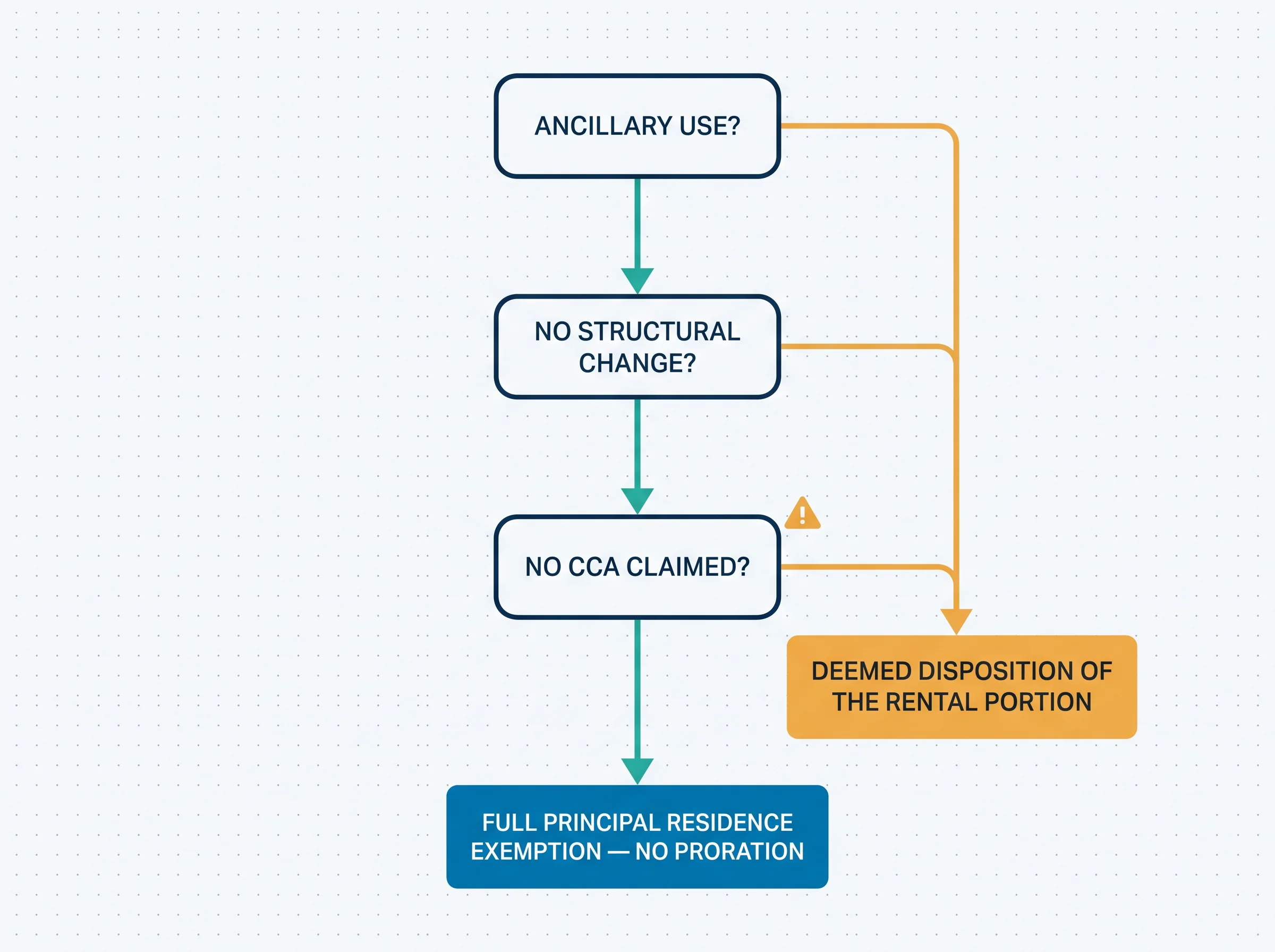
Three tests, one direction
Now put the pieces side by side and look at the shape.
Section 5(i) of the Residential Tenancies Act, section 21(1) of the Human Rights Code, and the CRA's three administrative conditions are three different tests. Two statutes and one administrative practice, drafted at different times, by different governments, for different reasons. Nobody designed them together. Nobody coordinated them. And here is where they land:

A boarder who shares your kitchen: outside the RTA, outside the Code — and, in the typical case, inside your full principal residence exemption, with no proration. A tenant in a self-contained suite with their own entrance and kitchen: full RTA, full Code — and the structural change that made the suite self-contained is precisely what tends to trigger a deemed disposition on that portion of your home.
Said once, plainly: the more rights your tenant has, the more tax you pay.
That is the shape of the ground. It is not a recommendation, and this article is not going to help you price a person's legal protections against your capital gain. You are allowed to know what you're standing in. You are not obliged to optimise it.
Two things stop that sentence from being a slogan. The first is that the exemption is not a perk somebody designed for landlords. It exists because forcing two strangers who share a sink through a tribunal process would be intolerable — for both of them — and you are one of the two. It genuinely cuts both ways: the tenant lost the Act's protections, and you lost the Act's machinery, and section three of this article is a catalogue of what losing the machinery costs. The second is the Ontario Human Rights Commission's finding about who actually occupies these rooms — newcomers and immigrants, disproportionately, excluded from the protections everyone else has. Both things are true at once. Hold both, and you understand this corner of Ontario law better than most of the people writing about it.
How to check any of this without trusting us
This is the part of every guide where we show you how to verify what you just read — and this time, we're going to do it by showing you two real errors, one of which is partly ours.
Specimen one. This spring, a property-management firm published a market report for an Ontario city — a firm, we should say, whose careful reading of a completely different legal question we had praised, deservedly, in a previous article. The report states Ontario's 2026 rent increase guideline as 2.5 per cent. The 2026 guideline is 2.1 per cent; the figure in the report is last year's number, one year stale, live on the page today. The lesson is not that the firm is careless — on the issue we'd praised them for, they were more careful than a law firm. The lesson is that being right about one thing is not a warranty on the next. Provenance does not transfer. When you verified a source, you verified one claim, on one day. That is the entire scope of what you verified.
And here is the half we owe you: we only caught the error because the guideline is our number. It appears in ten articles on this site; we know it cold. If that report had been wrong about something we didn't already know, we would very likely have repeated it. Catching it was not diligence — it was luck, backed by coverage. Which points at the uncomfortable truth underneath all source-checking: you can only catch errors in the things you already know, which is exactly where you need checking least.
Specimen two, the mirror image. A chartered accountancy firm's guide to the principal residence exemption — republished by an investment manager, well-ranked, live today — describes the partial-change-in-use election we covered above as something the 2019 federal budget "proposes," notes the amendments "have not yet received royal assent," and says they will be effective "once passed." They passed. Seven years ago. The page froze at the proposal stage and never thawed. Our previous article was about a law described as in force that isn't yet; this one hands you a law described as not-yet-law that has been law since 2019. Stale works in both directions, and "not yet" ages exactly as badly as "now." We'd add, in fairness, that our own working notes carried the same stale belief about this election until we checked — which is the whole reason this section exists.
So here is the procedure, and it beats every blog on the internet, including this one. For a statute: open e-Laws (ontario.ca/laws), find the exact section you're relying on — section 5(i) of the RTA, section 21 of the Code — read it, and read the commencement information, because a law on the books is not always a law in force. For tax: the CRA's own pages and folios, not summaries of them. For a case: CanLII, free, where Newman v. Glanville, 2019 ONSC 1040 and Cowie v. Bindlish, 2010 ONSC 2628 are both short enough to read over coffee, and are two of the more readable things in Ontario law.
Everything above has a section number, a case citation, or a named source attached to it precisely so you can go and disagree with us — including anything in this article about the Code, the Act, or the CRA.
What to do before you do anything
Before you buy. Two things are cheaper now than they will ever be again. First, the tax fact: whether you have a "change in use" at all can depend on whether you bought with the original intent of renting out part of the space — so the plan you make before the offer matters at the CRA years later. Second, the legal fact: if the unit you're imagining is self-contained, whether it can be a legal second unit is a municipal question of zoning, permits and fire code — our complete guide to basement apartment rules in Ontario covers that half, and nothing in this article replaces it.
Before you rent. Decide which side of section 5(i) you're on, honestly. It is mostly an architectural fact, not a preference — a function of doors, kitchens and who was living where, first. If it's ambiguous, that ambiguity is itself the finding: consider Form A1.
Before anyone signs. Write the agreement. If the RTA applies, that means the Ontario Standard Lease. If it doesn't, it means a clear written agreement that matters even more — term, rent, notice you'll each give, house rules — because it is most of your law. And tell your insurer someone is renting; an undisclosed rental is a coverage problem, not a saving.
Every year. Report the income on T776. Claim no CCA on the building. Keep the square-metre or room-count split you'd use on a sale, updated as the facts change.
On sale. T2091, and a reasonable allocation you can defend because you recorded it from day one.
And throughout: the three cheapest things you can buy are a CPA before your first return, a licensed paralegal or lawyer before you sign, and a written agreement. Measured against a deemed disposition on part of your own home, a rescinded election, or an unlawful-eviction claim, none of the three is expensive.
The House Hack Cash-Flow Worksheet (Ontario Edition): Know Your Legal Status Before You Count a Dollar
A free Excel worksheet that makes you answer the question every house hacker skips — does the RTA even apply to your tenant? — before it lets you touch the cash flow. Includes the legal-status checklist, a monthly cash-flow calculator, and the tax corner with the one line we deliberately left out.
Get the Free Worksheet →The short version
- Work out which side of section 5(i) you're on — required to share with you (or your spouse, child or parent, living in the building), or self-contained.
- If you're relying on the exemption, confirm you were living there first. The order of arrival is the rule, not a detail.
- Never call the police to remove an occupant as a trespasser. It is unlawful, and a landlord, police officers and a police services board have all learned it the hard way.
- Put it in writing. If you're exempt, the agreement is most of your law.
- No structural change and no CCA on the building if you want the full principal residence exemption — and record the square-metre split from day one.
- Report the income on T776. The RTA exemption is not a tax exemption.
- CPA before your first return; paralegal or lawyer before you sign.
The kitchen decides, and the order of arrival decides the kitchen. "Exempt" is not freedom — it is the Commercial Tenancies Act, Small Claims Court, and no guidelines, in a dispute inside your own home. Three tests from two statutes and one administrative practice all point the same direction, and you're allowed to see that clearly without acting on it. House hacking in Ontario is neither the effortless strategy the videos promise nor a trap — it is a legal arrangement that rewards the people who understood it before they signed anything. That can be you, and it costs a weekend of reading and two professional conversations.
Frequently asked questions
Does the Residential Tenancies Act apply if my tenant shares my kitchen?
Not if they're required to share a kitchen or bathroom with you — or your spouse, child or parent — and that person lives in the building. Both conditions must be met. And sharing only with other tenants doesn't exempt anything: if your renters share a kitchen with each other but not with you, the Act applies in full.
Can I evict a boarder without going to the Landlord and Tenant Board?
The LTB has no jurisdiction over an exempt arrangement — but that is not the same as being able to remove someone. There is no N4, no L1, and no sheriff; the arrangement is governed by the Commercial Tenancies Act, the common law and your written agreement, and disputes go to Small Claims Court. Declaring an exempt occupant a trespasser and calling the police is unlawful.
Will renting my basement cost me my principal residence exemption?
Usually not. Where the rental use is ancillary, there's no structural change, and no capital cost allowance is claimed, the CRA's practice is to leave the exemption intact — most basement suite scenarios qualify, with no proration. A separate entrance built for tenants generally breaks "ancillary." Confirm your facts with a CPA.
What if I move in after my tenant?
The exemption requires the owner (or the listed family member) to be residing in the building before the tenant moved in. Move in afterward and the Act still applies — the Divisional Court decided exactly this in Cowie v. Bindlish. The order of arrival is the rule.
Can I claim depreciation on the rented part of my home?
Claiming CCA on the building breaks the third condition for keeping your full principal residence exemption, can rescind a 45(2) election, and can come back later as recapture. CCA on movable assets like appliances doesn't affect the exemption. This is a CPA question — and it's why our worksheet has no CCA line, just a warning where the line would be.
Whichever side of the kitchen you're on, run the paperwork properly
Tenon10 keeps Ontario's rules in the software — the Standard Lease, guideline-checked rent increases, notices and records — so the formal side of an informal arrangement takes minutes, not weekends.
Free tier available • Tenants always free • Ontario compliance built in
Related resources
- Basement Apartment Rules in Ontario — the build side: zoning, permits, fire code, and what makes a second unit legal.
- Becoming a Landlord in Ontario: The Complete First-Timer's Guide — the pillar guide this article plugs into.
- Duplex vs Condo vs Single-Family — choosing the property shape before you choose the arrangement.
- Rent or Sell Your Toronto Condo — the full-property change-in-use rules, 45(1) and the elections, in depth.
- Accidental Landlord in Ontario — when you didn't choose any of this and the Act doesn't care.
- Renting to Students in Waterloo, London and Kingston — including the student-housing exemption, section 5(i)'s cousin.
- Is My Lease Legal? — the clauses that void themselves.
- CRA Audits of Rental Income — what draws attention and how to be ready.
- Ontario Standard Lease — the required form when the RTA applies.
- Ontario Rent Increase Calculator — guideline math, done for you.