

The most-quoted number in this entire debate — 77 per cent of Toronto condo investors losing money, an average of $597 a month — comes from a study published in 2023. Half the pages citing it this year quote it in the present tense, as though it were measured last week. The other half date it properly. Same number, same sentence, one verb tense — and one version is journalism while the other is misinformation. That single verb tense is why this article is built the way it is.
"Is being a landlord in Toronto still worth it?" gets answered, mostly, by two rage genres: tribunal horror stories that end in "sell everything," and greedy-landlord stories that end in "good riddance." Between them sits investor content running three-year-old numbers in this year's clothes. What almost nobody publishes is the honest version: that this is four different questions wearing one costume, that every number in every answer has an expiry date, and that the answer depends less on you than on the year you entered.
So here is the honest version, assembled on July 15, 2026. Every figure in it carries its source, its date, and what it actually measures. At the end, there's a box listing when each one dies — and five questions you should run against this very page.
Four questions wearing one costume
"Worth it" sounds like one question. It's four, and they don't share evidence, expiry dates, or answers.
Question one: does the cash flow work this year? That's arithmetic — this quarter's rents against this quarter's carrying costs. It has a current answer, and the answer has a date on it. Question two: does the decade work? That's a bet on appreciation and rate paths — a forecast, which is a different species of claim entirely, and we'll label it as one. Question three: can you live with the process? That's the Landlord and Tenant Board, and it deserves real numbers instead of anecdotes — including the queue nobody on the landlord side ever mentions. Question four: do you want the job? That one has no spreadsheet. A person lives inside your largest asset, and the phone rings on their schedule.
Anyone who answers all four with one word is selling something.
Before the numbers, the point that reframes all of them: "worth it" is a cohort question. The same Toronto street holds a landlord who bought a duplex in 2014, carries a nearly-dead mortgage, and has a good tenant paying guideline increases — and a landlord closing a 2022 pre-construction contract this spring into an appraisal that came in below the price on the contract. The first landlord is fine, boring, and invisible in the discourse. The second is in real trouble and very loud. Every viral take you've read describes one of these cohorts while claiming to describe landlording. We've spent this whole series showing how Ontario's rules sort people by status rather than intention; the last and simplest status is the year you entered.
One more thing this article will not do, stated plainly: it will not tell you to buy or to sell — that decision has its own guide, its own tax rules, and belongs with your own numbers and your own advisors. It will not print an undated statistic. And it will not tell you about the tribunal's landlord queue while pretending the tenant queue doesn't exist.
Question one: does the math work this year?
What rents are actually doing (with dates attached)
Start with the strangest fact in the market, because it explains everything else. In the first quarter of 2026, condo apartment leasing across the GTA rose — 16,365 leases signed, up 10.6 per cent year-over-year — while rents for every bedroom type fell. The average one-bedroom condo leased for $2,246, down 4.1 per cent from a year earlier; two-bedrooms averaged $2,939, down 3.2 per cent. Listings ran to 24,012 units, up six per cent. (Source: TRREB rental market report, Q1 2026 — condo apartments, leased transactions, GTA.) More leasing and falling rents at the same time is a supply story: there are simply more units competing for tenants than there are tenants bidding for units.
The purpose-built side tells the same story with a twist that matters enormously to landlords. CMHC's October 2025 rental market survey put the average Toronto-area one-bedroom at $2,073 for a unit that just turned over to a new tenant — and $1,711 for the same unit type with a sitting tenant. That $362-a-month gap is the entire economics of Ontario's rent-increase guideline in two numbers, and it's why turnover has slowed: the financial incentive for a tenant to stay put has rarely been stronger. Note the date on that survey — October 2025. It gets replaced this December, and until then it's the best purpose-built data that exists, not a reading of today.
By CMHC's own mid-year update (June 2026), asking rents in Toronto were still declining, landlords of new buildings were offering incentives up to several months of free rent, and newly completed units were taking months to fill. The same update contains the split that one citywide vacancy rate hides: vacancies are concentrated in buildings completed after 2020 and near campuses, while older, family-sized stock remains tight. One number, two markets. It also contains a genuine paradox worth sitting with: Toronto is one of only two major Canadian markets where affordability for existing tenants actually improved over the past year, as slower rent growth met wage growth. Whether this market is "bad" depends entirely on which side of a lease you're standing on — and which lease.
Why you've seen four different "average rents" this month
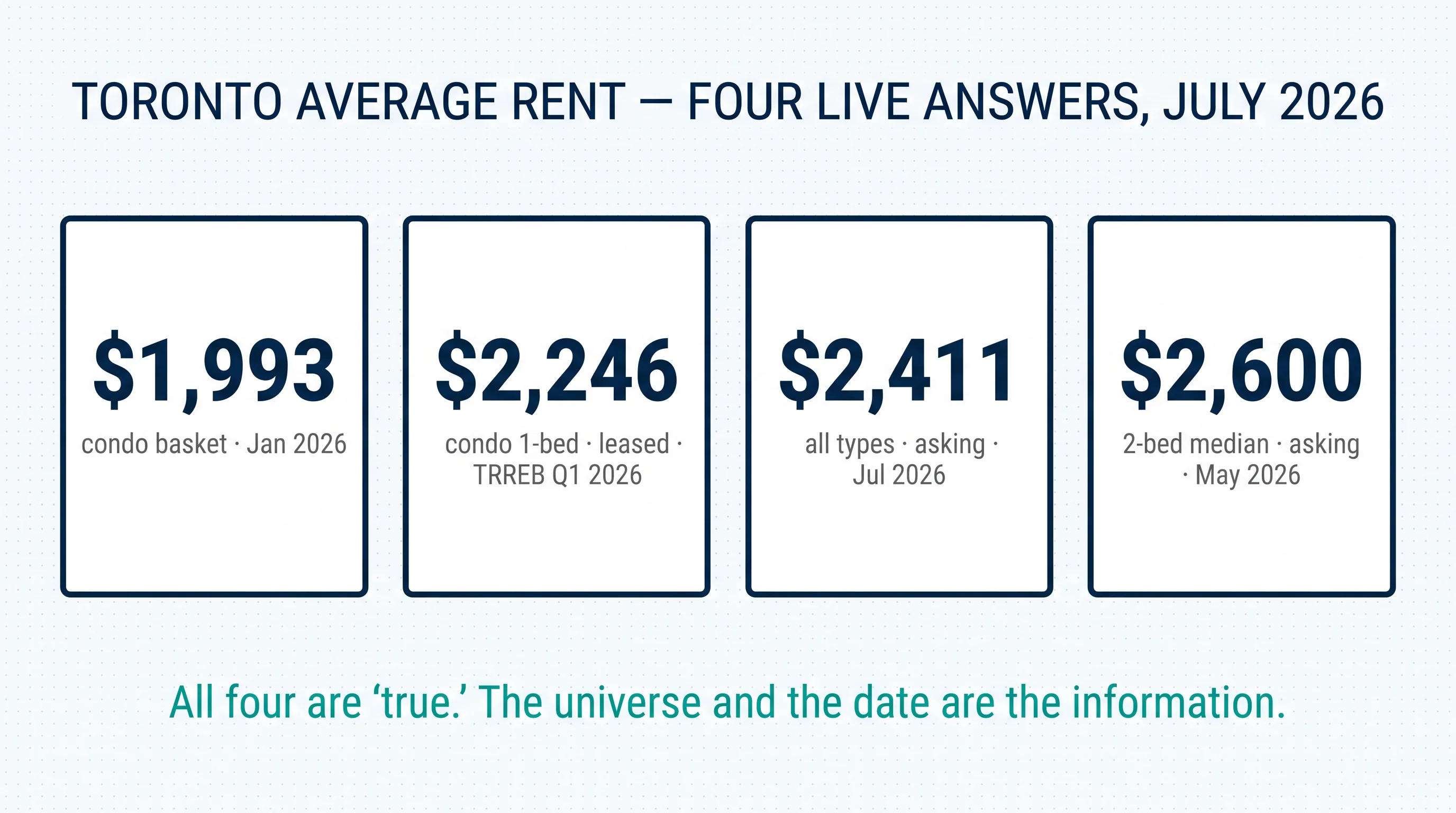
Here is the paragraph that will outlive every number in it. As of this July, you can find "the average rent in Toronto" reported as $1,993 (a condo-basket figure from January), $2,246 (TRREB's Q1 leased one-bedroom condo average), $2,411 (an all-property-types asking average from July), and $2,600 (a May median for two-bedroom asking rents). All four are "true." They measure different things: condo versus purpose-built, leased versus asking, mean versus median, city versus census metro area. A rent figure that arrives without its measurement universe and its date is not information — it's decoration. There is, right now, a live, well-ranked page pairing a Toronto rent figure with a claim that vacancy sits under two per cent, against everything CMHC has published this year; it isn't lying so much as quoting a universe that no longer exists. You cannot use a number you cannot place.
What the asset is doing
The rent side is soft; the asset side is where the last decade actually ended. Resale condos averaged $859 per square foot in the first quarter of 2026 — about 25 per cent below the early-2022 peak — while developers' unsold standing inventory was still asking $1,189 per square foot, a record 38 per cent premium over comparable resale (Urbanation data, Q1 2026). Predictably, nobody paid it: not a single new condo project launched in that quarter, and 2025's new-condo sales across the GTHA totalled 1,599 units — the lowest annual figure since 1991. Roughly 3,000 units, about a tenth of 2025's registrations, went back to developers after purchasers couldn't close, mostly because appraisals came in under contract prices signed years earlier.
The Bank of Canada's policy rate sits at 2.25 per cent, held on January 28, 2026 after nine cuts totalling 275 basis points from the 5 per cent peak. And the Bank itself published an analysis of this market in February 2026 — worth reading because a central bank writing about your asset class is itself a data point — concluding that the presale model that paid investors average gains above 40 per cent between 2015 and 2022, on 20 per cent deposits, is over. Their phrase: "times have changed."
The collision, with the year welded on
Now the famous number, properly dated. In 2023, CIBC and Urbanation found that 77 per cent of investors who took possession of new condos with a mortgage were cash-flow negative, losing $597 a month on average, because carrying costs had risen 24 per cent while rents rose 15. That was 2023. The direction still holds for new entries — the Bank of Canada and CMHC both describe 2026 investor math that doesn't work at current prices and rents — but the specific figure is three years old, and half the internet quoting it won't tell you that. We'll come back to why that omission matters more than the number itself.
What the year you entered actually determines, on one street:
| Your vintage | Your 2026, roughly |
|---|---|
| Bought 2016 or earlier — small or no mortgage, sitting tenant at guideline | Positive cash flow, quiet, fine — and completely invisible in the discourse |
| Bought 2021–22 pre-construction — closing now | Contract price above today's appraisal; possibly unable to close; if closed, renting into falling rents |
| Buying today — at roughly a quarter off peak prices | The arithmetic is closer than it was, but on most condo configurations still negative before appreciation — and anyone giving you a definitive answer is selling something |
Three different articles, pretending to be one. To run your own row honestly, start with the full cost stack — tax, insurance, condo fees, maintenance reserve, vacancy allowance — in our true monthly cost of owning a rental guide, and see the cap rates and average rents data page for how Toronto's yields compare across Ontario.

Question two: the decade bet — a forecast, labelled
Everything in the previous section was a measurement. Everything in this one is a prediction, and predictions get a visible fence around them.
What forecasters currently say (recorded July 15, 2026):
TD Economics expects GTA prices to stay negative through the first half of 2026 and turn modestly positive in the second. RE/MAX projects average prices down a further 3.5 per cent this year with sales up five per cent. Urbanation expects "virtually no new condos" to complete by 2029 and describes recovery in investor returns as more likely a 2028-and-later story. The national price benchmark isn't projected to reclaim its March 2022 peak until roughly 2029. These are the authors' models, dated the day they were published — nothing more.
Why the fence? Because forecasts are the least durable objects in this article. This series has spent five pieces documenting how landlord information goes wrong: stale dates quoted as current, laws described as in force before they were proclaimed, and — as you'll see below — official documents that changed after publication. A projection about 2029 is a claim about a model, not about 2029. Read them, note the date, and hold them loosely.
One thing in the future isn't a forecast, because it already happened: construction starts collapsed. Whatever prices do next, the pipeline of new condo completions after 2027 is thin, because the projects that would have delivered then were never launched. And that matters far beyond investors' spreadsheets, because of a single structural number: 40.3 per cent of the condominiums in the Toronto census metro area are rentals — 214,083 units, per CMHC's October 2025 survey. Toronto's rental supply is, to a remarkable degree, the residue of an investment thesis. When the thesis breaks, it's not just an investor event; it's a housing event, arriving on a delay.
Question three: can you live with the process?
Two true numbers that disagree
The workbook for this series had one instruction for this section: acknowledge the LTB pain honestly. So here is the honest shape of it, which is stranger than either rage genre admits.
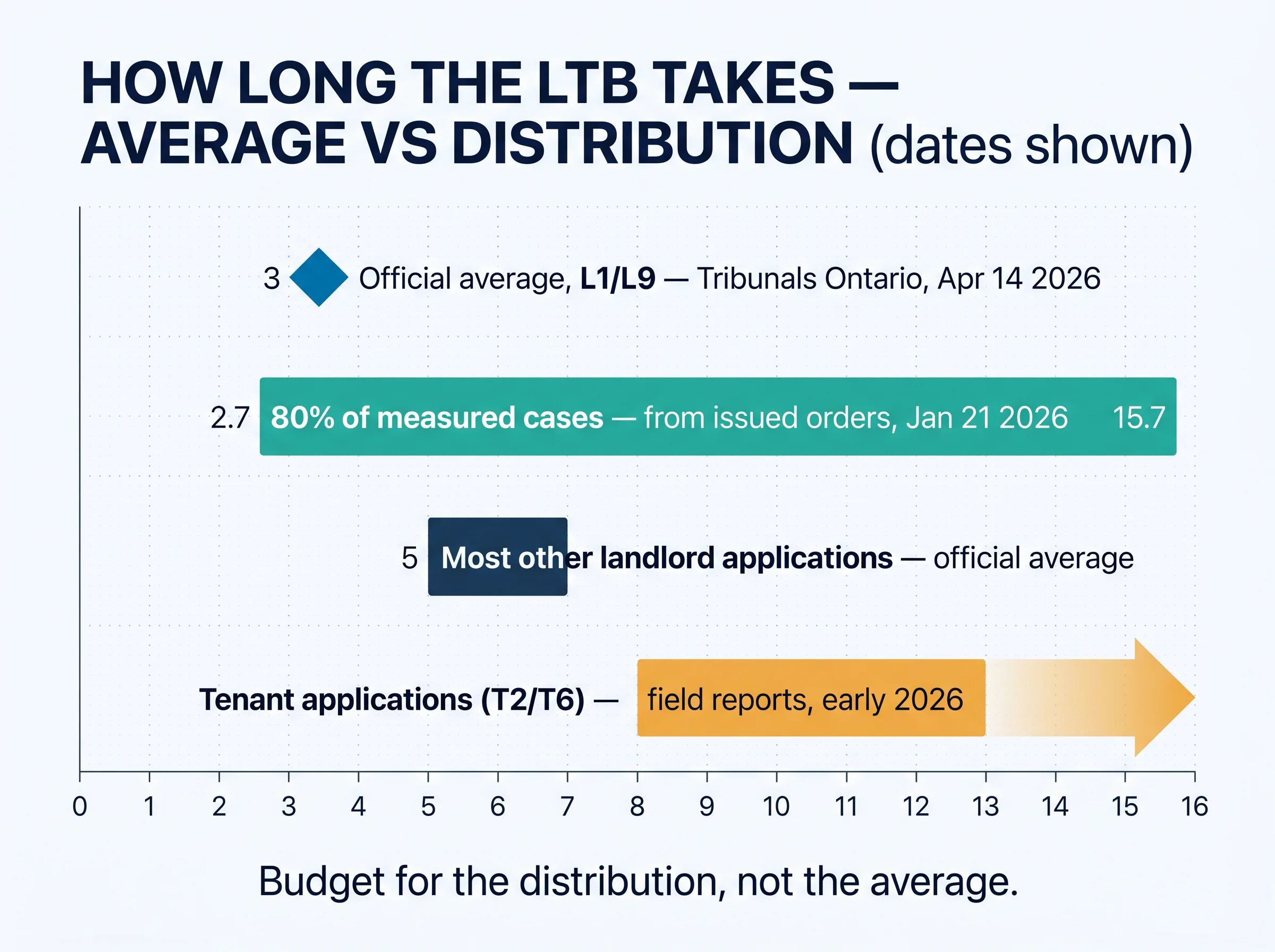
Tribunals Ontario's own published service standards — as of April 14, 2026 — say the average non-payment application (L1 or L9) is scheduled for a hearing in about three months, most other application types in five to seven, with written orders usually issued within thirty days after the hearing. The same page carries its own caveat, and it's the most honest sentence in the official source: these are averages, not promised dates.
Now the other true number. An independent tracker that measures wait times from actual issued orders — working backward from the arrears recorded at each hearing — found that as of January 21, 2026, 80 per cent of non-payment cases were heard somewhere between 2.7 and 15.7 months after the rent went unpaid. An average of three months and a tail past fifteen coexist without contradiction; that's what a skewed distribution looks like. The practical rule follows directly: budget for the distribution, not the average. A landlord whose finances only survive the three-month scenario is betting the mortgage on landing in the lucky half of the curve.
Both queues — because there are two
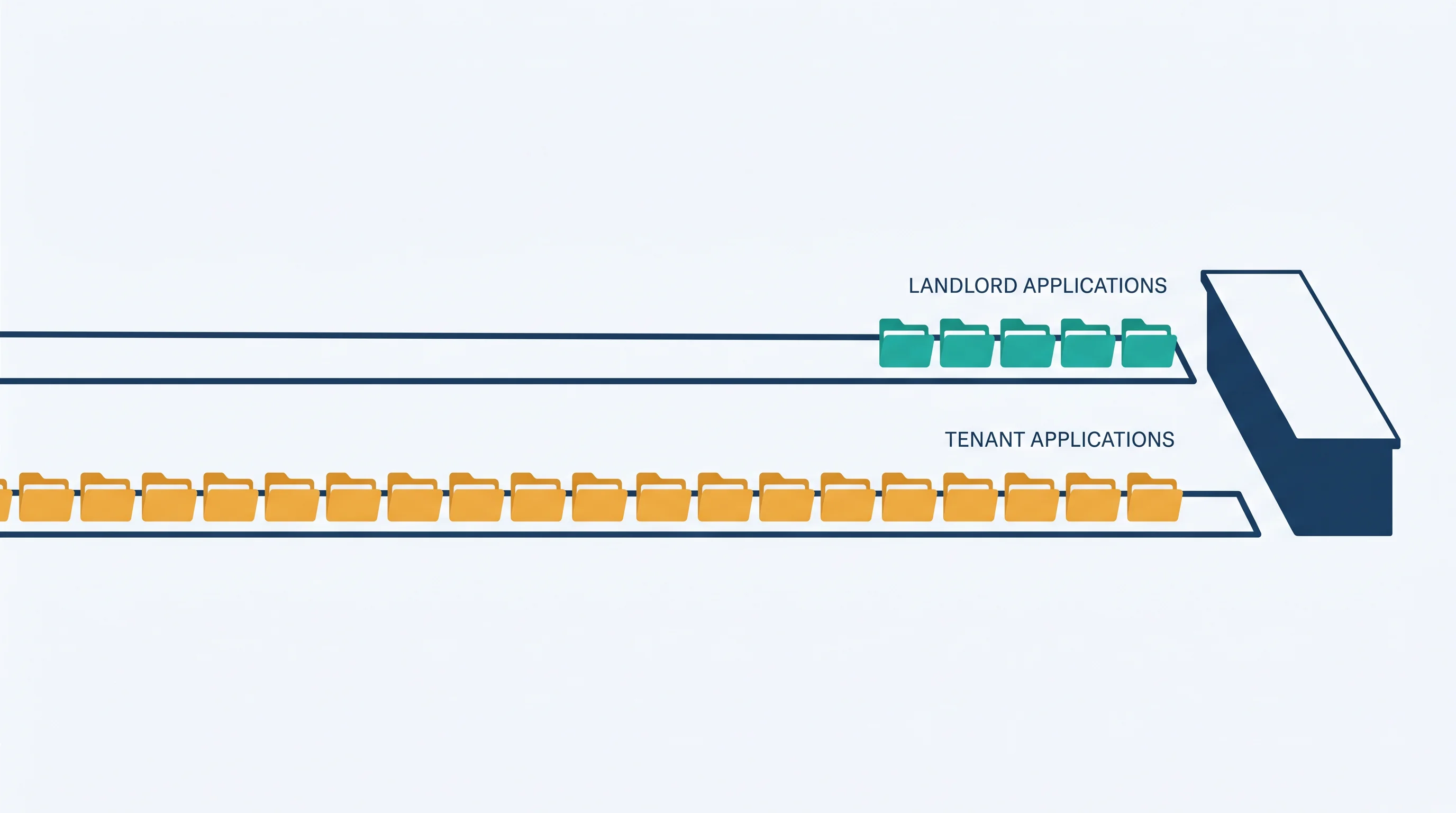
Here is the part the landlord-side genre never prints. However long you think your queue is, the longest waits in the building belong to tenants. Applications tenants file against landlords — the T2 for rights violations, the T6 to compel repairs — have been running eight to twelve months and beyond, per field reports through early 2026. That's a tenant with no heat, or an illegal entry problem, or a maintenance failure, waiting the better part of a year for a hearing while continuing to owe rent in full every month, because withholding rent is illegal in Ontario no matter how long the queue is.
And notice who's complaining about it. In CBC's reporting on the backlog, a board member of the Small Ownership Landlords of Ontario — a landlord group — argued that the cases which most urgently need faster handling are tenant applications against slumlords: buildings without heat or hot water, pest infestations left to fester. Tenant advocates at ACORN, meanwhile, say tenant applications get pushed aside outright. When landlord advocates and tenant advocates are angry about the same queue, believe the queue. This isn't a system rigged for one side; it's a machine that grinds everyone, at different speeds.
Inside the machine
The tribunal's most recent annual report — covering April 2024 to March 2025, and we'll have more to say about that document shortly — shows the machine mid-repair. The backlog fell by roughly 12,000 cases, which is real progress and cost real money. But per Tribunal Watch Ontario's analysis of the tabled version: the board now has 133 adjudicators against 51 in 2018–19, yet parties still wait about three times longer for a hearing than they did before the current structure; only 47 per cent of resolved applications were resolved by an actual hearing; and 29 per cent of applications were withdrawn, versus 12 per cent in 2018–19 — a near-tripling that the report doesn't explain. More than twenty adjudicators left before their terms ended in the past two years. Per adjudicator, the board resolves roughly a third of the hearings it used to.
The practical honesty, in one paragraph. Filing an L1 costs $186. A defective notice — a miscounted termination date, a misspelled name — is often discovered only at the hearing, which can mean discovering at month nine that you're starting over at month zero; our N4 guide and the termination date calculator exist precisely because of that failure mode. Under section 83 of the RTA, an adjudicator must consider relief from eviction even when your case is perfect — a tenant's job loss or children's school year can lawfully delay an order; that is the statute working as written, not malfunctioning. And on hearing day, the duty-mediation process can produce a consent order on the spot, which is frequently worth more than winning three adjournments later. For which application fits which situation, see our L1 versus L2 guide.
The number without a date
This series has been running a quiet second curriculum alongside the landlord content: how to tell whether the thing you just read is still true. This is the last lesson, and it has three specimens, in ascending order of discomfort.
Specimen one: tense drift
The 77-per-cent, minus-$597 study you met earlier was published in 2023. In 2026 it is still the most-quoted statistic in the Toronto landlord debate — and you can find it, this month, on professionally produced pages in two forms. Some write "a 2023 study found investors were losing $597 a month." Others write "investors are losing $597 a month." Same number, same sentence, one verb tense. One version is journalism. The other is misinformation. Nothing else on the page tells you which one you're reading — no correction, no flag, nothing. The date is the only defence, which is why every figure in this article has one welded on.
Specimen two: ours
While researching this article, a search returned one of our own guides — live, indexed, three weeks old in the results — stating that LTB waits "commonly run 6–9 months" for non-payment cases. Tribunals Ontario's published average, as of April 14, 2026, is about three months. Our figure may have described the contested tail of the distribution you saw above, where nine months is entirely real — but the page didn't say so, which means it failed the exact test we've spent five articles teaching. We've corrected it. Five articles ago we started asking "who told you?" This time the answer was: we did. If we're going to hand you a test for other people's numbers, it has to cut us too. Especially us.
Specimen three: the source that moved
The final specimen is the unsettling one. Throughout this series the advice has been: skip the blogs, read the primary source. In June 2026, Tribunal Watch Ontario reported that the tribunal's 2024–25 annual report — the document behind the adjudicator and backlog figures above — was changed after it was tabled in the Legislature, with, in their words, "no indication in the version currently online that this change was made." The authority for altering a tabled report is, they note, unclear. Think about what that does to a citation. A footnote pointing at that report now points at a document that may no longer say what it said when the footnote was written. Even the primary source can shift under your feet — which is the final lesson: record what you read, and when you read it. A citation without a date is a pointer into a moving document. (Our figures above are quoted from the tabled version, via Tribunal Watch's analysis, as of their November 2025 review and June 10, 2026 statement.)
So here is the reader's test, in its final form — five questions to run against any landlord content, from any source:
- Can you click it? A claim with no path to a source is a rumour with formatting.
- Can you look it up yourself? Not "does the page look credible" — can you reach the original?
- When was it true? Every statistic was measured on a date. Find it. If you can't, discard the statistic.
- Is it in force yet? For anything legal: passed is not proclaimed, and announced is not law.
- Who told you — and is that the same thing as checking? A source you trusted last year is a habit, not a verification.
Now the instruction that makes this article different from the twenty-nine before it: run all five against this page. It is dated July 15, 2026. Every number above names its source and its date. The next section tells you when each one dies.
The dated assumptions box
The centrepiece of this article isn't an argument; it's a table. Everything above, with its source, its measurement universe, and — the column almost nobody publishes — the date on which it stops being current. This is the box we promised at the start, and it is the article's real deliverable.

| Figure | Source & date | What it measures | Dies when |
|---|---|---|---|
| $2,246 avg one-bed rent (−4.1%) | TRREB, Q1 2026 | Condo apartments, leased, GTA | Next quarterly report (~August 2026) |
| 16,365 leases / 24,012 listings | TRREB, Q1 2026 | Condo rental transactions, GTA | Next quarterly report |
| $2,073 vs $1,711 turnover gap | CMHC survey, Oct 2025 | Purpose-built one-beds, Toronto CMA, new vs sitting tenant | December 2026 survey |
| 40.3% of condos rented (214,083 units) | CMHC survey, Oct 2025 | Toronto CMA condo stock | December 2026 survey |
| $859/sq ft resale; 38% developer premium | Urbanation, Q1 2026 | GTA condo resale vs unsold new inventory | Next quarterly data |
| 1,599 new condo sales in 2025 | Urbanation annual, 2025 | GTHA new-condo sales | Historical — final |
| Policy rate 2.25% | Bank of Canada, held Jan 28, 2026 | Overnight target rate | Any of eight fixed announcement dates |
| ~3 months L1/L9; 5–7 months others | Tribunals Ontario, as of Apr 14, 2026 | Official average scheduling times | Updates continuously — check the page |
| 2.7–15.7 months (80% of cases) | Measured from issued orders, as of Jan 21, 2026 | Distribution of non-payment case waits | Rolling — re-check before relying |
| 77% negative / −$597 per month | CIBC–Urbanation, 2023 | Investors with new condo mortgages, at possession | Already historical — direction, not measurement |
| Guideline 2.1% (2026), 1.9% (2027) | Ontario, announced 2025–26 | Rent-controlled units (first occupied before Nov 15, 2018) | Each year's announcement, ~late June |
For twenty-nine articles we've told you to distrust undated numbers, unproclaimed laws, and unverified sources. This is article thirty, and the test applies to us. When those dates pass, this article is wrong — not vaguely wrong, but wrong in the specific, checkable way the box makes visible. That's the whole trade we're offering: not permanence, which nobody honest can offer, but a printed expiry date.
One live example of why the box matters. Ontario's rental rules are mid-change right now: Bill 60 passed in November 2025, but its provisions come into force in stages, on dates that were not all officially proclaimed when this article was assembled. We are deliberately not printing commencement dates here — not because they don't exist, but because the only current answer lives at e-Laws and on Tribunals Ontario today, not on any blog dated last month, including ours. Our Bill 60 landlord guide covers what the changes do; the government's own sources are the only authority on when.
Every figure above lists its source, its date, and what it measures. This article was assembled on July 15, 2026. TRREB rental data updates quarterly; CMHC's survey lands each December; the LTB's published timelines change continuously; forecasts, whenever their authors feel like it. When those dates pass, treat this page the way we've taught you to treat every page: as a claim about the day it was written.
Question four, and the map
The fourth question has no data section, because there's no data for it. Being a landlord means a human being lives inside your largest asset. The furnace fails on their schedule, not yours. The rules changed twice while we wrote this series and will change again. Some people are genuinely suited to the work — they like housing people, fixing things promptly, running a small operation well, and the quiet compounding of a mortgage paid down by rent. Other people discover that the 7 a.m. phone call costs them more than the cash flow pays, at any cash flow. Both kinds of people are telling the truth about themselves, and no spreadsheet — not ours, not anyone's — can tell you which one you are.
What we can give you is the map, because this article was always meant to be an index as much as an essay. Deciding whether to keep or sell a unit you already own is its own decision with its own tax deadlines — that's our rent-or-sell guide for Toronto condo owners. The full cost stack lives in the true monthly cost of owning a rental. Yields across cities live on the cap rates and average rents data page, and vacancy by city on its own page. If you became a landlord without choosing to — inheritance, a move, a house that wouldn't sell — start with the accidental landlord guide. If you're weighing sharing your own home instead, house hacking in Ontario covers the very different rulebook that applies. And if you're starting from zero, becoming a landlord in Ontario is the complete first-timer's path, with screening, the standard lease, notices, and entry rules all one link deep from there.
The three cheapest things in this business, one final time: a paralegal before you file, a CPA before you sell, and dated sources before you believe anything — including us.
And the series itself, in one paragraph, because this is the last article of thirty. Every piece kept finding the same spine: Ontario's rules don't ask what you intended — they ask which status you're in. Whether you live in the building. Whether you share a kitchen. Whether the unit was first occupied before or after a date in November 2018. Which city the property sits in, and which bylaw regime. How many square metres, and whether there's a separate entrance. Whose signature is on which form, served on which day. Whether you chose to be a landlord at all, and who was living there first. Status after status after status — and the last one is the simplest and the least negotiable: the year you entered. It's also the only status on the list you can still pick.
Key takeaways
- "Worth it" is four questions, not one — this year's cash flow, the decade bet, the process, and the person. They have different evidence and different answers; anyone who compresses them into one word is selling something.
- Identify your cohort before reading anyone's take, including this one. A 2014 owner, a 2022 pre-construction closer, and a 2026 buyer are in three different businesses on the same street.
- Never accept a rent or wait-time figure without its universe and its date. There are at least four live "average Toronto rents" this month, all true, all measuring different things.
- Budget the LTB by the distribution, not the average — an official average near three months coexists with a measured spread of 2.7 to 15.7 months (as of January 2026). And remember both queues exist: tenant applications wait longest of all.
- Treat every forecast as a dated opinion about the author's model — including the ones we quoted.
- For anything legal, check force-of-law status at e-Laws the day you rely on it. Passed is not proclaimed; announced is not law.
- Re-run this article's numbers when their dates pass. The dated assumptions box tells you what dies when, and where to re-check it.
The dated answer
So — is being a landlord in Toronto still worth it? As of July 15, 2026: a new entry mostly doesn't cash-flow at current prices and rents; the decade is a forecast that reputable people currently place in 2028 or later, and forecasts are the least durable thing on this page; the process is survivable if you budget for the distribution rather than the average, and it's grinding tenants harder than it's grinding you; and the personal question was never ours to answer. That's not a dodge. That's what an honest answer to a four-part question looks like — and it comes with an expiry date, printed, which is more than the confident answers will give you.
The honest answer to "worth it" is a dated answer. Now you can date anyone's.
Run your rentals on current numbers, not last year's
Tenon10 keeps the guideline rates, LTB forms, and notice timelines current in the software — so the dates are checked before you serve, not after. Ontario-first, built for landlords with one to twenty-five units.
Free plan available • Tenants always free • Ontario compliance built in
Related resources
- Rent or Sell Your Toronto Condo: The Three Doors — the keep-or-exit decision this article deliberately doesn't make for you
- The True Monthly Cost of Owning a Rental: Toronto vs Hamilton vs London — the full cost stack for your own row of the cohort table
- Cap Rates and Average Rents by Ontario City (2026 Data Page) — yields in context
- Vacancy Rates by Ontario City — where units sit empty, and where they don't
- Becoming a Landlord in Ontario: The Complete First-Timer's Guide — the pillar, if you're starting from zero
- The Accidental Landlord in Ontario — if you didn't choose this
- House Hacking in Ontario: The Kitchen Decides — living in one unit, renting the other
- L1 vs L2 LTB Applications — which application fits which situation
- The N4 Notice: A Landlord's Complete Guide — the notice that starts the non-payment clock
- Ontario Rent Increases 2026: The Complete N1 Guide — the 2.1% guideline, properly
- Bill 60 and Bill 97: A Landlord's Guide — what's changing; check e-Laws for when
- Ontario Termination Date Calculator · Ontario Rent Increase Calculator
Frequently asked questions
Is being a landlord in Toronto worth it in 2026?
It's four questions, not one. Cash flow on a new purchase at mid-2026 prices and rents: mostly no, per the Bank of Canada's and CMHC's descriptions of current investor math. The decade: a forecast — currently pointing to 2028 or later for investor returns, and forecasts expire. The process: survivable if you budget for the measured distribution of LTB waits rather than the average. The person: only you can answer that one. And before you weigh any of it, identify your cohort — the year you entered determines which numbers are about you.
How long does the LTB actually take in 2026?
Tribunals Ontario's published averages, as of April 14, 2026: about three months for non-payment applications (L1/L9) and five to seven months for most others, with orders usually within thirty days after a hearing. A tracker measuring from actual issued orders found 80 per cent of non-payment cases heard between 2.7 and 15.7 months (as of January 21, 2026) — so plan for the spread, not the midpoint. Tenant applications such as the T2 and T6 have been waiting eight to twelve months or more — the longest queue in the building. These figures change; check the Tribunals Ontario site for today's.
Are Toronto condos really cash-flow negative?
For new purchases, mostly yes as of 2026 — the Bank of Canada and CMHC both describe investor math that doesn't work at current prices, rents, and rates. But the famous figure — 77 per cent negative, $597 a month — comes from a 2023 CIBC–Urbanation study, and any page quoting it in the present tense is three years stale. Your cohort and your own cost stack decide; run the true monthly cost numbers before believing anyone's average.
What's the average rent in Toronto right now?
There are at least four live answers this month, from roughly $1,993 to $2,600, and all of them are "true": they measure different universes — condo versus purpose-built, leased versus asking, mean versus median, city versus metro area. TRREB's Q1 2026 figure for a leased one-bedroom condo is $2,246, down 4.1 per cent year-over-year. Any rent figure that arrives without its universe and its date isn't usable information.
Should I sell my Toronto rental?
That's not a question this article answers — deliberately. It's the rent-or-sell decision, with its own guide, its own tax rules, and deadlines that punish improvisation. What we can tell you is how to make it: with dated numbers, your own cost stack, and a CPA who sees your whole picture before anything is signed.


