

The Eglinton Crosstown was slated to open in 2020. It opened in February 2026 — a fifteen-year build. If you bought a condo near one of its stations expecting the 2020 ribbon-cutting, you carried that property, and its mortgage, for six extra years before the transit you paid a premium for actually arrived.
"Buy near transit" is the most repeated tip in Ontario real estate, and the most casually misused. The premium is real — properties near a station command higher rents and tend to appreciate faster, and Ontario's Major Transit Station Area rules now bake density and zoning certainty into these corridors. But the tip skips the variable that actually decides the return: timing. Ontario's transit projects slip by years, and the carry over that delay can swallow the premium whole. This guide maps what's actually open, what's under construction, and what's still a promise; shows how big the premium really is, and where it isn't; explains the zoning layer most investors never mention; and hands you a checklist to underwrite the premium — and the delay — honestly. Figures are dated July 2026 and refreshed quarterly, and transit timelines move, so verify each project's current stage before you underwrite; this is market data, not investment advice.
The Transit-Premium Underwriting Checklist: Buying Near Ontario's LRT & GO Lines
The step-by-step checklist that verifies the project's real stage, stress-tests the delay carry, maps the premium gradient, and reads the MTSA zoning — so a transit line becomes a genuine catalyst, not an expensive act of faith.
Get Free PDF →The Transit Premium Is Real — But Smaller and Patchier Than You Think
The transit premium is the price and rent bump a property earns for being close to rapid transit. What operators claim, attributed: values up roughly 3–8% in the areas surrounding a station, with rents 8–15% higher and appreciation 2–3% faster within a 10-minute walk of a GO or LRT stop; some cite ranges as wide as 5–25%. Treat every one of those figures as a market claim and check it against your own comps.

The honest counterweight comes from the research literature. Land-value uplift near transit is positive on average, but it varies from clearly positive to roughly zero — even negative — depending on the area, the neighbourhood's income, and its distance from downtown. One counterintuitive finding: properties within about 200 metres of a station are often no more valuable than those 800 metres away, because rail noise, congestion, and less residential character at the platform offset the convenience. Right at the station is not automatically the premium zone. So treat the premium as real but modest, and map the gradient for your specific corridor rather than assuming closer always means higher. This is the same honest-cap discipline our cap rates guide applies to yield, and our cheap-cities cash-flow guide applies to the honest cap — here it's applied to appreciation.
What's Actually Open, Building, or Just Promised
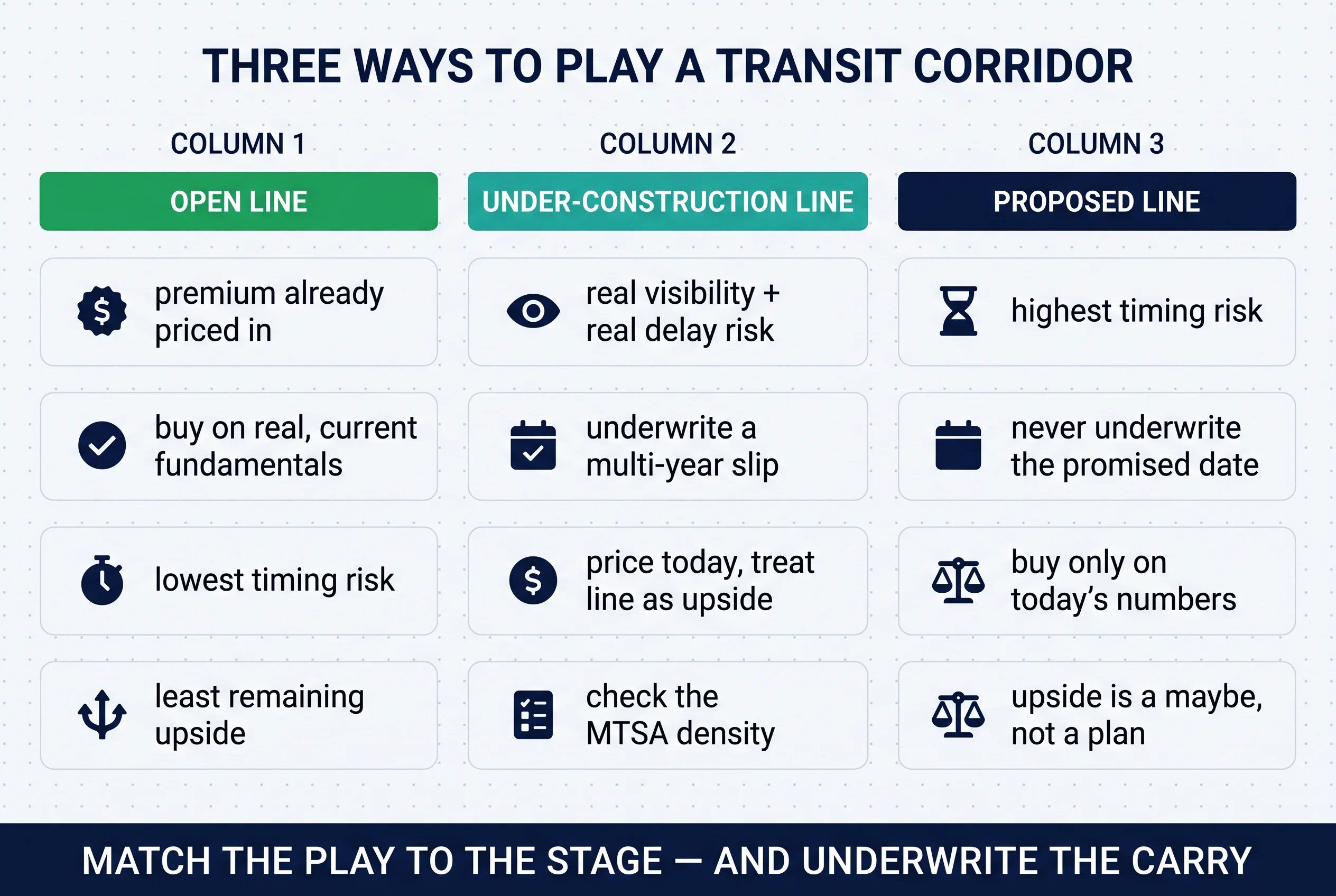
The single most important discipline is knowing which stage a project is actually in, because the investment case is completely different for an open line, a line under construction, and a line that's still a promise. Every date below moves — Metrolinx itself now speaks in ranges rather than firm dates — so verify before you offer.
Open — the future that arrived. The Eglinton Crosstown (Line 5) opened February 8, 2026 — 19 kilometres, 25 stops, about 123,000 riders a weekday — after being slated for 2020. Finch West (Line 6) opened in December 2025. These are no longer speculative; whatever premium exists is now being priced in real time.
Under construction — the genuine "future transit" buys. The Hazel McCallion Line (the Hurontario LRT), 18 kilometres from Port Credit to Brampton, broke ground in 2020 for a 2024 finish and is now aimed at roughly early 2028 amid contractor disputes. Alongside it: the Scarborough Subway Extension (tunnelling past halfway), the Eglinton Crosstown West Extension (heading toward Pearson), the Yonge North Subway Extension, the Hamilton LRT (early works underway after a 2025 procurement — the appreciation catalyst behind our Hamilton neighbourhoods guide), and the Bowmanville GO Extension (ground broken January 2026), plus incremental GO Expansion service. These carry real delay risk but real visibility.
Proposed or further out. The Ontario Line — a 15.5-kilometre relief line — was pitched as "delivered by 2027" and is now mooted for the early 2030s; the Sheppard LRT and SmartTrack stations remain studies. Buying on a promised date here is the riskiest bet of all.
The proven cases bracket the range. Waterloo's ION LRT is a corridor our student-rentals guide flags as commanding premium rents; Ottawa's LRT is the cautionary one, where the research found the value effect ran from positive to negative depending on the specific area — the same lesson our Ottawa neighbourhoods guide carries.
The Delay Is the Risk — Underwrite the Carry, Not the Ribbon-Cutting
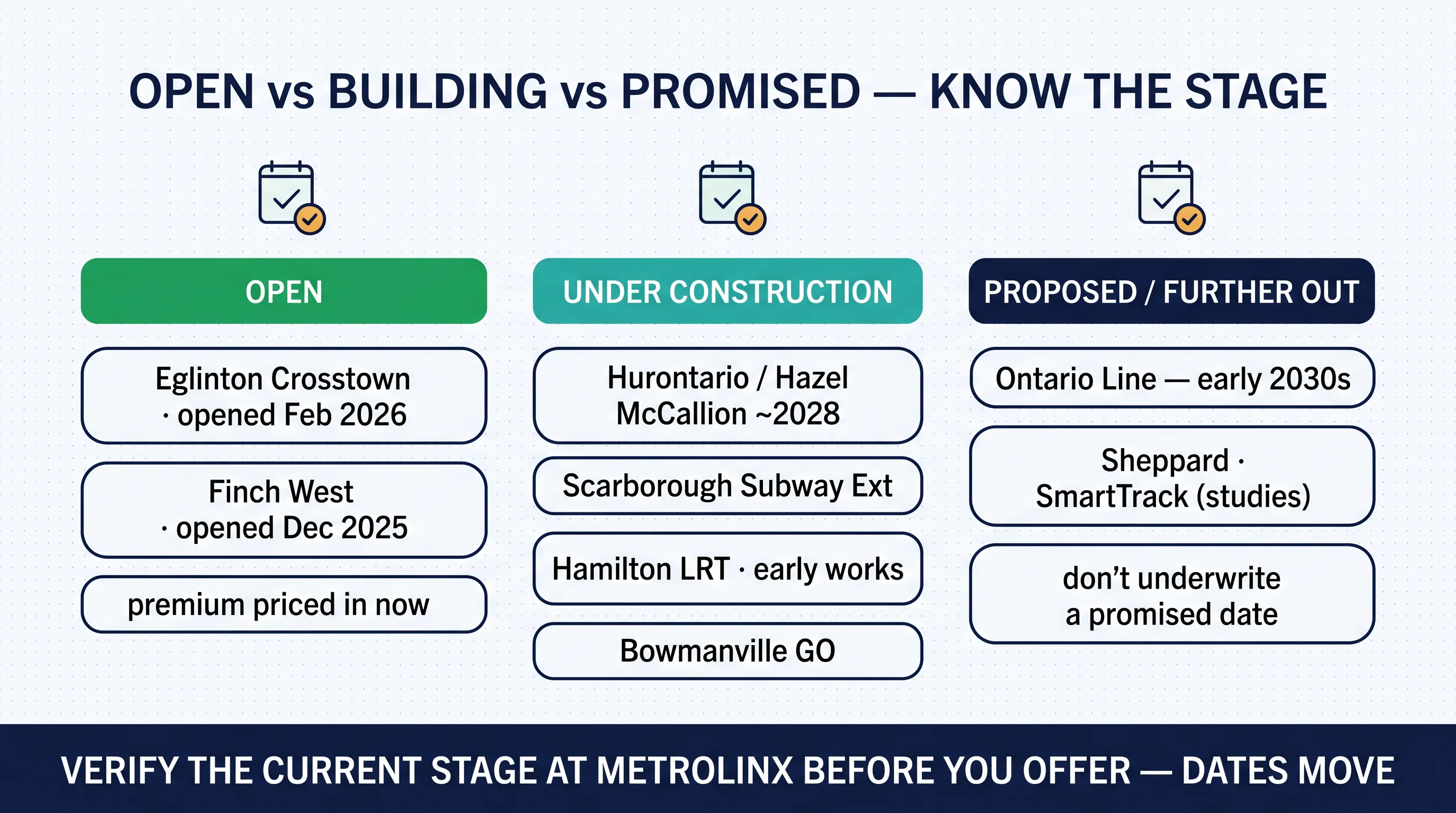
Here's the lesson the tip forgets: the premium is a payoff at the finish line, but the delay is a cost you pay the whole way there. Ontario's flagship projects have slipped by years — the Crosstown from 2020 to 2026, Hurontario from 2024 to about 2028, the Ontario Line from 2027 to the early 2030s.
The math that matters is simple. If you buy expecting a two-year wait and it becomes six, you carry four extra years of mortgage interest, property tax, insurance, and possibly softer interim rents on a property whose premium hasn't materialized yet. On a leveraged purchase, that carry can equal or exceed the premium you were chasing — the same honest-cap trap from the cheap-cities math, wearing a different disguise.
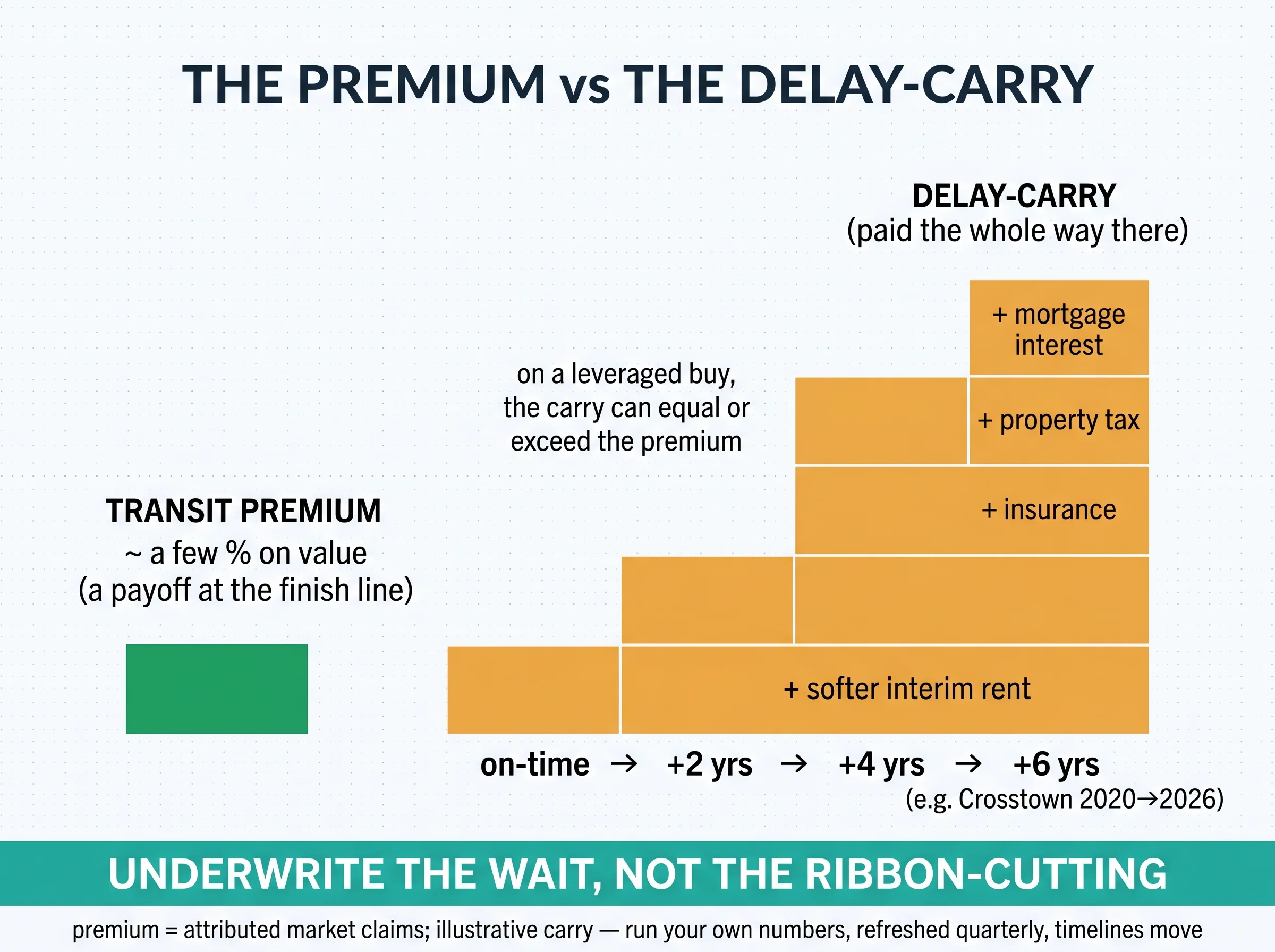
So underwrite it deliberately: price the property on today's fundamentals — current rent, current comps — treat the future premium as upside rather than the basis for the offer, and stress-test the carry against a delay of several years, not the promised date. If the deal only works when the line opens on time, it doesn't work.
The MTSA Layer Most Investors Never Mention
The durable value near transit isn't just sentiment — it's zoning. Ontario's Major Transit Station Areas (MTSAs) are a provincial framework that requires municipalities to align zoning and density targets with transit nodes, effectively guaranteeing the right to build more intensively around stations. For an investor, the value is entitlement certainty: a lot inside an MTSA carries density permissions that reduce the risk of a rezoning fight, which makes the value structural — baked into the planning framework — rather than dependent on a ribbon-cutting date. It's also part of why transit-oriented assets tend to hold value better in downturns: car-light households save real money, which stabilizes tenancy and income.
The practical move is to read the specific MTSA policy and boundaries at the municipality before you offer, because the as-of-right density inside the zone is often the real prize, and it's frequently ignored by buyers focused only on the station itself. And mind the fine print. The pre-construction specifics — Ontario's 10-day cooling-off on new condos, the Tarion warranty, assignment clauses, land transfer tax (plus Toronto's municipal land transfer tax), development charges, and closing costs of roughly 1.5–4% — are general information, not advice; review the agreement of purchase and sale with a real-estate lawyer, and confirm financing under the current mortgage stress test. The Ontario base rules still travel, too: the 2.1% guideline for 2026 on Form N1, and the post-November-15-2018 exemption on the N2.
Practical Takeaways
- Verify the project's actual stage and current date at Metrolinx before you underwrite — open, building, or promised changes everything.
- Price the property on today's fundamentals and treat the future premium as upside, not the basis for your offer.
- Stress-test the carry against a multi-year delay, not the promised opening.
- Map the premium gradient for your specific corridor — closer to the platform isn't automatically higher.
- Read the Major Transit Station Area policy for as-of-right density, often the real prize.
- Treat every premium figure as an attributed claim — 3–8% on value, 8–15% on rent — and check it against your own comps.
- Re-check the timelines next quarter, because they move constantly.
Quick win: run one candidate address through the transit-premium underwriting checklist tonight, stage and delay-carry included. Long-term: the investor who underwrites the carry and reads the zoning keeps the premium.
The Transit-Premium Underwriting Checklist: Buying Near Ontario's LRT & GO Lines
The step-by-step checklist that verifies the project's real stage, stress-tests the delay carry, maps the premium gradient, and reads the MTSA zoning — so a transit line becomes a genuine catalyst, not an expensive act of faith.
Get Free PDF →Verify the Stage, Then Underwrite the Wait
"Buy near transit" is good advice wrapped around a trap. The premium is real but modest and uneven, and the thing that decides your return isn't the line — it's the timing. Ontario's transit map is full of projects that opened years late or are still promises: the Crosstown took fifteen years, Hurontario is four years past its first target, the Ontario Line has slipped to the next decade. Buy on the ribbon-cutting and the carry can eat the premium whole. So map the stage honestly, underwrite the delay rather than the promise, verify the premium is where you think it is, and use the Major Transit Station Area zoning that makes the value structural rather than sentimental. Do that, and transit becomes a genuine appreciation catalyst instead of an expensive act of faith. Figures July 2026, refreshed quarterly, and timelines move — verify before you offer; market data, not investment advice.
Underwrite the Wait, Then Run the Property Properly
Track carrying costs, rent, and every deductible line while you hold for the upside — with Ontario's rules built into every workflow, free for up to 3 units on Tenon10.
Free plan available • Tenants always free • Ontario compliance in code
Related Resources
The Cities & Markets series: Best Ontario Cities to Buy a Rental Property — the province-wide starting point · Cap Rates & Average Rents — the honest-vs-paper method · Do Cheap Ontario Cities Actually Cash-Flow? — the honest-cap and delay-carry discipline · Best Hamilton Neighbourhoods (the Hamilton LRT), Best Ottawa Neighbourhoods (the LRT cautionary case), and student rentals in Waterloo, London & Kingston (the ION premium).
The rules underneath: Ontario Rent Increases 2026: The Complete N1 Guide · the N1 and N2 forms · the rent increase calculator · the Ontario LTB forms hub.
Getting started: Buying Your First Rental Property in Ontario · Becoming a Landlord in Ontario: The First-Timer's Guide · Landlord Insurance in Ontario.
Frequently Asked Questions
Does buying near transit actually increase property value in Ontario?
On average, yes, but less dramatically and less uniformly than the headlines suggest. Operators commonly cite value premiums of roughly 3–8% in areas surrounding a station, with rents 8–15% higher and appreciation 2–3% faster within a 10-minute walk of a GO or LRT stop — treat those as market claims and check them against your own comps. The research literature is more cautious: land-value uplift is positive on average but varies from clearly positive to roughly zero, or even negative, depending on the neighbourhood, its income level, and its distance from downtown. One counterintuitive finding is that properties within about 200 metres of a station are often no more valuable than those 800 metres away, because rail noise and congestion offset the convenience right at the platform. So the premium is real, but you have to map it for your specific corridor rather than assume that closer is always better. Market data, not investment advice.
Is it worth buying near a future LRT station before it opens?
It can be, but only if you underwrite the delay rather than the promise. Ontario's transit projects have a long record of slipping: the Eglinton Crosstown was slated for 2020 and opened in February 2026; the Hurontario line was due in 2024 and is now aimed at roughly 2028; the Ontario Line's "2027" has become the early 2030s. If you buy expecting a two-year wait and it becomes six, you carry four extra years of mortgage interest, property tax, and insurance on a property whose premium hasn't arrived yet — and on a leveraged purchase, that carry can equal or exceed the premium you were chasing. The discipline is to price the property on today's fundamentals, treat the future line as upside rather than the basis for your offer, and stress-test the deal against a multi-year delay. If it only works when the line opens on time, it doesn't work.
Which Ontario transit projects are actually open right now?
As of mid-2026, two of the big Toronto-area LRTs are open: the Eglinton Crosstown (Line 5), which opened February 8, 2026 after a fifteen-year build, running 19 kilometres with 25 stops and carrying about 123,000 riders a weekday; and Finch West (Line 6), which opened in December 2025. Under construction are the Hazel McCallion Line (Hurontario LRT, aimed at roughly early 2028), the Scarborough Subway Extension, the Eglinton Crosstown West Extension, the Yonge North Subway Extension, the Hamilton LRT (early works underway), and the Bowmanville GO Extension, alongside incremental GO Expansion service. The Ontario Line and Sheppard LRT remain further out — the Ontario Line is now mooted for the early 2030s. Because these dates move frequently, always verify a project's current stage at Metrolinx before you make an investment decision around it.
What is a Major Transit Station Area and why should investors care?
A Major Transit Station Area (MTSA) is a provincially defined zone around a transit station where Ontario requires municipalities to align zoning and density targets with the transit investment — effectively guaranteeing the right to build more intensively near the station. For investors, the value is entitlement certainty: a lot inside an MTSA carries density permissions that reduce the risk of a rezoning fight, which makes the value structural rather than dependent on a ribbon-cutting date. It's also part of why transit-oriented assets tend to hold value better in downturns — car-light households save real money, which stabilizes tenancy and income. The practical move is to read the specific MTSA policy and boundaries at the municipality before you offer, because the as-of-right density inside the zone is often the real prize, and it's frequently overlooked by buyers focused only on the station itself.
How much of a premium should I pay for a property near transit?
As little as the deal can justify on today's numbers. The mistake is paying a big premium up front for a benefit that may be years away and may be smaller than expected. Because the value uplift is modest (single-digit percentages on value in most credible estimates), uneven (it varies by distance, income, and corridor), and often delayed (Ontario projects slip by years), the safe approach is to underwrite the property as if the transit weren't coming — on current rent and current comps — and treat the future line as upside. If you must pay a premium, keep it small enough that a multi-year delay in the opening won't turn your cash flow negative. Then verify the actual premium gradient for your corridor, read the Major Transit Station Area zoning, and confirm the project's current stage before you commit. This is general market information, not investment advice.
This article presents Ontario rental market and transit information current as of July 14, 2026 and is refreshed quarterly. It provides market information for educational purposes, not investment, legal, or tax advice. Transit premium, rent-uplift, and appreciation figures are attributed market-participant claims and vary widely by corridor — verify against your own comps. Transit timelines are set by Metrolinx and the Province of Ontario and change frequently; Major Transit Station Area policies and pre-construction rules vary by municipality and over time. Confirm every project's current stage and date, the applicable MTSA policy, and all pre-construction terms at the source (Metrolinx, each municipality, the Province of Ontario) and consult licensed professionals — realtor, lawyer, accountant, mortgage broker — before making investment decisions.


