

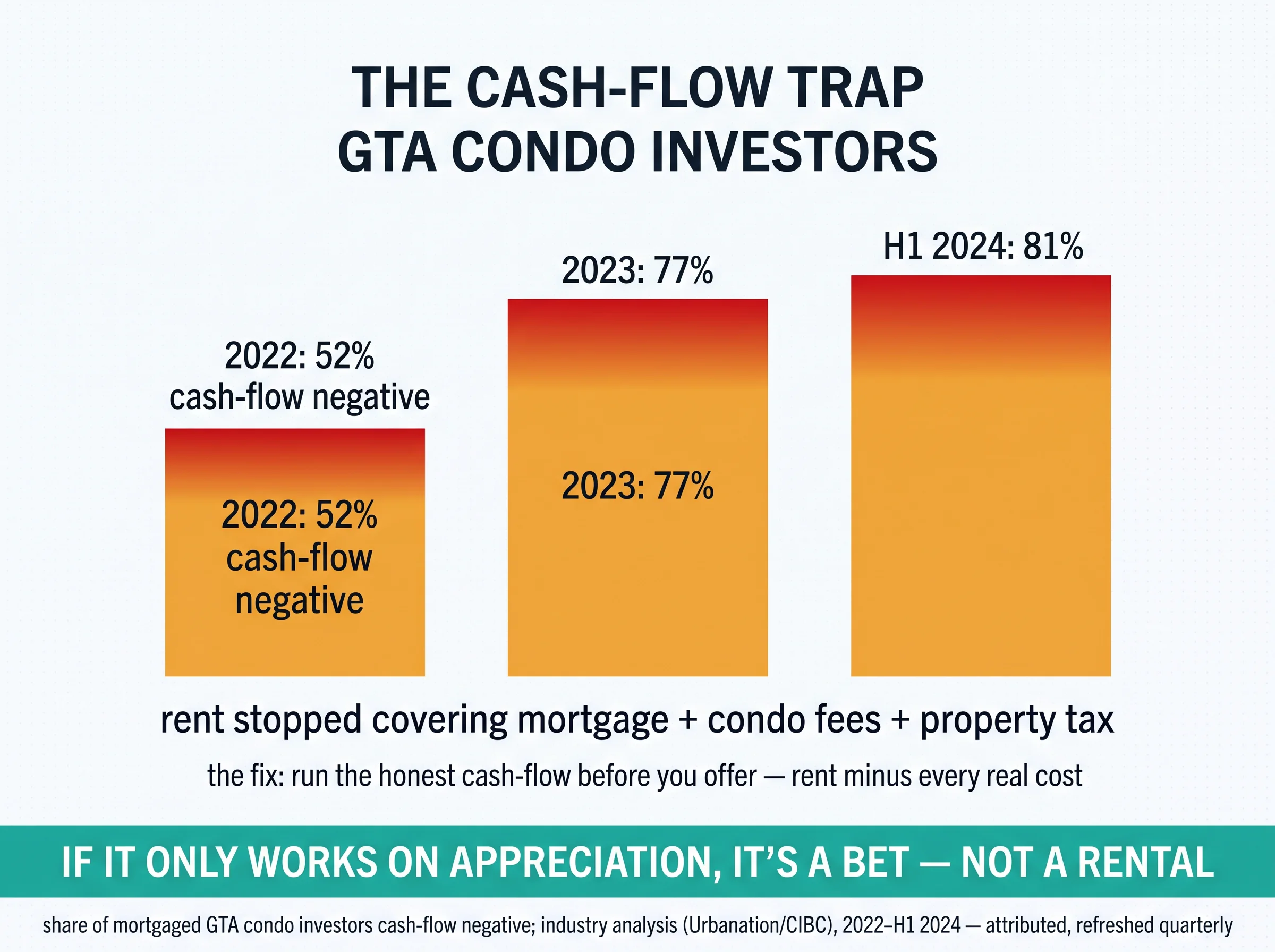
In the first half of 2024, 81% of GTA condo investors carrying a mortgage were cash-flow negative — their rent no longer covered the mortgage, condo fees, and property tax. That's up from 52% just two years earlier. Here's the part worth sitting with: none of them bought in the "wrong city." They bought the wrong deal.
Every "best places to buy" list has a shadow — the deals that quietly lose money. But here's the honest version almost nobody writes: there is no city in Ontario you should blanket-avoid. There are deals to avoid, and every one of them fails the same handful of tests. The danger was never a place on a map; it's a property that can't survive an honest underwrite. This guide is the counterweight to the best-of lists — the five red flags that sink a rental investment (cash flow, oversupply, insurance, a single-industry market, and a thinning demand curve), each with the 2026 data behind it and, more importantly, the way to price it in before you offer. Figures are dated July 2026 and refreshed quarterly; this is market data, not investment advice.
The Red-Flag Pre-Purchase Checklist: Pressure-Test Any Ontario Rental Before You Buy
The five-test pressure check that runs the honest cash-flow, checks absorption, pulls the real insurance quote and flood score, prices the demand risk, and confirms your exit — so you walk from the deals that sink and buy the ones that pass.
Get Free PDF →There Is No City to Avoid — Only Deals to Avoid
"Where not to buy" is the wrong question, because a blanket "avoid this city" verdict is almost always wrong. The same city — often the same street — holds a deal that cash-flows and one that bleeds. The right question is "what not to buy without pricing the risk in."
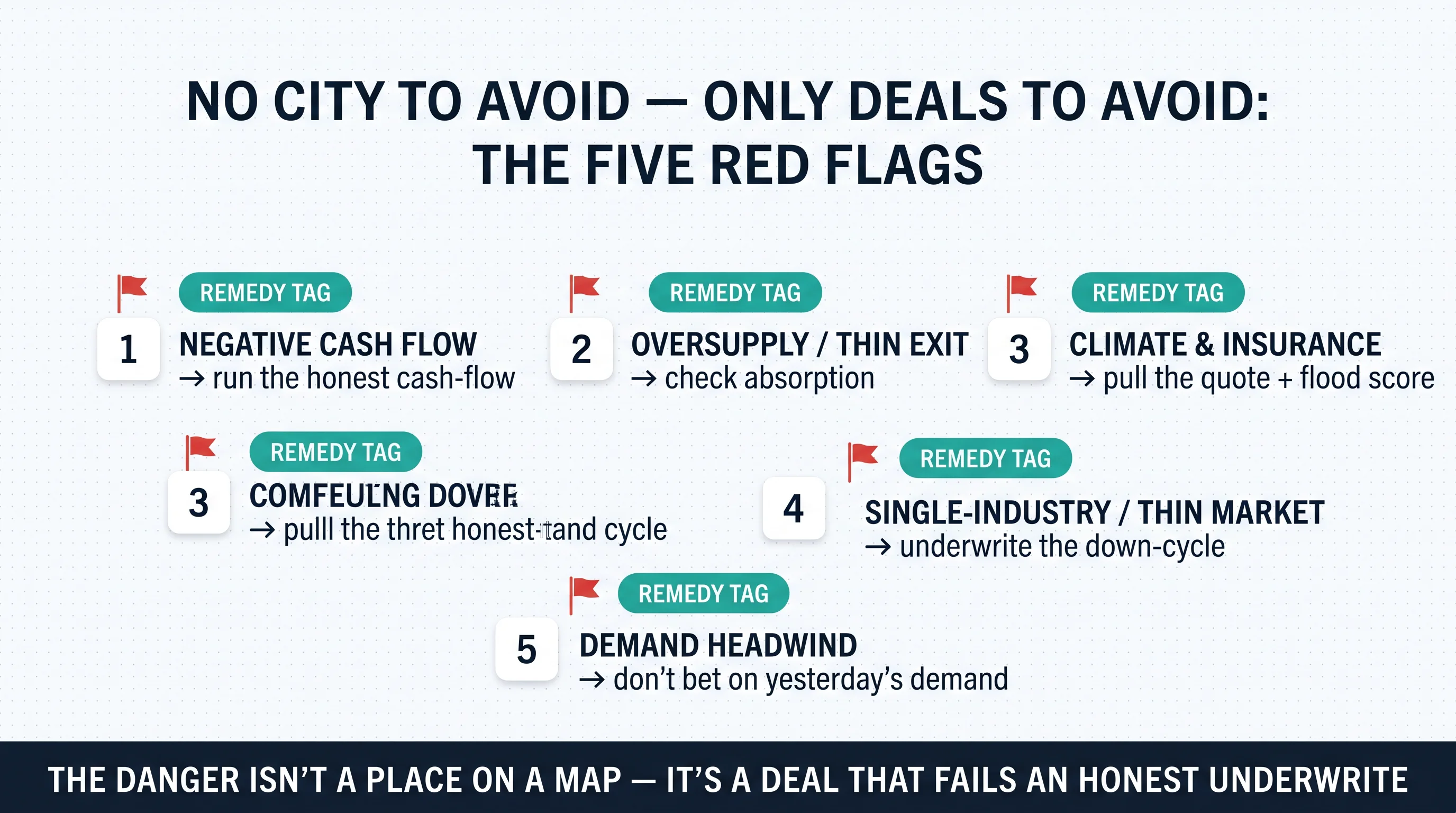
One lesson unifies the entire Cities series: run the honest numbers. Every red flag that follows is a subtraction the paper math skips — the same discipline behind the paper-versus-honest cap in our cap rates guide, the rate-versus-bill inversion in the property tax guide, the honest cap in the cheap-cities guide, and the delay carry in the future-transit guide. And the 2026 market rewards that discipline: analysts describe it as a market for long-horizon, stable-financing, cash-flow-focused investors, not short-appreciation, high-leverage, rapid-resale ones (an attributed characterization, not a guarantee).
So treat the five red flags below as tests to run on a specific property, not verdicts to pin on a place. This is the deliberate shadow of our best Ontario cities guide: the same honest method, pointed at what to walk away from.
Red Flags 1 & 2 — The Cash-Flow Trap and the Thin Exit
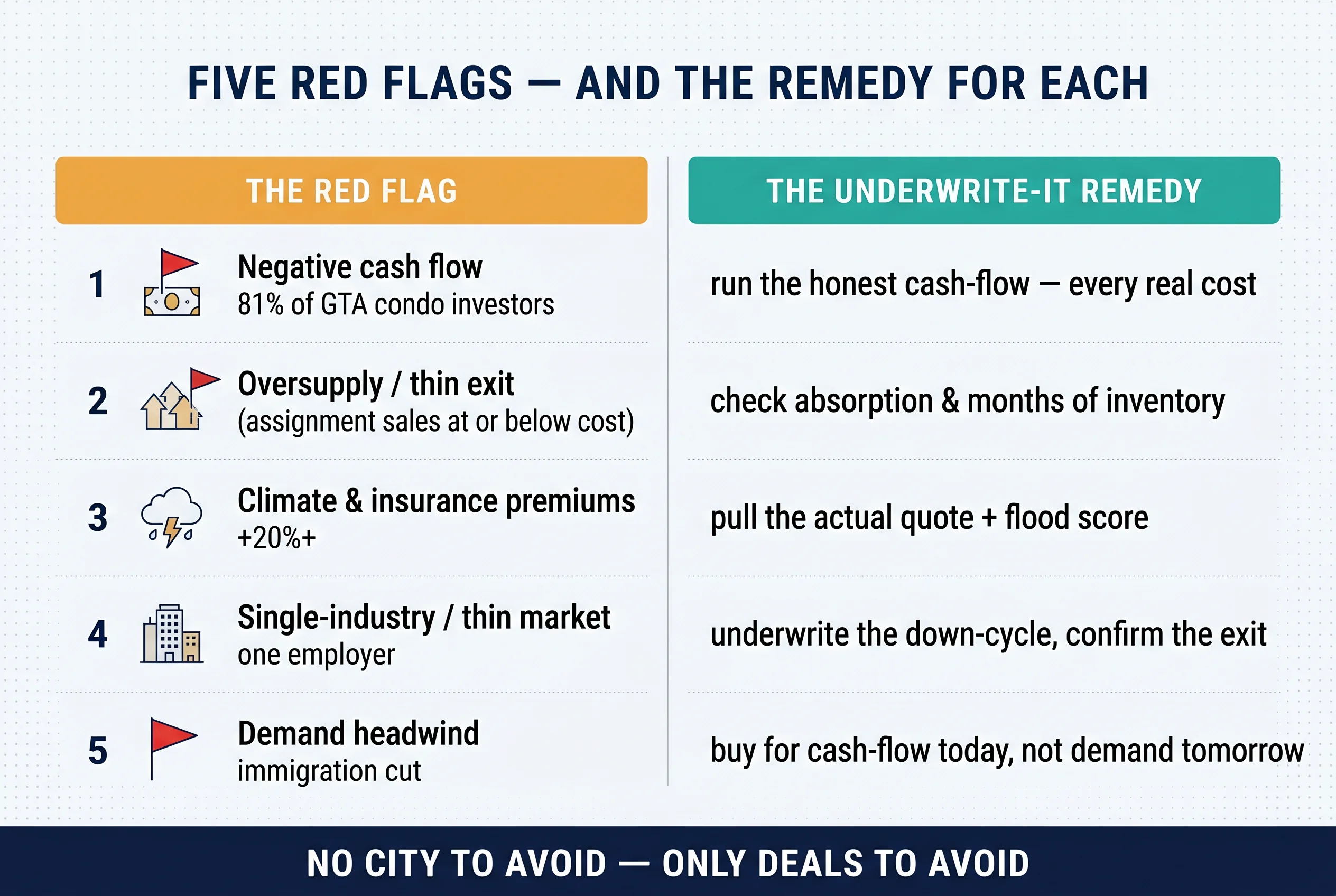
Red flag 1 — the negative-cash-flow trap. The defining story of the last two years: about 81% of mortgaged GTA condo investors were cash-flow negative in the first half of 2024, up from 77% in 2023 and 52% in 2022 (attributed, Urbanation/CIBC). The cause was a timing mismatch — presale units bought in 2020–22 on rising-rent assumptions, arriving into falling rents and rising carrying costs, with condo fees climbing 2–5% a year and elevated mortgage rates. The remedy is the whole point of this guide: run the honest cash-flow before you offer — rent minus mortgage, condo fees, property tax, insurance, maintenance, and a real vacancy allowance. If it only works on appreciation, it's a bet, not a rental.
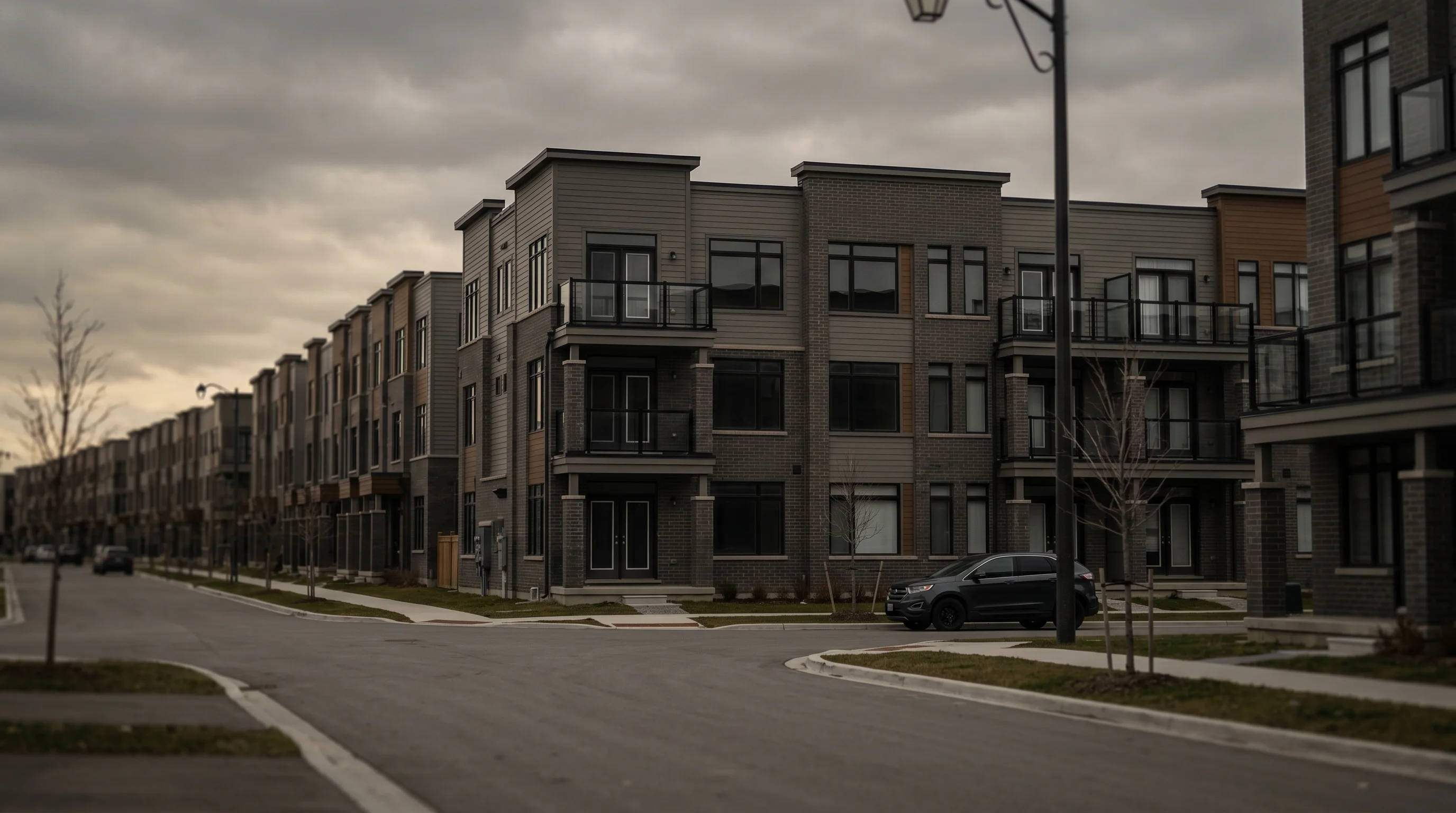
Red flag 2 — oversupply and the thin exit. Toronto completed 29,924 condo units in 2024 and another 29,291 in 2025; by January 2026 only 856 GTA condos sold — down 26% year-over-year, the steepest drop of any property type — against 17,975 active listings, and assignment sales surged, often at or below the original purchase price (attributed). Condo listings are still working through in Toronto, Hamilton, and London. The remedy: check months-of-inventory and absorption for the exact sub-market and unit type before you buy into a wall of near-identical units, because that wall means weak pricing power and a slow exit — the thin-market friction from the cheap-cities math, in an urban dialect.
Red Flags 3, 4 & 5 — Insurance, Single-Industry, and the Demand Headwind
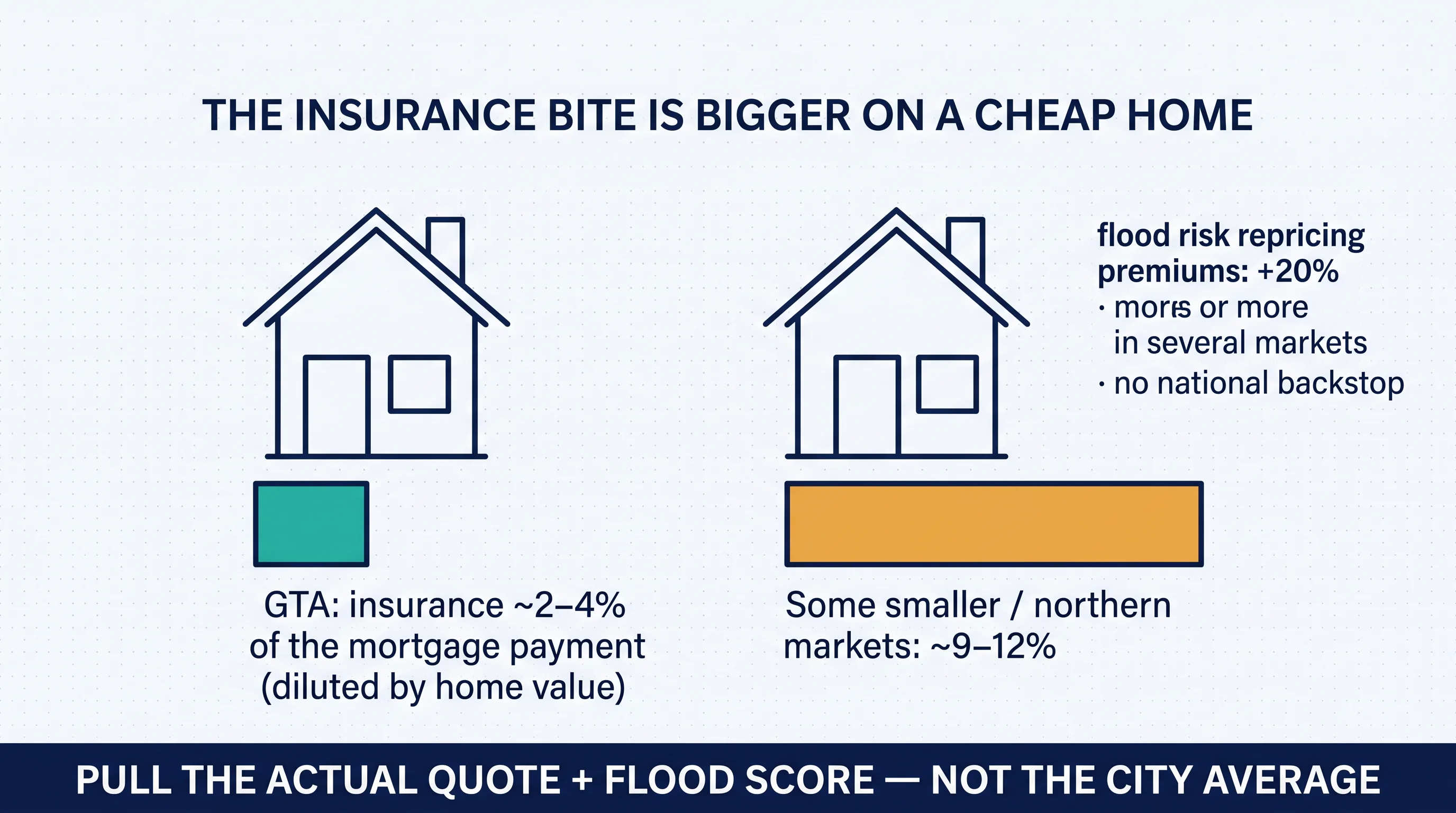
Red flag 3 — climate and insurance risk. This is the freshest of the five. Flood risk is repricing insurance across Ontario: between 2024 and 2026, premiums rose 26% in the province's highest-flood-risk city, 22% in another GTA market, and 20% or more in several others (attributed, Wahi/MyChoice). The investor lesson is the affordability divide. Insurance runs about 2–4% of a mortgage payment in the higher-priced GTA, where high home values dilute it, but 9–12% in some smaller and northern markets — and on a cheaper home, that premium dents the cap the way a high property-tax bill does. Canada still has no national flood-insurance backstop, so the risk is priced straight into private premiums. The remedy: pull the actual insurance quote and the flood score for the specific address — not the city average — before you offer, and budget insurance as a real line in the cap. Our landlord insurance guide covers where the coverage gaps hide.
Red flag 4 — the single-industry, thin market. A property riding one employer or one commodity carries tenant-solvency risk in a downturn, and a small renter pool means weak pricing power, longer lease-ups, and a thin exit — the exact dynamic our cheap-cities cash-flow guide examined in Windsor, Sudbury, and Thunder Bay. The remedy: underwrite the down-cycle, not the peak; budget the thin-market friction; and confirm who buys this from you when you sell. This isn't "avoid these towns" — it's cash-flow them honestly.
Red flag 5 — the demand headwind. The props under rental demand are thinning: federal immigration targets have been cut, the three largest cities are losing population through 2026, and the study-permit cap is softening student hubs — the same policy shift our student-rentals guide tracked. The remedy: don't underwrite on yesterday's demand curve. Stress-test rents and vacancy against softer in-migration, and buy for cash-flow today, not demand tomorrow.
How to Pressure-Test Any Deal
Turn the five red flags into a repeatable pre-purchase pressure test, run in order:
- The honest cash-flow — rent minus every real cost, including insurance, maintenance, and vacancy. If it only works on appreciation, stop here.
- The absorption check — months of inventory, and how many near-identical units are competing with yours now and at resale.
- The insurance-and-flood check — the actual quote and flood score for the specific address, not the city average.
- The demand-and-employer check — who rents this, who employs them, and what happens in a down-cycle.
- The exit check — who buys this from you when you sell, and how many others will be selling the same thing.
Any deal that fails two or more of these is a deal to walk from — in any city. The diligence tools that make it real travel with you: the condo status certificate and reserve-fund review, a home inspection, and an insurance quote before you close (general information, not advice — review with a lawyer, inspector, and broker). And the Ontario base rules still apply: the 2.1% guideline for 2026 on Form N1, the post-November-15-2018 exemption on the N2, last-month's-rent-only deposits, and an MPAC assessment that still sits on a 2016 base.
Practical Takeaways
- Stop asking "which city to avoid" and start asking "does this deal survive an honest underwrite."
- Run the real cash-flow — rent minus mortgage, fees, tax, insurance, maintenance, and vacancy — and refuse any deal that only works on appreciation.
- Check absorption and months-of-inventory before buying into new supply, and picture your exit.
- Pull the actual insurance quote and flood score for the specific address, not the city average.
- Price the single-industry and demand-headwind risks into your vacancy and arrears assumptions, and underwrite the down-cycle.
- Use the real diligence tools — status certificate, reserve fund, inspection, insurance quote before close.
- Re-check the volatile inputs — insurance, oversupply, immigration — next quarter.
Quick win: run one candidate address through the red-flag pre-purchase checklist tonight, insurance quote included. Long-term, the discipline is the edge — the investor who prices the red flags in buys the deals everyone else was scared out of, in the cities everyone else wrote off.
The Red-Flag Pre-Purchase Checklist: Pressure-Test Any Ontario Rental Before You Buy
The five-test pressure check that runs the honest cash-flow, checks absorption, pulls the real insurance quote and flood score, prices the demand risk, and confirms your exit — so you walk from the deals that sink and buy the ones that pass.
Get Free PDF →The Danger Was Never a Place
"Where not to buy" is the wrong question, because the danger was never a place on a map. It's a deal that can't survive an honest underwrite — and those exist in every city, right next to the deals that can. The 81% of GTA condo investors who went cash-flow negative didn't pick the wrong city; they skipped the honest math. So did the buyers caught by a wall of new supply, a flood-repriced insurance premium, a single-employer downturn, or a demand curve that stopped rising. Each of those is a red flag with a remedy: run the real cash-flow, check the absorption, pull the insurance quote, price the risk, and confirm the exit. Do that, and you don't need a list of cities to avoid — you need the discipline to walk from any deal that fails the test, and the confidence to buy the ones that pass. Figures July 2026, refreshed quarterly; market data, not investment advice.
Buy the Deal That Passes — Then Run It Properly
Track cash flow, rent, insurance, and every deductible line on the properties that clear your tests — with Ontario's rules built into every workflow, free for up to 3 units on Tenon10.
Free plan available • Tenants always free • Ontario compliance in code
Related Resources
The Cities & Markets series: Best Ontario Cities to Buy a Rental Property — the direct counterweight to this guide · Cap Rates & Average Rents — the honest-vs-paper method · Do Cheap Ontario Cities Actually Cash-Flow? — the single-industry and honest-cap lessons · Buying Near Future Transit — the delay-carry discipline · Student Rentals in Waterloo, London & Kingston — the demand-headwind case · Property Tax Rates by Ontario City — the carrying-cost bite.
The diligence and rules underneath: Landlord Insurance in Ontario · Ontario Rent Increases 2026: The Complete N1 Guide · the N1 and N2 forms · the rent increase calculator · the Ontario LTB forms hub.
Getting started: Buying Your First Rental Property in Ontario · Becoming a Landlord in Ontario: The First-Timer's Guide.
Frequently Asked Questions
Where should you NOT buy a rental property in Ontario?
The honest answer is that there's no city you should blanket-avoid — there are deals you should avoid, and they exist in every city. A blanket "don't buy in this town" verdict is almost always wrong, because the same street holds a deal that cash-flows and one that bleeds. What actually sinks a rental investment is a property that fails an honest underwrite: one that's cash-flow negative once you subtract every real cost, sits in a wall of near-identical new supply with a thin exit, carries a flood-repriced insurance premium you didn't budget, depends on a single employer or a still-rising demand curve, or has no clear buyer when you sell. So instead of asking which city to avoid, run the five tests in this guide on the specific property. If it fails two or more, walk — whatever the city. Market data, not investment advice.
Is buying a Toronto condo a bad investment in 2026?
Not inherently — but it's the clearest cautionary tale of the last two years, so it demands an honest underwrite. In the first half of 2024, about 81% of mortgaged GTA condo investors were cash-flow negative, because rent stopped covering the mortgage, condo fees, and property tax; meanwhile Toronto completed nearly 30,000 condo units in each of 2024 and 2025, sales fell sharply, and assignment sales surged at or below original prices. That's an oversupply-and-negative-cash-flow combination, not a curse on the asset. For a long-horizon investor who runs the real cash-flow, budgets the condo fees and rising insurance, and buys at a price that works on today's rent rather than tomorrow's appreciation, some of those same units are now more reasonably priced than they've been in years. The asset isn't the problem; the un-run math was.
How does flood risk affect home insurance and my returns in Ontario?
More than most investors budget for. Between 2024 and 2026, flood risk pushed home insurance premiums up by 20% or more in several Ontario markets, and Canada still has no national flood-insurance backstop, so that risk is priced straight into private premiums. The part that matters for returns is the ratio: in the higher-priced GTA, insurance is only about 2–4% of a mortgage payment because home values dilute it, but in some smaller and northern markets it runs 9–12% — so on a cheaper home, a flood-driven premium eats into your cap the way a high property-tax bill does. The fix is simple but frequently skipped: pull the actual insurance quote and the flood score for the specific address before you offer, rather than assuming a city average, and put insurance in your pro forma as a real, current line item.
What are the biggest red flags when buying a rental property?
Five recur. First, negative cash flow — the property only works if you assume appreciation, which is a bet, not a rental. Second, oversupply and a thin exit — a wall of near-identical new units means weak pricing power and a slow, discounted sale. Third, unbudgeted insurance or climate risk — a flood-exposed or expensive-to-insure property whose premium quietly dents the cap. Fourth, a single-industry or thin market — one employer or one commodity carrying the whole tenant base, with limited appreciation and few buyers when you exit. Fifth, a demand headwind — buying on a demand curve (immigration, students) that has stopped rising. Each has a remedy: run the honest cash-flow, check absorption, pull the insurance quote and flood score, underwrite the down-cycle, and confirm the exit. A deal that trips two or more is one to walk from.
Is 2026 a bad time to buy a rental in Ontario?
It depends entirely on your profile, not the calendar. For investors relying on short-term appreciation, high leverage, and rapid resale, current conditions are unforgiving — carrying costs are elevated, several segments are oversupplied, and demand props like immigration have thinned. But for long-horizon investors with stable financing who focus on cash-flow sustainability, 2026's moderated prices, higher inventory, and reduced competition can actually improve risk-adjusted entry points (attributed). In other words, it's a poor time to make an appreciation bet and a potentially good time to buy a property that cash-flows honestly today. The market has shifted from rewarding speculation to rewarding discipline, which is exactly why the red-flag tests in this guide matter more now than they did in 2021. This is general market information, not investment advice.
This article presents Ontario rental market information current as of July 14, 2026 and is refreshed quarterly. It provides market information for educational purposes, not investment, legal, or tax advice, and it does not identify any city as one to avoid — it identifies risks to price into any specific deal. Cash-flow shares, oversupply counts, insurance and flood figures, appreciation, and demand indicators are attributed market-participant and analyst claims (Urbanation/CIBC, Wahi/MyChoice, TRREB, CMHC) that vary by market and over time — verify against your own numbers and the current sources. National flood-insurance backstop status and all figures change; confirm before relying on them, and consult licensed professionals — realtor, lawyer, inspector, accountant, mortgage broker, insurance broker — before making investment decisions.


