You served a 10 Day Notice for unpaid rent. The tenant did not pay in full and did not file a dispute. The effective date is coming, and the tenant shows no sign of leaving.
In British Columbia you cannot change the locks. You need an order of possession from the Residential Tenancy Branch (RTB), and for undisputed notices the fastest route is usually a Direct Request. It is decided on paper alone, with no hearing and no testimony. That speed has a price: the file must be complete and your proof of service must be solid, because the tenant does not get a chance to respond.
This guide covers who can use a Direct Request, what to submit, how to serve the package, and how to enforce the order.
BC Direct Request Document Checklist
A landlord checklist for a BC Direct Request after an undisputed 10 Day Notice: eligibility, the documents to file, serving the package and enforcing the order.
Get Free PDF →When you can use a Direct Request

The RTB's Direct Request page says landlords can only use it when the tenant has not disputed the notice. For a 10 Day Notice, RTB Policy Guideline 39 and the landlord information sheet (RTB-130) set these conditions:
- You gave the tenant a 10 Day Notice to End Tenancy for Unpaid Rent or Utilities (RTB-30).
- The tenant did not pay all overdue rent or utilities within 5 days of receiving it.
- The tenant did not apply for dispute resolution within those 5 days.
- The 5-day window has expired.
- For utilities: the tenancy agreement requires the tenant to pay utilities, and the charges stayed unpaid more than 30 days after your written demand.
The RTB asks landlords to confirm with [email protected] that the tenant did not dispute before applying.
What you can ask for
On a 10 Day Notice, a Direct Request can give you one or more of: an order of possession, a monetary order for unpaid rent and/or utilities, and recovery of the filing fee. You cannot use it to keep the security deposit or to claim damages. Those need a regular dispute application.
The same process also covers undisputed One Month Notices for Cause (RTB-33), Four Month Notices for demolition or conversion (RTB-29) and Two Month Notices for a tenant who no longer qualifies for a subsidized unit. It does not cover orders of possession for the landlord's own use of the property.
Documents you need
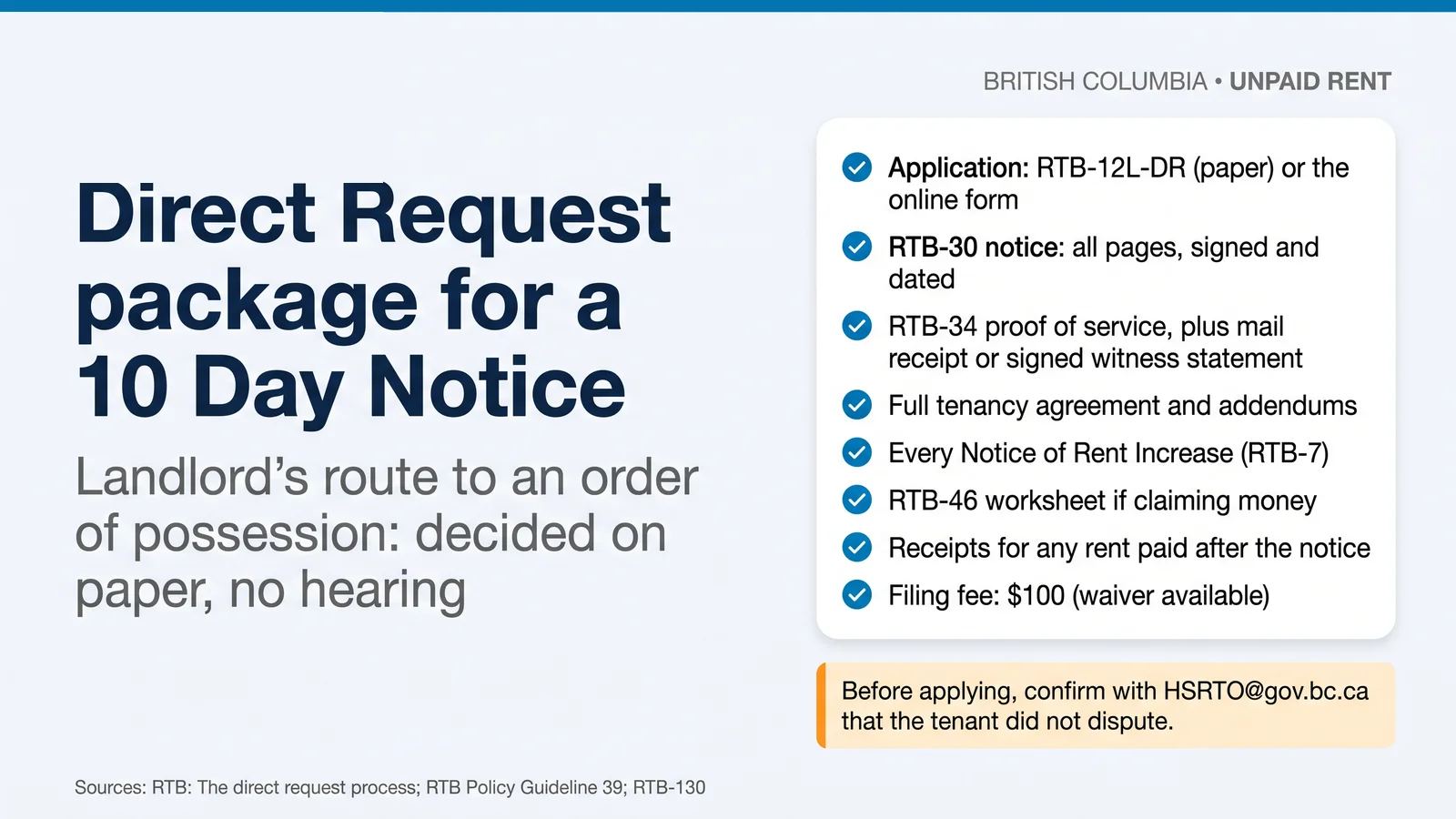
The RTB's complete and serve page lists the documents for a 10 Day Notice application:
| Document | Form | Notes |
|---|---|---|
| Landlord Application for Dispute Resolution, Direct Request | RTB-12L-DR | Paper filing only; online applicants use the web form |
| 10 Day Notice to End Tenancy | RTB-30 | All pages, signed and dated |
| Direct Request Worksheet | RTB-46 | Needed if you claim a monetary order; a rent ledger can support it |
| Written tenancy agreement | None | The whole agreement, with any addendums |
| Documents showing changes | For example RTB-7 | Every Notice of Rent Increase, and changes to parties or agents |
| Proof of service of the notice | RTB-34 | Plus a registered mail receipt, or a written receipt signed by the tenant or a witness |
| Utilities (if claimed) | None | The written demand showing amount and due date, the bills, and proof the demand was served |
| Receipts | None | For any rent received after the notice was issued |
The filing fee is $100. The RTB also offers a fee waiver for applicants with very low income or expenses that make the fee a hardship.
Why proof of service matters so much
Guideline 39 calls substantive proof of service essential. If your proof is unclear, the RTB may dismiss the application with or without leave to reapply, or send it to a participatory hearing, which defeats the purpose. Strong proof looks like this:
- Registered mail: the receipt with date and time, plus a printed tracking report.
- Hand delivery: a receipt signed by the tenant, or a signed witness statement.
- Mailbox, mail slot or door: a signed witness statement; describe the place if it was not the door.
- Email: a copy of the sent email showing the address, date and attachment, plus the tenant's written email address for service (for example, an RTB-51).
Ordinary mail is allowed but not preferred, because delivery cannot be confirmed.
Step by step
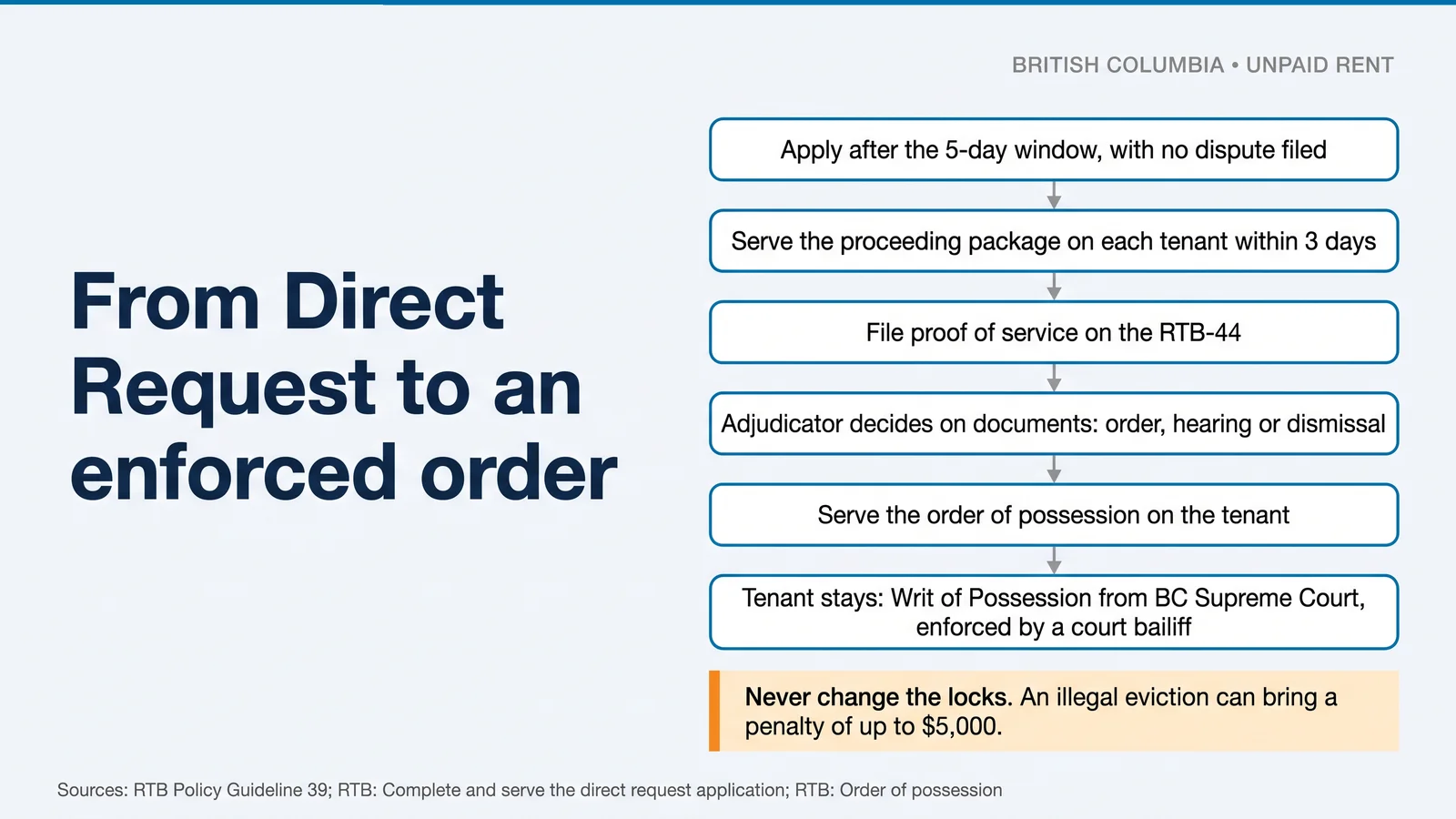
- Confirm eligibility. Check that 5 days have passed since receipt and that no dispute was filed.
- Apply online through the RTB dispute site, or in person at a Service BC office or the RTB office in Burnaby. Upload all documents and pay the fee.
- Wait for the proceeding package. The RTB reviews the file and issues a Notice of Dispute Resolution Proceeding package.
- Serve the package within 3 days of it being made available, on each tenant, with copies of your documents. Allowed methods include in person, registered mail, and email to an address the tenant gave for service. If you claim a monetary order, Guideline 39 says attaching to the door or leaving it with an adult is not allowed.
- File proof of service on the RTB-44, one per tenant, through the Dispute Access site or in person.
- Receive the decision. The adjudicator may grant the orders, schedule a participatory hearing, or dismiss the application.
- Serve the order on the tenant.
When the order takes effect
Guideline 39 says that if the notice's effective date has not passed when the decision is made, the order is effective on that date. If it has passed and the tenant is still there, the order typically takes effect two days after it is served. The tenant may apply for review within 2 days of receiving the order if they say it was obtained with false information, and you cannot enforce while a review is under way.
Enforcing the order
The RTB's order of possession page is clear: only the BC Supreme Court and authorized court bailiffs can enforce it.
- Contact a bailiff from the province's list of authorized court bailiffs for availability, fees and timing.
- File the Writ of Possession package at a Supreme Court registry: a Requisition (Form 17.2), a Writ of Possession (Form 52) and an Affidavit of Service.
- Pay the court fees.
- Tell the registry which bailiff you are using; the registry sends the writ to the bailiff.
- Pay the bailiff's deposit and arrange the date.
You can seek reimbursement of enforcement costs from the tenant. A monetary order for unpaid rent is enforced separately through the courts.
Common mistakes
- Filing before the 5-day window has closed.
- Leaving out a Notice of Rent Increase, so the rent on the notice does not match the lease.
- Submitting a proof of service with no witness or no tracking report.
- Serving the proceeding package on day four, or on only one of two co-tenants.
- Serving the package on the door while also asking for a monetary order.
- Adding a claim for damage or the deposit, which makes the Direct Request ineligible for that part.
- Changing the locks after getting the order. The RTB warns that an illegal eviction can bring a penalty of up to $5,000.
Running Direct Requests across a portfolio
If you manage dozens of units, Direct Requests become routine. Keep a standard file for every tenancy: the signed lease, every rent increase notice, the ledger and the current tenant contact details, including any email address given for service. When a 10 Day Notice goes out, add the RTB-30 and the RTB-34 to that file the same day. On day six, the application is mostly assembly, not research. Track the 3-day service deadline for each package separately, since packages can be issued on different days.
How Tenon10 helps
Tenon10 generates the RTB-30 10 Day Notice and the RTB-7 Notice of Rent Increase, which are two of the documents a Direct Request relies on. The application itself is filed with the RTB.
Lease, notice and payment records stay together for each tenancy, so the evidence record for your application is already in one place.
FAQ
How much does a Direct Request cost?
The filing fee is $100. You can ask to recover it from the tenant in the same application.
What if the tenant disputed the notice?
Then a Direct Request is not available. The dispute goes to a hearing. If the arbitrator upholds your notice and it complies with section 52, you must be granted an order of possession and, for unpaid rent, an order for the rent.
Can I get a monetary order without an order of possession?
The process allows you to apply for one or more of the orders. Guideline 39 notes the RTB may grant possession without the monetary order if the amount owing is not proven exactly.
Can police remove the tenant?
No. The RTB says landlords may not ask police to carry out an eviction. A court bailiff enforces a Writ of Possession.
BC Direct Request Document Checklist
A landlord checklist for a BC Direct Request after an undisputed 10 Day Notice: eligibility, the documents to file, serving the package and enforcing the order.
Get Free PDF →Start with a clean RTB-30
Tenon10 generates the BC 10 Day Notice and keeps lease, notice and payment records together as your evidence record.
Built for Canadian landlords and property managers.
Related BC guides
- How to Give a 10 Day Notice to End Tenancy for Unpaid Rent in BC (RTB-30)
- Serving Documents in BC: Every Method the RTA Allows
Sources: RTB: The direct request process; RTB: Complete and serve the direct request application; RTB Policy Guideline 39; RTB-130 Landlord's Direct Requests information sheet; RTB: Order of possession; Residential Tenancy Act, SBC 2002 c.78. This article is a summary of British Columbia rules as of October 2026, not legal advice. Check the Residential Tenancy Branch for your situation.