A 10 Day Notice for unpaid rent has been served. The landlord is waiting. The tenant is worried. And the most important number on the form is not 10. It is 5.
In British Columbia, the five days after a tenant receives the notice decide almost everything that follows. Pay in full and the notice disappears. Apply to dispute it and there is a hearing. Do nothing and the tenancy is treated as ending on the notice's effective date.
This article explains how those five days are counted, what counts as paying or disputing, and what each side should do once the window closes. It is written for both landlords and tenants.
BC 10 Day Notice Five-Day Window Checklist
A landlord checklist for the five days after a BC 10 Day Notice: counting from receipt, what counts as paying or disputing, and the day-six steps.
Get Free PDF →The rule: what section 46 says
The Residential Tenancy Act sets out the window in section 46(4). Within 5 days after receiving a 10 Day Notice, the tenant may:
- pay the overdue rent, in which case the notice has no effect, or
- dispute the notice by applying to the Residential Tenancy Branch (RTB) for dispute resolution.
If the tenant does neither, section 46(5) says the tenant is conclusively presumed to have accepted that the tenancy ends on the effective date, and must move out by that date. The effective date itself must be at least 10 days after the tenant receives the notice.
For unpaid utilities, the same window applies, but the landlord can only serve the notice if the tenancy agreement requires the tenant to pay utilities to the landlord and the charges are still unpaid more than 30 days after a written demand.
When does the tenant "receive" the notice?
The five days run from receipt, not from the day the landlord filled out the form. The RTB-30 form lists the deemed-receipt rules:
| How it was served | Treated as received |
|---|---|
| Handed to the tenant, or to an adult who appears to live with them | The same day |
| Mailbox or mail slot, attached to the door, or emailed to an address for service | 3 days later |
| Registered or regular mail | 5 days later |
If the tenant actually gets it sooner, the actual date counts. The deeming rules do not give the tenant extra time beyond the real date of receipt.
A worked example
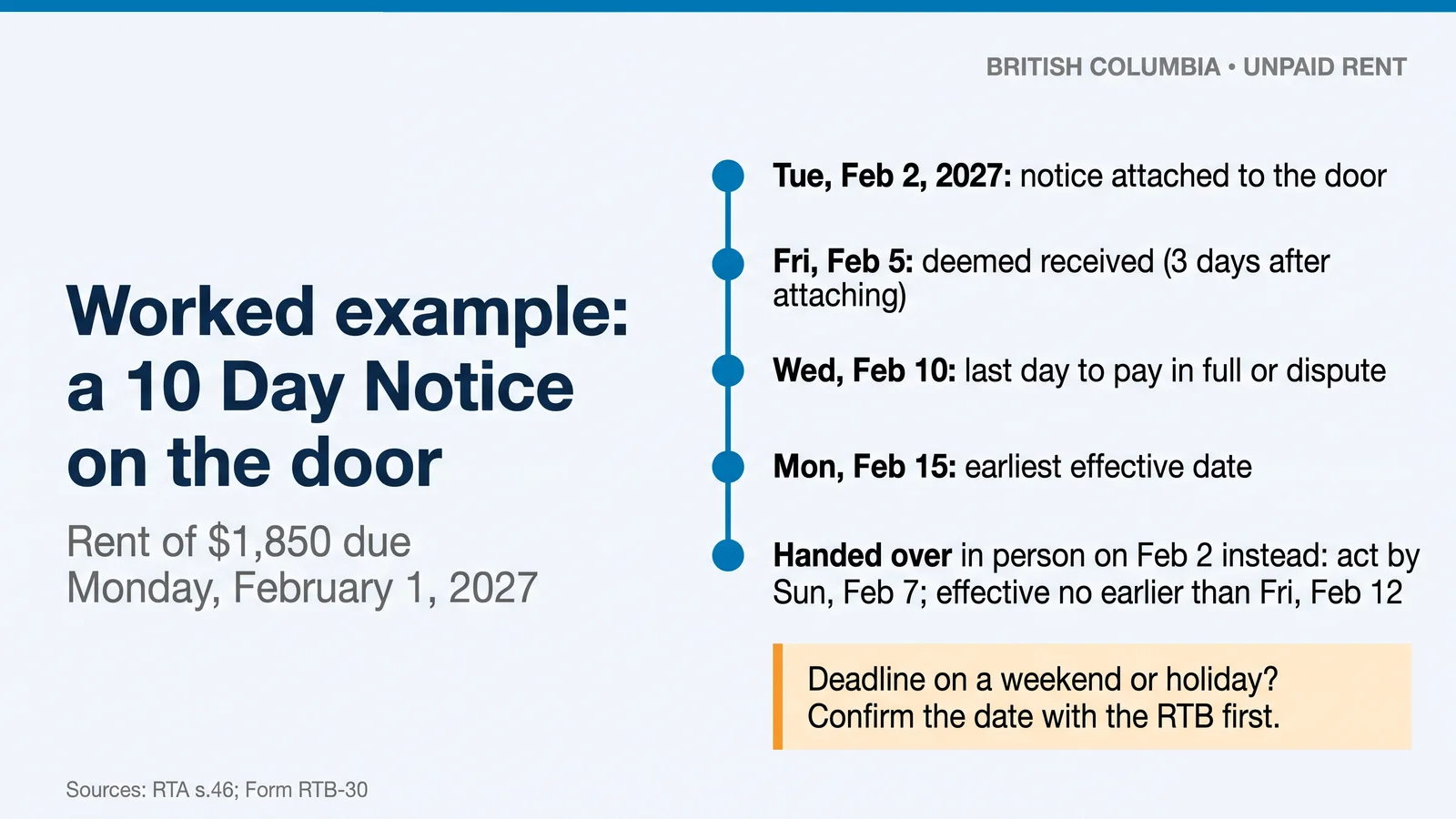
Rent of $1,850 was due Monday, February 1, 2027. The landlord attaches a 10 Day Notice to the tenant's door on Tuesday, February 2, 2027.
- Deemed received: Friday, February 5, 2027 (3 days after attaching).
- Last day to pay in full or dispute: Wednesday, February 10, 2027.
- Earliest effective date: Monday, February 15, 2027.
If the same notice were handed to the tenant on February 2, the last day to act would be Sunday, February 7, and the earliest effective date Friday, February 12.
What counts as paying, and what counts as disputing

Paying
RTB Policy Guideline 39 is clear that the tenant must pay all overdue rent or utilities listed on the notice, in full, within the five days. A partial payment does not cancel the notice. Tenants paying in cash should always get a receipt.
Disputing
A dispute means filing an Application for Dispute Resolution with the RTB: online, at a Service BC office, or at the RTB office in Burnaby. Telling the landlord you disagree is not a dispute. Valid grounds listed on the RTB-30 include proof the rent was paid, an arbitrator's order letting the tenant keep the rent, or money spent on emergency repairs after notice to the landlord.
Can the deadline be extended?
Rarely. The RTB-30 says an arbitrator may allow a late dispute only if the tenant shows a serious and compelling reason. Section 66 of the Act also limits extending the time to pay: only if the landlord agrees, or if the tenant deducted the amount believing it was allowed for emergency repairs or under an RTB order. The time to dispute cannot be extended past the notice's effective date.
What happens on day six
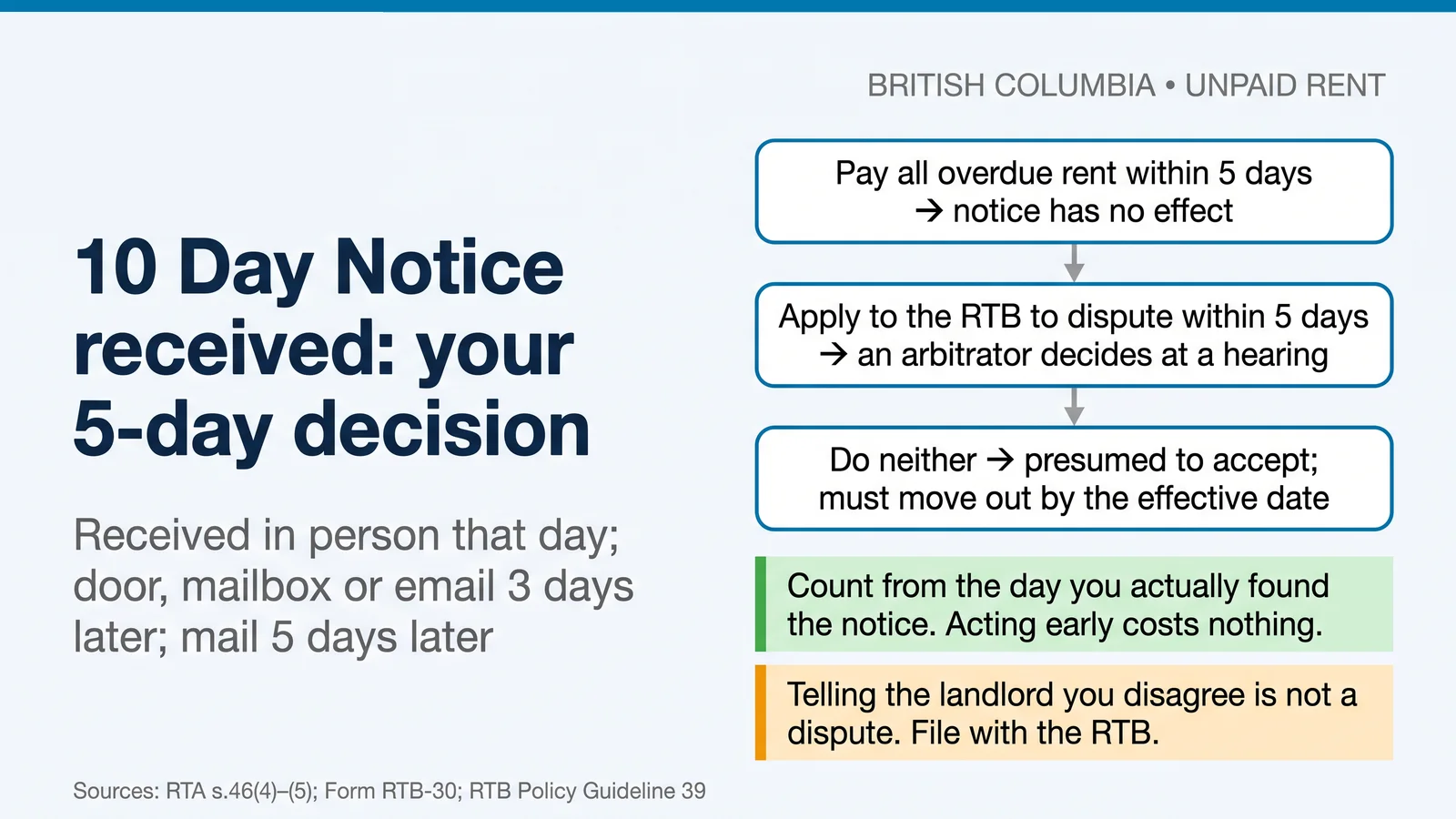
| What the tenant did | Result | Next step |
|---|---|---|
| Paid all overdue rent within 5 days | Notice has no effect | Tenancy continues; landlord issues a receipt |
| Applied for dispute resolution within 5 days | An arbitrator decides the notice at a hearing | Both sides prepare evidence for the arbitrator |
| Did neither | Tenant is presumed to accept the end of tenancy | Tenant must move out by the effective date; landlord may apply by Direct Request |
At a hearing, section 55 says that if the arbitrator dismisses the tenant's application or upholds the notice, and the notice complies with section 52, the landlord must be granted an order of possession and an order for the unpaid rent.
If there was no dispute, the landlord can use the Direct Request process. It is decided on documents, with no hearing, and costs $100 to file.
Common mistakes
Landlords
- Counting from the service date instead of the receipt date.
- Filing a Direct Request without first confirming that no dispute was filed. The RTB suggests checking with [email protected].
- Accepting a partial payment without a receipt that notes it was taken after the notice was served.
- Changing the locks after day five. Only a BC Supreme Court Writ of Possession, carried out by a court bailiff, can remove a tenant.
Tenants
- Paying part of the arrears and assuming the notice is cancelled.
- Arguing with the landlord by text instead of filing a dispute.
- Waiting for the effective date before doing anything. By then, the five-day window is long gone.
What to do next
If you are a landlord: on day six, check your payment records and the RTB for a dispute. If the tenant paid in full, issue a receipt and move on. If they disputed, gather the lease, rent increase notices, ledger and proof of service. If there is no payment and no dispute, prepare your Direct Request.
If you are a tenant: decide on day one. If you can pay the full amount, pay it and get a receipt. If you think the notice is wrong, file a dispute. If you cannot pay, talk to the landlord in writing and call the RTB at 1-800-665-8779 for information on your options. The RTB's paying rent page lists rental help resources.
How Tenon10 helps
Tenon10 generates the RTB-30 10 Day Notice on the approved form, for landlords and property managers who want it right the first time.
Payment and notice records stay together with the lease. If the tenant disputes, or you apply by Direct Request, that record is your evidence file.
FAQ
Do weekends count in the five days?
Section 46 says 5 days, not 5 business days. If a deadline falls on a weekend or holiday, confirm the date with the RTB before relying on any extra day.
Does the notice disappear if the tenant pays on day six?
No. Section 46(4) only cancels the notice if the overdue rent is paid within 5 days. After that, it is the landlord's choice whether to continue the tenancy.
Can a tenant dispute and pay at the same time?
Yes. A tenant who pays in full within the window cancels the notice. A tenant who believes the amount is wrong can still apply for dispute resolution.
What if the effective date on the notice is too early?
Section 53 deems it changed to the earliest date that complies. The notice is not void because of a wrong date.
BC 10 Day Notice Five-Day Window Checklist
A landlord checklist for the five days after a BC 10 Day Notice: counting from receipt, what counts as paying or disputing, and the day-six steps.
Get Free PDF →Get the RTB-30 right the first time
Tenon10 generates the BC 10 Day Notice and keeps lease, notice and payment records together for any RTB hearing.
Built for Canadian landlords and property managers.
Related BC guides
- How to Give a 10 Day Notice to End Tenancy for Unpaid Rent in BC (RTB-30)
- Got a 10 Day Notice in BC? What Tenants Should Do Now
- Direct Request for an Order of Possession in BC
Sources: Residential Tenancy Act, SBC 2002 c.78; RTB-30 10 Day Notice to End Tenancy; RTB Policy Guideline 39; RTB: The direct request process; RTB: Paying rent. This article is a summary of British Columbia rules as of October 2026, not legal advice. Check the Residential Tenancy Branch for your situation.