A notice that was not served properly is a notice the Residential Tenancy Branch (RTB) may not act on. Many BC landlords learn this at a hearing, when an arbitrator asks how the 10 Day Notice reached the tenant and the honest answer is "I slid it under the door."
British Columbia's Residential Tenancy Act has two sets of service rules. Section 88 covers most documents, including notices to end tenancy. Section 89 sets tighter rules for dispute applications and RTB decisions and orders. Section 90 then says when each document is treated as received, which is when tenant deadlines start running.
This guide lays out every method side by side so you can pick the right one for each document.
BC Service Methods Checklist
A landlord checklist for serving documents in BC: which methods sections 88 and 89 allow, deemed receipt under section 90, and how to prove service.
Get Free PDF →Section 88: notices and most other documents

Section 88 applies to the documents you give during an ordinary tenancy: the 10 Day Notice (RTB-30), the One Month Notice for Cause (RTB-33), the Notice of Rent Increase (RTB-7), a written demand for unpaid utilities, a notice of entry, and similar records. RTB Policy Guideline 12 lists the permitted methods:
- In person, by handing it to the person (or to the landlord's agent, when a tenant serves a landlord).
- Ordinary or registered mail to the address where the person lives, or to a forwarding address the tenant provided. A tenant can mail a landlord at the address where the landlord carries on business as a landlord.
- With an adult who apparently lives with the person, at the person's residence.
- In the mailbox or mail slot for the residence (or the landlord's business address).
- Attached to the door or another conspicuous place at the residence (or the landlord's business address).
- By fax to a number the person provided as an address for service.
- By email to an address the person provided for service.
- As ordered by the RTB under section 71.
The RTB-34 Proof of Service form, used for notices to end tenancy and utility demands, mirrors this list with checkboxes for each method.
Section 89: dispute applications, decisions and orders
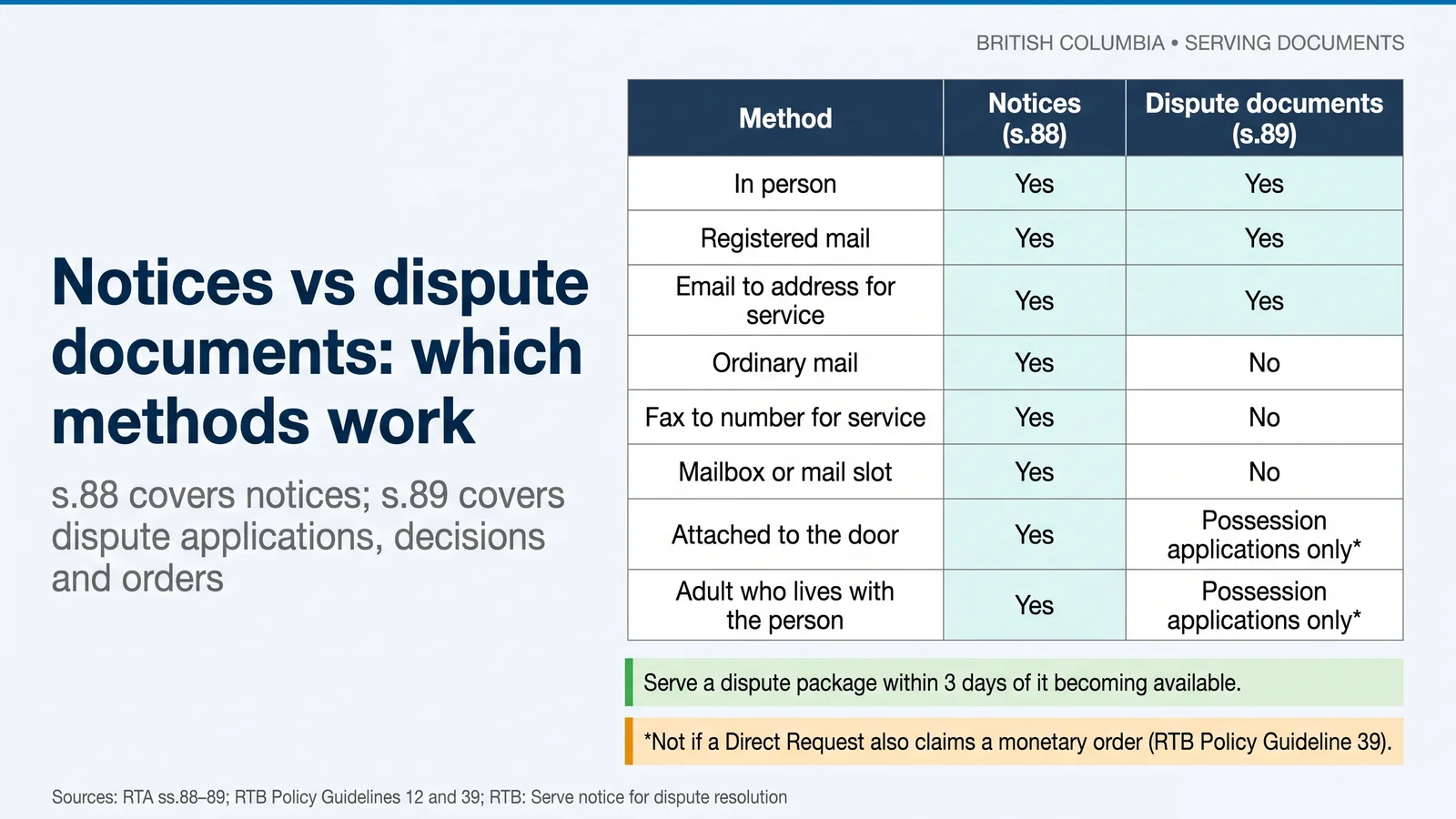
An Application for Dispute Resolution, and the RTB's decisions and orders, follow stricter rules. Guideline 12 says there are only four methods for these:
- In person (a landlord serving co-tenants gives each one a copy).
- Registered mail to the tenant's residence or forwarding address.
- Email to an address provided for service.
- As ordered by the RTB.
Ordinary mail, the mail slot and the door are not on this list.
The exception for possession applications
When a landlord applies for an order of possession, or to end a tenancy early, section 89(2) allows five methods:
- In person, including leaving a copy at the residence with an adult who apparently lives with the tenant.
- Registered mail to the tenant's residence.
- Attaching a copy to the door or another conspicuous place at the residence.
- Email to an address provided for service.
- As ordered by the RTB.
There is a catch. If your Direct Request also asks for a monetary order for unpaid rent, RTB Policy Guideline 39 says door attachment and leaving it with an adult are not allowed for that package. Use personal service, registered mail or email.
Timing is strict too. The RTB says a dispute resolution proceeding package must be served within 3 days of the date it became available to you.
Section 90: when a document counts as received
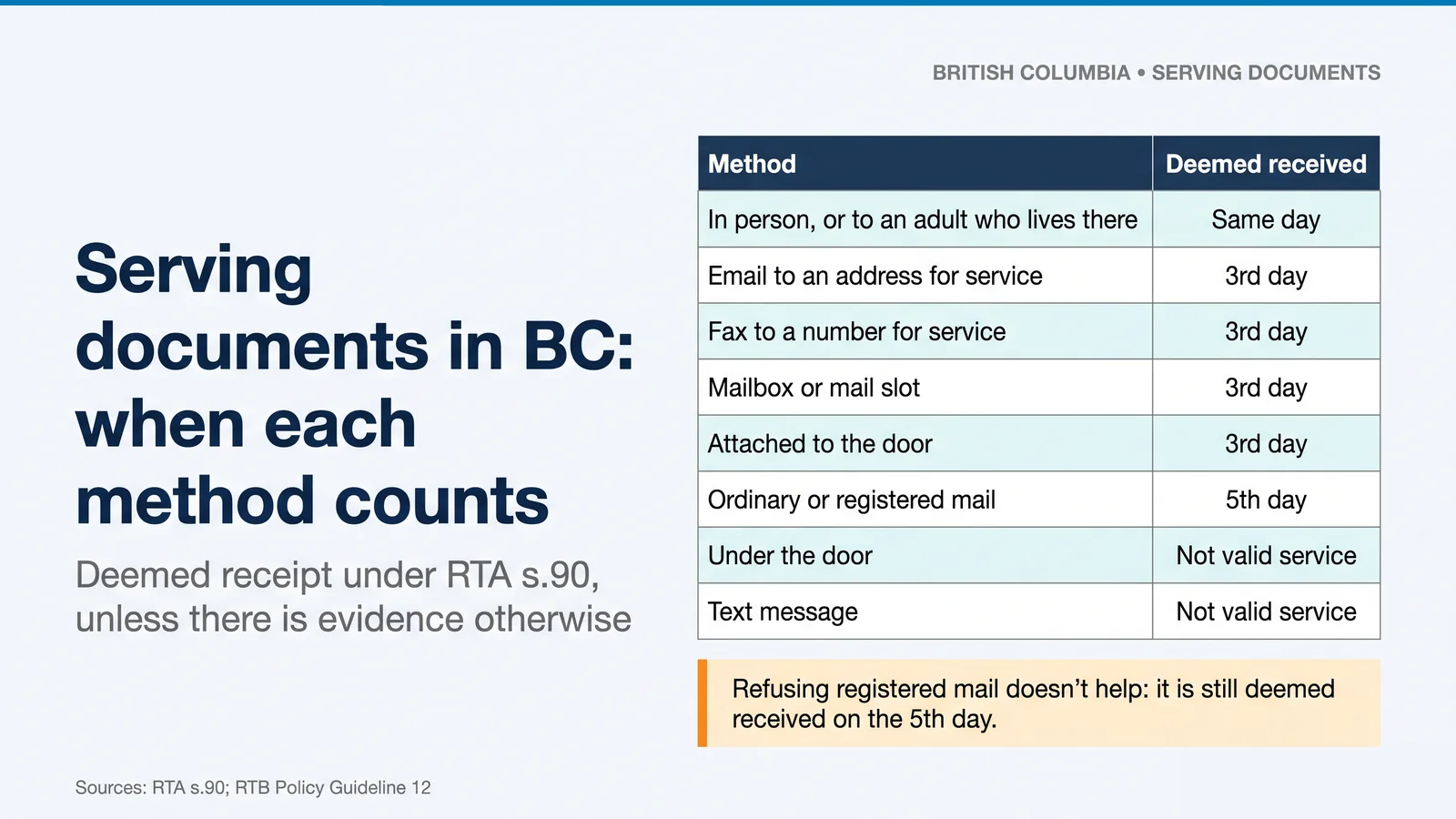
Unless there is evidence to the contrary, a document that was not handed over in person is deemed received as follows:
| Method | Deemed received |
|---|---|
| In person, or to an adult who lives with the person | Same day |
| Mailbox or mail slot | 3rd day after it was left |
| Attached to door or conspicuous place | 3rd day after it was attached |
| Email to address for service | 3rd day after it was sent |
| Fax to number for service | 3rd day after it was sent |
| Ordinary or registered mail | 5th day after mailing |
Two points from Guideline 12 matter in practice. Deeming does not extend the time to respond; if the tenant actually received the document sooner, the actual date is used. And a tenant who refuses to pick up registered mail is still deemed to have received it on the fifth day.
Worked example
Rent was due Monday, March 1, 2027. You serve a 10 Day Notice on Tuesday, March 2.
- Handed to the tenant: received March 2; the 5-day pay-or-dispute window ends March 7; earliest effective date March 12.
- Emailed to an address for service: deemed received March 5; window ends March 10; earliest effective date March 15.
- Registered mail: deemed received March 7; window ends March 12; earliest effective date March 17.
What is not service
- Under the door. Guideline 12 says placing a record under the door is not recognized by the legislation.
- Text message. The RTB lists text messages among methods not typically allowed.
- Email to an address the tenant never gave for service. An address used for casual chat is not the same as one provided for service.
- Mail to a tenant's workplace, unless the tenant gave it as a forwarding address.
When normal methods do not work: section 71
Section 71 lets the RTB order substituted service, order a specific manner of service, find that a document was sufficiently served on a date it picks, or accept a document that was not served under section 88 or 89 as sufficiently served. To get substituted service, you must show the tenant cannot be served by the permitted methods and that there is a reasonable expectation they will receive the document by the method you propose. Apply online, or on paper with the RTB-13.
Common mistakes
- Serving one co-tenant and assuming the other is covered.
- No witness for door or mail slot service. The RTB-34 has a witness statement section; use it.
- No tracking report for registered mail. Keep the receipt with date and time and print the tracking.
- Counting deadlines from the date you served, not the date of receipt.
- Serving by email with no written proof that the address was given for service.
Serving across many units
Property managers serving notices in several buildings should standardize. Choose a default method per document type: for example, door attachment with a witness for 10 Day Notices, registered mail for anything going to a forwarding address, and registered mail or personal service for dispute packages. Fill in the proof of service on the day you serve, attach the receipt or witness statement, and record the deemed-receipt date next to it. When a file reaches the RTB months later, nobody has to remember who served what.
How Tenon10 helps
Tenon10 generates the BC notices you most often serve, including the RTB-30 10 Day Notice, the RTB-33 One Month Notice for Cause and the RTB-7 Notice of Rent Increase.
Each notice is kept with the lease and payment records for that tenancy, so your evidence record for an RTB hearing is in one place.
FAQ
Can I serve a 10 Day Notice by email?
Yes, if the tenant provided that email address for service. It is deemed received on the third day after sending.
Is ordinary mail good enough?
For section 88 documents it is allowed, but the RTB notes only registered mail can be easily confirmed. For dispute applications, use registered mail.
The tenant refused to take the notice from me. Is it served?
Guideline 12 says that if a person declines a document, it may be left near them once the server explains what it is.
Do I need to file proof of service with the RTB?
For a dispute application, yes: the RTB-55, or the RTB-44 for a Direct Request. For a notice, you keep the RTB-34 and file it if you later apply.
BC Service Methods Checklist
A landlord checklist for serving documents in BC: which methods sections 88 and 89 allow, deemed receipt under section 90, and how to prove service.
Get Free PDF →Notices that are ready to serve
Tenon10 generates the BC RTB-30 and keeps every notice with your lease and payment records as one evidence record.
Built for Canadian landlords and property managers.
Related BC guides
- How to Give a 10 Day Notice to End Tenancy for Unpaid Rent in BC (RTB-30)
- Direct Request for an Order of Possession in BC
Sources: Residential Tenancy Act, SBC 2002 c.78; RTB Policy Guideline 12: Service Provisions; RTB: Serve notice for dispute resolution; RTB Policy Guideline 39; RTB-34 Proof of Service; RTB-30 10 Day Notice. This article is a summary of British Columbia rules as of October 2026, not legal advice. Check the Residential Tenancy Branch for your situation.