The province has published the 2027 number, and it is lower than this year's. If you own or manage rental units in British Columbia, you now know the most you can raise rent for an existing tenant next year, and you have a short window to serve notices for the first months of 2027.
The percentage is only one part of a lawful increase. The notice has to be on the right form, it has to reach the tenant three full months ahead, and twelve months must have passed since the last increase. Miss any of these and the increase is late, reduced, or recoverable by the tenant.
This guide covers the full picture: the 2027 limit, how to work out the dollar amount, notice timing with real dates, the 12-month rule, written tenant agreements, additional rent increase applications, and the mistakes that show up most often at the Residential Tenancy Branch (RTB).
The 2027 limit: 2.2%
On August 27, 2026, the B.C. government announced that the maximum allowable rent increase for 2027 is 2.2%. It applies to increases that take effect on or after January 1, 2027. The 2026 limit, for increases taking effect during 2026, is 2.3%.
The figure is tied to inflation. Under the current approach, the limit equals the 12-month average change in the all-items Consumer Price Index for B.C., ending in July of the year before the increase takes effect. You can read the announcement on the B.C. government news site.
The release also lists housing types the limit does not apply to, including commercial tenancies, non-profit rent-geared-to-income housing, co-operative housing and some assisted-living facilities. Manufactured home park tenancies have their own formula.
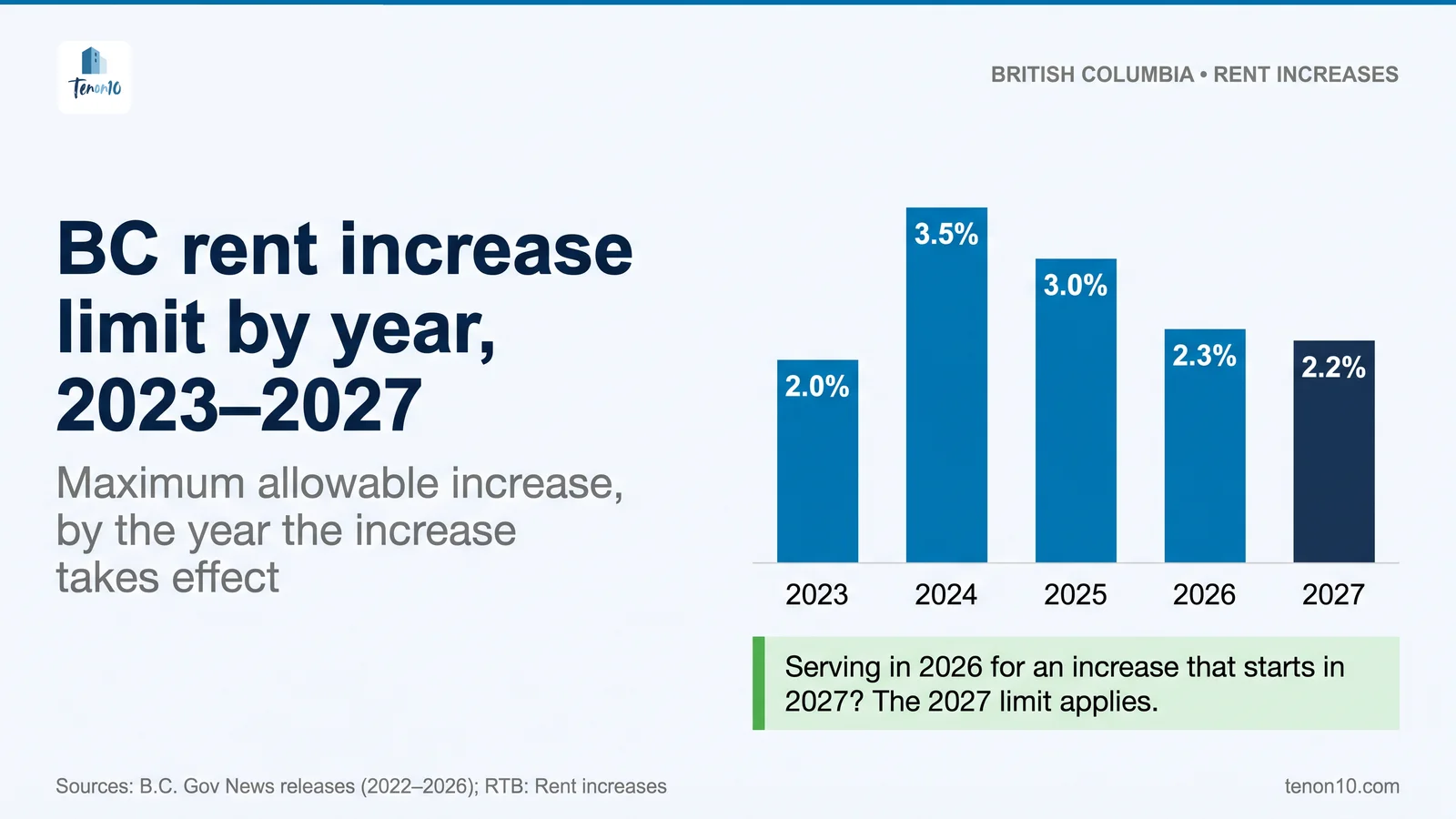
Recent B.C. limits at a glance
| Year the increase takes effect | Maximum increase |
|---|---|
| 2022 | 1.5% |
| 2023 | 2.0% |
| 2024 | 3.5% |
| 2025 | 3.0% |
| 2026 | 2.3% |
| 2027 | 2.2% |
The year that matters is the year the increase takes effect, not the year you serve the notice. A notice you serve in October 2026 for a February 1, 2027 increase uses the 2027 limit of 2.2%.
What the law says
Rent increases sit in Part 3 of the Residential Tenancy Act (sections 40 to 43). Section 41 is short: a landlord must not increase rent except in accordance with that Part. Four rules follow from it.
1. The amount
Under section 43(1), you can raise rent only up to one of three amounts:
- the amount calculated under the regulations (the annual limit, 2.2% for 2027);
- an amount the director orders on an application for an additional rent increase; or
- an amount the tenant agrees to in writing.
The RTB says you cannot round up the allowable amount, and you cannot bank an unused increase. If you raised rent by 1% in a year when 2% was allowed, the missing 1% is gone. It cannot be added to next year's increase.
The limit also covers anything included in the rent. If heat or hydro is part of the rent, a rise in your utility bills does not let you go over 2.2%.
2. The notice
Section 42(2) of the Act requires notice at least three months before the increase takes effect, and section 42(3) requires the approved form. The RTB describes this as at least three full months' notice, using the Notice of Rent Increase (Form RTB-7). The notice must show the exact dollar amount of the new rent and the date it takes effect.
3. The 12-month rule
Under section 42(1), you cannot impose an increase for at least 12 months after:
- the date rent was first payable for the unit, if the tenant has never had an increase; or
- the effective date of the last lawful increase.
The RTB notes this still applies when the building changes hands or a new tenant takes over through an assignment or sublet. A new owner does not get a fresh start on the clock.
4. What happens when the timing is wrong
Section 42(4) is easy to overlook. If your notice does not meet the 12-month rule or the three-month notice rule, it is not thrown out. It takes effect on the earliest date that does comply. In practice, a late notice means a later increase, and the tenant does not owe the higher rent until that later date.
Working out the 2027 dollar amount
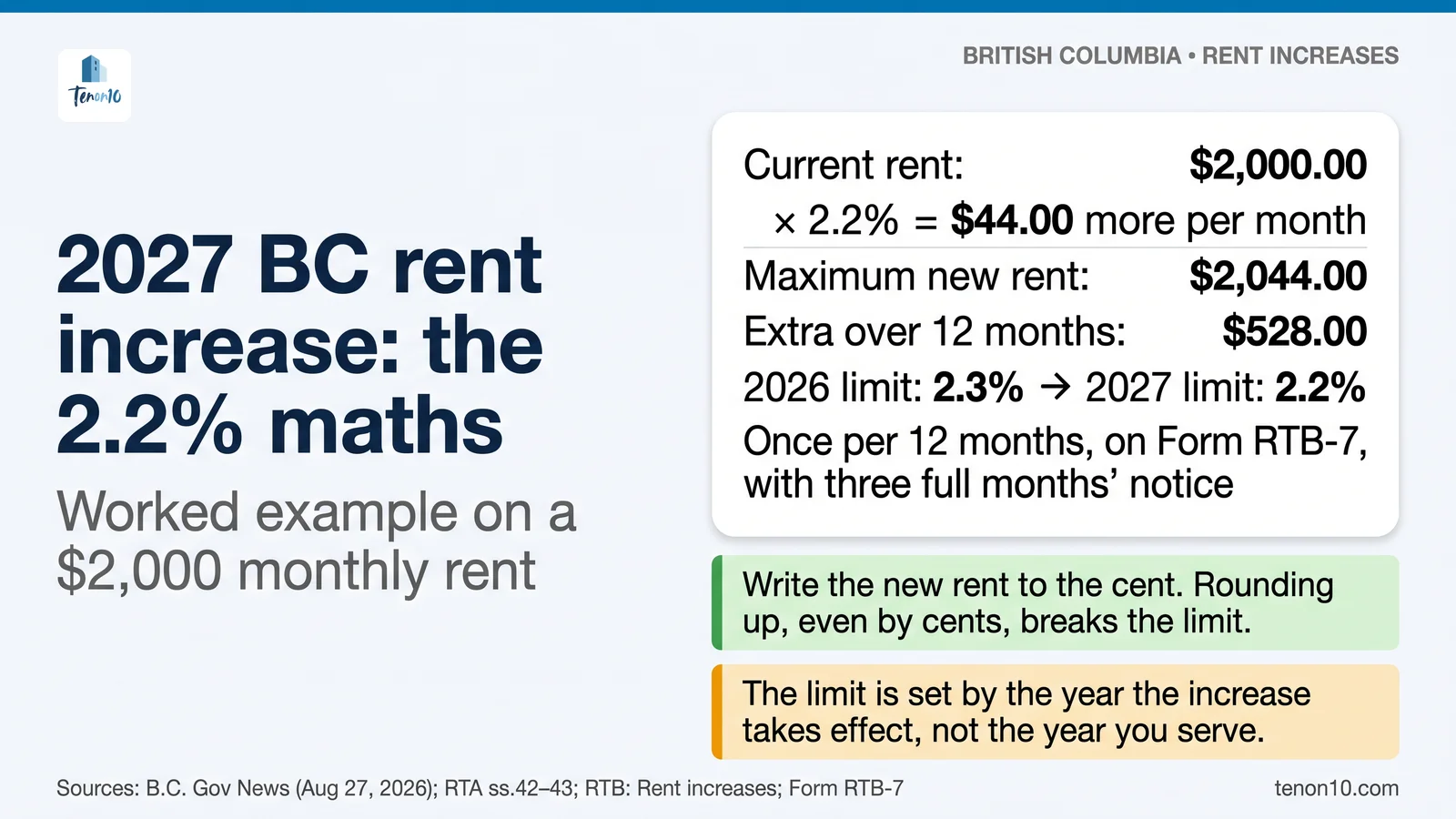
Multiply the current rent by 0.022 and add the result. Do not round up to the next dollar.
| Current monthly rent | 2.2% increase | Maximum new rent |
|---|---|---|
| $1,450.00 | $31.90 | $1,481.90 |
| $1,875.00 | $41.25 | $1,916.25 |
| $2,000.00 | $44.00 | $2,044.00 |
| $2,350.00 | $51.70 | $2,401.70 |
| $3,100.00 | $68.20 | $3,168.20 |
Notice timing with real 2027 dates
"Three full months" means the tenant must receive the notice before three whole rental months begin. The RTB-7 gives its own example: with rent due on the 1st, a notice given at any time in January allows an increase starting May 1. February, March and April are the three full months.
Receipt depends on how you serve. Under the RTB's Policy Guideline 12, a notice that is not handed over in person is deemed received:
- by mail (regular or registered): on the fifth day after mailing;
- by email to an address the tenant gave for service: on the third day after sending;
- attached to the door or left in the mailbox or mail slot: on the third day.
Personal delivery counts on the day you hand it over. Here are the last safe dates for the first half of 2027, for rent due on the 1st:
| Increase takes effect | Tenant must receive notice by | Last day to mail | Last day to email, post on door or leave in mailbox |
|---|---|---|---|
| February 1, 2027 | October 31, 2026 | October 26, 2026 | October 28, 2026 |
| March 1, 2027 | November 30, 2026 | November 25, 2026 | November 27, 2026 |
| April 1, 2027 | December 31, 2026 | December 26, 2026 | December 28, 2026 |
| May 1, 2027 | January 31, 2027 | January 26, 2027 | January 28, 2027 |
| June 1, 2027 | February 28, 2027 | February 23, 2027 | February 25, 2027 |
A January 1, 2027 increase needed the notice received by September 30, 2026. If you missed that, the earliest you can now reach is February 1, and only if the notice is in the tenant's hands by October 31.
If rent is due on a day other than the 1st, the RTB-7 example does not fit directly. Count back conservatively and leave a few days of margin.
When a tenant agrees to more than 2.2%
Section 43(1)(c) allows an increase above the limit if the tenant agrees in writing. The RTB is clear that a tenant does not have to agree. If they do, the written agreement must show:
- the exact dollar amount of the increase;
- the date it takes effect;
- any conditions attached to the agreement; and
- the tenant's signature.
A handshake, a text exchange or a vague email is not enough. Keep the signed agreement with the tenancy file. Never present the agreement as something the tenant must sign to keep the unit.
Additional rent increase (ARI) applications
Under section 43(3), a landlord can ask the RTB to approve an increase above the annual limit in prescribed situations. The RTB's additional rent increase page describes two routes.
Capital expenditures (ARI-C)
- Covers major work such as replacing a major system or component to meet health, safety or housing standards, replacing something broken or at the end of its useful life, or upgrades that cut energy use or emissions or improve security.
- Costs must have been incurred in the 18 months before you apply, must not be expected to recur for at least five years, and the work must be finished when you apply.
- Costs caused by poor maintenance, routine upkeep, and amounts covered by insurance or rebates are not eligible.
- Eligible costs are spread over 120 months and divided among the affected units. Each phase is capped at 3% on top of the annual increase, and any amount over 3% can roll into up to three phases.
- You apply online. Approved increases are served on the RTB's phase notice forms (RTB-53 series), and the RTB says an additional increase is given at the same time as an annual increase.
Expenses
- Covers a financial loss from unforeseen financing costs when buying a residential property, or significant increases in costs for services included in the rent.
- Uses paper Form RTB-52, filed with the RTB office in Burnaby or through Service BC. The fee is $300 plus $10 per affected unit, up to $600.
Tenants can take part and present evidence. An ARI is slow and evidence-heavy. Plan it months ahead, not in the weeks before your annual notices go out.
Common mistakes
- Using a letter instead of the RTB-7. The Act requires the approved form. A letter or email in your own words is not a valid notice.
- Counting from the send date. Mail is deemed received on the fifth day. A notice mailed October 30 is deemed received November 4, which pushes a February 1 increase to March 1.
- Rounding up. Even a few cents above the limit is an unlawful increase.
- Applying last year's percentage. An increase effective in 2027 uses 2.2%, even if you serve the notice in 2026.
- Restarting the 12 months from the notice date. The clock runs from the effective date of the last increase, not the date you served it.
- Raising included utilities separately. If utilities are part of the rent, they are capped with the rent.
- Emailing an address the tenant never gave for service. Email works only to an address provided for that purpose.
- Collecting the increase anyway. Under section 43(5), a tenant can deduct a non-compliant increase from rent or otherwise recover it.
Running increases across several units
With one unit, a calendar note may be enough. With twenty, the dates drift apart: tenancies started in different months, some tenants had increases mid-year, and some have never had one. A simple routine helps:
- List every tenancy with its current rent, the date rent was first payable, and the effective date of the last increase.
- Find the first date each unit becomes eligible: 12 months after the later of those two dates.
- Choose the effective date (usually the 1st of the month after eligibility) and calculate the new rent at 2.2%.
- Work back to the "receive by" date and pick a service method with a buffer.
- Serve, record how and when, and keep a copy of each RTB-7 with proof of service.
Keep proof of service with each tenancy. If a tenant disputes the increase, that record is your evidence.
How Tenon10 helps
Tenon10 generates the B.C. Notice of Rent Increase (RTB-7) from the tenancy details you already have, so names, addresses, current rent and the new amount come from one record.
Each unit's lease, rent history and notices stay together. If an increase is ever questioned at the RTB, you have the notice, the dates and the payment record in one place.
FAQ
Can I raise rent by 2.2% on January 1, 2027?
Only if the tenant received a valid RTB-7 by September 30, 2026 (for rent due on the 1st) and 12 months have passed since the last increase. For most landlords reading this now, February 1 or later is the earliest realistic date.
Does the limit apply when I sign a new tenant?
The annual limit applies to increases for an existing tenant. The 12-month clock starts when rent is first payable under the tenancy.
What if my notice arrives a few days late?
Under section 42(4), the increase takes effect on the earliest date that complies. For rent due on the 1st, that usually means one month later.
Can a tenant dispute a 2.2% increase?
Section 43(2) says a tenant cannot apply for dispute resolution over an increase that complies with Part 3. They can dispute one that does not comply.
Can I add last year's unused increase?
No. The RTB says unused increases cannot be carried forward.
Prepare your 2027 RTB-7 notices
Tenon10 generates the B.C. Notice of Rent Increase and keeps each unit's lease, rent and notice records together as your evidence file.
Built for Canadian landlords and property managers.
More guides for Canadian landlords are on our landlord hub. Managing units in Ontario as well? See our Ontario 2027 rent increase guide.
Related BC guides
- The BC Notice of Rent Increase (RTB-7): How to Fill It In
- Three Full Months: Serve-Date Maths for BC Rent Increases
- Serving 2027 BC Rent Increases Across a Portfolio in Tenon10
- Disputing a BC Rent Increase: A Tenant's Guide
Sources: B.C. Gov News, 2027 rent increase limit (Aug 27, 2026); Residential Tenancy Act, Part 3; RTB: Rent increases; RTB: Additional rent increases; Form RTB-7; RTB Policy Guideline 12. This article is a summary of British Columbia rules as of October 2026, not legal advice. Check the Residential Tenancy Branch for your situation.