You moved out weeks ago. You cleaned, handed back the keys and gave your landlord your new address. The deposit has not arrived, and your messages go unanswered. Or a cheque came, but for a few hundred dollars less, with a note about "cleaning" you never agreed to.
In British Columbia the law gives landlords a short, fixed window to deal with your deposit. If they let it pass, you may be entitled to twice the amount they held, not just your money back.
This article explains when the double-deposit rule applies, when it does not and how to claim it through the Residential Tenancy Branch (RTB).
BC Double Deposit Claim Checklist
A tenant checklist for claiming double the deposit in BC: checking the 15-day deadline, whether you qualify, and filing a direct request.
Get Free PDF →The rule: 15 days, three options, or pay double
What your landlord must do
Your landlord's deadline is 15 days after the later of these two dates: the day your tenancy ended, and the day they received your forwarding address in writing. Within that time, they must do one of three things:
- Return your full deposit, plus any interest.
- Get your written agreement to keep a set amount, and return the rest.
- Apply to the RTB for dispute resolution to keep some or all of it.
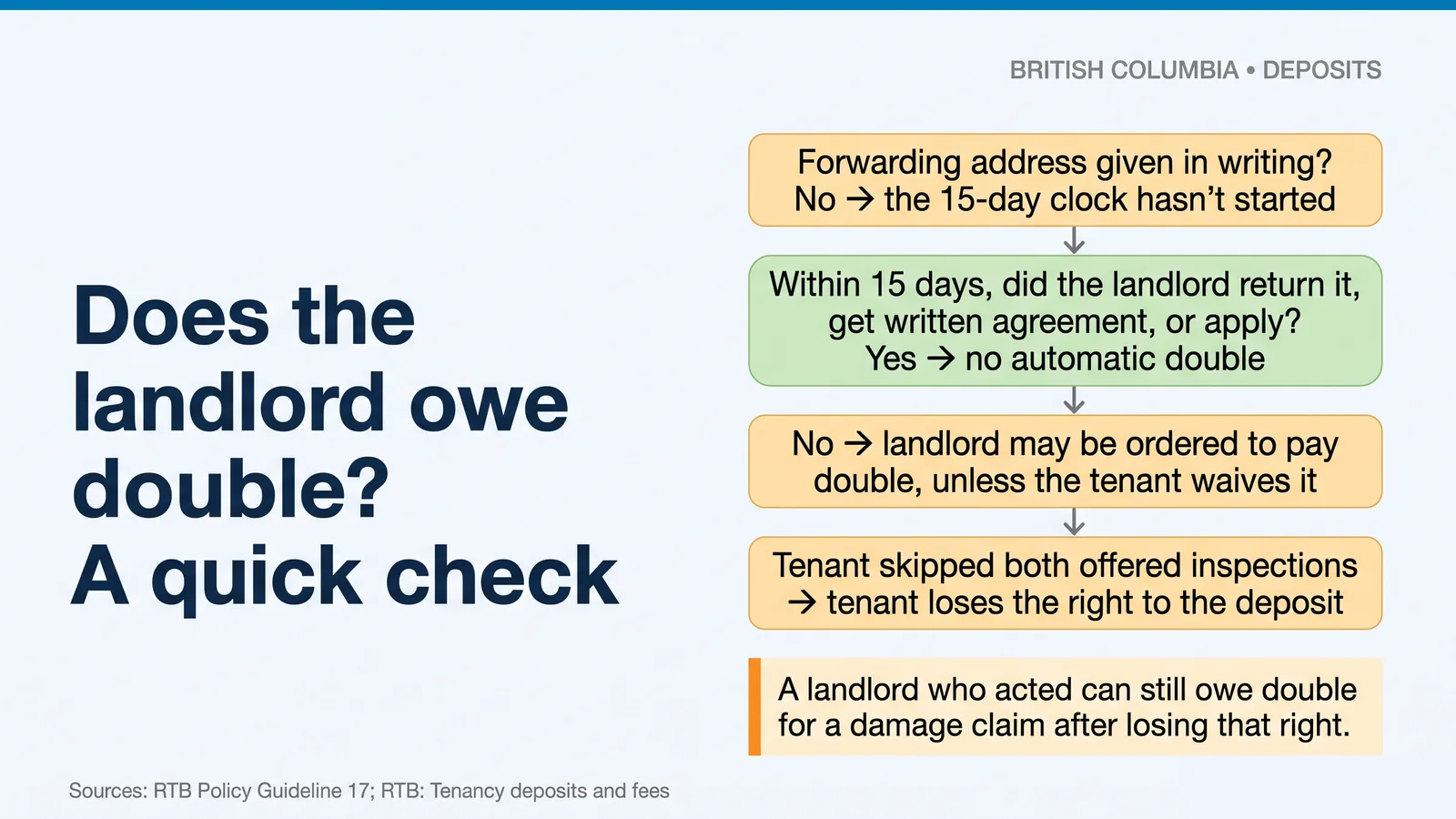
If they do none of these, they cannot claim against your deposit, and they may be ordered to pay you double the deposit. This applies to a security deposit, a pet damage deposit or both.
What counts toward "double"
RTB Policy Guideline 17 explains the details:
- The arbitrator orders double whether or not the landlord had a valid claim for damage, unless you choose to waive it.
- Interest is not doubled. It is added on the original deposit only. The interest rate for 2026 is 0%, so for a recent tenancy the interest is often small or nil.
- Any amount you already agreed in writing that the landlord could keep is taken out before doubling.
- An amount you still owe under an earlier RTB order is also left out.
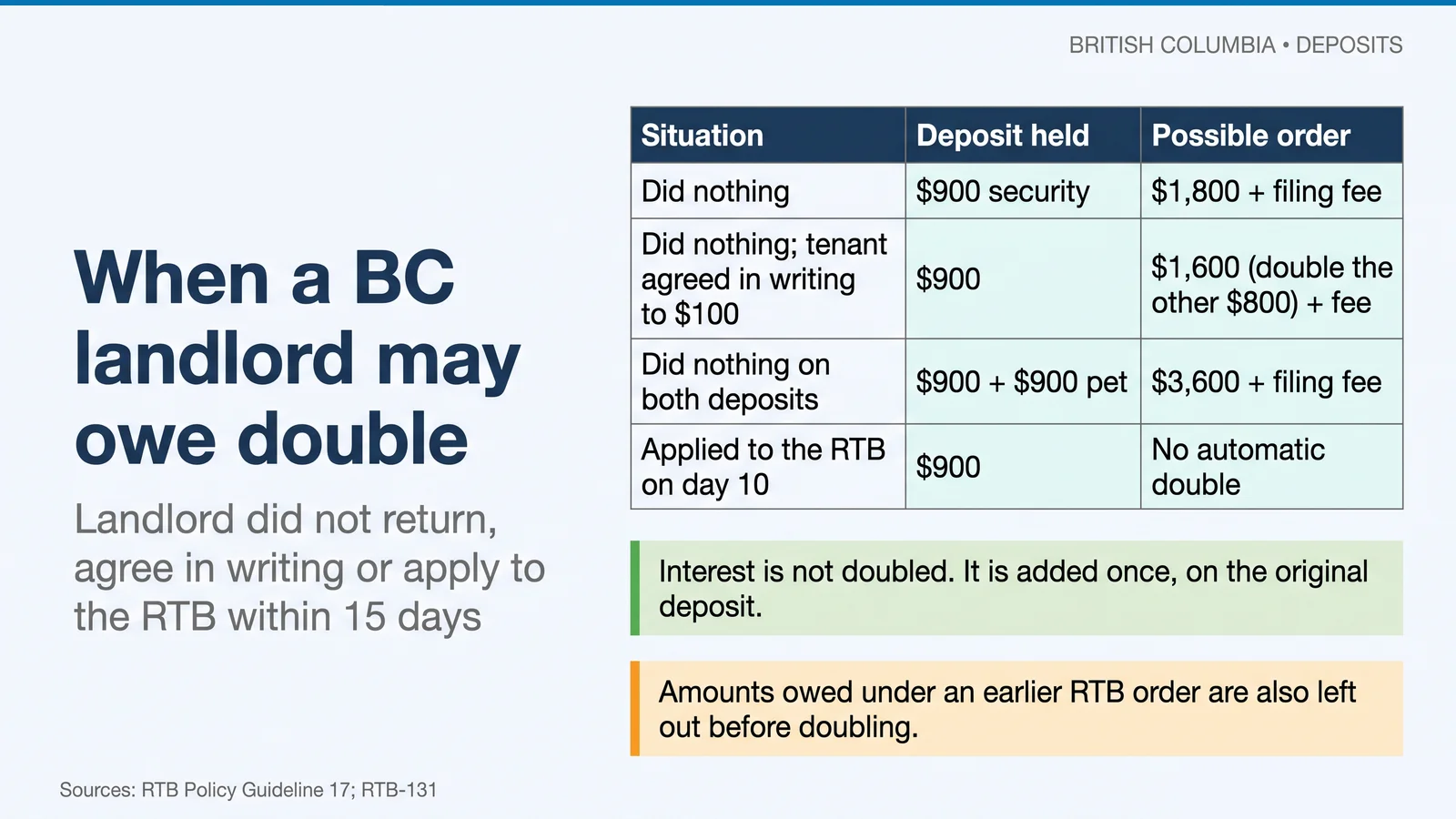
| Situation | Deposit held | Possible order |
|---|---|---|
| Landlord did nothing within 15 days | $900 security deposit | $1,800 plus filing fee |
| Landlord did nothing; you had agreed in writing they could keep $100 | $900 | Double the remaining $800: $1,600 plus filing fee |
| Landlord did nothing on both deposits | $900 security + $900 pet | $3,600 plus filing fee |
| Landlord applied to the RTB on day 10 | $900 | No automatic double; the arbitrator decides the claim |
Other cases where double is ordered
Guideline 17 also lists situations where a landlord who did act can still face double. These include claiming against the deposit for damage after the landlord lost that right by skipping inspections, filing a frivolous or abusive claim, or getting your written agreement after their right to it was already gone.
When you will not get double
- You skipped both inspections. If your landlord offered you at least two opportunities to do the move-in or move-out inspection and you took part in neither, you lose your right to the deposit.
- You never gave a written forwarding address. The clock does not start without it. After one year from the end of the tenancy, the landlord may keep the deposit.
- The landlord acted in time. A timely return, a written agreement or an RTB application means the double rule does not kick in.
A worked example
Your tenancy ended on November 30, 2026. Your security deposit was $1,050. On December 3 you handed your landlord a signed letter with your new address and kept a photo of it.
- The clock starts December 3 (the later date).
- Your landlord's deadline is December 18, 2026.
- Nothing arrives and the landlord has not applied to the RTB.
- You can file a direct request 20 days after the tenancy ended and you gave the address, so from December 23, 2026.
- If successful, the order can be for $2,100 plus your application fee.
Common mistakes tenants make
- Giving the address only by phone or text. It must be in writing and served properly. Keep proof of how and when you gave it.
- Missing the move-out inspection. If the landlord offers two times and you attend neither, you can lose the deposit entirely.
- Filing too early. The direct request is available 20 days after the tenancy ended and the address was given. Filing before then can lead to dismissal.
- Not checking whether the landlord filed. If the landlord applied within the window, the double rule does not apply. The RTB says you can check by emailing [email protected].
- Treating the deposit as rent. You cannot apply the deposit to rent without the landlord's written permission.
What to do next
- Confirm the dates: tenancy end, and when the landlord received your written forwarding address.
- Add 15 days to the later date. If that has passed with no refund, no agreement and no RTB filing, you may have a double claim.
- Gather proof: your tenancy agreement, deposit receipt or e-transfer record, the forwarding address letter and proof of delivery, and any inspection reports.
- File a tenant's direct request with the RTB. The filing fee is $100, and a waiver is available for people with very low income.
- Once a decision is made, serve the landlord as directed. If they do not pay, the order can be enforced through the courts.
How Tenon10 helps
Tenon10 is built mainly for landlords and property managers, but our free forms page includes BC resources tenants can use. Tenon10 generates the tenant's notice to end tenancy and includes a fillable RTB-27 Condition Inspection Report with a room-by-room grid.
When your landlord uses Tenon10, deposit tracking follows the 15-day return clock and flags the double-penalty risk on their side, which helps deposits go back on time.
FAQ
Is double automatic?
Not automatic. You need to apply to the RTB. If the landlord missed the 15-day window, the arbitrator orders double unless you waive it.
Does the landlord's damage claim cancel the double?
No. Guideline 17 says double applies whether or not the landlord had a valid claim, if they did not act in time. The landlord can still pursue damage separately.
What if my landlord says I damaged the unit?
Your landlord can raise damage by applying to the RTB within the 15 days, or by filing a separate monetary claim. Saying so in a text message does not stop the clock. If they never applied, your double claim still stands, and any damage claim is dealt with on its own merits.
Is interest doubled too?
No. Interest is calculated on the original deposit and added once.
How long do I have to give my forwarding address?
Up to one year after the tenancy ends.
BC Double Deposit Claim Checklist
A tenant checklist for claiming double the deposit in BC: checking the 15-day deadline, whether you qualify, and filing a direct request.
Get Free PDF →Free BC tenancy resources
Tenon10 includes a fillable RTB-27 Condition Inspection Report and the BC tenant's notice to end tenancy, with free resources on our forms page.
Built for Canadian landlords and property managers.
Related BC guides
- BC Security and Pet Damage Deposits: The Complete Landlord Guide
- The Half-Month Cap: How Much Deposit a BC Landlord Can Collect
- The 15-Day Rule: Returning a Deposit at the End of a BC Tenancy
- Getting Your Deposit Back in BC: A Tenant's Step-by-Step Guide
Sources: RTB Policy Guideline 17: Security Deposit and Set Off; RTB-131: Tenant's Direct Request information sheet; RTB: Direct request process; RTB: Tenancy deposits and fees. This article is a summary of British Columbia rules as of October 2026, not legal advice. Check the Residential Tenancy Branch for your situation.