You have found a good tenant, the rent is agreed and the tenancy agreement is ready to sign. Now you need to set the deposit. In some provinces and in many landlords' habits, that number is a full month's rent. In British Columbia it is not.
BC sets a hard ceiling on what you can take up front, and the ceiling is lower than many new landlords expect. Go over it, even by accident, and the tenant can simply stop paying part of next month's rent to get the excess back.
This article explains the half-month cap for security deposits and pet damage deposits, shows the numbers for common rents and covers the edge cases that trip landlords up.
BC Deposit Cap Checklist
A landlord checklist for BC's half-month deposit cap: calculating the security and pet damage deposit limits, timing, exemptions and fees you cannot charge.
Get Free PDF →The rule: half of the first month's rent
Security deposit
A security deposit in BC can be no more than half of the first month's rent. It covers unpaid rent and damage beyond normal wear and tear. There is one security deposit per tenancy agreement, regardless of how many tenants sign.
Pet damage deposit
If you allow pets, you can also take a pet damage deposit. It is a separate deposit, and it is also capped at half of the first month's rent. The cap does not grow with the number of pets. Two dogs and a cat still mean one pet damage deposit of up to half a month.
A pet damage deposit can only be used to repair damage caused by a pet, unless the tenant agrees in writing or an arbitrator orders otherwise.
The combined ceiling
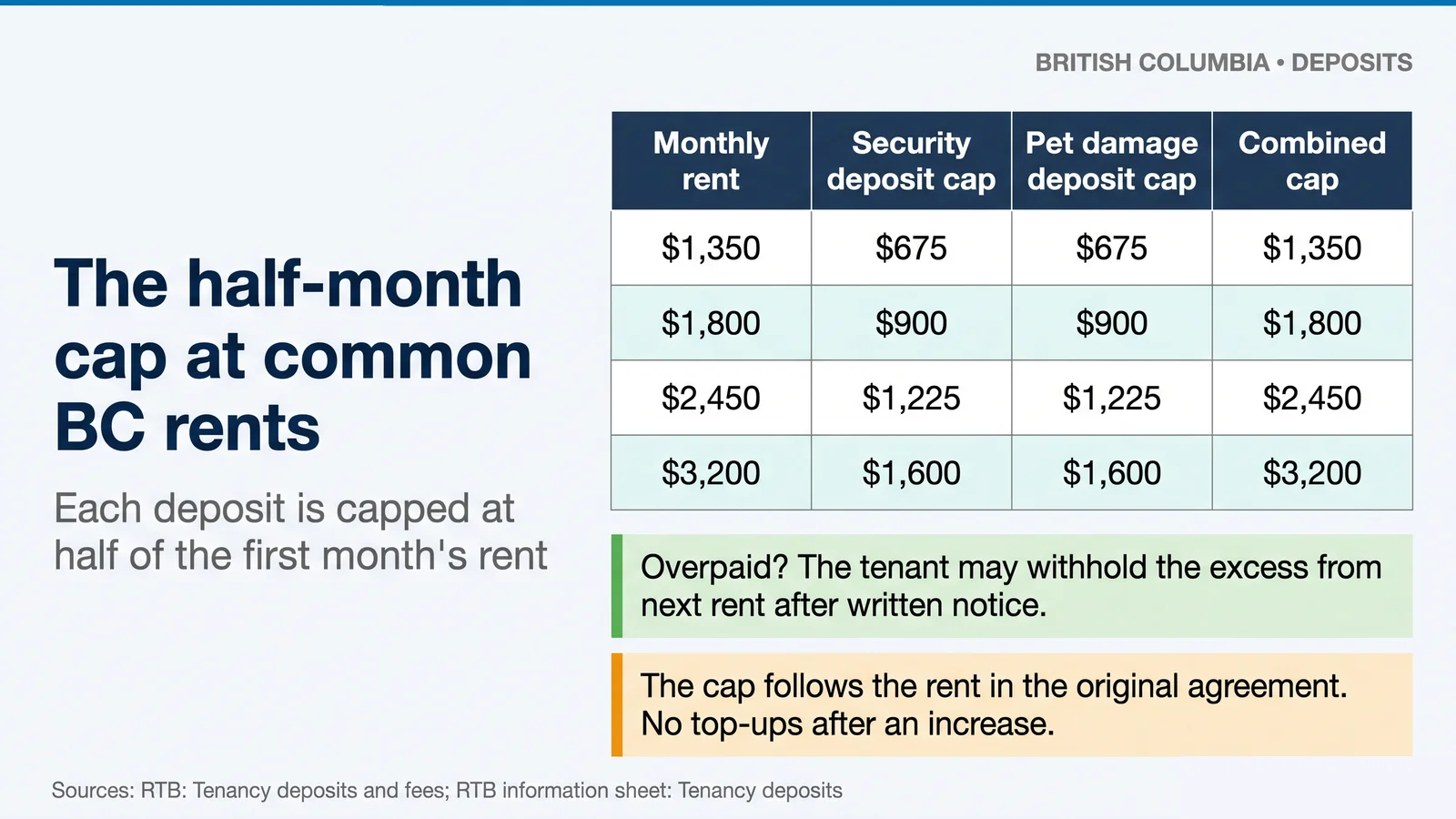
Taken together, a security deposit and a pet damage deposit can total no more than one full month's rent. That is the absolute most you can hold as deposits for a single tenancy.
| Monthly rent | Security deposit cap | Pet damage deposit cap | Combined cap |
|---|---|---|---|
| $1,350 | $675 | $675 | $1,350 |
| $1,800 | $900 | $900 | $1,800 |
| $2,450 | $1,225 | $1,225 | $2,450 |
| $3,200 | $1,600 | $1,600 | $3,200 |
Which rent counts
The cap is based on the rent in the initial tenancy agreement. If you raise the rent in year two, the deposit stays where it was. You cannot ask the tenant to top it up.
Timing and who is exempt
You may require the security deposit at the start of the tenancy. The tenant has 30 days after entering the agreement to pay it. If they do not, you may serve a One Month Notice to End Tenancy (Form RTB-33).
A pet damage deposit can be required at the start of the tenancy or when the tenant gets a pet with your permission partway through. The tenant has 30 days from when it is required. You cannot require one for a guide or service dog. The RTB's deposit information sheet also says pets already living in the unit as of January 1, 2004 are exempt.
What happens if you collect too much
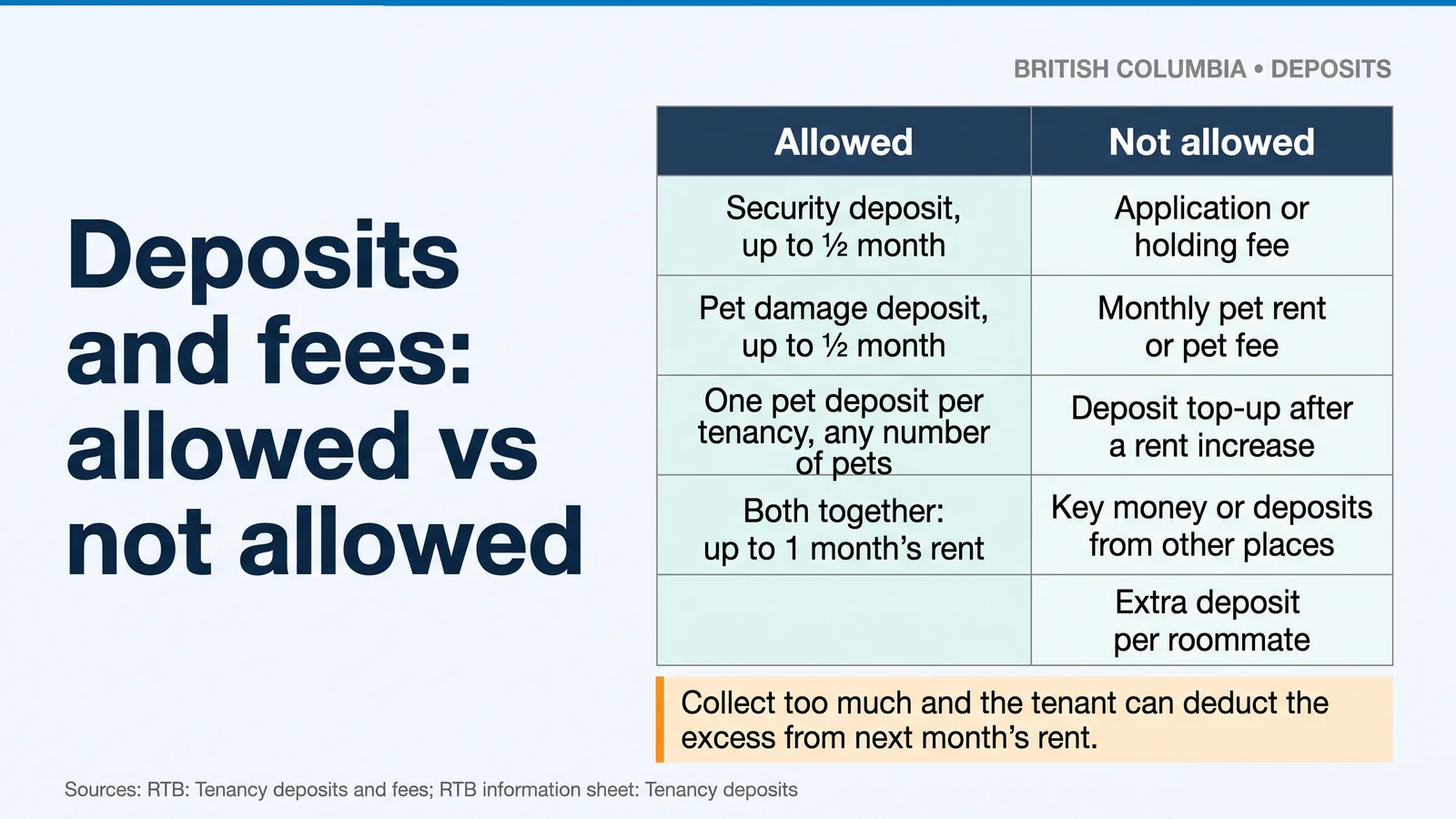
If a tenant pays more than the cap, they can withhold the overpayment from their next rent payment, as long as they tell you in writing. The RTB's example: if the excess is $150, the tenant can pay $150 less next month. The tenant can also apply for dispute resolution to get the money back.
Worked example: rent is $2,000 under an agreement signed November 1, 2026. You take a $1,000 security deposit and a $1,000 pet damage deposit. That is exactly one month and is allowed. If you had asked for a $2,000 security deposit instead, the tenant could give you written notice and pay only $1,000 of the December 1 rent.
Common mistakes
- Bringing habits from other places. The RTB says landlords cannot request deposits based on practices from other areas, such as key money. Stick to the two deposits BC allows.
- Charging monthly pet rent. Pet fees beyond the pet damage deposit are not allowed.
- Charging an application or holding fee to "secure" a unit. Application fees are not allowed in BC.
- Charging per tenant. Four roommates on one agreement still means one security deposit capped at half a month.
- Using today's rent after an increase. The cap is fixed to the rent in the original agreement.
- Charging for a guide or service dog. These are not pets and do not attract a pet damage deposit.
Applying the cap across a portfolio
For a property manager, the risk is not one tenant. It is a template or a leasing agent quoting the wrong figure on every unit for months.
- Calculate deposits from rent, never type them. Half of rent, rounded down, with a hard stop at that figure.
- Store the original rent with the deposit. After two or three increases, nobody remembers what the starting rent was.
- Audit at intake. Before keys are released, check that the deposits on file are at or under the cap and that the agreement says the same.
- Handle pets as a change event. When a pet is approved mid-tenancy, record the date, the deposit requested and the 30-day payment window, and book the inspection.
- Remove non-compliant fees from listings. Pet rent, application fees and "admin fees" in an ad invite complaints.
How Tenon10 helps
Tenon10 generates the BC Residential Tenancy Agreement (RTB-1) with its standard terms, so the rent and deposit amounts are recorded in the agreement from day one. The fillable RTB-27 Condition Inspection Report sits with the tenancy for move-in and pet inspections.
Deposit tracking then follows each deposit to the end of the tenancy, with the 15-day return clock and a flag for the double-penalty risk. See pricing or the forms page.
FAQ
What is the maximum security deposit in BC?
Half of the first month's rent. On $2,200 rent that is $1,100.
Can I take both a security deposit and a pet deposit?
Yes. Each can be up to half of the first month's rent, so the combined total is at most one full month's rent.
Can I charge a bigger pet deposit for a large dog?
No. The pet damage deposit cap is half a month regardless of the size or number of pets.
Can I ask for more deposit when the rent goes up?
No. The deposit is tied to the rent in the original agreement and cannot be increased later.
What if the tenant does not pay the deposit?
If the deposit is not paid within 30 days of when it is required, you may serve a One Month Notice to End Tenancy (RTB-33).
BC Deposit Cap Checklist
A landlord checklist for BC's half-month deposit cap: calculating the security and pet damage deposit limits, timing, exemptions and fees you cannot charge.
Get Free PDF →Keep every deposit on the right side of the rules
Tenon10 tracks each deposit through to the 15-day return clock and flags the double-penalty risk, with your RTB-1 agreement and RTB-27 reports in one place.
Built for Canadian landlords and property managers.
Related BC guides
- BC Security and Pet Damage Deposits: The Complete Landlord Guide
- The 15-Day Rule: Returning a Deposit at the End of a BC Tenancy
- When a BC Landlord Must Pay Back Double the Deposit
- Getting Your Deposit Back in BC: A Tenant's Step-by-Step Guide
Sources: RTB: Tenancy deposits and fees; RTB information sheet: Tenancy deposits; RTB: Pets and tenancy. This article is a summary of British Columbia rules as of October 2026, not legal advice. Check the Residential Tenancy Branch for your situation.