A deposit looks like the simplest money in a tenancy. The tenant pays it, you hold it, and you hand it back at the end. In British Columbia it is also one of the easiest places to lose a dispute, because most of the rules are about timing and paperwork, not about who caused the damage.
Landlords lose deposit claims for the same few reasons again and again. They skip the move-in inspection, collect more than the cap, keep money without a written agreement or an order, or miss the 15-day window at move-out. Any one of those can turn a fair claim for a stained carpet into an order to pay the tenant double.
This guide walks through the full life of a BC security deposit and pet damage deposit, from the day you sign the tenancy agreement to the day the money goes back. It covers what the Residential Tenancy Branch (RTB) allows, where landlords slip, and how to keep this under control across many units.
BC Deposit Lifecycle Checklist
A landlord checklist for BC security and pet damage deposits from signing to return: caps, inspections, interest and the 15-day deadline.
Get Free PDF →The rules: what BC law says about deposits
How much you can collect
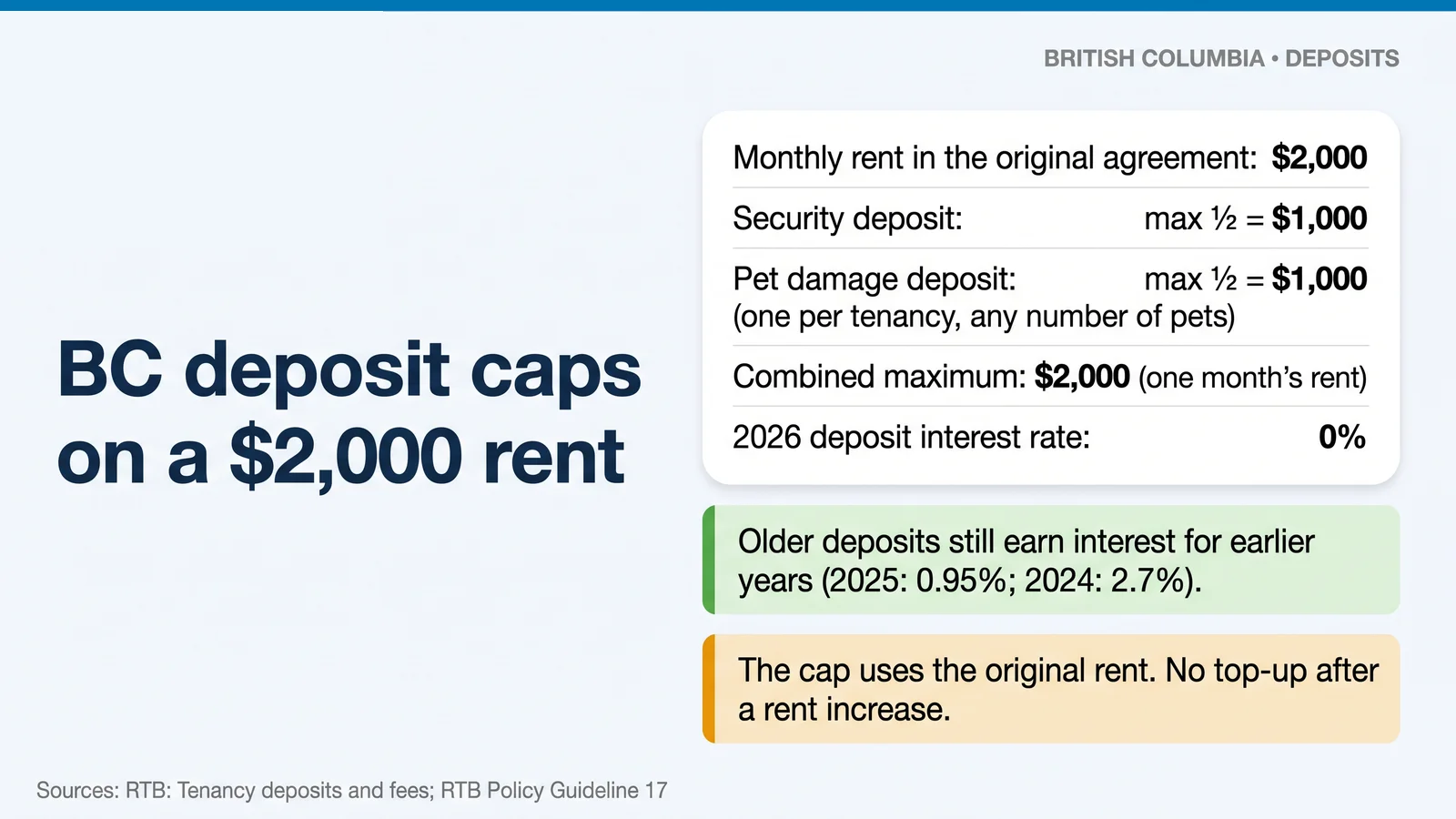
A security deposit can be no more than half of the first month's rent. A pet damage deposit is a separate deposit, also capped at half of the first month's rent, no matter how many pets you allow. If you take both, the total cannot be more than one full month's rent.
| Monthly rent | Maximum security deposit | Maximum pet damage deposit | Maximum total |
|---|---|---|---|
| $1,500 | $750 | $750 | $1,500 |
| $2,200 | $1,100 | $1,100 | $2,200 |
| $3,000 | $1,500 | $1,500 | $3,000 |
The cap is tied to the rent in the original tenancy agreement. When you raise the rent later, you cannot top up the deposit. You also cannot charge a monthly pet fee or any other pet charge beyond the pet damage deposit.
When a deposit can be required
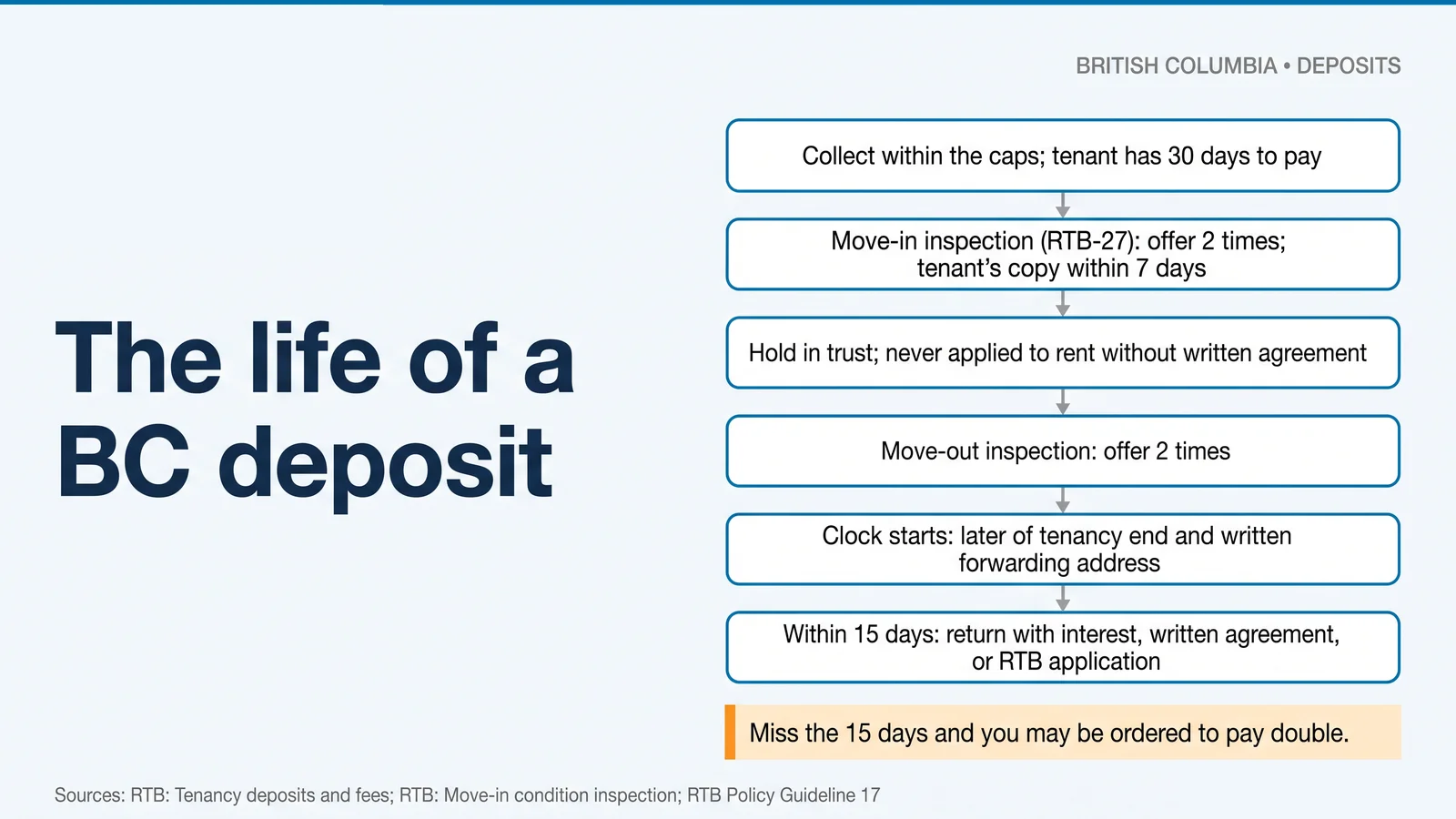
You may ask for the security deposit at the start of the tenancy. The tenant has 30 days from entering the tenancy agreement to pay it. If they do not, you can serve a One Month Notice to End Tenancy (Form RTB-33).
A pet damage deposit can be requested at the start of the tenancy, or later if the tenant gets a pet with your permission. The tenant has 30 days from when it is required to pay. You cannot require a pet damage deposit for a tenant with a guide or service dog, because those dogs are not pets under the rules.
Once the tenant pays the deposit, the tenancy is established. You cannot rent the unit to someone else.
Holding the deposit
You hold the deposit in trust for the tenant. Neither side can treat it as rent. The tenant cannot use it as rent without your written permission, and you cannot apply it to rent without the tenant's written agreement.
Interest is owed on deposits, calculated on the full amount from the date you received it to the date you return it. The rate is set at the start of each year. For 2026 the rate is 0%. Earlier years were higher (0.95% in 2025, 2.7% in 2024), so a deposit taken in 2023 or 2024 will still carry some interest. The RTB's deposit interest calculator works it out.
Condition inspections protect your right to claim
You and the tenant must inspect the unit together at move-in and at move-out and record it on a condition inspection report. The RTB provides the Condition Inspection Report (Form RTB-27), though you may use your own form.
For each inspection you must offer the tenant at least two opportunities. If the tenant misses the first, give written notice of the final opportunity (the RTB uses Form RTB-22 for this). After the move-in inspection, give the tenant a copy of the report within 7 days.
If you do not offer two opportunities, do not complete the report, or do not give the tenant a copy, you lose the right to claim against the deposit for damage. RTB Policy Guideline 17 says this loss covers damage only. You can still seek the tenant's agreement or apply to the RTB for other amounts, such as unpaid rent, and you can still file a separate monetary claim for damage.
The rule cuts both ways. If you offered two opportunities and the tenant took part in neither, the tenant loses the right to get the deposit back.
The 15-day rule at the end of the tenancy
The tenant must give you a forwarding address in writing. They have up to one year after the tenancy ends to do it. Your clock starts on the later of the day the tenancy ends and the day you receive that address. Within 15 days you must do one of three things:
- Return the deposit, with any interest.
- Get the tenant's written agreement to keep part or all of it, and return the rest.
- Apply to the RTB for dispute resolution to keep some or all of it.
A tenancy agreement clause that lets you keep the deposit automatically is not valid. You cannot charge a fee for returning it. You can send it electronically, hand it over, mail it or leave it in the tenant's mailbox or mail slot.
The double-penalty rule
If you do none of the three within 15 days, you cannot claim against the deposit and you may be ordered to pay the tenant double the deposit. The tenant can file a direct request 20 days after the tenancy ends and they have given the forwarding address. Policy Guideline 17 says an arbitrator will order double whether or not you had a valid claim, unless the tenant waives it. Interest is not doubled; it is calculated on the original deposit only.
Worked example: rent is $2,400 and you hold a $1,200 security deposit. The tenancy ends Monday, November 30, 2026 and the tenant hands you a forwarding address at the move-out inspection that day. Your deadline is Tuesday, December 15, 2026. If you do nothing, the tenant can apply for $2,400 plus the application fee.
Common mistakes BC landlords make
- Taking more than half a month. A "full month's deposit" on top of a pet deposit puts you over the cap. The tenant can withhold the overpayment from rent after giving you written notice.
- Charging a pet fee. Monthly pet rent or a non-refundable pet cleaning fee is not allowed. The pet damage deposit is the only pet charge.
- Skipping the move-in report. Without it you lose the right to claim against the deposit for damage, even if the damage is obvious at move-out.
- Offering one inspection time. One text with one time is not two opportunities. The second offer must be in writing.
- Deducting first, asking later. Keeping any part of the deposit needs the tenant's written agreement or an RTB order. A verbal "okay" at the door is not enough.
- Leaving it to the last day. Plan as if every day counts, weekends and holidays included, and act in the first week.
- Forgetting interest on older deposits. The 2026 rate is 0%, but a deposit taken in 2024 still earns interest for the years it was held.
Managing deposits across many units
With one unit, you remember what you collected. With forty, deposits sit in different accounts, inspections happen on different days, and move-outs bunch up at month end. Treat deposits as a ledger, not a memory.
- Record each deposit at intake. Note the amount, the date received, the type (security or pet) and the rent in the original agreement. That rent sets the cap for the life of the tenancy.
- Tie each deposit to its move-in report. If a unit has no signed RTB-27 on file, flag it now. You will not be able to claim for damage on that unit later.
- Log the two dates that start the clock. The tenancy end date and the date you received the forwarding address in writing. The later date plus 15 days is your deadline.
- Decide early. Within a few days of move-out, choose: return in full, ask for written agreement, or file. Waiting until day 14 leaves no room for a tenant who will not sign.
- Hand over deposits on a sale. If a building changes hands, the new landlord must return the deposits. Transfer the records and tell tenants.
How Tenon10 helps
Tenon10 includes a fillable RTB-27 Condition Inspection Report with a room-by-room grid, so your move-in and move-out reports sit next to each other in the tenancy record. It also generates the BC Residential Tenancy Agreement (RTB-1) with its standard terms.
Deposit tracking follows the 15-day return clock and flags the double-penalty risk. Your lease, notices, inspection reports and payment records stay together, which gives you an evidence record if a deposit goes to an RTB hearing. See pricing or browse the forms we support.
FAQ
Can I charge a pet damage deposit per pet?
No. A tenancy can have one pet damage deposit of up to half the first month's rent, no matter how many pets you allow.
Can I raise the deposit when I raise the rent?
No. The deposit is based on the rent in the original tenancy agreement and does not change with later increases.
What if the tenant never gives a forwarding address?
If the tenant does not give a forwarding address in writing within one year after the tenancy ends, you may keep the deposit.
What interest do I owe in 2026?
The rate for 2026 is 0%. Interest for earlier years still applies to the time you held the deposit in those years. Use the RTB calculator.
Do I lose everything if I skipped the move-in inspection?
You lose the right to claim against the deposit for damage. You can still pursue other amounts, such as unpaid rent, and file a separate monetary claim for damage.
BC Deposit Lifecycle Checklist
A landlord checklist for BC security and pet damage deposits from signing to return: caps, inspections, interest and the 15-day deadline.
Get Free PDF →Never miss a 15-day deadline
Tenon10 tracks each deposit against the 15-day return clock, flags the double-penalty risk and keeps your RTB-27 inspection reports with the tenancy.
Built for Canadian landlords and property managers.
Related BC guides
- The Half-Month Cap: How Much Deposit a BC Landlord Can Collect
- The 15-Day Rule: Returning a Deposit at the End of a BC Tenancy
- When a BC Landlord Must Pay Back Double the Deposit
- Getting Your Deposit Back in BC: A Tenant's Step-by-Step Guide
Sources: RTB: Tenancy deposits and fees; RTB information sheet: Tenancy deposits; RTB Policy Guideline 17: Security Deposit and Set Off; RTB: Move-in condition inspection; RTB: Moving out of rental units; RTB: Pets and tenancy. This article is a summary of British Columbia rules as of October 2026, not legal advice. Check the Residential Tenancy Branch for your situation.