The tenant has moved out, the keys are back and the unit needs paint. The last thing on your list is the deposit. In British Columbia it should be near the top, because the deposit comes with a short, fixed deadline and a costly penalty for missing it.
The 15-day rule is simple on paper. In practice, landlords miss it because they wait for a contractor's quote, assume the clock has not started or think holding the money "until it is sorted out" is fair. The RTB does not see it that way.
This article explains when the 15 days start, what you must do before they end, how to count them with real dates and what happens if you run out of time.
BC 15-Day Deposit Return Checklist
A landlord checklist for BC's 15-day deposit rule: finding the start date, the three permitted actions, interest, and avoiding a double-deposit order.
Get Free PDF →The rule: three choices within 15 days
When the clock starts
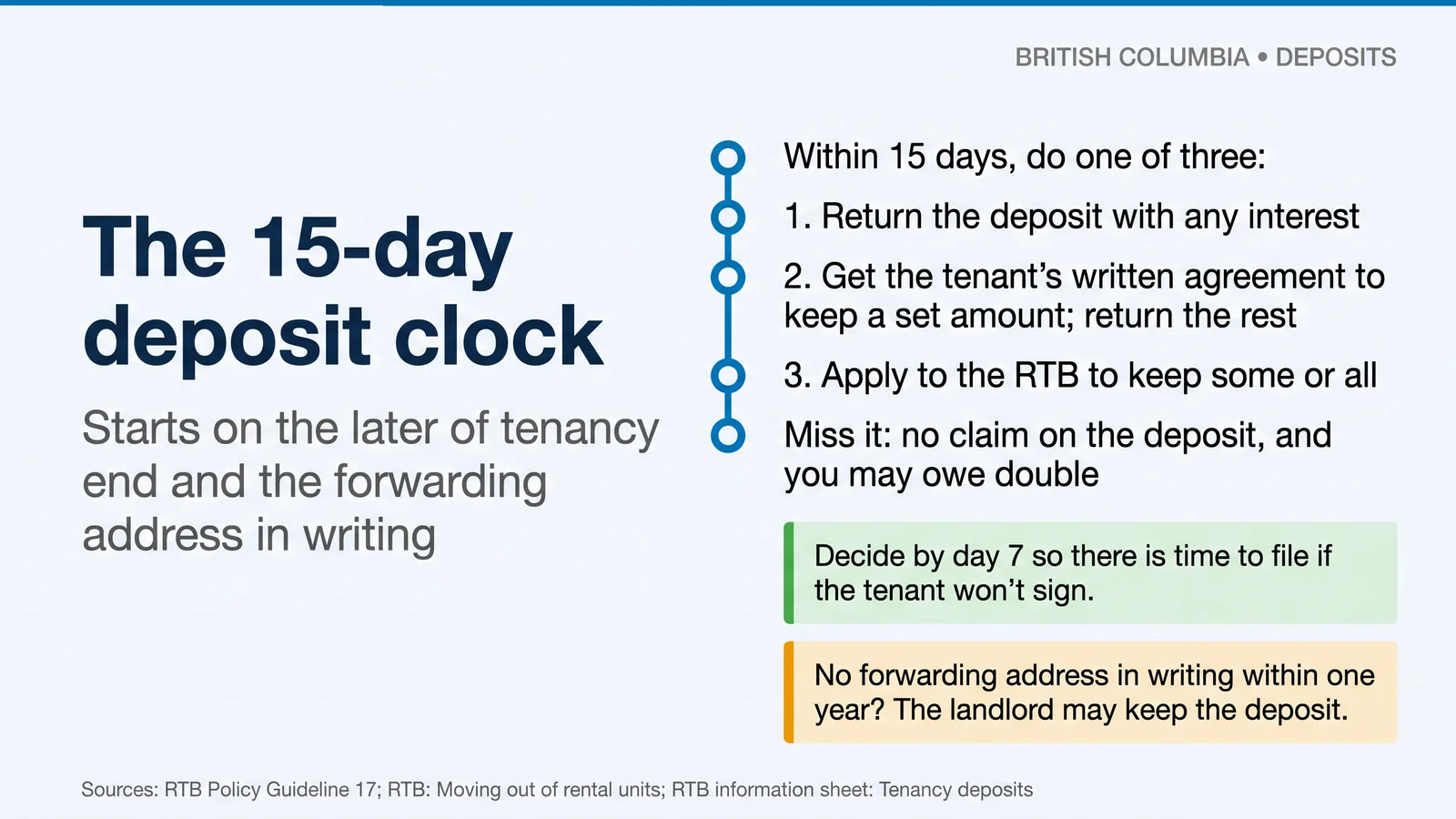
The 15 days run from the later of two dates:
- the day the tenancy ends, and
- the day you receive the tenant's forwarding address in writing.
The tenant has up to one year after the tenancy ends to give you that address. If they never do, you may keep the deposit after that year. The forwarding address must be in writing and served by a method the rules allow.
What you must do before the 15 days end
- Return the deposit in full, with any interest owed; or
- Get the tenant's written agreement to keep a specific amount, and return the rest with interest; or
- Apply to the RTB for dispute resolution to keep some or all of the deposit.
Holding the money while you think about it is not one of the options. Neither is deducting an amount you believe is fair. A clause in the tenancy agreement saying you keep the deposit automatically is not valid either.
Interest
Before you return the deposit, ask for deductions or file, calculate interest on the full deposit. The rate for 2026 is 0%, but earlier years had a rate (0.95% in 2025, 2.7% in 2024, 1.95% in 2023), and interest compounds on the anniversary of the date you received the deposit. The RTB's deposit interest calculator does the arithmetic.
How to return it
You can return the deposit by electronic transfer, in person, by mail or by leaving it in the tenant's mailbox or mail slot. You cannot charge a fee for returning it.
Worked dates
| Tenancy ends | Forwarding address received in writing | Clock starts | 15 days end |
|---|---|---|---|
| October 31, 2026 | October 31, 2026 (on the move-out report) | October 31, 2026 | November 15, 2026 |
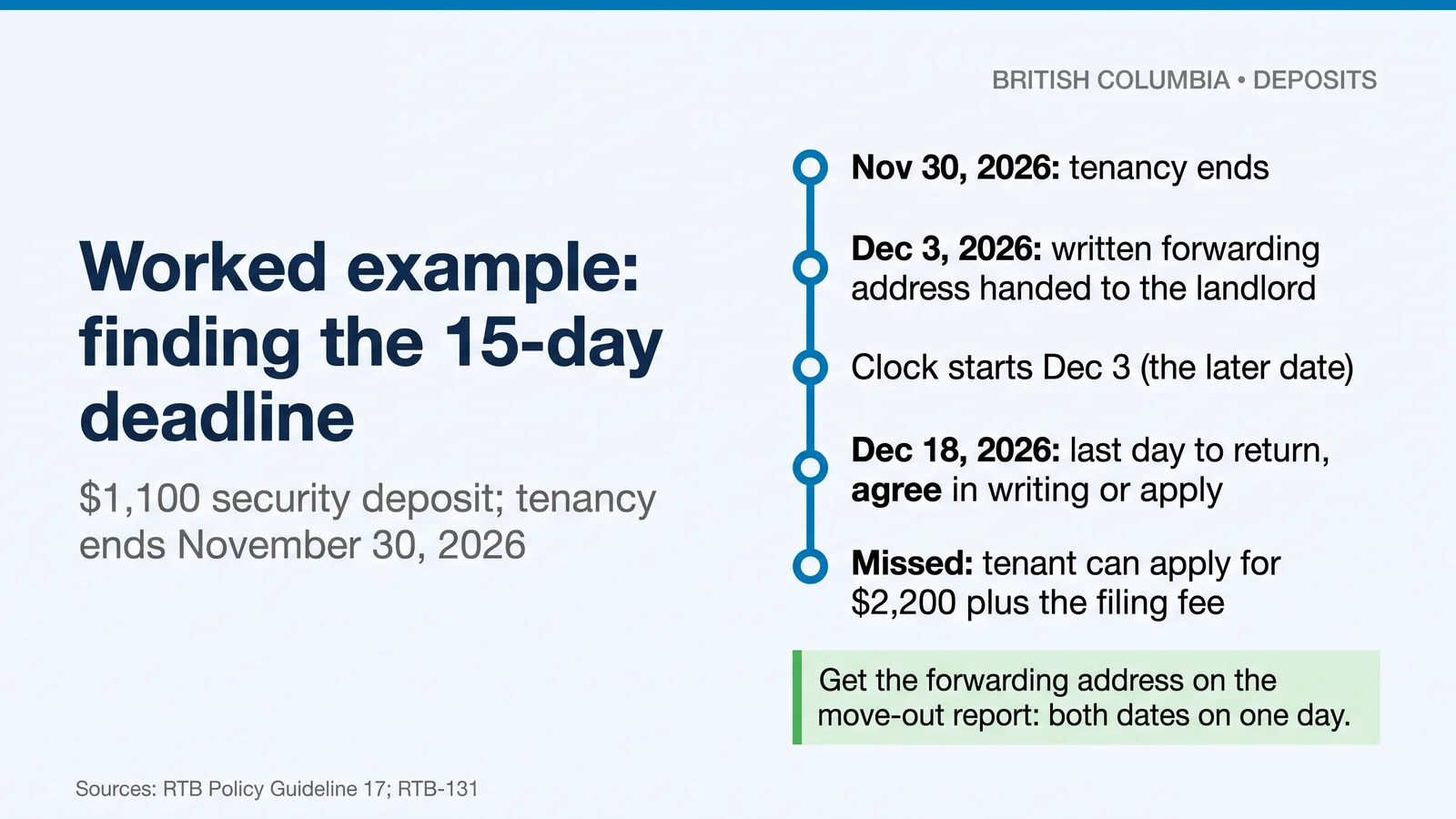
| November 30, 2026 | December 3, 2026 (handed to you) | December 3, 2026 | December 18, 2026 |
| January 31, 2027 | Given before move-out, January 20, 2027 | January 31, 2027 | February 15, 2027 |
| March 31, 2027 | Not yet given | Not started | Not started |
Treat the "15 days end" date as the last possible day, not the target. November 15, 2026 is a Sunday and February 15, 2027 is Family Day. Section 25 of BC's Interpretation Act would carry a period that ends on a Sunday or holiday to the next day that is not one, but do not rely on that: the dates in the table are the safe ones. Aim to act within the first week so a tenant who will not sign a deduction agreement still leaves you time to file.
Also allow for how the address reached you. If it came by mail, it may be treated as received some days after it was sent, which can move your start date. Keep the envelope or the email.
What happens if you miss the deadline
If you do none of the three things within 15 days, you can no longer claim against the deposit, and you may be ordered to pay the tenant double the deposit. The tenant can file a direct request 20 days after the tenancy ends and the forwarding address is given (the 15 days plus 5 days for mail).
RTB Policy Guideline 17 adds detail that matters:
- Double is ordered whether or not you had a valid claim, unless the tenant waives it.
- Interest is not doubled. It is calculated on the original deposit only.
- Amounts the tenant already agreed in writing that you could keep are left out of the doubling calculation.
Example: you hold a $1,100 security deposit. The tenancy ended November 30, 2026 and the tenant handed you a written forwarding address on December 3. You did nothing by December 18. The tenant can apply for $2,200 plus the application fee. If the tenant had earlier agreed in writing that you could keep $100 for unpaid utilities, the doubling would be applied to the remaining $1,000.
Common mistakes
- Waiting for repair quotes. You can file with your best estimate. Missing the 15 days to get a perfect number costs you far more.
- Taking a verbal "okay" to deduct. The tenant's agreement must be in writing and name the amount.
- Deducting for damage after skipping inspections. If you did not offer two inspection opportunities, complete the report or give the tenant a copy, you lose the right to claim against the deposit for damage. Guideline 17 lists a damage claim after that right is lost as a case where double is ordered.
- Thinking the clock only starts when you are ready. It starts on the later of the two dates, whether you have inspected or not.
- Charging a cheque or transfer fee. Returning a deposit cannot cost the tenant anything.
Handling move-outs across many units
Month end brings clusters of move-outs. Ten tenancies ending on the same day means ten clocks starting together, some delayed by late forwarding addresses.
- Keep a move-out register. One line per unit: end date, forwarding address date, deposit amount, interest and the calculated deadline.
- Sort by deadline, not by building. Work the earliest deadlines first.
- Set an internal cut-off. For example, a decision by day 7: return, agreement or filing.
- Use one written deduction form. Amount, reason and signature, so every agreement looks the same if it is ever reviewed.
- Record how and when each deposit went back. E-transfer confirmations and dated receipts are your proof.
How Tenon10 helps
Tenon10's deposit tracking follows the 15-day return clock for each tenancy and flags the double-penalty risk, so a late forwarding address or a busy month end does not slip by. The fillable RTB-27 Condition Inspection Report keeps move-in and move-out conditions side by side.
Lease, notice, inspection and payment records stay together and serve as your evidence record if a deposit claim goes to an RTB hearing. Browse our forms or tools.
FAQ
Does the 15 days count weekends?
The safe approach is to plan as if every day counts, weekends and holidays included, and to act early in the window. If a deadline falls on a weekend or holiday and you are unsure how it is counted, ask the RTB before relying on extra time.
Can I keep part of the deposit if the tenant agrees?
Yes, if the tenant agrees in writing to a specific amount. Return the balance, with interest, within the 15 days.
What if I cannot reach the tenant?
The clock does not start until you receive a forwarding address in writing. If the tenant does not give one within a year after the tenancy ends, you may keep the deposit.
Is filing with the RTB enough to stop the double penalty?
Applying for dispute resolution within 15 days is one of the three permitted actions. Whether you can keep the money is then up to the arbitrator.
BC 15-Day Deposit Return Checklist
A landlord checklist for BC's 15-day deposit rule: finding the start date, the three permitted actions, interest, and avoiding a double-deposit order.
Get Free PDF →See every deposit deadline at a glance
Tenon10 follows the 15-day return clock on each deposit and flags the double-penalty risk before it becomes an order.
Built for Canadian landlords and property managers.
Related BC guides
- BC Security and Pet Damage Deposits: The Complete Landlord Guide
- The Half-Month Cap: How Much Deposit a BC Landlord Can Collect
- When a BC Landlord Must Pay Back Double the Deposit
- Getting Your Deposit Back in BC: A Tenant's Step-by-Step Guide
Sources: RTB: Moving out of rental units; RTB Policy Guideline 17: Security Deposit and Set Off; RTB: Tenancy deposits and fees; RTB-131: Tenant's Direct Request information sheet. This article is a summary of British Columbia rules as of October 2026, not legal advice. Check the Residential Tenancy Branch for your situation.