On April 1, 2026, the Residential Tenancy Dispute Resolution Service (RTDRS) stopped charging one flat fee and moved to a fee based on the size of the claim. Many guides, forms and checklists still show the old figure, so it is worth checking the number before you pay.
RTDRS is Alberta's tribunal for landlord and tenant disputes under the Residential Tenancies Act. It hears claims up to $100,000 by telephone, as an alternative to court. This FAQ covers what it costs to file, who qualifies for a fee waiver, how to pay, and the limits that decide whether RTDRS is the right place for your claim.
RTDRS Filing Checklist (Fees from April 1, 2026)
A checklist for filing with Alberta's RTDRS: the 2026 fee bands, fee waiver, payment methods, the $100,000 limit and service deadlines.
Get Free PDF →How much does it cost to file with RTDRS?
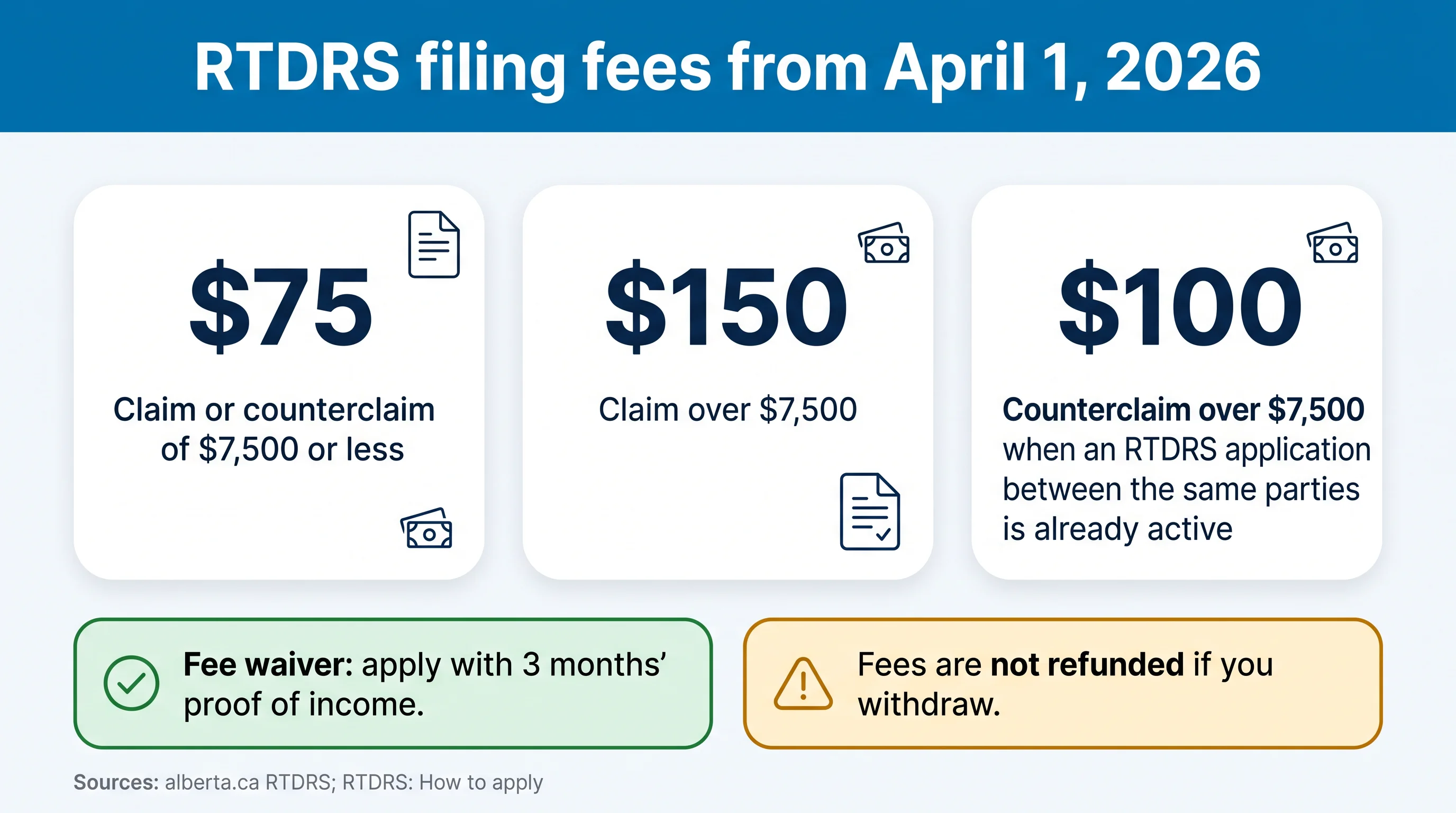
The RTDRS page on alberta.ca lists three fees, effective April 1, 2026. The fee is set by the total claim amount, not counting costs:
| What you file | Filing fee |
|---|---|
| A claim or counterclaim of $7,500 or less | $75 |
| A claim over $7,500 | $150 |
| A counterclaim over $7,500, where an RTDRS application between the same parties is already active | $100 |
A landlord asking only for possession and a few months of unpaid rent will often fall in the $75 band. A tenant claiming the security deposit back will usually pay $75 too. Claims for larger damages, or long periods of arrears, move to $150.
What is a counterclaim fee, and when does $100 apply?
If you have been served with an RTDRS application and you have a claim of your own against the same person, you can file your own separate application. The RTDRS "how to apply" page says you must file it, and serve it on the other party, before the hearing date of the application served on you if you want the officer to consider hearing the two together.
That application is charged as a counterclaim: $75 if it is $7,500 or less, and $100 if it is over $7,500 while the first application is still active. A claim over $7,500 that is not a counterclaim costs $150.
Can the filing fee be waived?
Yes. If the fee is a financial difficulty, you can apply to RTDRS to waive it. The RTDRS "how to apply" page says you must:
- complete the RTDRS Fee Waiver Form, listed on the RTDRS forms page; and
- provide 3 months' proof of income, as pay stubs or a printout of your bank account.
How do I pay, and is the fee refundable?
- Accepted: MasterCard, VISA, American Express, cheque or money order. Cheques are made payable to the "Government of Alberta".
- Not accepted: cash.
- Refunds: RTDRS does not refund fees for withdrawn matters. If you settle before the hearing, the fee is not returned.
What is the RTDRS claim limit?
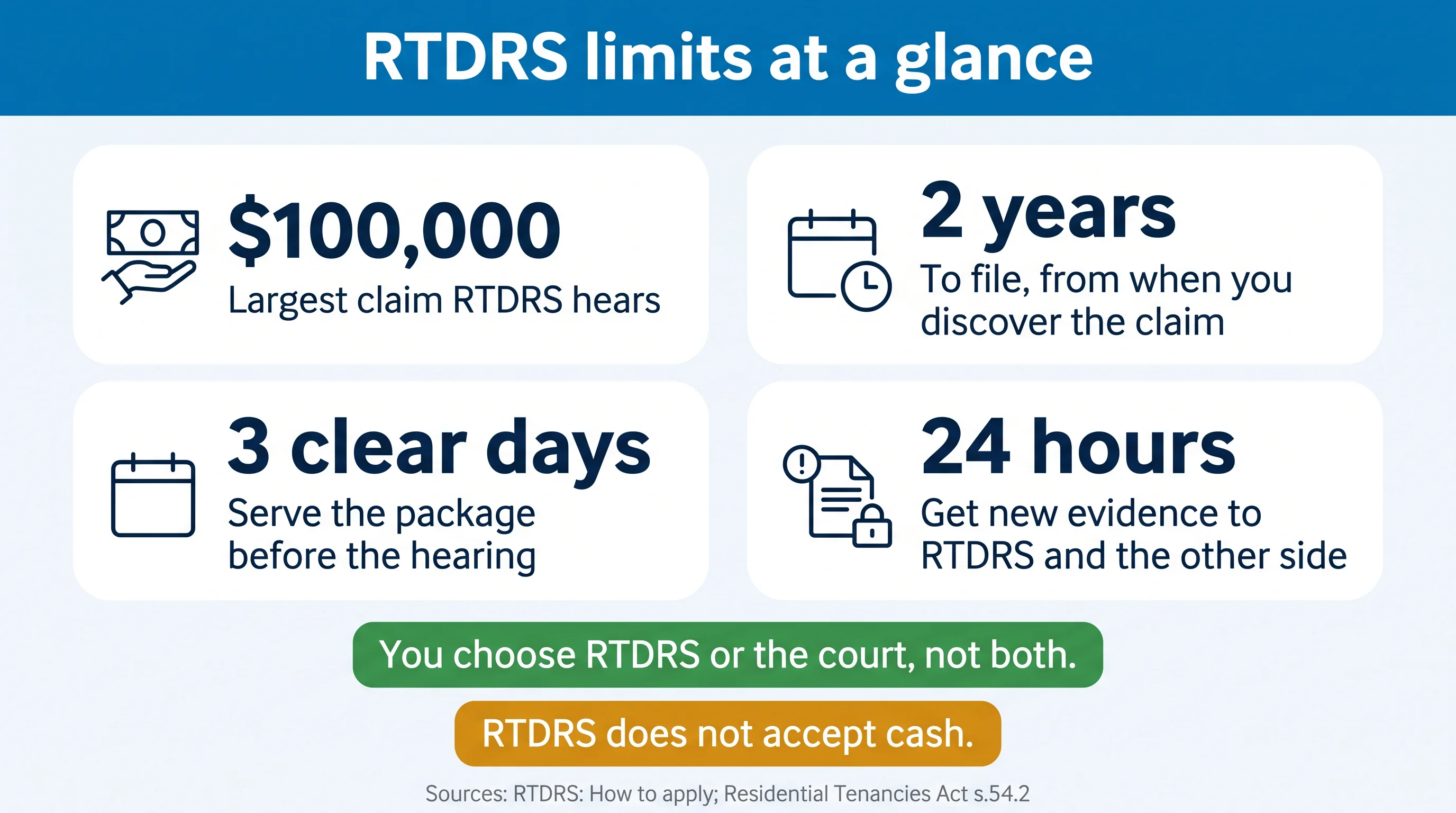
RTDRS hears claims of up to $100,000. The application must also be made within 2 years of the date the claim is discovered, and the rental and the claim must be covered by the Residential Tenancies Act or the Mobile Home Sites Tenancies Act.
When you apply, you confirm that you have not applied to a civil court about the same matter and do not know of a court application about it. Under section 54.2 of the Residential Tenancies Act, the person applying chooses RTDRS or the court, and you cannot run the same dispute in both.
What can RTDRS order, and what can it not?
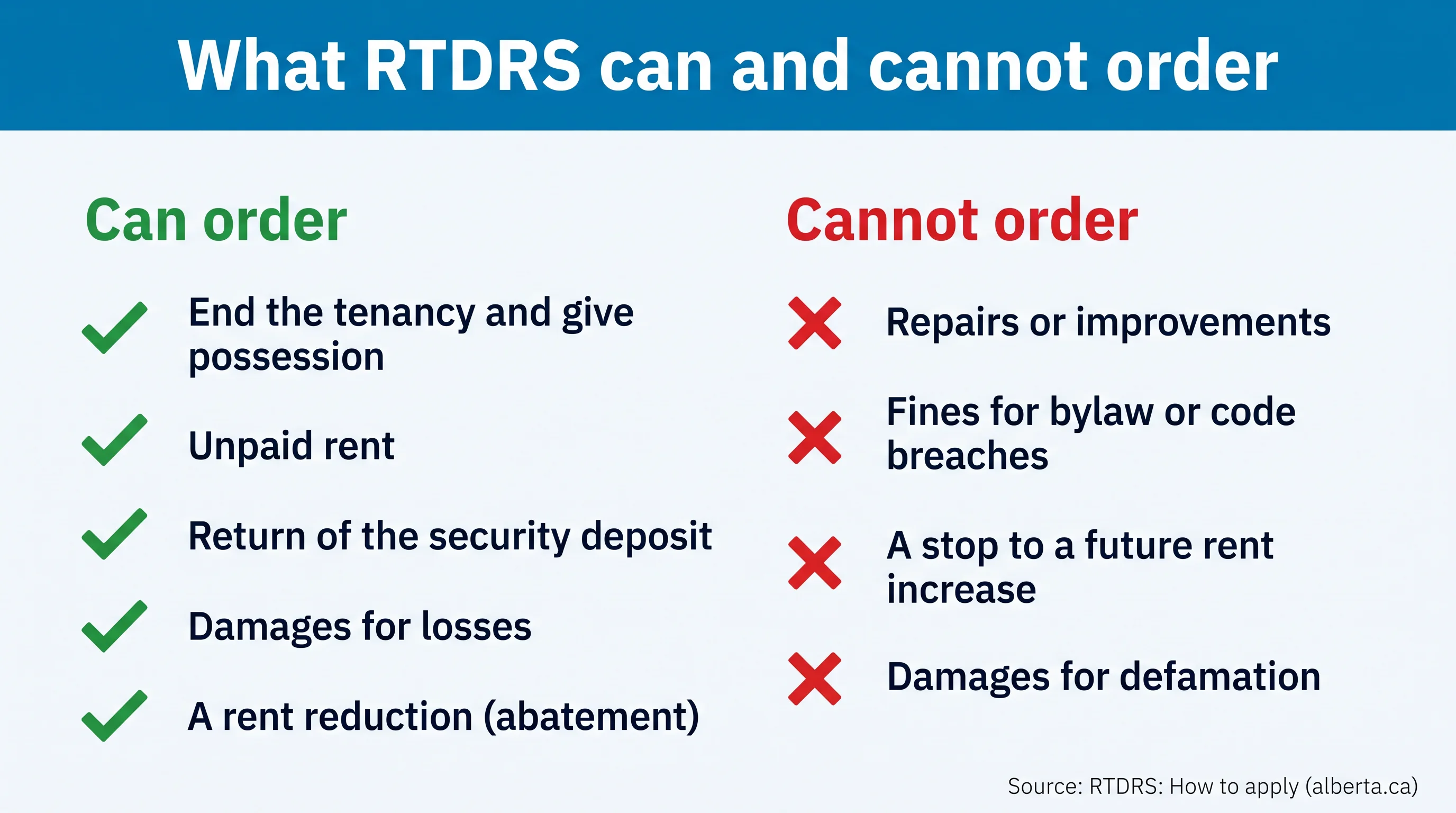
RTDRS can award the remedies the legislation allows, including ending the tenancy, possession of the premises, recovery of the security deposit, rent arrears, a rent reduction (abatement), damages, compensation for performing the landlord's obligations, and compensation from a tenant who overholds.
It cannot:
- order specific performance, such as making a landlord do repairs or improvements;
- investigate an offence, a bylaw or building code breach, or issue a fine;
- stop someone from doing something in the future, such as a rent increase;
- make someone file an insurance claim; or
- stop defamatory comments or award damages for defamation.
If your dispute needs one of those, the fee is not the only question. A repair problem, for example, may also call for a public health inspection.
What happens after I pay?
RTDRS sends two emails once your application is processed. The first holds the filed package, including the Notice of Telephone Hearing, which you copy and serve on each respondent. The second holds the Declaration of Service, which the person who served the package completes and files.
- Serve the package so that at least 3 clear days pass before the hearing.
- Serve any additional evidence on RTDRS and the other party at least 24 hours before the hearing.
- If you served by registered mail, keep the postal receipt with its tracking number and the Canada Post delivery confirmation showing the signature.
RTDRS does not publish a set time from filing to hearing, so plan for the date on your Notice of Telephone Hearing, not for an estimate.
Common mistakes
- Paying the old fee. Fees changed on April 1, 2026. Use the table above.
- Counting costs in the claim total. The band is set on the claim amount excluding costs.
- Turning up at an office. There is no in-person filing.
- Filing in court and at RTDRS. Pick one forum for the dispute.
- Waiting too long. Claims must be filed within 2 years of discovery.
- Withdrawing and expecting a refund. Fees for withdrawn matters are not refunded.
What to do next
- Total your claim, excluding costs, and pick the fee band.
- Decide whether you qualify for a fee waiver and gather 3 months of income records if so.
- Check the full name of the person or business you are claiming against. An order is issued against the exact name you give.
- File online, by fax or by mail, and plan service so 3 clear days pass before the hearing.
How Tenon10 helps
A claim at RTDRS is only as good as the records behind it. Tenon10 lets you create an Alberta lease and run the move-in and move-out inspection reports, so the rent, the term and the condition of the unit are on file from the first day.
When a tenancy ends, Tenon10 tracks the 10-day deposit return date, and for unpaid rent it helps you prepare the 14-day notice (Form 3). Filing with RTDRS is still something you do yourself through the eFiling Service.
Frequently asked questions
Is the RTDRS fee still $75 for everything?
No. Since April 1, 2026 it is $75 for claims or counterclaims of $7,500 or less, $150 for claims over $7,500, and $100 for counterclaims over $7,500 where an application between the same parties is already active.
Is the fee refunded if we settle before the hearing?
No. RTDRS does not refund fees for withdrawn matters. If you settle, you can withdraw, or attend and tell the officer, who may issue a consent order.
Does RTDRS take claims over $100,000?
No. A claim over $100,000 goes to court.
Can I pay by e-transfer or cash?
The accepted methods are MasterCard, VISA, American Express, cheque or money order. RTDRS does not accept cash.
How long do I have to file?
Within 2 years of the date the claim is discovered.
RTDRS Filing Checklist (Fees from April 1, 2026)
A checklist for filing with Alberta's RTDRS: the 2026 fee bands, fee waiver, payment methods, the $100,000 limit and service deadlines.
Get Free PDF →Build the record before the dispute
Create your Alberta lease and inspection reports in Tenon10, and track the 10-day deposit return date when a tenancy ends.
Built for Canadian landlords and property managers.