Squatters rights in Maryland are limited. An owner removes someone holding a property without any right through a wrongful detainer case in the District Court (Md. Code, Real Prop. § 14-132). Since October 1, 2025, the hearing must be held within 10 business days of filing.
What is a wrongful detainer in Maryland?
Maryland defines wrongful detainer as holding possession of real property without the right of possession (§ 14-132(a)). The statute says plainly that a person may not hold possession of property unless they are entitled to it under the law (§ 14-132(c)). That is the court action Maryland uses against a squatter: someone who moved in with no lease, no permission and no court order.
The action is not available in three situations (§ 14-132(b)):
- the person in possession was granted possession by a court order;
- a remedy is available under Title 8 of the Real Property Article, the landlord and tenant title;
- another statute or rule provides an exclusive way to recover possession.
How does a Maryland owner remove a squatter?
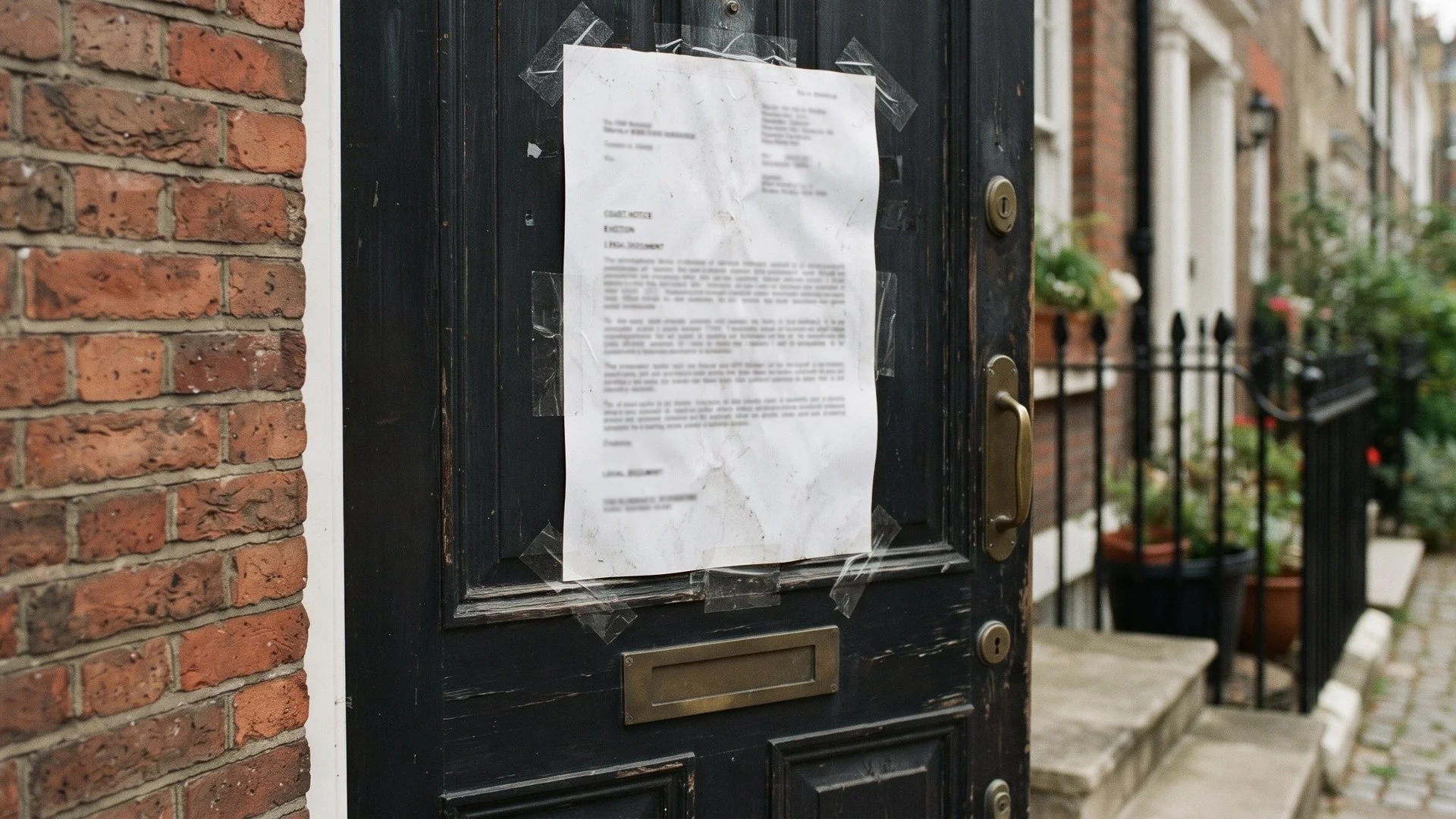
The owner, or anyone claiming possession, files a written complaint in the District Court of the county where the property is (§ 14-132(d)(1)). The court then summons the person in possession to appear and show cause why possession should not be restored to the person who filed.
| Step | Maryland rule | Source |
|---|---|---|
| File | Written complaint in the District Court of the county where the property is. | § 14-132(d)(1) |
| Hearing date | Held no more than 10 business days after the complaint is filed. | § 14-132(d)(2)(ii) |
| Service deadline | Service under the alternate method must be made within 4 business days of filing. | § 14-132(d)(5) |
| Counterclaims | No counterclaim or cross-claim may be filed in the action. | § 14-132(e) |
| Judgment | If the owner is entitled to possession, the court gives judgment for restitution and issues a warrant to the sheriff or constable to deliver possession. | § 14-132(f)(1) |
| Appeal | Either side may appeal to the circuit court within 10 days of judgment. | § 14-132(h)(1) |
What changed for Maryland squatters in 2025?
Chapter 188 of 2025 (Senate Bill 46), approved on April 22, 2025 and in effect from October 1, 2025, rewrote the timing and service rules in § 14-132.
- A fast hearing. The show-cause hearing must be held no more than 10 business days after the complaint is filed.
- Service when the occupant cannot be found. After two good-faith attempts on different days, the process server files an affidavit describing them, mails the complaint by certified mail (return receipt requested) and first-class mail to the occupant's last known address and to the property, and posts an attested copy of the summons on the property (§ 14-132(d)(3)). That notice is sufficient service to support restoring possession (§ 14-132(d)(4)).
- A service deadline. Service under those paragraphs must be made within 4 business days of filing.
Senate Bill 46 was introduced as a criminal-fraud bill that would have let an owner hand a sworn affidavit to the sheriff for removal. That part was amended out before passage. Bills proposing a sheriff affidavit process were introduced again in 2025 and 2026, but the law as it stands today is the court route in § 14-132.
What if the squatter is not personally served?

Posting and mailing are enough to get possession back. They are not enough for a money judgment. The court can award damages, court costs and attorney fees only if the complainant claimed damages and the occupant was personally served, or there was service or submission to the court's jurisdiction that would support a judgment in contract or tort (§ 14-132(f)(2)). An occupant who was not personally served can appear only to defend possession without submitting to a money judgment (§ 14-132(f)(3)).
Can a squatter appeal and stay in a Maryland home?
Only on terms. Under § 14-132(h)(2), the occupant keeps possession during an appeal only if they file an affidavit that the appeal is not taken for delay, and either post a sufficient bond or pay to the owner or into the appellate court:
- the fair rental value for the whole period of possession up to judgment;
- all court costs;
- other losses or damages the court found due because of the detention;
- the fair rental value while the appeal is pending.
Either party can ask for a hearing date, which must be set 5 to 15 days after the application (§ 14-132(h)(3)). If the circuit court rules for the owner, the sheriff executes the warrant immediately (§ 14-132(i)).
Is a tenant a squatter under Maryland law?
No. Because wrongful detainer does not apply where a Title 8 remedy is available, a landlord removes a tenant through the landlord and tenant procedures, such as the failure-to-pay-rent action in § 8-401 or the holdover action in § 8-402, not through § 14-132. Someone holding under a tenant who stays past the end of the tenancy is covered by § 8-402 too.
Is squatting a crime in Maryland?
It can be trespass. Under Md. Code, Crim. Law § 6-403(b), a person may not remain on private property after the owner or the owner's agent has told them not to. A first violation is a misdemeanor punishable by up to 90 days in jail, a fine of up to $500, or both, with higher penalties for repeat violations within two years (§ 6-403(c)). The section covers only wanton entry, and entry under a good-faith claim of right is excluded from subsection (a). Police decide whether to charge; the civil case is what returns possession.
Frequently asked questions
How long does it take for a squatter to get rights in Maryland?
To claim ownership, much longer than most squatters stay. Maryland gives a person 20 years from when a cause of action accrues to sue for possession of land or enter on it (Md. Code, Cts. & Jud. Proc. § 5-103(a)). An owner who acts well within that period keeps the right to recover possession.
Can the squatter file a counterclaim to delay the case?
No. A counterclaim or cross-claim may not be filed in a wrongful detainer action (§ 14-132(e)).
Can I ask for a jury in a Maryland wrongful detainer case?
Yes. Subject to § 8-118.1, either party may demand a jury trial under Title 8, Subtitle 6 of the Real Property Article (§ 14-132(g)).
Who actually puts the owner back in?
The sheriff or constable, under the warrant the District Court issues with its judgment for restitution of possession.
Maryland has no shortcut around the court for squatters, but the 2025 changes made the court route fast: a hearing within 10 business days, service even when the occupant hides, and no counterclaims. For a landlord, the line to watch is the tenancy, which goes through Title 8 instead.
More guides for US landlords
Leases, deposits and eviction rules, state by state.
Free • No signup required