When a Texas tenant dies and was the sole occupant, Texas Property Code 92.014 lets the landlord remove and store the tenant's property, requires the landlord to hand it to the tenant's designated contact or another person lawfully entitled to it, and requires the security deposit, less lawful deductions, to be refunded to that person.
This how-to follows section 92.014 of the Texas Property Code, Chapter 92 from lease signing to the final refund.
Texas Deceased Tenant: Landlord Checklist
A one-page checklist for Texas landlords: the emergency contact to collect at move-in, the steps after a sole tenant dies, the 30-day certified letter and the deposit refund.
Get Free PDF →What you'll need when a Texas tenant dies
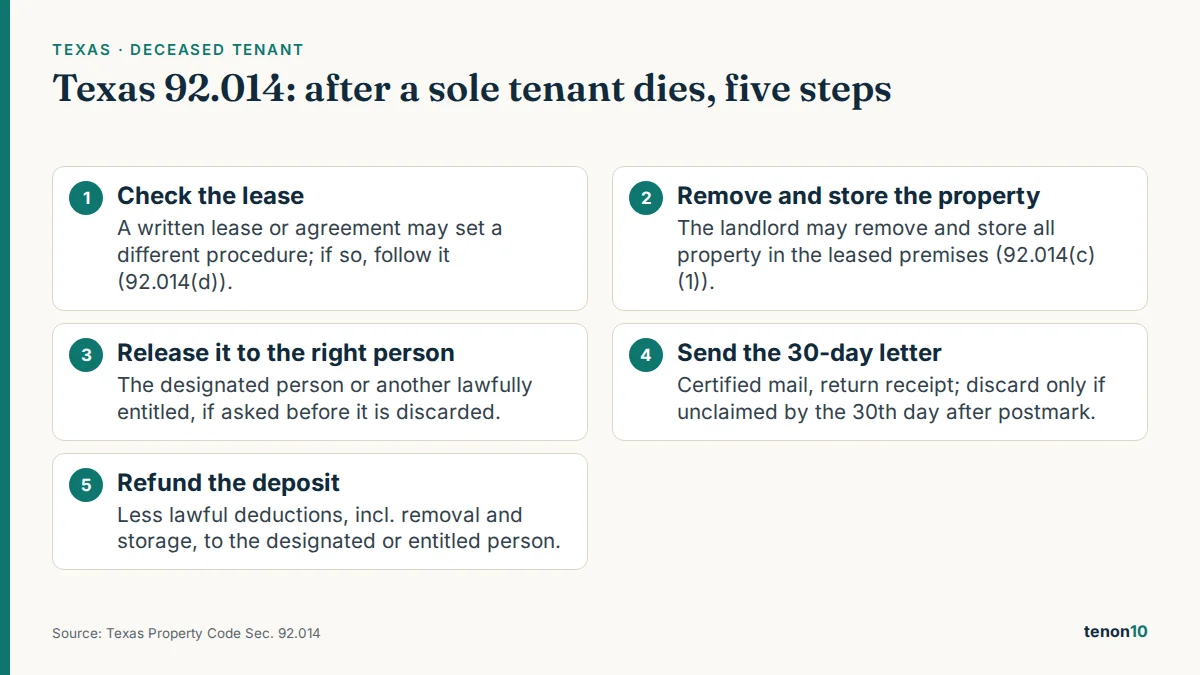
To handle a deceased Texas tenant's unit you need the tenant's emergency contact form, the lease, a way to store belongings, an inventory sheet and certified mail.
- The emergency contact and signed authorization collected under 92.014(a), if you asked for one.
- The lease, because 92.014(d) lets a written lease set a different procedure.
- Storage for the tenant's property, and an inventory form for whoever collects it.
- Certified mail, return receipt requested, for the 30-day removal letter.
How do Texas landlords prepare before a tenant dies?

A Texas landlord can ask the tenant, in writing, for an emergency contact and a signed authorization that applies if the tenant dies. Under 92.014(a), on the landlord's written request the tenant shall:
- give the name, address and telephone number of a person to contact if the tenant dies; and
- sign a statement authorizing the landlord, if the tenant dies, to let that person into the premises at a reasonable time in the presence of the landlord or the landlord's agent, to let that person remove the tenant's property, and to refund the security deposit, less lawful deductions, to that person.
A tenant may also give this information without being asked (92.014(b)). Put the request in your move-in packet so you are not searching for family later.
Steps: what does a Texas landlord do after a sole tenant dies?
When a Texas tenant who was the sole occupant dies, and the lease sets no different procedure, the landlord follows 92.014(c):
Step 1: Check the lease
Under 92.014(d), the landlord and tenant can agree in a written lease or other agreement to a different procedure for removing, storing or disposing of a deceased tenant's property. If the lease has one, follow it.
Step 2: Remove and store the property
The landlord may remove and store all property found in the tenant's leased premises (92.014(c)(1)).
Step 3: Release it to the right person
The landlord shall turn the property over to the person the tenant designated, or to any other person lawfully entitled to it, if that person asks before the property is discarded (92.014(c)(2)). The landlord may require anyone who removes property to sign an inventory of what they take (92.014(c)(4)).
Step 4: Send the 30-day letter
Before discarding anything, mail a written request by certified mail, return receipt requested, to the designated person asking them to remove the property. You may discard it only if the person does not remove it by the 30th day after the postmark date, and nobody has contacted you claiming it before you discard it (92.014(c)(5)).
Step 5: Refund the deposit
The landlord shall refund the security deposit, less lawful deductions, including the cost of removing and storing the property, to the designated person or any other person lawfully entitled to the refund (92.014(c)(3)). The usual deduction rules still apply; see our guide to Texas security deposit return rules.
What are the consequences in Texas if either side ignores 92.014?
Section 92.014 puts consequences on both sides once a copy of the subchapter has been furnished:
| Who | What happens | Section |
|---|---|---|
| Tenant who knowingly violates the landlord's request for a contact and authorization | Landlord has no responsibility after the death for removal, storage, disappearance, damage or disposition of the property | 92.014(e) |
| Landlord who knowingly violates the after-death steps | Liable to the tenant's estate for actual damages | 92.014(f) |
Tips and troubleshooting
- Only the sole occupant. Subsection (c) is written for the death of a tenant who is the sole occupant of the dwelling.
- Two people claim the property. The statute directs the property to the designated person or another person lawfully entitled to it. Keep the inventory signatures and every letter.
- No contact on file. The discard rule in 92.014(c)(5) runs from a certified letter to the designated person, so with no designated person it gives you no discard date. Property still goes to any other person lawfully entitled to it.
- Others with a right to the unit. Texas lockout rules protect tenants; see Texas lockout and utility cutoff rules.
Arizona and Florida have their own abandoned-property statutes: compare Arizona's abandoned unit rules and Florida's Chapter 715.
Frequently asked questions
Who gets a deceased tenant's security deposit in Texas?
The person the tenant designated under 92.014, or any other person lawfully entitled to the refund, less lawful deductions including the cost of removing and storing the property (92.014(c)(3)).
How long must a Texas landlord keep a deceased tenant's belongings?
At least until the 30th day after the postmark of a certified-mail letter to the designated person, and only if no one has claimed the property before disposal (92.014(c)(5)).
Can a Texas lease change the procedure?
Yes. A written lease or other agreement may set a different procedure for removing, storing or disposing of the property (92.014(d)).
Texas Deceased Tenant: Landlord Checklist
A one-page checklist for Texas landlords: the emergency contact to collect at move-in, the steps after a sole tenant dies, the 30-day certified letter and the deposit refund.
Get Free PDF →The bottom line
Collect the 92.014 contact at move-in, send the 30-day certified letter before discarding anything, and refund the deposit to the designated person. More guides are in the Tenon10 guides by topic.
More guides for Texas landlords
Read our free guides on Texas deposits, notices, repairs and evictions.
Free • No signup required