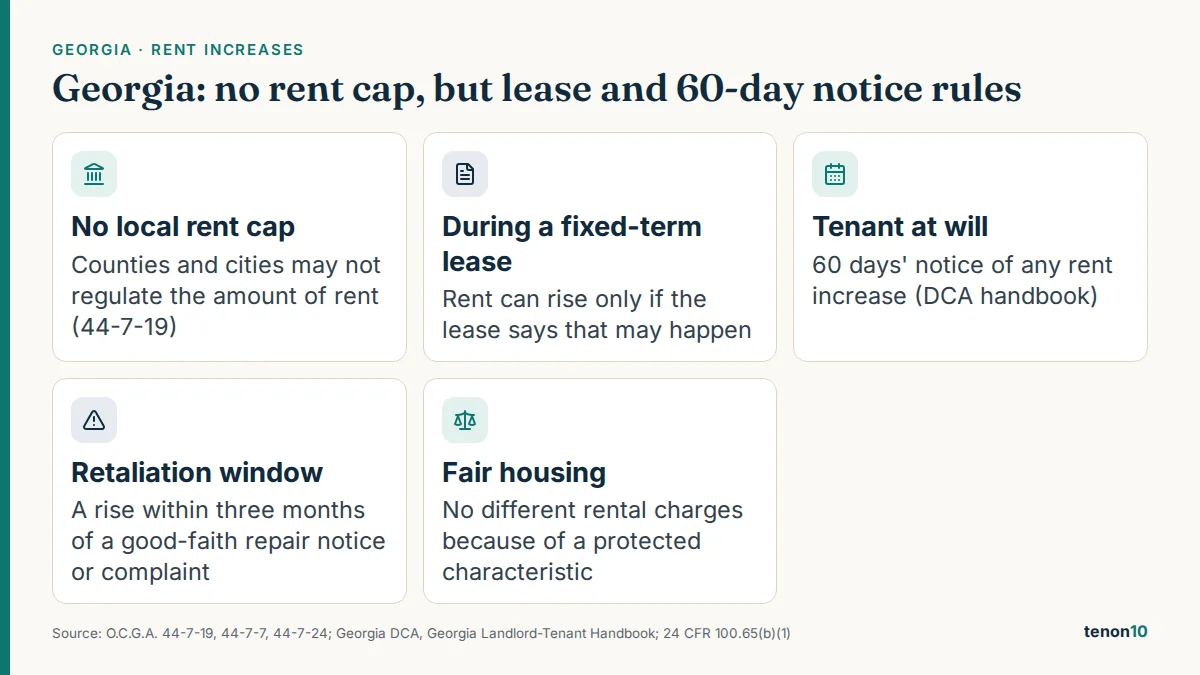
Georgia has no rent control: O.C.G.A. 44-7-19 bars counties and cities from regulating the amount of rent on private residential rentals, and no state statute caps increases. A Georgia landlord may raise rent during a lease only if the lease allows it, and must give a tenant at will 60 days' notice.
Each Georgia rent increase turns on three things: the lease, the notice rules for a tenancy at will, and the retaliation and fair housing limits that apply to every landlord. The Department of Community Affairs summarizes the practical rules in its Georgia Landlord-Tenant Handbook.
Georgia Rent Increase: Landlord Checklist
A one-page checklist for Georgia landlords raising rent: no local rent control, the lease, 60 days' notice to a tenant at will, the retaliation window and fair housing.
Get Free PDF →What will a Georgia landlord need before raising the rent?
- The current lease, to see whether it allows an increase during the term.
- The lease end date, or confirmation that the tenancy has no fixed end.
- A record of any repair requests or code complaints in the past three months.
How do you raise the rent in Georgia step by step?

Step 1: Confirm no local cap applies
Under O.C.G.A. 44-7-19, "No county or municipal corporation may enact, maintain, or enforce any ordinance or resolution which would regulate in any way the amount of rent to be charged for privately owned, single-family or multiple-unit residential rental property." A bill to repeal 44-7-19 was filed in the 2025-2026 session (House Bill 299), so check the current code before relying on it in a future year.
Step 2: Read the lease for the term you are in
During a fixed-term lease, the DCA handbook says rent "can only be increased during a lease if the lease says that may happen," and that the lease decides "whether or not a landlord can raise rent and how often." If the lease is silent, the new figure waits for the renewal.
Step 3: Work out whether the tenant is a tenant at will
Under O.C.G.A. 44-7-6, "Where no time is specified for the termination of a tenancy, the law construes it to be a tenancy at will." The DCA handbook adds that if a lease expires without renewal and the landlord keeps accepting monthly rent, a tenancy at will arises on the terms of the old lease.
Step 4: Give a tenant at will 60 days' notice
O.C.G.A. 44-7-7 says "Sixty days' notice from the landlord or 30 days' notice from the tenant is necessary to terminate a tenancy at will." The DCA handbook applies the same period to rent: a landlord "must give 60 days' notice of any rent increases," after which a new tenancy at will begins at the new rent. See our guide to Georgia's 60-day notice for a tenancy at will.
Step 5: Check the retaliation window
Increasing the tenant's rent is one of the actions O.C.G.A. 44-7-24(c) treats as retaliation when it comes within three months after a tenant, in good faith and about a life, health, safety or habitability concern, exercised a legal right against the landlord, gave notice to repair, complained to a housing code enforcement agency or utility, or joined a tenant organization. Subsection (d) excludes some increases, such as those under an escalation clause for utilities, taxes or insurance. Our Georgia retaliation guide lists the other exceptions.
Step 6: Apply the increase evenly
The federal Fair Housing Act applies in Georgia as in every state, and HUD's rule at 24 CFR 100.65(b)(1) lists using different lease provisions "such as those relating to rental charges" because of a protected characteristic as a prohibited practice. Use the same method for every unit and keep your reasons in writing.
Step 7: Recheck the deposit at renewal
The two-month security deposit cap in O.C.G.A. 44-7-30.1 applies to leases entered into or renewed on or after July 1, 2024 (HB 404, Section 6). Any extra deposit you ask for must keep the total within two months' rent; see our Georgia security deposit guide.
What goes wrong most often with Georgia rent increases?
- Raising rent mid-lease with no clause. Without lease language, the old rent runs to the end of the term.
- Short notice to a month-to-month tenant. Thirty days is the tenant's period; the landlord's is 60.
- An increase right after a repair request. Within three months, it invites a retaliation defense.
Frequently asked questions
Is there rent control in Georgia?
No. O.C.G.A. 44-7-19 bars counties and cities from regulating rent on privately owned residential rentals, and the state code sets no cap on the size of an increase.
How much notice does a Georgia landlord need to give to raise rent?
For a tenant at will, 60 days, according to the DCA handbook and the 60-day period in O.C.G.A. 44-7-7. For a fixed-term lease, the increase follows the lease, which may allow none until renewal.
Can a Georgia landlord raise rent during a one-year lease?
Only if the lease says rent may increase during the term. Otherwise the agreed rent applies until the lease ends.
Georgia Rent Increase: Landlord Checklist
A one-page checklist for Georgia landlords raising rent: no local rent control, the lease, 60 days' notice to a tenant at will, the retaliation window and fair housing.
Get Free PDF →Georgia law leaves the amount to the market and the lease, but the process is regulated. Get the notice right and the rest follows.
Keep Georgia rent changes clean and documented
Read Tenon10's free guides for US landlords on notices, deposits and leases.
Free • No signup required