In Alberta, every lease includes the landlord's promise not to disturb the tenant's possession or peaceful enjoyment in any significant way (Residential Tenancies Act s.16(b)). Landlord harassment, such as entering without proper notice, changing locks without giving a key, or retaliating against a complaint, breaks that promise, and a tenant can claim damages, a rent reduction or termination.
Alberta's Act does not use the word "harassment" for landlords. It protects the same ground through the peaceful enjoyment covenant and a handful of specific rules. This guide sets out what those rules are, what does not count, and what a tenant can do. For the full picture of a tenancy, see the Alberta tenant guide.
What does quiet enjoyment mean in Alberta?
Quiet enjoyment, called "peaceful enjoyment" in Alberta's Residential Tenancies Act (RTA), is the tenant's right not to be significantly disturbed in their home while they meet their own obligations. The landlord promises that neither the landlord nor anyone claiming under the landlord will in any significant manner disturb the tenant's possession or peaceful enjoyment, subject to the entry rules in section 23 (s.16(b)).
The Government of Alberta's RTA Handbook adds an important limit: peaceful enjoyment does not mean the landlord guarantees the property will always be quiet. It means the landlord will not interfere with the tenant's ability to live in and enjoy the home.
What landlord conduct can breach peaceful enjoyment in Alberta?

The clearest breaches are the ones the Act spells out, because each is a specific rule a landlord either followed or did not.
| Conduct | The rule | Section |
|---|---|---|
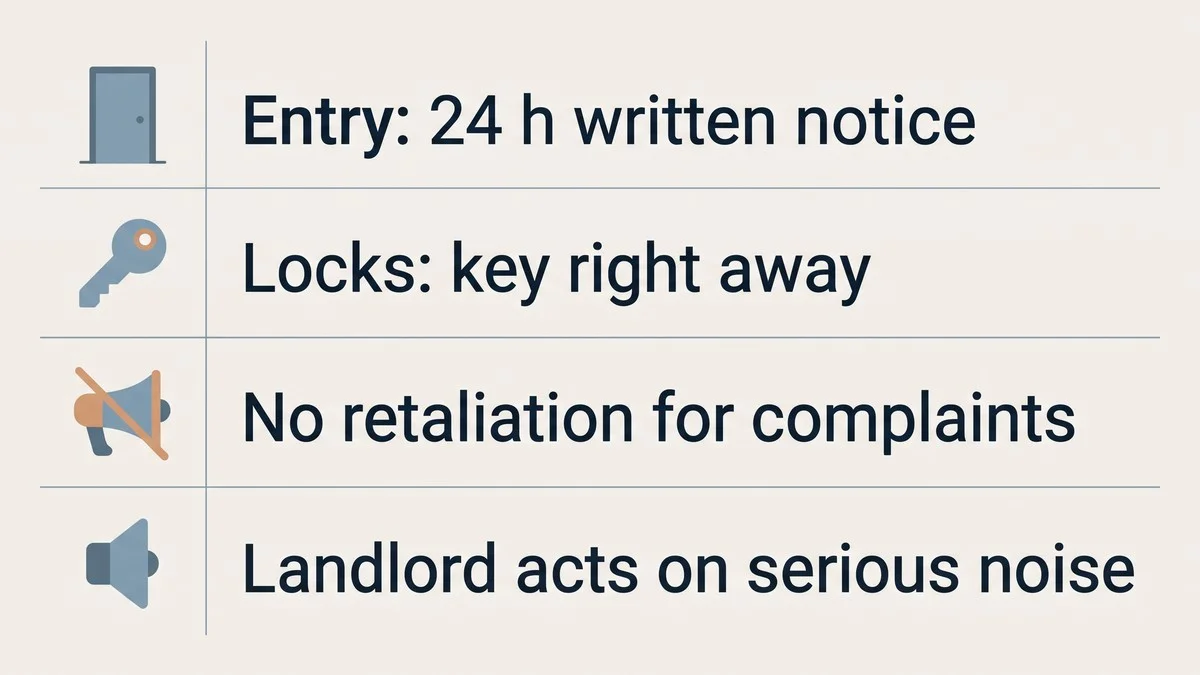
| Entering without consent or proper notice | Written, signed notice at least 24 hours ahead, with the reason and a time between 8 a.m. and 8 p.m., not on a holiday; no notice only for an emergency or a reasonable belief the tenant abandoned the unit | s.23 |
| Frequent entries, even with notice | The Handbook says entries must not be so frequent that they significantly disturb peaceful enjoyment | s.16(b), s.23 |
| Changing locks without giving the tenant a key | A key must be made available to the tenant as soon as the change is made | s.24(2) |
| Ending a tenancy or penalising a tenant for complaining | No termination or retaliation, including a financial penalty, because the tenant applied, complained or gave evidence under the RTA or the Public Health Act | s.25 |
| Ignoring a problem that is disturbing tenants | Alberta's guidance says it is the landlord's responsibility to take action if something is causing problems for tenants, including excessive noise | alberta.ca |
The noise point comes from the province's Common problems for landlords and tenants page, which excludes activity in the normal course of everyday living. Entry rules are covered in more depth in how much notice an Alberta landlord needs to enter.
What is not a breach of peaceful enjoyment?
A landlord who follows the Act is not harassing a tenant by doing so. Proper 24-hour entry for repairs, inspections, pest control or showings is allowed (s.23(3)), a lawful notice to end a tenancy is a right the Act gives, and so is a rent increase served with proper notice. Necessary building work can be inconvenient: the Handbook says the courts and the Residential Tenancy Dispute Resolution Service (RTDRS) balance the inconvenience to the tenant against the landlord's needs when deciding what is reasonable.
How to tell whether an entry notice is valid
Many complaints about a landlord's behaviour start at the door. Before objecting to an entry, check the notice against section 23. A notice for an entry without consent must:
- be in writing and signed by the landlord or the landlord's agent (s.23(5));
- state the reason, and the reason must be one the Act allows: inspecting the state of repair, making repairs, controlling pests, showing the unit to prospective buyers or mortgagees, or showing it to prospective tenants after a notice ending a periodic tenancy has been served or in the last month of a fixed term (s.23(3));
- be served at least 24 hours before the entry (s.23(4)(a));
- name a date and a time between 8 a.m. and 8 p.m., or a period of reasonable duration that begins and ends at specified times (s.23(4)(c), s.23(6));
- not fall on a holiday, or on the tenant's day of religious worship if the tenant has given the landlord written notice of that day (s.23(4)(b)).
The Handbook adds three points that are easy to miss. Consent given under fear, fraud, deception or coercion is not real consent, so pressure at the door does not replace a notice. When a landlord needs to enter several units, each tenant must get a notice; posting one in the common areas is not enough. And the tenant does not have to be home: with proper notice, the landlord may enter while the tenant is out.
A worked example
A landlord leaves a signed note on Monday evening saying they will "come by this week to look around." The note names no date or time window, so it does not meet s.23(5)(d) and s.23(6), and the tenant can decline entry on it. The landlord then serves proper notices for an inspection on Wednesday, a repair on Thursday and another inspection on Saturday. Each notice may be valid on its own, but the Handbook says entries must not be so frequent that they significantly disturb peaceful enjoyment. The tenant's log of every notice and visit is what lets an RTDRS officer see that pattern.
What can an Alberta tenant do about landlord harassment?
An Alberta tenant whose landlord breaches the lease or the Act can apply to the RTDRS or the court for one or more remedies (s.37(1), s.54.2(2)):
- damages for the loss the breach caused;
- an abatement (reduction) of rent for the benefit the tenant lost;
- compensation for the cost of doing what the landlord should have done;
- termination of the tenancy, if the breach is serious enough that the tenancy should end.
RTDRS claims must be filed within 2 years of discovering the claim and are limited to $100,000, according to the RTDRS application page. See RTDRS explained for how a hearing works.
Reporting an offence
Some breaches are also offences. Contravening the entry, lock or anti-retaliation rules (ss.23, 24 and 25) carries a fine of up to $5,000 (s.60(1)), and a prosecution must start within 3 years (s.61). The Handbook says a written complaint to Service Alberta and Red Tape Reduction is needed before the province can act on a lock offence.
Frequently asked questions
Can my Alberta landlord text me constantly?
The Act has no rule on messages as such. If contact becomes so frequent or aggressive that it significantly disturbs your peaceful enjoyment, it can support a claim under s.16(b); keep every message.
Can a landlord enter just to check on me?
Not without consent. Inspection of the state of repair is a listed reason, but it still needs 24 hours' written notice (s.23(3)-(5)), and entries so frequent they disturb you can breach peaceful enjoyment.
Is it harassment if my landlord serves a notice to end my tenancy?
A notice that follows the Act is a lawful step, not harassment. A termination because you complained, applied or gave evidence under the RTA or Public Health Act is prohibited (s.25).
Can I change the locks to keep my landlord out?
No. Neither a tenant nor a landlord may add to or change locks on doors giving access to the unit without the other's consent, and a tenant who changes a lock with consent must make a key available to the landlord as soon as the change is made (s.24(1), (4)). The Act does let a tenant install a security device that can only be put into effect while someone is inside, as long as it can be installed and removed without damage or stays with the unit when the tenancy ends (s.24(3)).
Can I end my lease because of harassment?
Not on your own say-so. You can ask the RTDRS or court to terminate the tenancy if the breach is serious enough (s.37(1)(d)); the separate 14-day tenant notice in s.28 applies only where a public health order has been issued and not complied with.
Does peaceful enjoyment cover noisy neighbours?
The covenant is the landlord's own promise, but Alberta's guidance says it is the landlord's responsibility to take action when something, including excessive noise, is causing problems for tenants. Activity in the normal course of everyday living does not count.
Ending a tenancy after a landlord breach?
Alberta's tenant notice for a landlord's substantial breach applies only where a public health order has not been complied with. Fill it out online and download the PDF.
Free • No signup required