In Alberta, roommates who all signed the lease are co-tenants: each is a tenant under the Residential Tenancies Act, a notice served on any one adult tenant satisfies the Act's service rule, and the deposit is returned to all of them together. When one roommate wants to leave, the Act sets no special rule, so put any change in writing with the landlord.
This guide is about people who are all named on one lease. A roommate who is not on the lease is a different case, covered in subletting in Alberta along with the 14-day consent rule. For the rules that apply to every tenancy, see the Alberta tenant guide.
Who counts as a tenant when roommates share an Alberta rental?
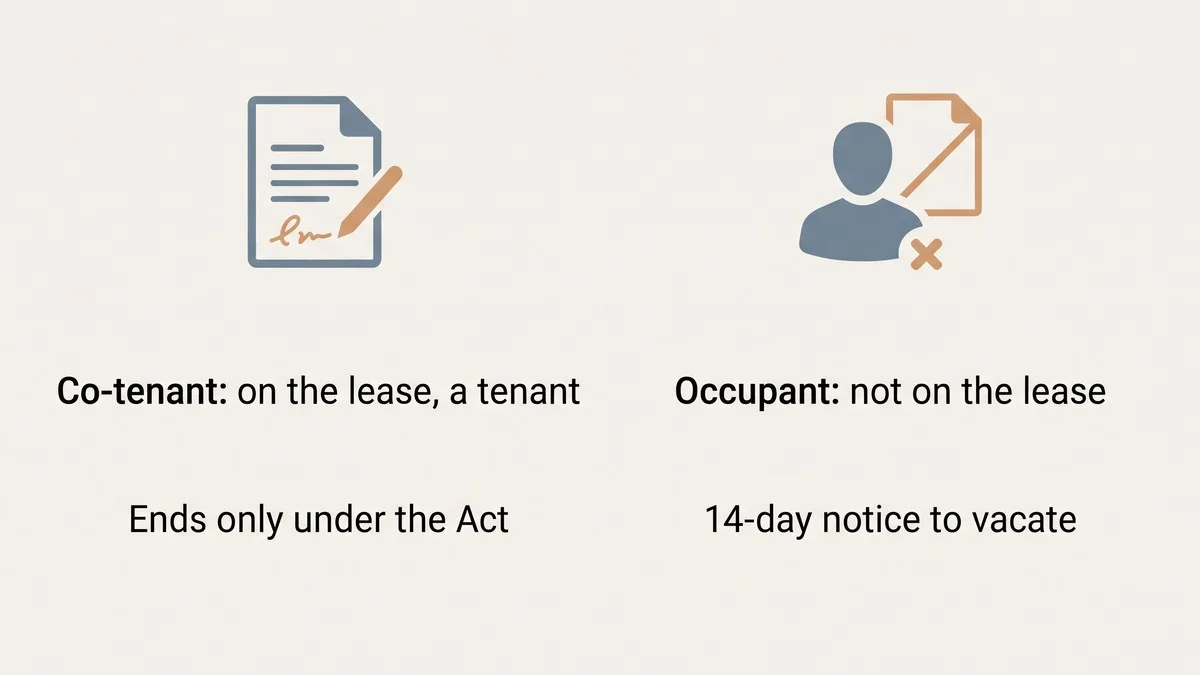
A tenant is anyone the landlord permits to occupy the premises under the tenancy agreement, plus anyone occupying under an assignment or sublease the landlord consented to (RTA s.1(1)(t)). Roommates who each signed the lease are all tenants. Alberta's Starting a tenancy page says the agreement should list the names of the people permitted to live in the unit, which is what keeps the line between a co-tenant and an occupant clear.
| Co-tenant on the lease | Roommate not on the lease | |
|---|---|---|
| Status under the Act | Tenant (s.1(1)(t)) | Not a tenant, unless the landlord consented to a sublease or assignment |
| Can the landlord require them to leave on short notice? | No: only by ending the tenancy under the Act | Yes: a notice to vacate giving at least 14 days (s.36) |
| If every tenant on the lease has abandoned the unit | Not applicable | A notice to vacate giving at least 48 hours (s.33) |
Co-tenants also share possession. The Government of Alberta's RTA Handbook defines exclusive possession as possession, control and use of the premises that nobody else has, with the exception of other co-tenants (or the landlord in very limited circumstances). Each co-tenant's right to the home is shared with the others on the lease, not held against them.
How do notices work with several tenants?

A notice, order or document the Act requires to be served on the tenant is properly served if it is given to one adult who falls within the definition of tenant (s.58(2)). So a notice handed to one co-tenant counts as served, and roommates should tell each other the moment one arrives.
The move-in and move-out inspections work the same way: the landlord can only complete one alone if no adult who falls within the definition of tenant agrees to take part (s.19(3)), so one co-tenant taking part is enough for the inspection to be done with a tenant present. See inspection report rules.
Who pays the rent when roommates share a lease?

The Act does not divide rent between co-tenants. What each owes the landlord comes from the agreement, so read how the lease describes the rent and the tenants' responsibility before signing. Paying rent when due is a covenant of the tenancy (s.21(a)), so a 14-day notice for unpaid rent is a notice to end the tenancy, not one roommate's part of it (see Alberta's 14-day notice for unpaid rent).
Splits between roommates (who pays which bill, who covers a share if one leaves) are a private arrangement. Write it down among yourselves; the landlord is not a party to it.
What happens to the deposit with co-tenants?
The Handbook says that when several tenants are on one agreement, the landlord must return the security deposit by a cheque made out to all of them, not to one, because every tenant on the agreement is equal. The usual 10-day deadline after the tenants give up possession applies (RTA s.46). Read more in how long an Alberta landlord has to return a deposit.
What happens when one roommate wants to leave?
The RTA does not set out a rule for one co-tenant leaving while the others stay, so the safe routes are the ones the Act does provide, each agreed in writing:
- Assignment of the leaving tenant's place to a replacement, with the landlord's written consent (s.22). The landlord cannot refuse without reasonable grounds and cannot charge a fee for consent.
- A new agreement with the remaining tenants, if the landlord agrees.
- Ending the tenancy together with proper notice: see notice periods in Alberta.
Moving out does not by itself take a roommate's name off the agreement. The Act does not say whether a notice signed by only one co-tenant ends a periodic tenancy for everyone, so do not rely on one; get the landlord's written agreement to whatever comes next.
Asking the landlord to consent to a replacement, step by step
- Agree among yourselves first: the replacement, the date, and how the leaving roommate's share of the deposit and any shared bills will be settled.
- Send the landlord a written, dated request naming the replacement and the date, and keep a copy. If the landlord does not respond within 14 days of receiving a request for consent, consent is deemed given (s.22(4)).
- If the landlord refuses, the refusal needs reasonable grounds (s.22(2)), and the landlord must give the tenant who asked written reasons (s.22(5)).
- No fee or other consideration may be charged for consent (s.22(6)).
- Once consent is given, the replacement occupies under an assignment the landlord consented to, which makes them a tenant (s.1(1)(t)(ii)).
A worked example
Three roommates share a monthly periodic lease. One moves out at the end of the month without asking the landlord for anything. Her name is still on the agreement. A notice the landlord later hands to either remaining roommate is served on the tenant under s.58(2), and when the tenancy ends, the Handbook's rule means the deposit cheque is made out to all the tenants on the agreement, including her. Had she arranged a consented assignment, her replacement would have become the tenant in her place.
Common mistakes with shared leases
- Moving a friend in "for a while" without the landlord's agreement. That person is not a tenant and can be served a 14-day notice to vacate (s.36).
- Expecting the landlord to refund one roommate's share on the way out. The Act sets no rule for a partial refund mid-tenancy; settle it in writing.
- Ignoring a notice because it was given to a roommate. Service on one adult tenant counts for the tenant (s.58(2)).
- Treating a verbal "fine by me" as consent to a replacement. An assignment or sublease is not valid without the landlord's written consent, unless consent is deemed after 14 days (s.22(1), (4)).
Frequently asked questions
Can a landlord evict just one roommate on the lease?
Not by a notice to vacate. That notice (s.36) is for a person who is not a tenant. A co-tenant on the lease is a tenant, and the Act's termination notices end the tenancy, not one tenant's share of it.
Do all roommates have to sign the lease?
The Act does not require it, but Alberta's guidance says the agreement should name everyone permitted to live there. People who sign are tenants; people who are not named and not consented to are occupants.
How much notice does a roommate who is not on the lease get?
At least 14 days from the day the notice to vacate is served, and the notice must be in writing, signed by the landlord or agent, and set out the time and date to leave (s.36). The Handbook reads this as 14 clear days, so neither the day of service nor the move-out day counts. If every tenant has abandoned the unit, the notice to a person still living there can be 48 hours (s.33).
Can my roommate's replacement just move in?
Not validly without the landlord's written consent to an assignment or sublease (s.22(1)). If the landlord does not answer a request within 14 days, consent is deemed given (s.22(4)).
If one roommate damages the unit, who pays?
The tenant's covenant not to do or permit significant damage is part of every tenancy agreement (s.21(e)), so damage by one co-tenant is a breach of the agreement they all signed. How the roommates share the cost between themselves is their own agreement.
Name every tenant from the start
Fill out an Alberta residential tenancy agreement online, with a section for the names and addresses of all parties, and download the PDF.
Free • No signup required