A Texas landlord may offer a fee in lieu of a security deposit only as an option beside a regular deposit, in a written agreement signed by both sides, charged as an equal recurring fee with each rent payment. The tenant's choice cannot affect approval, and the tenant can switch to a deposit at any time (Property Code 92.111).
Section 92.111 of the Texas Property Code, chapter 92 took effect September 1, 2021. Get it wrong and the fee can be treated as a security deposit. Dollar amounts here are in US dollars.
Texas Fee in Lieu of Deposit: Landlord Checklist
A one-page checklist for Texas landlords offering a fee in lieu of a security deposit: the written offer, the signed agreement, billing and the 30-day claim notice.
Get Free PDF →What you'll need before offering a Texas fee in lieu of a deposit
In Texas, you need a lease that requires a security deposit in the first place (92.111(a)). Have these ready:
- Your standard deposit amount for the unit, because the tenant must be told they can pay it instead.
- The fee amount and the cost behind it. If the fee buys insurance, it may not exceed the reasonable cost of obtaining and administering that insurance (92.111(e)).
- A written disclosure of both options and their charges (92.111(b)).
- A separate written fee agreement for signature by you (or your legal representative) and the tenant (92.111(c)).
For how a regular deposit is held and returned, see Texas security deposit rules.
Steps: how does a Texas landlord offer a fee in lieu of a deposit?

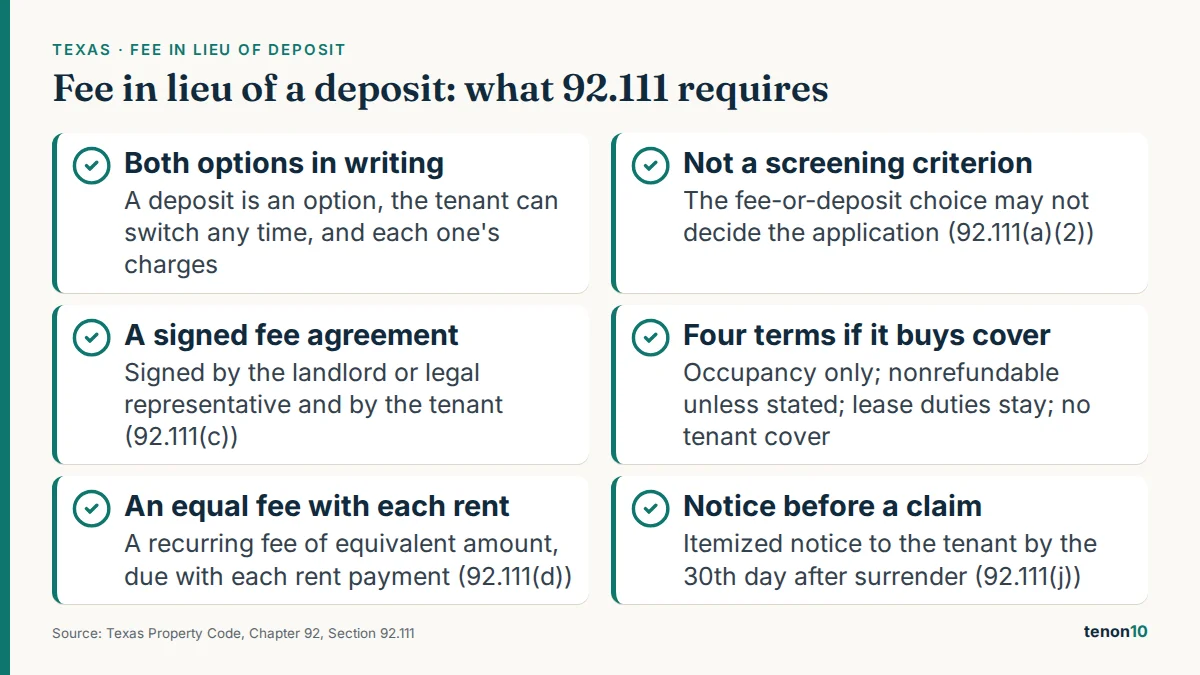
Step 1: Offer both options in writing
When you offer the fee, Texas requires you to tell the tenant in writing, at that time, three things (92.111(b)):
- that the tenant can pay a security deposit instead;
- that the tenant can end the fee agreement at any time, stop paying the fee and pay a security deposit in the amount you are then offering new tenants for substantially similar housing; and
- the charges for each option.
Step 2: Keep the choice out of screening
You may not use a prospective tenant's choice between the fee and the deposit as a criterion in deciding whether to approve the application (92.111(a)(2)). Decide the application first, on the criteria you publish; our guide to Texas rental application fees and selection criteria covers that notice.
Step 3: Get the fee agreement signed
If the tenant picks the fee, the agreement to collect it must be in writing and signed by the landlord or the landlord's legal representative and by the tenant (92.111(c)).
Step 4: Write in the four required terms if the fee buys insurance
Where you use the fee to buy insurance coverage, the agreement must clearly say (92.111(f)):
- the fee is paid only to secure occupancy without paying a security deposit;
- the fee, unless otherwise specified, is not refundable;
- paying it does not limit the lease, including the duty to pay rent when due and damages the tenant is liable for, other than normal wear and tear; and
- the fee, unless otherwise specified, is not paying for insurance that covers the tenant.
Step 5: Bill it as an equal fee with each rent payment
The fee must be a recurring fee of equivalent amount, payable when each rent payment is due during the lease (92.111(d)).
Step 6: Give notice before any insurance claim
You may not submit a claim for damages or unpaid rent to the insurer unless you notified the tenant no later than the 30th day after the tenant surrendered the dwelling. The notice must include a written description and itemized list of all damages and unpaid rent, with the dates the rent was due (92.111(j)).
When does a Texas fee in lieu count as a security deposit?
In Texas, a fee in lieu is treated as a security deposit for chapter 92 unless both of these are true: a signed agreement exists under 92.111(c), and the fee is used to buy insurance for damages and unpaid rent the tenant is liable for (92.111(g)-(h)).
| Situation | Treatment (92.111) |
|---|---|
| Signed agreement and fee buys insurance | Not a security deposit |
| No signed agreement | Security deposit under chapter 92 |
| Fee kept by the landlord, no insurance bought | Security deposit under chapter 92 |
Troubleshooting
The tenant disputes your notice of damages. If the challenge leads you or a court to find the notice incorrect, that debt is void: you may not claim it, must withdraw a claim already filed and must return any payment already received (92.111(k)).
The insurer paid and you want the rest from the tenant. You may not collect from the tenant the amounts the insurer paid you. If the policy has a subrogation clause, the insurer may seek only what it paid, before the first anniversary of the end of occupancy, and the tenant keeps every defense (92.111(l)).
You want to charge for worn carpet. A landlord may not charge a tenant for normal wear and tear (92.111(i)).
No deposit and no fee at all. A different rule applies: before reporting a move-out claim to a credit bureau or debt collector, you must notify the tenant in writing, unless no forwarding address was given, or you forfeit the claim (92.110).
Frequently asked questions
Is a fee in lieu of a security deposit legal in Texas?
Yes. Texas Property Code 92.111 has allowed it since September 1, 2021, if the lease requires a security deposit, the tenant is also offered a regular deposit and the agreement is in writing and signed by both sides.
Is a Texas fee in lieu of deposit refundable?
Where the fee buys insurance, the agreement must say that the fee, unless otherwise specified, is not refundable (92.111(f)). If the fee does not buy insurance, it is treated as a security deposit under chapter 92.
Can a Texas tenant switch from the fee to a deposit?
Yes, at any time. The tenant can end the fee agreement and pay a deposit in the amount you are then offering new tenants for substantially similar housing (92.111(b)(2)).
Texas Fee in Lieu of Deposit: Landlord Checklist
A one-page checklist for Texas landlords offering a fee in lieu of a security deposit: the written offer, the signed agreement, billing and the 30-day claim notice.
Get Free PDF →The bottom line
In Texas, offer the fee only beside a regular deposit, disclose both options in writing, keep the choice out of screening, sign a clear agreement and bill an equal fee with rent. More Texas topics are in the Texas retaliation guide and Tenon10 guides by topic.
More guides for Texas landlords
Read our free guides on Texas deposits, notices, repairs and evictions.
Free • No signup required