

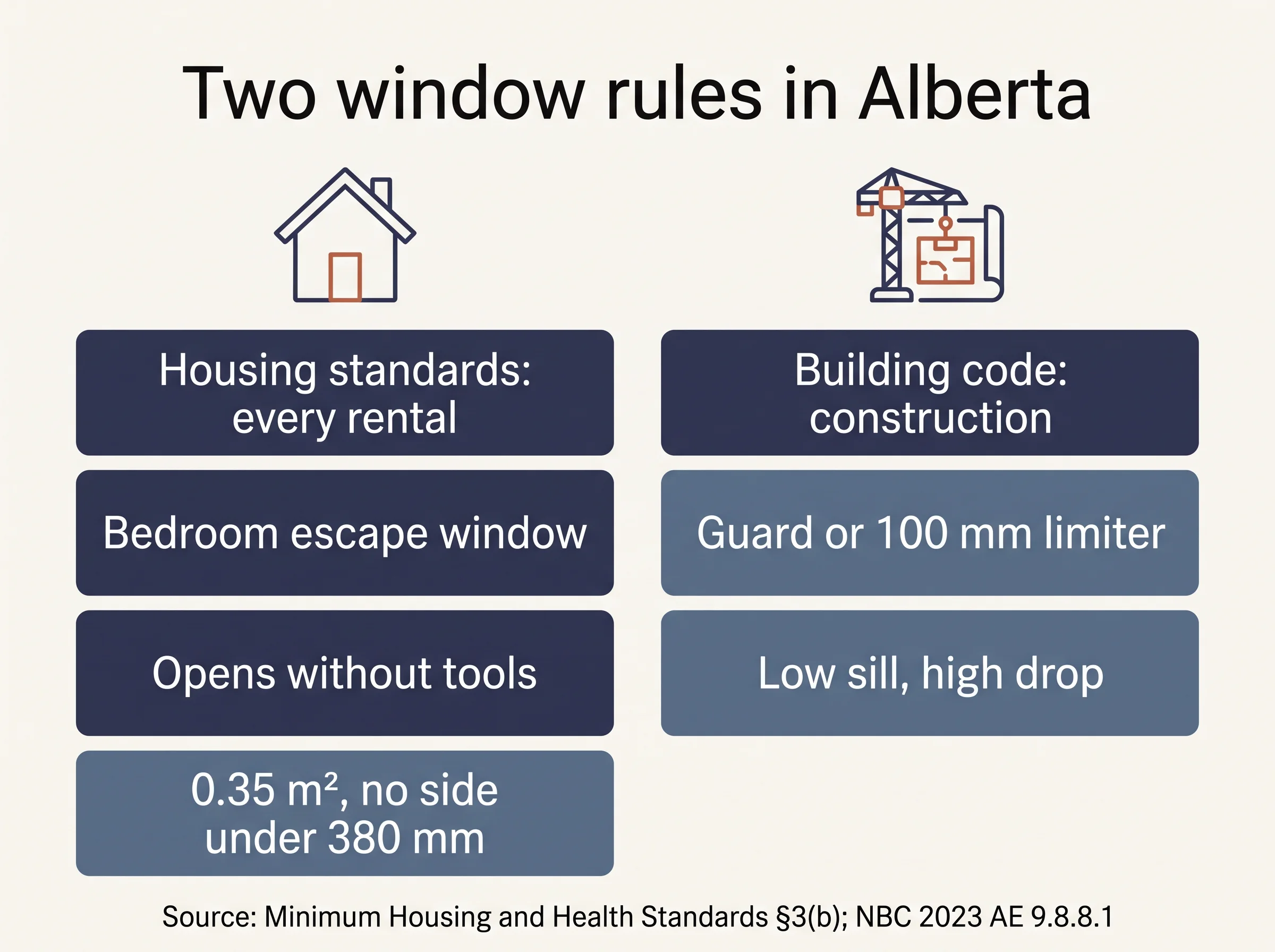
Window fall prevention in Alberta rentals sits between two rules. The Minimum Housing and Health Standards require every bedroom to have an escape window that opens from inside without tools. The building code limits many low-sill windows to a 100 mm opening. Alberta's STANDATA variance 23-BCV-001 allows a fall-prevention device with an emergency release that satisfies both.
Picture a family with a toddler moving into a second-floor suite, where the bedroom window is a wide slider with a low sill and only a fly screen stands between the child and the yard. This guide sets out what each Alberta rule says, using only official sources, and the conservative way to apply them without creating a new problem: a bedroom window nobody can escape through in a fire.
Which rules govern rental window safety in Alberta?
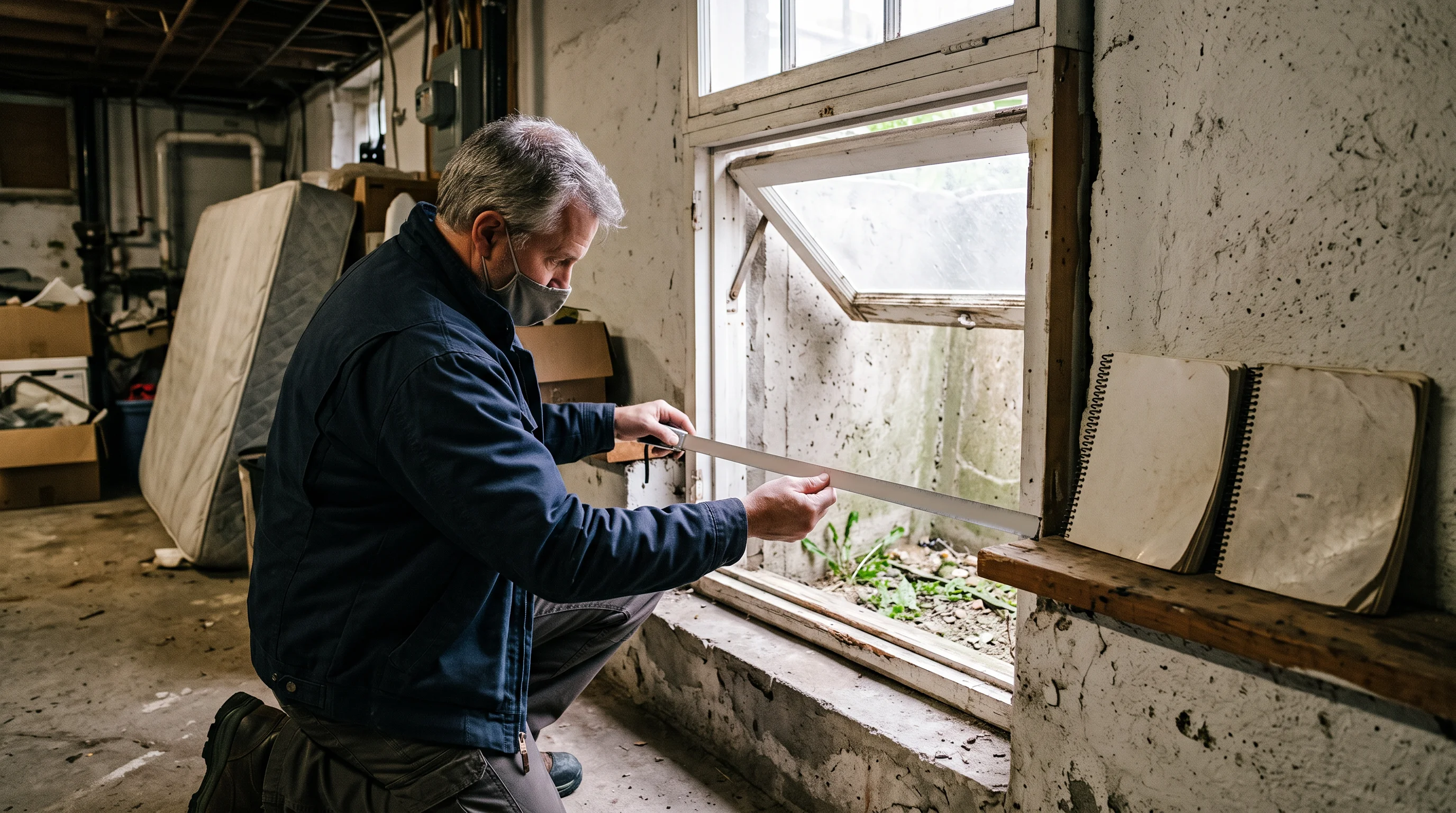
Two rulebooks govern rental windows in Alberta: the Minimum Housing and Health Standards, which apply to rental homes as they are maintained, and the National Building Code – 2023 Alberta Edition, which governs construction. The Minimum Housing and Health Standards explain the difference themselves: housing standards "govern the conditions and maintenance" of housing and are enforced by public health inspectors, while a building code's principal purpose is "to regulate the construction of buildings" and is enforced mainly through permits and inspections.
| Minimum Housing and Health Standards | National Building Code – 2023 Alberta Edition | |
|---|---|---|
| Applies to | Every rental home, as it is maintained today | Construction work, through permits |
| Enforced by | Alberta Health Services public health inspectors | Safety codes officers through permits and inspections |
| Window rule | Bedroom escape window, openable without tools (§3(b)) | Guard or 100 mm opening limiter on low-sill, high-drop windows (9.8.8.1(4)–(5)) |
What is the bedroom escape window rule for Alberta rentals?
In Alberta rentals in buildings of 3 storeys or less, each bedroom must have at least one outside window that opens from inside without tools and gives at least 0.35 m² with no dimension under 380 mm, under §3(b) of the Standards. The rule does not apply where a bedroom door leads directly outside or the suite is sprinklered. The window must:
- open from the inside "without the use of tools or special knowledge";
- give an unobstructed opening of at least 0.35 m² (3.8 sq ft), with no dimension under 380 mm (15 in).
If the window has security bars, they must open from the inside without tools or special knowledge (§3(b)(iii)). A health officer may approve another means of escape after consulting a safety codes officer (§3(b)(iv)). Exterior windows must also be capable of being secured (§3(a)). That is the rule a public health inspector checks in an existing rental, including basement suites.
What does Alberta's building code say about child window falls?
Alberta's building code requires openable windows in residential buildings to have a guard or a tool-release limiter that keeps the opening to 100 mm or less, unless the window falls under an exemption. Alberta's STANDATA variance 23-BCV-001 (April 2024) quotes Sentence 9.8.8.1(4) of the National Building Code – 2023 Alberta Edition: openable windows in buildings of residential occupancy must be protected by a guard, or by a mechanism that can only be released with tools or special knowledge and limits any clear opening to not more than 100 mm. Sentence 9.8.8.1(5) exempts a window whose openable bottom edge is more than 900 mm above the floor, or less than 1,800 mm above the floor or ground on the other side.
So the rule bites on a window with a low sill (900 mm or less) and a real drop outside (1,800 mm or more). The appendix note quoted in the STANDATA says the intent is "to minimize the likelihood of small children falling significant heights from open windows," and that 100 mm is the maximum opening recognised as protecting small children.
The note also warns that rotary crank mechanisms "cannot limit window openings to 100 mm" and cannot act as guards even with the handle removed, and that the rule mainly affects sliding windows without built-in limiting devices.
How does Alberta reconcile escape windows with fall prevention?
Alberta reconciles the two through STANDATA 23-BCV-001, a province-wide variance that allows a window opening control device complying with ASTM F2090 to meet both the fall rule and the egress rule. A tool-release limiter on a bedroom window would otherwise clash with the code's own egress rule (9.9.10.1(1)), which, like the housing standard, requires a bedroom window openable from inside without keys, tools or special knowledge.
The variance names ASTM F2090, "Standard Specification for Window Fall Prevention Devices with Emergency Escape (Egress) Release Mechanisms," as meeting both 9.8.8.1(4) and 9.9.10.1(1). One condition: these devices are not permitted in adaptable or barrier-free dwelling units.
The conservative reading for a rental: on a bedroom escape window, use only a device that limits the opening for children and has an emergency release an adult can operate without tools. Check that, once released, the window still gives the 0.35 m² and 380 mm opening the housing standard requires.
Does an Alberta landlord have to retrofit fall-prevention devices?
Alberta's Minimum Housing and Health Standards, which apply to existing rentals, contain no window-opening limit for child safety; the 100 mm limit is a building code rule, and the code regulates construction. Where windows are being replaced, check with your municipality's permit office whether the new installation must meet 9.8.8.1. In Calgary, the City says a same-size window replacement needs no permit, while a larger or smaller one needs a development and building permit (calgary.ca).
Not required is not the same as not wise. Federal injury data from the Public Health Agency of Canada's Spotlight on Children's Falls (2025) says falls from windows and balconies were the falls "most likely to result in hospital admission," and lists causes including "children pushing through the window screen" and "climbing on furniture or on a ledge." An ASTM F2090 device on an upper-floor window is a step that fits within both rules.
What about blind cords in Alberta rentals?
Health Canada's Window covering safety page says new regulations for corded window coverings came into force in 2021, and recommends replacing coverings that have long accessible cords. Until then it advises keeping cords out of reach, never placing cribs, beds or playpens near a window where a child could reach a cord, and not placing climbable furniture near a window. Alberta landlords who supply blinds can replace old corded ones at turnover.
What should an Alberta landlord check on every rental window?
An Alberta landlord should check that every bedroom has a working escape window, that no egress window has a keyed stop, and that upper-floor family units have fall-prevention devices with an egress release. The full checklist:
- Every bedroom has one escape window that opens from inside without tools, at least 0.35 m² with no side under 380 mm (or an approved alternative).
- Any security bars open from the inside without tools.
- Upper-floor windows with low sills have a fall-prevention device with an egress release, where the tenant wants one or the unit is let to a family.
- No keyed or screw-in stops on egress windows.
- Screens are present and intact on ventilation windows in fly season (Standards §2(b)(iii)), but nobody treats them as fall protection.
- Old corded blinds replaced with cordless ones.
- Window hardware noted on the move-in inspection report.
How do you choose a window contractor in Alberta?
When choosing a window contractor in Alberta, ask them to confirm in writing which code requirements the new windows meet, including 9.8.8.1 and the bedroom egress opening, and whether a permit is needed in your municipality. Alberta.ca's Hiring a contractor page adds the basics: a written contract with a detailed description of the work, insurance and Workers' Compensation Board coverage, and a licensed prepaid contractor where money is taken up front on a contract made away from the business's premises.
What can Alberta tenants do about unsafe windows?
Alberta tenants can ask the landlord in writing for a fall-prevention device, and keep furniture away from low windows. If a bedroom has no window that opens enough to escape, or bars that need a key, that is a minimum-standards issue: write to the landlord first, then contact Alberta Health Services Environmental Public Health (1-833-476-4743, listed on the AHS Environmental Public Health page). For money claims, the Residential Tenancy Dispute Resolution Service (RTDRS) or the court can award damages or a rent reduction, but alberta.ca says the RTDRS cannot order repairs.
How can Tenon10 help record window safety in an Alberta rental?
Tenon10's Alberta move-in and move-out inspection report gives you a place to record each window, its hardware and any limiters at the start and end of every tenancy, kept with the lease.
Frequently asked questions
Are window stops required in Alberta rentals?
The building code requires a guard or a 100 mm opening limiter on many low-sill, high-drop windows in construction the code covers. The Alberta housing standards that apply to existing rentals do not require them. Where one is fitted to a bedroom window, use a device with an emergency release.
How big must a bedroom window be in an Alberta rental?
In buildings of 3 storeys or less, at least one bedroom window must open from inside without tools and give at least 0.35 m², with no dimension under 380 mm. The exceptions are a sprinklered suite, a bedroom door that leads outside, or an alternative approved by a health officer.
Can I put a lock on my child's bedroom window in Alberta?
Not one that needs a key or tool if it is the room's escape window. Use a fall-prevention device that meets ASTM F2090 with an egress release, and ask your landlord first if it is attached to the frame.
Do window screens stop children falling?
No. The Public Health Agency of Canada lists children pushing through window screens among the causes of window falls, so a screen is not fall protection in an Alberta rental or anywhere else.
Record every window at move-in
Run Alberta move-in and move-out inspection reports and keep them with the lease in Tenon10.
Built for Canadian landlords and property managers.
What else should Alberta landlords and tenants read?
These Tenon10 guides cover the related Alberta rules on windows, repairs and Calgary rentals:


