The landlord must fix a drafty or broken window in an Alberta rental: Alberta's minimum housing standards require rental windows to be in good repair, free of cracks and weatherproof. A tenant pays only for damage they or their guests cause. If repairs stall, Alberta tenants can call public health and claim through the RTDRS.
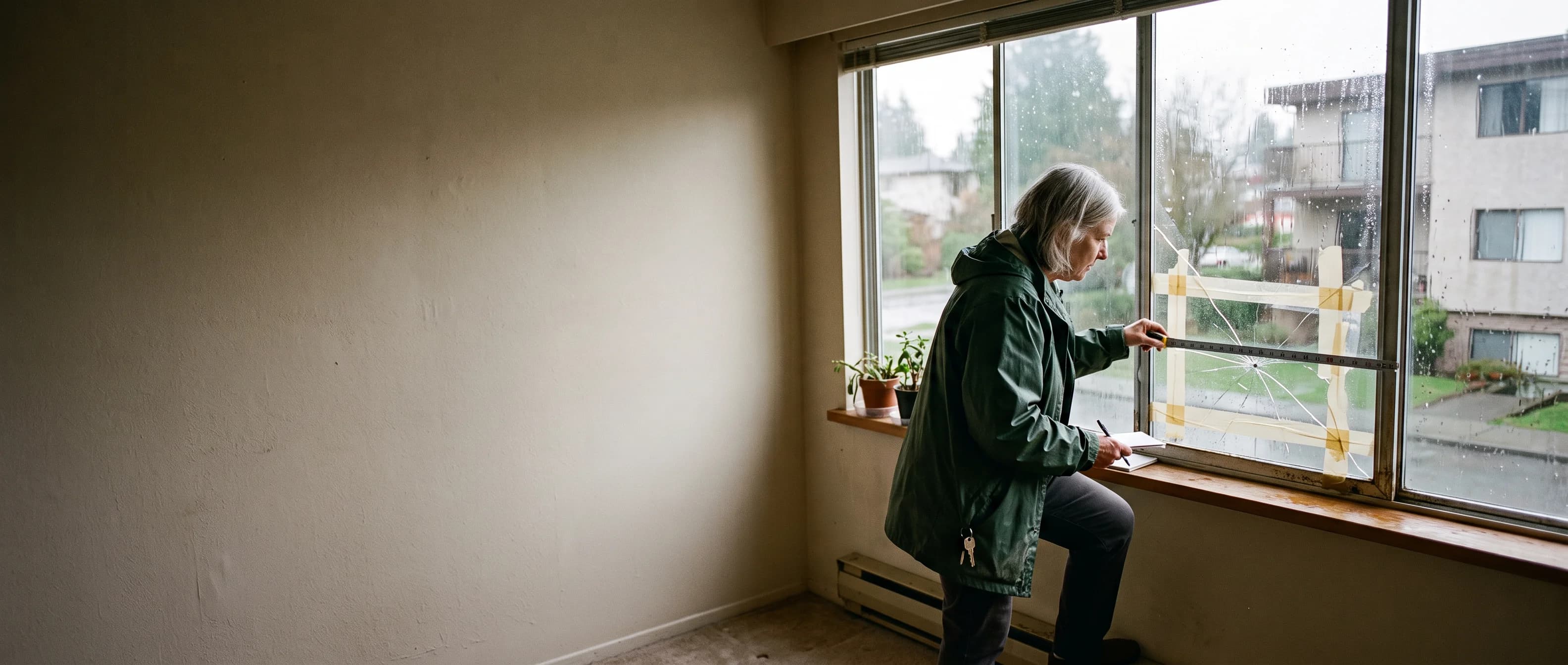
Picture frost on the inside of a bedroom window in January, a pane cracked corner to corner, and plastic film over the frame that still lets the draft move the curtains. This guide is for Alberta landlords, property managers and tenants: what the rules require of a window, who pays when one breaks, how to ask for a repair, and what to do when a request is ignored.
Who has to fix a broken window in an Alberta rental?
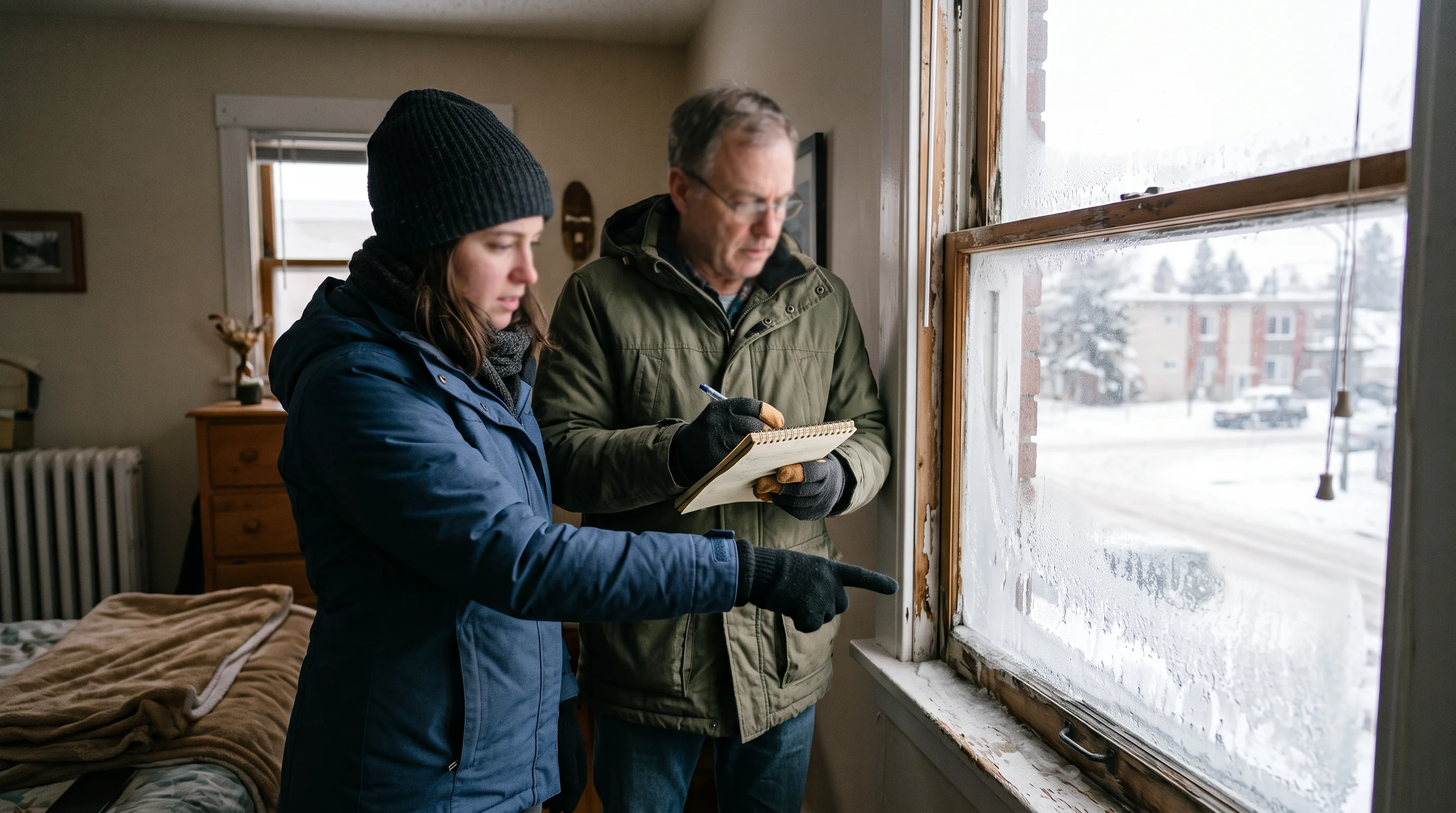
The landlord does. Section 16(c) of Alberta's Residential Tenancies Act (RTA, SA 2004, c R-17.1) makes it a landlord promise in every tenancy that the premises meet at least the minimum housing standards under the Public Health Act, and those standards are where the window rules live.
The Housing Regulation (AR 173/99) requires the owner to keep housing premises structurally sound, safe, in good repair and "maintained in a waterproof, windproof and weatherproof condition" (s.3), and to maintain them in compliance with the Minimum Housing and Health Standards (s.4). Alberta.ca's Common problems page says the lease should state who repairs what, and that the landlord is usually responsible for the building structure, "including windows, doors, walls, roof, ceilings, and floors."
What does Alberta law require of a rental window?
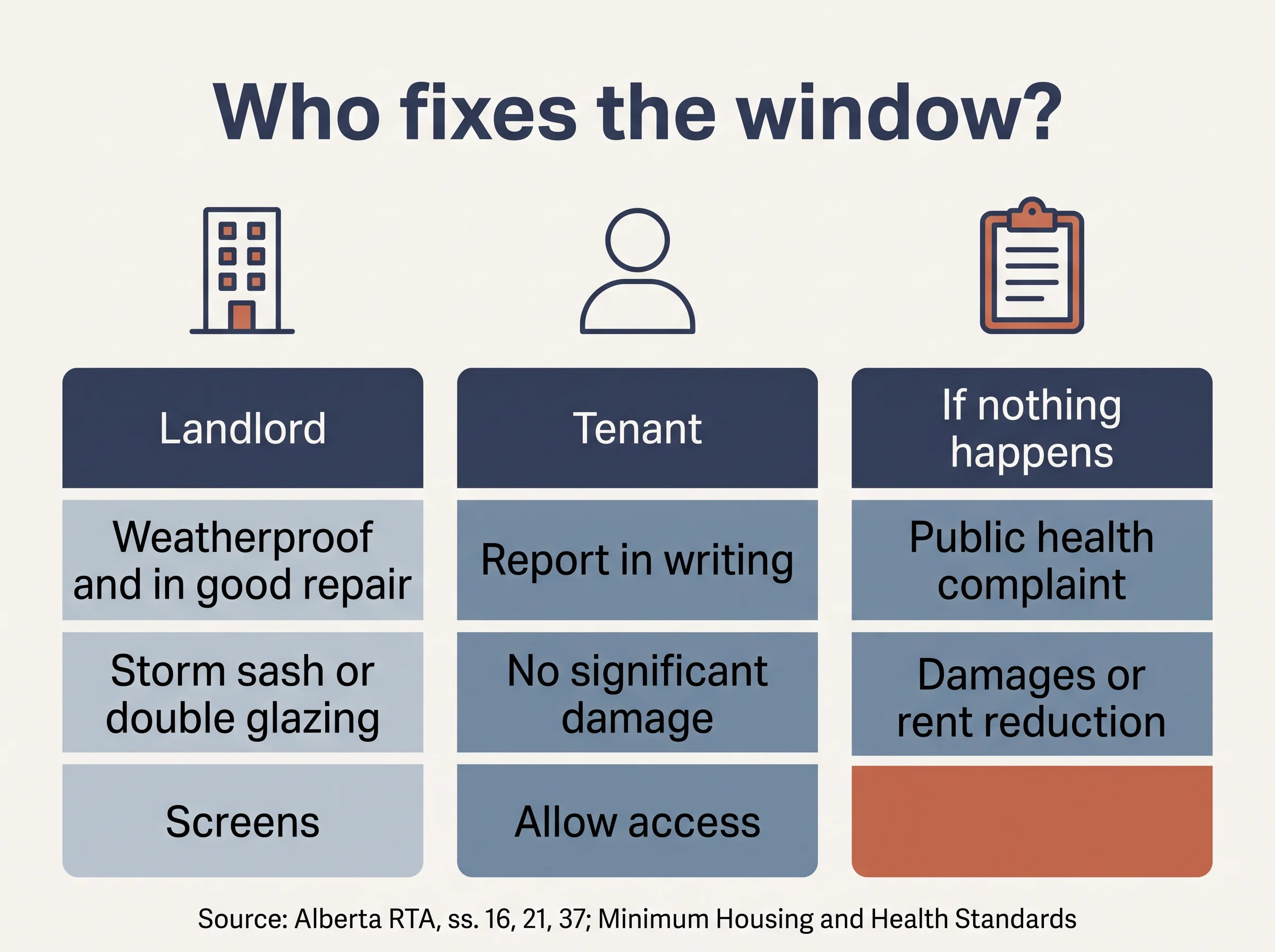
Alberta's Minimum Housing and Health Standards require rental windows to be in good repair, free of cracks and weatherproof, protected against winter cold, screened in fly season and capable of being locked. The table sets out each rule:
| Requirement | What it means in practice | Standards section |
|---|---|---|
| Good repair, free of cracks, weatherproof | A cracked pane, a rotted sash or a frame that lets in wind or water does not meet the standard | §2(b)(i) |
| Cold-weather protection | In homes used in winter, windows in habitable rooms need a storm sash, double glazing or another durable thermal and air barrier approved by the health officer | §2(b)(ii) |
| Screens | Every window meant for ventilation needs an effective screen during fly season | §2(b)(iii) |
| Can be secured | Exterior windows must be capable of being locked | §3(a) |
| Bedroom escape window | In buildings of three storeys or less, a bedroom window that opens from inside without tools, at least 0.35 m² with no dimension under 380 mm, unless an exemption applies | §3(b) |
| Bedroom ventilation | An openable window area of 0.28 m², or mechanical ventilation | §4 |
| Finishes | Walls, windows, ceilings and floors kept in good repair, free of cracks and holes | §5 |
A lease clause cannot lower that floor in Alberta. The RTA covenant is that the premises meet "at least" the minimum standards, so a term saying "tenant accepts windows as is" does not make a drafty single pane acceptable in a Calgary winter.
Who pays when a window breaks in an Alberta rental?
In Alberta, the landlord pays for windows that fail through age and ordinary wear, and can recover the cost from a tenant who caused the damage. Failed seals, hardened weatherstripping and rotted frames all fall under the landlord's duty to keep the premises in good repair.
Damage a tenant causes is different. RTA s.21(e) makes it a tenant covenant not to "do or permit significant damage to the premises." If a tenant or a guest breaks a window, the landlord still has to make the unit weathertight again, but can look to the tenant for the cost. Section 46 lets a landlord deduct damage from the security deposit at move-out, but only if the move-in and move-out inspection reports were done (s.46(6)). See our guide to Alberta inspection reports for why that report matters.
Whatever breaks the window, whether a storm, hail or a stranger, the owner's duty under Housing Regulation s.3 to keep the premises weatherproof stays in place.
| Cause | Who must repair | Who bears the cost |
|---|---|---|
| Age, failed seals, worn weatherstripping, rot | Landlord | Landlord |
| Damage done or permitted by the tenant or a guest | Landlord (to restore a weatherproof window) | Landlord may claim it from the tenant (RTA s.21(e)), or deduct it from the deposit if inspection reports were done (s.46(6)) |
How should an Alberta tenant ask for a window repair?
An Alberta tenant should ask in writing, keep paying rent and allow the landlord access on proper notice. These steps build the record that later remedies depend on:
- Put it in writing. Describe the window, the room, what is wrong and when it started. Add photos. For drafts, a dated photo of frost or ice on the inside of the glass and a thermometer reading by the window help.
- Say what you need. "Please repair or replace the cracked pane in the north bedroom" is clearer than "the windows are bad."
- Allow access. The landlord may enter to repair after giving at least 24 hours' written notice, between 8 a.m. and 8 p.m., and not on a holiday (RTA s.23). Our article on entry notice for window work explains the rules.
- Keep paying rent. Alberta.ca says a tenant "cannot withhold rent because they believe the landlord is not meeting their obligations."
- Keep copies of every message, reply and date.
What can an Alberta tenant do if the landlord will not fix a window?
An Alberta tenant whose landlord ignores a window repair can make a public health complaint and apply to the Residential Tenancy Dispute Resolution Service (RTDRS) or the court. The two routes work together, because only a public health order can require the repair itself.
Public health complaint
Alberta Health Services Environmental Public Health enforces the Minimum Housing and Health Standards. Its Renting in Alberta page tells tenants to contact Environmental Public Health if repairs are not done, and says a public health inspector may inspect the rental and speak to the landlord. The AHS Environmental Public Health page lists an online form and a phone line, 1-833-476-4743 (Monday to Friday).
An inspector can issue an order under section 62 of the Public Health Act. If an order is issued for a substantial breach and the tenant reasonably believes the landlord has not complied, RTA s.28 lets the tenant end the tenancy with at least 14 days' written, signed notice that gives the reasons and the end date. The notice is ineffective if, within 7 days of receiving it, the landlord objects in writing because it has complied with the order or the order has been stayed. Tenon10 has a free online version of that tenant's notice for substantial breach.
RTDRS or the court
Under RTA s.37 an Alberta tenant can ask for damages, a rent reduction (abatement) for the benefit lost, the cost of doing the landlord's work, or, for a serious breach, an end to the tenancy. The RTDRS hears claims up to $100,000, within 2 years of discovering the claim, for a $75 filing fee on claims of $7,500 or less and $150 above that.
One limit matters for windows: alberta.ca says the RTDRS cannot "require specific performance, such as that a landlord does repairs or improvements." It can award money or end the tenancy; it cannot order the window fixed. See RTDRS explained for how a hearing works.
A landlord cannot retaliate. Alberta.ca says a landlord "cannot evict a tenant for exercising their rights under the RTA or the Public Health Act."
| Route | What it can do | What it cannot do |
|---|---|---|
| AHS Environmental Public Health | Inspect, speak to the landlord, issue an order under Public Health Act s.62 | Award the tenant money |
| RTDRS or court (RTA s.37) | Damages, rent abatement, cost of doing the landlord's work, ending the tenancy | Order the landlord to make the repair (RTDRS) |
Should an Alberta landlord repair or replace a failing window?
Alberta law asks for a result, not a method: the window must meet the standard, whether by repair or replacement. A fogged sealed unit, a torn screen or a worn weatherstrip can often be repaired. A rotted frame or a single-pane window with no storm sash in a habitable room usually cannot meet §2(b)(ii) without a storm sash or a new unit.
For tax purposes, the Canada Revenue Agency's Rental Income guide says a repair that "simply restores a property to its original condition is usually a current expense," while one that improves it beyond its original condition is probably a capital expense.
In Calgary, the City's storm damage page says no permit is needed to replace a door, window or skylight of the same size, while a larger or smaller one needs a development and building permit. Check with your own municipality before changing an opening.
How do you choose a window contractor in Alberta?
Alberta.ca's Hiring a contractor page gives a neutral checklist that fits window work in an Alberta rental:
- insist on a written contract with a detailed description of the work and any cancellation rights;
- a contractor that takes money before the work is complete and sells away from its normal place of business must be licensed by Service Alberta as a prepaid contractor and post a security;
- ask for an insurance certificate showing liability and property damage coverage;
- make sure workers have Workers' Compensation Board coverage;
- check with your municipality whether permits or inspections are needed.
For a tenanted unit, add one more: agree the install date early enough to give the tenant proper written notice of entry.
What mistakes do Alberta landlords and tenants make with windows?
The most common mistakes in Alberta rentals are treating a stopgap as the repair and skipping the paperwork the RTA relies on:
- Treating plastic film as the fix. Film can help for a night; it does not make a cracked or single-pane window meet the standard.
- A lease clause that shifts all window repairs to the tenant. It cannot reduce the minimum standards.
- Entering to measure or install without written notice. Unless it is an emergency, s.23 applies.
- Tenants withholding rent instead of using public health and the RTDRS.
- No move-in inspection report, which leaves the landlord unable to deduct for a window the tenant broke.
How can Tenon10 help with window repairs in an Alberta rental?
In Tenon10 you can create an Alberta lease and run the move-in and move-out inspection report for each tenancy, so the condition of every window on day one is on record. Whatever tools you use, keep each repair request, your reply and the invoice in the tenancy file.
Frequently asked questions
Does my Alberta landlord have to replace single-pane windows?
Not necessarily replace them. In Alberta homes used in winter, windows in habitable rooms must be protected by a storm sash, double glazing or another durable thermal and air barrier approved by the health officer (Standards §2(b)(ii)). A single pane with a working storm sash can meet that standard.
Can I fix the window myself and deduct the cost from rent in Alberta?
No. Alberta.ca says rent cannot be withheld. A tenant can ask the RTDRS or the court for "compensation for the cost of performing the landlord's obligations" under RTA s.37, so keep receipts and get the landlord's position in writing first.
Who pays if my child broke the window in an Alberta rental?
An Alberta tenant must not do or permit significant damage (RTA s.21(e)). The landlord must still make the window weathertight, and may claim the cost from the tenant, or deduct it from the deposit if the move-in and move-out inspection reports were done (s.46(6)).
Can the RTDRS order my Alberta landlord to fix the window?
No. Alberta.ca says the RTDRS cannot require specific performance such as repairs. It can award damages, reduce the rent, compensate you for doing the work, or end the tenancy, while a public health order is the route that can require the repair.
Are window screens required in Alberta rentals?
Yes, on windows intended for ventilation. Alberta's Minimum Housing and Health Standards require an effective screen during the part of the year when flies and other flying insects need to be kept out (§2(b)(iii)).
Keep every window on the record
Create an Alberta lease and run move-in and move-out inspection reports in Tenon10.
Built for Canadian landlords and property managers.
What else should Alberta landlords and tenants read about windows?
These Tenon10 guides cover the related Alberta rules on repairs, mould and winter preparation: