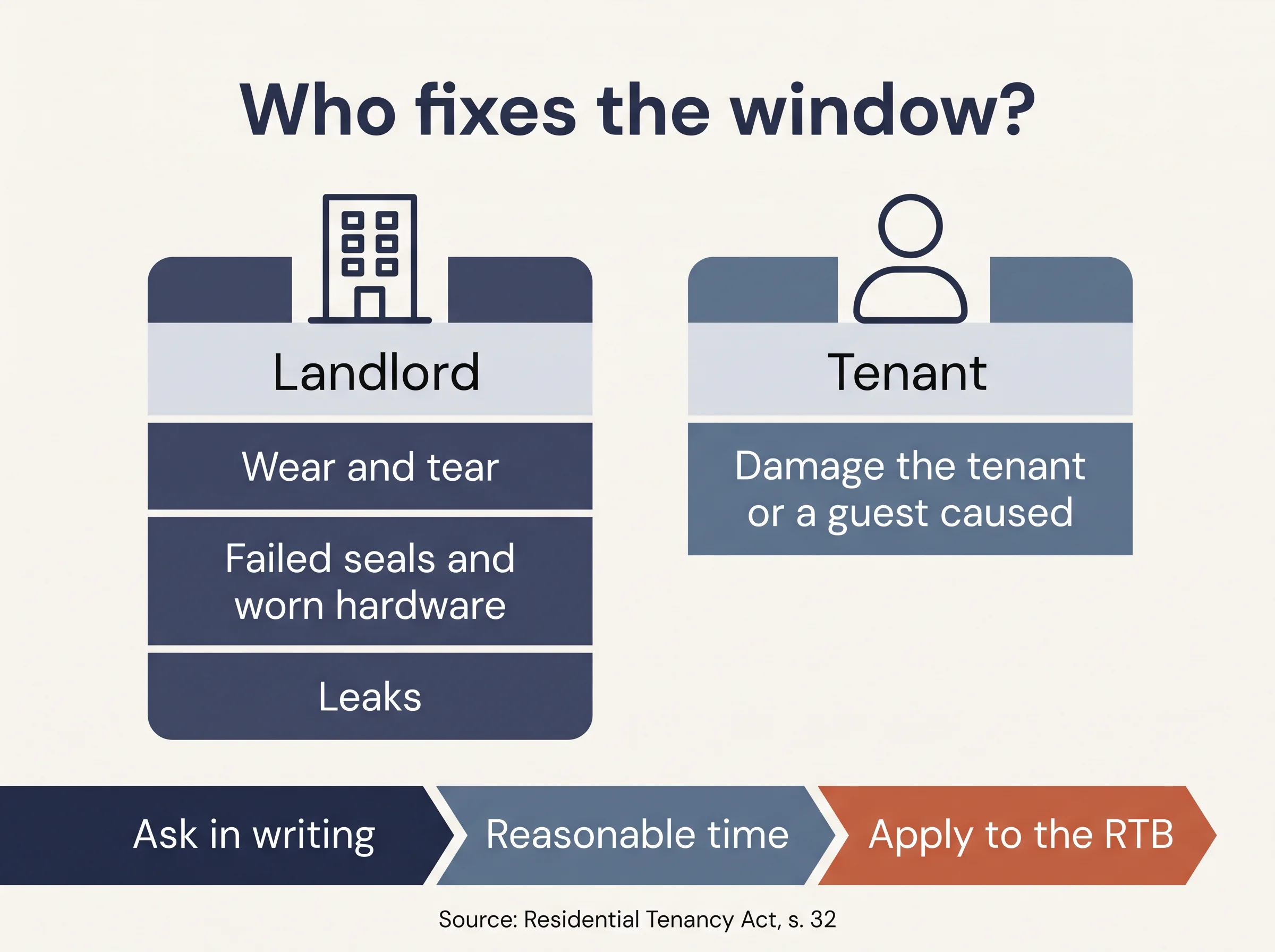
The landlord fixes a drafty or broken window in a BC rental when the cause is age, weather or normal wear, because section 32(1) of the Residential Tenancy Act requires BC landlords to keep the unit in a proper state of repair. The tenant repairs or pays only for damage they or their guests cause (RTA s.32(3)).
A window that whistles in a winter wind, a cracked pane, a sash that will not close or a lock that no longer catches all raise the same question. This guide sets out where windows fall between the landlord's repair duty and the tenant's damage duty, what a tenant can do when a repair request goes nowhere, and what landlords should do to stay out of a dispute.
Who has to fix a broken window in a BC rental: the landlord or the tenant?

In BC, the landlord repairs windows that fail through wear, age or weather, and the tenant repairs or pays for window damage caused by their own actions or neglect, or by people they let in (Residential Tenancy Act s.32(3)). Where the two sides disagree about the cause, the landlord should still get the window fixed and let the Residential Tenancy Branch (RTB) decide who pays.
| Window problem in a BC rental | Usually repairs or pays | Source |
|---|---|---|
| Failed seals that fog double glazing, drafts from shrinking frames or worn weatherstripping, worn crank operators or balances, leaks around old frames | Landlord | RTA s.32(1); RTB Policy Guideline 1 (wear and tear) |
| A pane broken by a ball, a sash forced off its track, a screen torn by a pet, a lock snapped by misuse | Tenant | RTA s.32(3) |
| Locks or locking devices on exterior windows | Landlord provides and maintains; tenant pays only if the tenant or a guest damaged them | RTB Policy Guideline 1 |
| Cause disputed | Landlord makes the repair; an arbitrator decides who pays | RTB repairs and maintenance guidance |
What does section 32 of the Residential Tenancy Act require for windows in BC?
Section 32(1) requires a BC landlord to provide and maintain the rental property in a state of decoration and repair that complies with the health, safety and housing standards required by law and that, having regard to the age, character and location of the rental unit, makes it suitable for occupation by a tenant. Section 32(5) adds that the duty to meet health, safety and housing standards applies whether or not the tenant knew about the problem when they signed the tenancy agreement, so a tenant who moved in knowing a bedroom window was cracked has not waived the repair.
On the tenant's side, section 32(2) requires the tenant to keep reasonable health, cleanliness and sanitary standards, section 32(3) makes the tenant repair damage caused by their actions or neglect (or by people they let in), and section 32(4) says a tenant is not required to repair reasonable wear and tear.
The RTB's Policy Guideline 1 adds window-specific detail. At the start of a tenancy the landlord is expected to provide clean windows in a reasonable state of repair. The landlord must provide and maintain adequate locks or locking devices on all exterior doors and windows, and the tenant pays for repairs to those locks only where the tenant or their guest damaged them. For a fuller picture of the general duty, see our guide to repairs and maintenance in BC.
How does the RTB tell wear and tear from tenant damage on a BC rental window?
The BC Residential Tenancy Branch treats reasonable wear and tear as natural deterioration caused by ageing and other natural forces where the tenant has used the premises reasonably (Policy Guideline 1). A fogged sealed unit or a worn-out crank is usually wear and tear; glass broken in an accident inside the unit is usually tenant damage.
The RTB's Policy Guideline 40 on useful life gives a sense of scale for window parts:
| Window element | Estimated useful life (RTB Policy Guideline 40) |
|---|---|
| Vinyl-frame window | About 20 years |
| Wood or aluminum-frame window | About 35 years |
| Window crank or opener | About 15 years |
| Window screen | About 5 years |
When a tenant damages an item near the end of its useful life, an arbitrator may reduce what the tenant pays to reflect that age, because full replacement cost could leave the landlord better off than before.
Is a broken window an emergency repair in BC?
Probably not on its own: windows are not on the list of emergency repairs in section 33 of BC's Residential Tenancy Act, and we did not find a prescribed circumstance in the Residential Tenancy Regulation that adds them. Section 33 lets a tenant arrange and bill for emergency repairs only for major leaks in pipes or the roof, damaged or blocked water or sewer pipes or plumbing fixtures, the primary heating system, damaged or defective locks that give access to a rental unit, the electrical systems, and other repairs only in prescribed circumstances.
The conservative reading is that a tenant should not arrange a window repair and charge it back under section 33. A broken lock on a window that gives access to the unit may fall under the locks item, but that is for an arbitrator to decide on the facts. That does not make a smashed ground-floor window a low priority: the RTB says that where a repair is urgent because of safety and security, a tenant can apply through the expedited hearing process, and a landlord who leaves a unit open to the weather or to intruders also risks a compensation claim.
How does a BC tenant get a landlord to fix a window?
A BC tenant asks for the window repair in writing, gives the landlord a reasonable time, and, if a repair affecting health, safety or usability is still not made, applies to the RTB for a repair order and compensation. The RTB's repairs and maintenance page sets out the steps:
- Ask in writing. Describe the problem and give the landlord a reasonable amount of time. Keep a copy, with dated photos of the window, condensation, drafts or damage.
- Follow up. Talk to the landlord, document the conversation and keep any replies.
- Apply for dispute resolution. If the repair is not made within a reasonable time, apply to the RTB for an order that the repair be made and for money to cover the inconvenience. Our walkthrough of filing a dispute resolution application covers the process.
The arbitrator's powers are broad. Under section 65, the director can order that past or future rent be reduced by an amount equivalent to the reduction in the value of the tenancy, or that the tenant deduct an amount from rent to be spent on a repair. Under section 67, the director can order compensation for damage or loss caused by a party not complying with the Act. The RTB's Policy Guideline 16 confirms that loss of quiet enjoyment, and the reduced value of a tenancy, can be compensated, sometimes as a percentage of the rent.
What should a BC landlord do when a tenant reports a broken window?
A BC landlord should acknowledge the report in writing, make the window safe, give proper written notice before entering, and repair it, leaving any argument about cost for later. The steps that keep a landlord out of trouble:
- Acknowledge in writing and say when you will inspect.
- Give proper notice to enter. Unless the tenant agrees at the time, section 29 requires written notice at least 24 hours and not more than 30 days before entry, stating a reasonable purpose and a date and time between 8 a.m. and 9 p.m. Notice taped to the door is deemed received three days after it is posted (section 90), so plan the lead time. Our guide to serving documents in BC explains each method.
- Make it safe first. Board or tape a broken pane, secure a lock, and protect the floor from water while you arrange the permanent repair. The RTB expects both sides to minimize loss.
- Repair, then argue about cost. If you believe the tenant caused the damage, the RTB's guidance is to make the repair and let an arbitrator decide who pays.
- Keep the file. The request, your notices, photos, quotes and invoices are your defence if the tenant later claims compensation.
Who fixes a window in a rented strata unit in BC?
In a BC strata, the window may be the strata corporation's responsibility under the bylaws, but the owner who rents out the unit still has to report the problem to the strata and push for a timely repair. The RTB's Policy Guideline 21 says that where a defect starts in the common property, an order to make the repair will not be made against an owner-landlord who has no authority to make it; the landlord must make sure the strata corporation knows about the problem and take reasonable steps to have it fixed in a timely way.
The tenant may still be awarded a rent reduction or damages if their use of the unit is affected. Our guide to renting out a strata unit in BC covers the wider relationship.
How do you choose a licensed window contractor in BC?
Whoever does the work, a few checks protect the landlord, the tenant and the building:
- A written, itemized quote that names the product, the number of openings and who is responsible for permits and disposal.
- Proof of a valid business licence and liability insurance before anyone starts work in an occupied unit.
- Product labels and certification kept for your records; rebate programs and Residential Tenancy Branch arbitrators both ask for paper, not memory.
- A clear schedule you can turn into proper written entry notices for the tenant.
- Warranty terms in writing, for the product and for the installation.
Frequently asked questions
Can a BC tenant replace a window and deduct the cost from rent?
Not without permission. The BC Residential Tenancy Branch says tenants must have the landlord's written agreement before making regular repairs themselves and charging the landlord, and windows are not on the section 33 emergency repair list. A tenant who deducts a window repair from rent without that agreement or an RTB order risks a 10 Day Notice for unpaid rent.
Does a BC landlord have to fix a window that was already cracked when the tenant moved in?
Yes. Section 32(5) of BC's Residential Tenancy Act says the landlord's duty to meet health, safety and housing standards applies whether or not the tenant knew about the problem when they signed the tenancy agreement. Recording the crack on the move-in condition inspection report still matters, because it shows the tenant did not cause it.
Who pays to fix a broken window lock in a BC rental?
The landlord, unless the tenant or a guest broke it. RTB Policy Guideline 1 says BC landlords must provide and maintain adequate locks or locking devices on all exterior doors and windows, and the tenant pays for lock repairs only where the tenant or their guest damaged them.
How much notice does a BC landlord need to enter and fix a window?
At least 24 hours and not more than 30 days of written notice, unless the tenant agrees at the time of entry (RTA s.29). The notice must state a reasonable purpose and a date and time between 8 a.m. and 9 p.m. A notice attached to the door is deemed received three days after it is posted (s.90).
Can a BC tenant get a rent reduction for a drafty window?
Possibly, if the landlord does not make the repair. Under section 65 of BC's Residential Tenancy Act, the RTB can reduce past or future rent by an amount equivalent to the reduction in the value of the tenancy, and RTB Policy Guideline 16 says such compensation is sometimes calculated as a percentage of the rent. The tenant needs evidence, such as dated photos and the written repair request.
Keep every window repair on the record
In Tenon10, tenants submit maintenance requests from their account, and you track each one through work orders, scheduled visits and your own vendor list, so the paper trail is there if a dispute ever reaches the RTB.
Built for Canadian landlords and property managers.