A deposit that never came back. A notice you think is wrong. Rent that a tenant stopped paying, or repairs a landlord won't make. When talking hasn't worked, both landlords and tenants in British Columbia take the dispute to the same place: the Residential Tenancy Branch (RTB).
The RTB process is designed to be used without a lawyer, but it is strict about deadlines, forms and service. Plenty of good claims fail because the fee was paid a day late, the other party wasn't served properly, or the evidence arrived too close to the hearing.
This guide walks through the whole application: choosing the right process, what it costs, which form to use, how to serve the other side, the evidence deadlines, and what happens after the decision.
BC RTB Application Checklist
A checklist for landlords and tenants filing a BC RTB dispute resolution application: deadlines, the right RTB-12 form, the $100 fee, service and evidence dates.
Get Free PDF →The rule: who decides and when you can apply
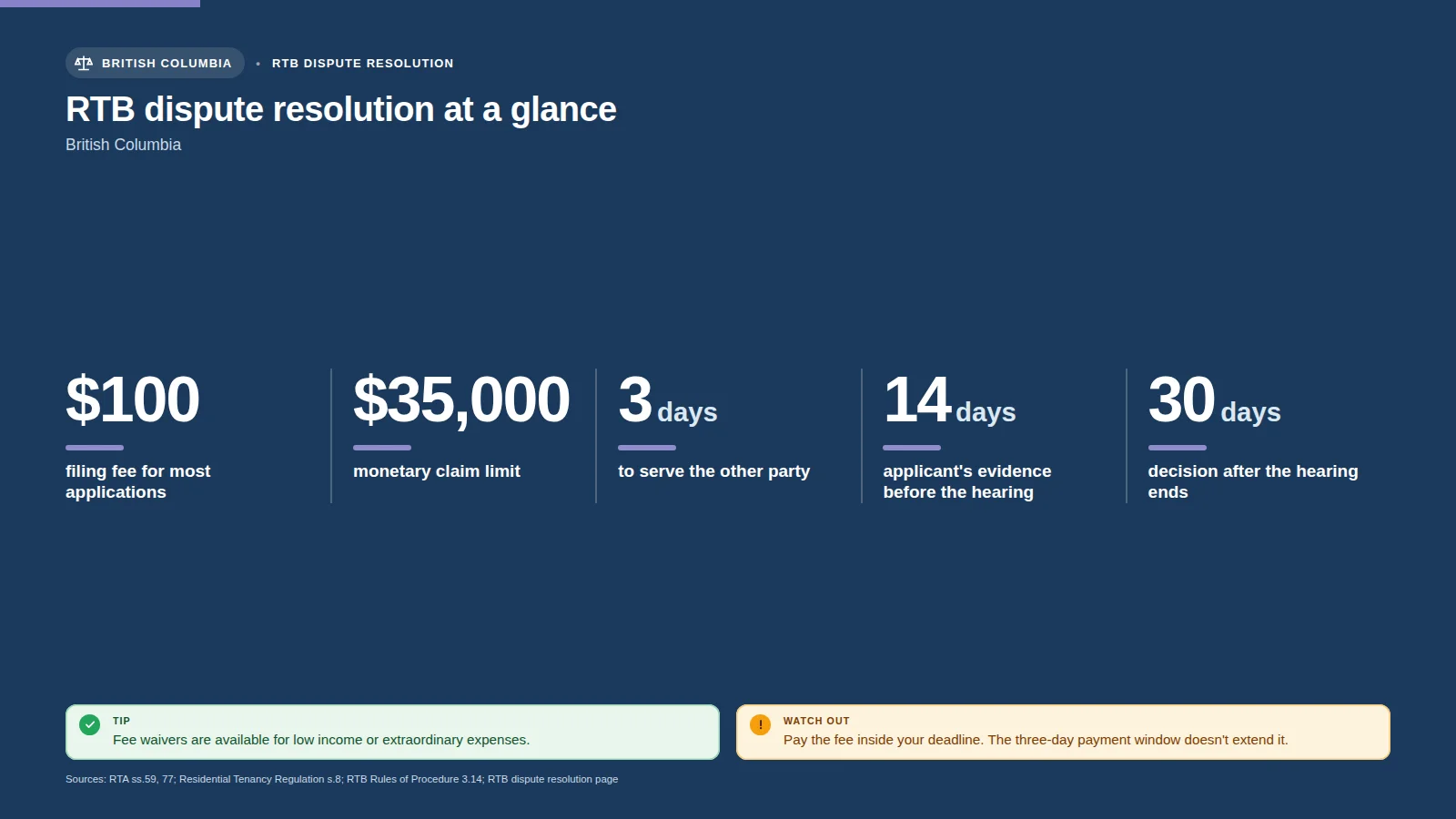
Under section 58 of the Residential Tenancy Act (RTA), a landlord or tenant can apply for dispute resolution about their rights and obligations under the Act, the Regulation or the tenancy agreement. Section 59(2) says the application must be on the approved form, include full particulars of the dispute and come with the fee.
The RTB's dispute resolution page sets a monetary claim limit of $35,000. Larger debt and damage claims go to the BC Supreme Court. Disputes between roommates go to the Civil Resolution Tribunal, and human rights complaints to the BC Human Rights Tribunal.
Deadlines to apply
| Situation | Deadline | Source |
|---|---|---|
| Disputing a 10 Day Notice for unpaid rent (RTB-30) | 5 days after receiving it | RTA s.46(4); RTB |
| Disputing a One Month Notice for Cause (RTB-33) | 10 days after receiving it | RTA s.47(4) |
| Other notices to end tenancy | The deadline printed on the notice | The notice and the RTB's deadlines page |
| A landlord claiming against a deposit | Within 15 days after the later of the tenancy ending and receiving the tenant's forwarding address in writing | RTA s.38(1) |
| Anything the Act doesn't give a time for | Within 2 years after the tenancy ends or is assigned | RTA s.60(1) |
Section 60(3) adds an exception: once one side applies in time, the other may apply about a different dispute between the same parties until the first proceeding concludes, even after the 2 years.
Choosing the right process
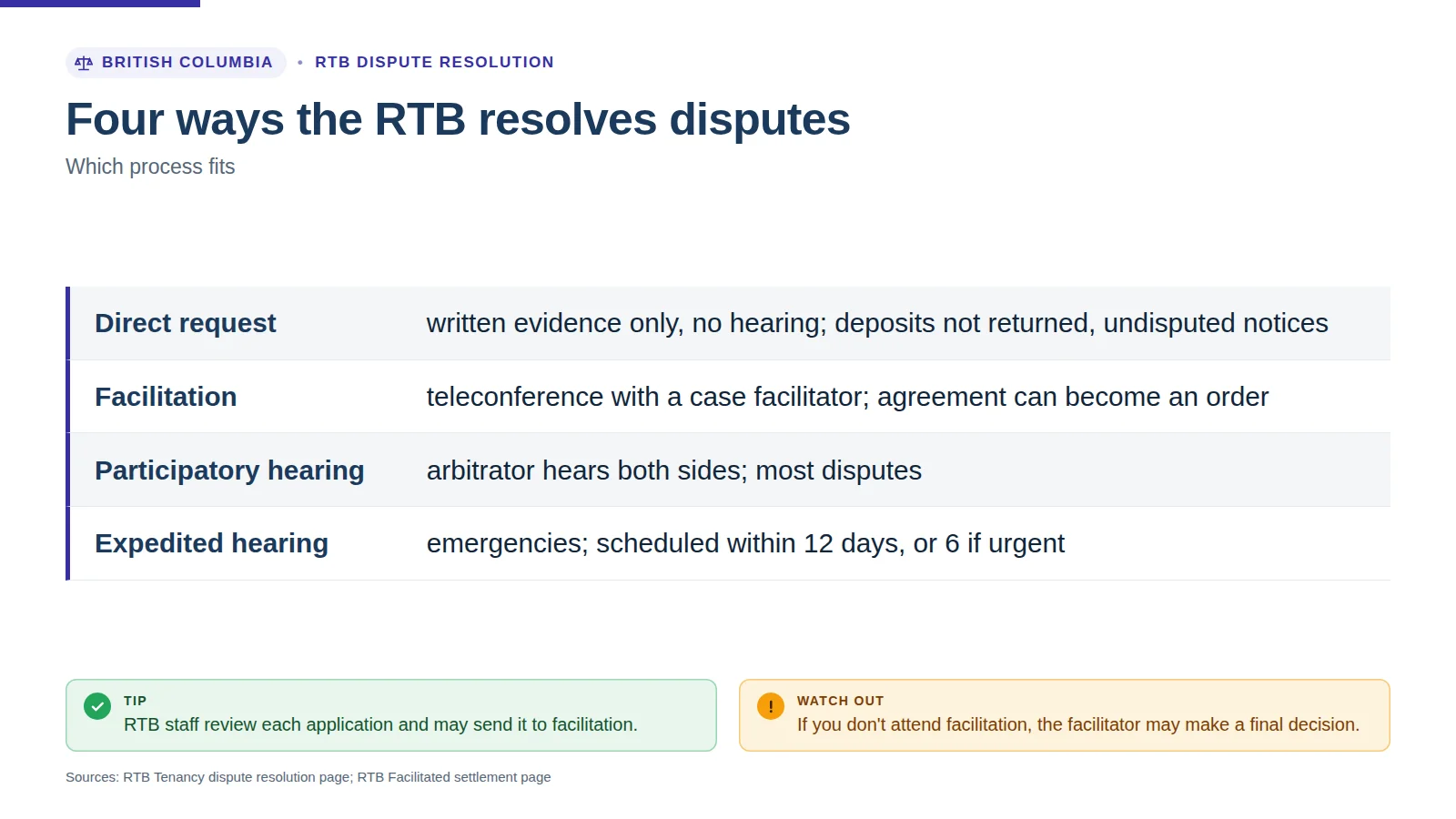
The RTB runs four processes. You don't always choose: staff review each application and decide, for example, whether it goes to facilitation.
| Process | Used for | Hearing? |
|---|---|---|
| Direct request | Narrow cases: a tenant whose deposit wasn't returned, or a landlord seeking possession or money when the tenant didn't dispute a notice | No. Decided on written evidence. |
| Facilitation | Disputes the RTB thinks may settle. A case facilitator shares a neutral, non-binding opinion and can turn an agreement into an enforceable order | Teleconference |
| Participatory hearing | Most disputes that can't use a direct request | Yes, before an arbitrator |
| Expedited hearing | Emergencies, such as a landlord's application for an early end to a tenancy, a tenant's order of possession, or certain emergency repairs | Yes. The RTB tries to schedule within 12 days, or within 6 in urgent situations |
The RTB says that if you are scheduled for facilitation, you must attend or send an agent with written permission. If one side doesn't attend, the facilitator may make a final and binding decision.
Filing the application, step by step
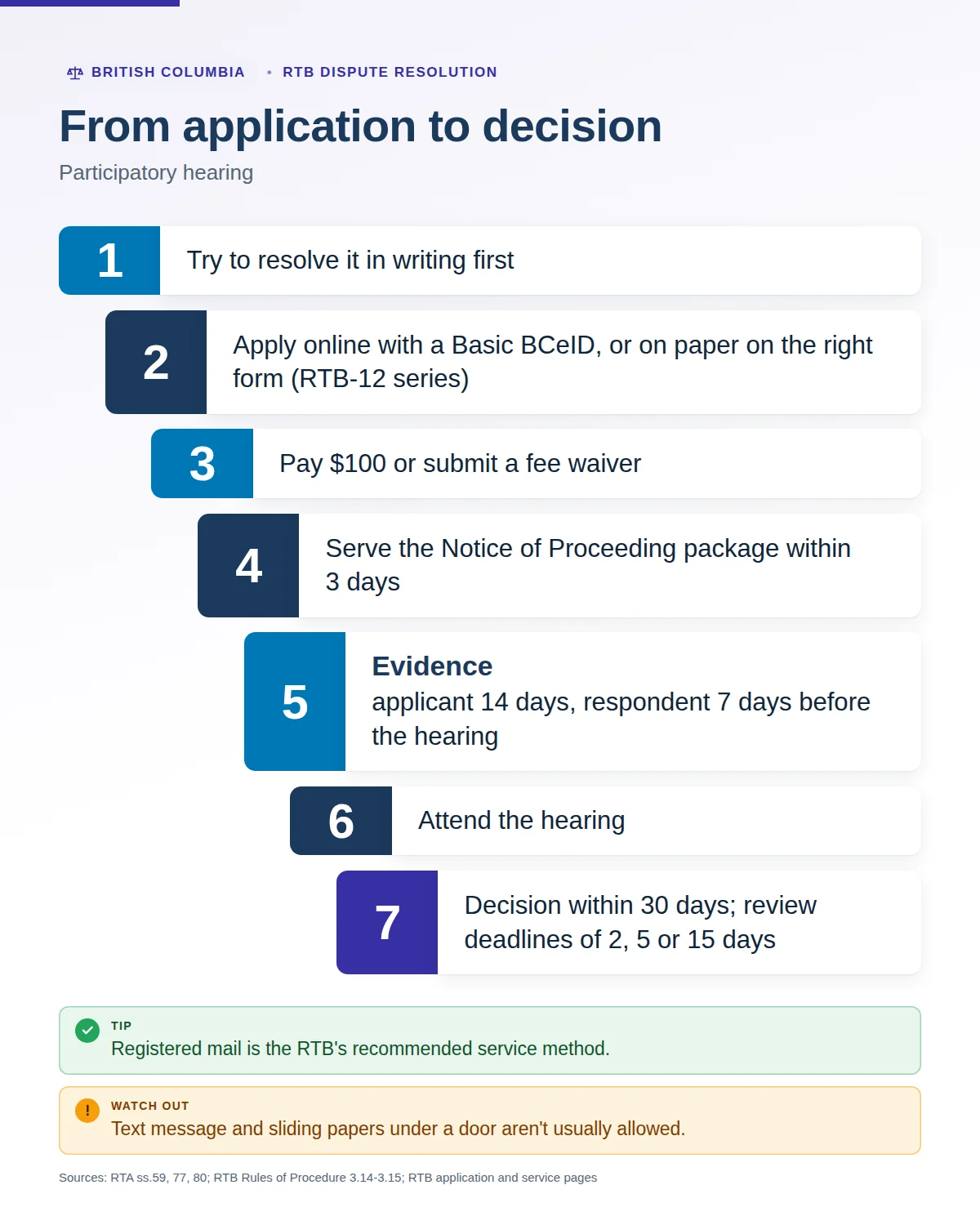
- Try to resolve it first and keep a record. The RTB suggests notifying the other party in writing and giving them a reasonable time to respond.
- Choose online or paper. Online is fastest and needs a Basic BCeID; all communication then comes by email. Paper applications are filed at a Service BC office outside the Lower Mainland, or at the RTB office in Burnaby.
- Pick the right form. Tenants: RTB-12T-CT (current tenancy) or RTB-12T-PT (past tenancy). Landlords: RTB-12L-CT or RTB-12L-PT. Add RTB-12T-O or RTB-12L-O for issues not on the main form, the Monetary Order Worksheet (RTB-37) for money claims, and the Schedule of Parties (RTB-26) if there are more parties than fit.
- Attach what the Rules require. Rule 2.5 of the RTB Rules of Procedure asks for a detailed calculation of any money claim, a copy of the notice to end tenancy if one is involved, and your other evidence, as far as possible with the application.
- Pay the fee. $100 for most applications (Regulation s.8). An application for an additional rent increase is $300 plus $10 per unit, to a maximum of $600.
Fee waivers and the three-day trap
The RTB's fees page offers a waiver if your household income is below the federal Low-Income Cut-Offs or you're on income assistance, or if you've had extraordinary expenses in the past 8 weeks. If you apply online and pay or submit a waiver in person, Rule 2.4 gives you three days to do it.
Rule 2.6 is the catch: an application counts as made only once the fee is paid or the waiver submitted, and the three days don't extend any legal deadline. If they pass without payment, the application is abandoned.
Serving the Notice of Dispute Resolution Proceeding
After you apply, the RTB issues a Notice of Dispute Resolution Proceeding package: a letter with the hearing or conference date and call-in details, your application, and instructions for the respondent. Online applicants get it by email. A paper package must be picked up within 3 days of being issued.
Section 59(3) of the Act requires you to give the other party a copy within 3 days. The RTB's service page says to serve it within 3 days of it becoming available to you, with copies of any evidence you already submitted, and warns that missing the deadline to prove service can mean the application is treated as withdrawn.
| Method | Considered received |
|---|---|
| Registered mail (the RTB's recommended method) | 5 days after serving, unless the person says they got it earlier |
| In person | The same day |
The service page lists methods that aren't usually allowed, including mailing to a tenant's workplace (unless it's their forwarding address), sliding it under a door and text message. If you can't serve by a permitted method, apply for substituted service (RTB-13). Record service on the Proof of Service form the RTB provides.
Evidence and the hearing
The evidence deadlines are in Rules 3.14 and 3.15:
- Applicant: evidence must be received by the respondent and the RTB not less than 14 days before the hearing.
- Respondent: evidence must be received by the applicant and the RTB not less than 7 days before the hearing.
Late evidence is accepted only in limited cases, such as new and relevant evidence that wasn't available earlier (Rule 3.17). Most hearings are by phone. The arbitrator applies a balance of probabilities, and the person making the claim usually carries the burden of proof. When a tenant disputes a notice, the landlord must prove the reason and usually presents first (Rules 6.6 and 7.20).
After the decision
Section 77 requires the decision within 30 days after the proceedings conclude, and makes it final and binding, subject to the review, clarification and correction routes below.
| Option | Deadline | Notes |
|---|---|---|
| Clarification, or an obvious error or omission | Within 15 days after receiving the decision (s.78) | Typing, grammar and arithmetic errors can be corrected without that time limit |
| Review: order of possession, 10 Day Notice, or a refused sublet | 2 days (s.80) | Fee $50 (Regulation s.9) |
| Review: repairs, services or facilities, other notices to end tenancy | 5 days (s.80) | Fee $50 |
| Review: anything else | 15 days (s.80) | Fee $50 |
A review is only available on the grounds in section 79, such as being unable to attend for reasons you couldn't anticipate or control, or new and relevant evidence that wasn't available. Beyond that, the decision can be challenged by judicial review in the BC Supreme Court.
The RTB doesn't enforce its own orders. An order of possession is enforced through the BC Supreme Court, and a monetary order through small claims court.
Common mistakes
- Paying late on a deadline application.
- Splitting a claim to stay under the limit. Rule 2.9 says an applicant may not divide a claim.
- No proof of service. Keep the registered-mail receipt and tracking.
- Evidence on the day. Count backwards from the hearing date and meet the 14-day or 7-day mark.
- Skipping the hearing. Rule 7.3 lets the arbitrator proceed without you, or dismiss your application.
Handling applications across a portfolio
- One file per dispute, holding the lease, notices, payment history, correspondence and proof of service.
- Calendar every deadline the day you apply: payment, service, the 14-day evidence date, the hearing, and the review window after the decision.
- Use the same evidence labels for the RTB and the other party, as Rule 3.7 requires identical copies.
- Decide who attends. Rule 6.7 lets a party be represented by an agent or a lawyer.
How Tenon10 helps
Tenon10 keeps the lease, notices and payment records for each tenancy together. When a dispute starts, that is your evidence record: what was agreed, which notices were served and when, and what was paid.
Tenon10 doesn't file dispute applications. Applications are made through the RTB, online or on paper, and Tenon10 links you there.
Frequently asked questions
How much does it cost to apply to the RTB?
$100 for most applications, or $300 plus $10 per unit (up to $600) for an additional rent increase. A $50 fee applies to a review. Fee waivers are available.
Can I get my filing fee back?
Section 72 lets the arbitrator order the other party to repay the fee. A landlord may deduct it from the deposit, and a tenant from rent, under that order.
Do I need a lawyer?
No. Rule 6.7 lets you be represented by an agent or a lawyer, or assisted by an advocate or interpreter, but many people represent themselves.
How long until my hearing?
The RTB says there's no set wait time for participatory hearings. Expedited hearings are scheduled within 12 days where possible.
Can I apply about something that happened years ago?
Generally only within 2 years after the tenancy ends, unless the Act sets a shorter deadline (s.60).
BC RTB Application Checklist
A checklist for landlords and tenants filing a BC RTB dispute resolution application: deadlines, the right RTB-12 form, the $100 fee, service and evidence dates.
Get Free PDF →Go into your hearing with a complete record
Tenon10 keeps the lease, notices and payment history for each tenancy together, so your evidence is ready when a dispute starts.
Built for Canadian landlords, property managers and renters.
Related BC guides
- Serving Documents in BC: Every Method the RTA Allows
- Direct Request for an Order of Possession in BC
- Got a 10 Day Notice in BC? What Tenants Should Do Now
- Getting Your Deposit Back in BC: A Tenant's Step-by-Step Guide
Sources: Residential Tenancy Act; Residential Tenancy Regulation; RTB Rules of Procedure; RTB: Tenancy dispute resolution; RTB: Complete and file the application; RTB: Fees and fee waivers; RTB: Serve notice for dispute resolution; RTB: Facilitated settlement; RTB: Review, clarify or correct decisions. This article is a summary of British Columbia rules as of October 2026, not legal advice. Check the Residential Tenancy Branch for your situation.