A homeowner rents a spare bedroom and shares the kitchen. A student rents a room in a house where the owner lives upstairs. A tenant takes in a roommate to help with the rent. All three look like rentals, yet only some of them fall under British Columbia's Residential Tenancy Act.
Whether the Act applies decides almost everything: whether there are deposit limits and rent increase rules, which notices are needed, and whether the Residential Tenancy Branch (RTB) can hear a dispute at all. Getting it wrong works both ways. An owner may follow rules that do not bind them, or ignore rules that do. A renter may find the RTB cannot help them.
This guide looks at the shared-accommodation exclusion exactly as the Act words it, how to apply it, and what governs an arrangement the Act does not cover.
BC Shared Accommodation Checklist
A checklist for BC owners renting a room: test the arrangement against the words of section 4(c), put the terms in writing, and know where disputes go.
Get Free PDF →The rule: section 4(c), word by word
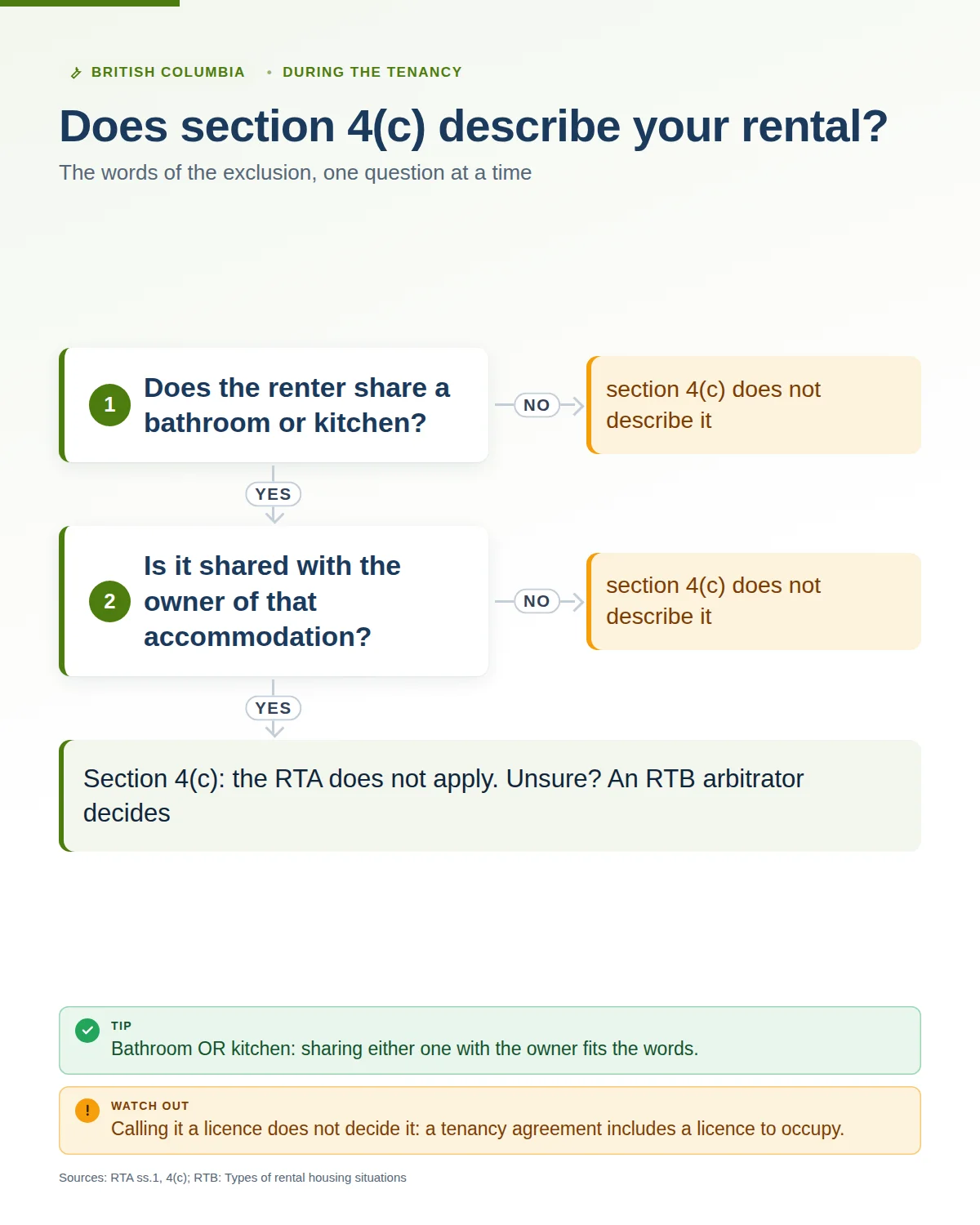
Section 4 of the Residential Tenancy Act (RTA) lists what the Act does not apply to. Paragraph (c) reads:
"living accommodation in which the tenant shares bathroom or kitchen facilities with the owner of that accommodation"
Each part matters:
| Words in s.4(c) | What they mean in practice |
|---|---|
| "shares" | The facilities must actually be shared. A suite with its own bathroom and its own kitchen, used by no one else, is not described by these words. |
| "bathroom or kitchen" | The text says "or," not "and." On its words, sharing either one with the owner is enough. |
| "with the owner" | The person the renter shares with must be the owner of that accommodation. The paragraph says nothing about sharing with a tenant, a property manager or other occupants. |
| "of that accommodation" | Ownership is tied to the accommodation being rented. |
The RTB's page on types of rental housing repeats the rule in the same terms and adds that, depending on the type of dispute and the amount claimed, disputes between such a renter and the owner may be resolved through the Civil Resolution Tribunal or the courts.
Who decides when it is unclear
The RTB says that if there is a dispute over whether the Act applies, either side can apply for dispute resolution, and an arbitrator will decide whether the RTB has jurisdiction. Labels in a written agreement do not settle it. Under section 1, a "tenancy agreement" includes a licence to occupy a rental unit, so calling an arrangement a licence does not by itself take it outside the Act.
Examples: covered or not?
| Arrangement | How section 4(c) reads on it |
|---|---|
| Owner lives in the home and rents a bedroom; the renter uses the owner's kitchen | Described by s.4(c): the renter shares kitchen facilities with the owner. |
| Owner lives upstairs; basement suite has its own kitchen and bathroom; nothing shared | Not described by s.4(c). Nothing is shared with the owner. |
| A tenant rents a two-bedroom unit from a landlord and rents the second bedroom to a roommate | Not an s.4(c) case, because the tenant is not the owner. Policy Guideline 27 says the RTB has no jurisdiction over disputes between the two roommates, for a different reason: a tenant occupying the unit is excluded from the definition of a landlord. |
| Several roommates each signed an agreement with the landlord, who lives elsewhere | Not an s.4(c) case. The RTB says roommates who signed with the landlord can resolve disputes with the landlord through the RTB. |
| Owner shares the kitchen with renters but is away for long stretches | Unclear on the words alone. Ask the RTB, or let an arbitrator decide. |
The other exclusions
Section 4 also excludes, among others: accommodation a not-for-profit housing co-op rents to a member; student or staff housing owned or operated by an educational institution; vacation or travel accommodation; emergency shelters and transitional housing; certain care and treatment facilities; accommodation included with premises primarily used for business and rented under one agreement; and tenancy agreements with a term longer than 20 years. The RTB notes the Act does apply to supportive housing.
What applies instead
When section 4(c) applies, the Act does not, so its rules do not govern the arrangement. That includes the rules a renter might expect, such as the deposit limits, the annual rent increase limit, the RTB notice forms and the RTB's dispute resolution service.
The RTB points to other bodies for disputes outside its jurisdiction:
- the Civil Resolution Tribunal, for monetary claims up to $5,000,
- Small Claims Court, for claims between $5,001 and $35,000,
- the Supreme Court of British Columbia, for any monetary claim.
The RTB also suggests independent legal advice, and names the Lawyer Referral Service run by the Canadian Bar Association, BC Branch, for people without a lawyer.
Common mistakes
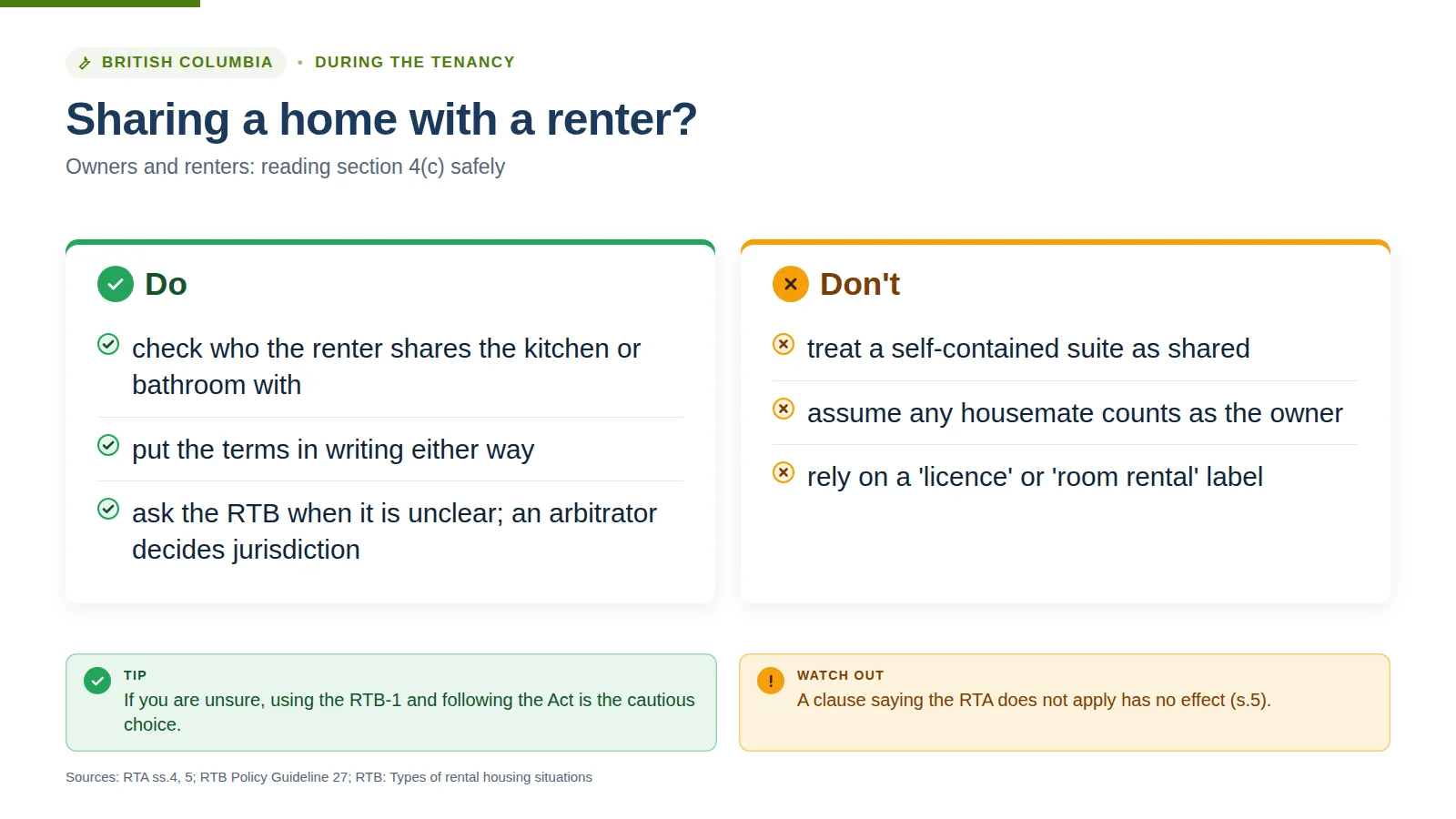
- Treating a self-contained suite as shared. Section 4(c) does not mention entrances. It asks whether bathroom or kitchen facilities are shared with the owner, and a suite with its own kitchen and bathroom shares neither.
- Assuming any housemate counts. The paragraph names the owner. Sharing with another renter is not the same thing.
- Relying on the agreement's label. "Room rental," "licence" or "boarder" wording does not decide whether the Act applies.
- Not writing anything down. Outside the Act there are no RTB standard terms to fall back on, so the written agreement between you carries more weight.
- Ignoring changes. The exclusion describes a living arrangement. If it changes, for example the owner moves out, ask the RTB whether the Act now applies.
What to do next
- Map the arrangement. Who owns the home? Who lives there? Which kitchen and bathroom does the renter use, and with whom?
- Compare it with the words of s.4(c). Shared bathroom or kitchen, with the owner.
- If it fits, put the terms in writing: rent, what is shared, house rules, how either side ends the arrangement, and any deposit.
- If it does not fit, or you are unsure, treat it as an RTA tenancy: use the RTB-1 tenancy agreement and follow the Act, or contact the RTB.
- For a dispute, start with the RTB if the Act may apply. Otherwise look at the Civil Resolution Tribunal or the courts.
How Tenon10 helps
For arrangements the Act does cover, Tenon10 generates a BC tenancy agreement with every detail the Act requires and the standard terms copied word for word from the current Regulation, and a fillable RTB-27 Condition Inspection Report with a room-by-room grid.
Lease, notice and payment records stay together for each tenancy, which gives you an evidence record if a dispute reaches the RTB.
Frequently asked questions
I rent a room and share the kitchen with the homeowner. Does the RTB help me?
On the words of section 4(c), the Act does not apply, so the RTB generally cannot resolve the dispute. The RTB points to the Civil Resolution Tribunal or the courts.
Is sharing only a bathroom enough?
The text says "bathroom or kitchen facilities," so sharing either one with the owner fits the words.
What if I share with the owner's adult child, and the owner lives elsewhere?
Section 4(c) refers to the owner. It does not mention family members, so do not assume the exclusion applies. Ask the RTB, or let an arbitrator decide.
Is a roommate I found myself covered by the RTA?
Guideline 27 says the RTB cannot resolve disputes between roommates when one tenant rents a room in their own unit to another. The Civil Resolution Tribunal may be able to help.
BC Shared Accommodation Checklist
A checklist for BC owners renting a room: test the arrangement against the words of section 4(c), put the terms in writing, and know where disputes go.
Get Free PDF →Renting under the RTA? Start with the right agreement
Tenon10 generates a BC tenancy agreement with the current standard terms and keeps lease, notice and payment records together.
Built for Canadian landlords and property managers.
Related BC guides
- The BC Residential Tenancy Agreement (RTB-1): The Complete Landlord Guide
- What You Can and Can't Add to a BC Tenancy Agreement
Sources: Residential Tenancy Act, ss.1, 4, 5; RTB: Types of rental housing situations; RTB Policy Guideline 27: Jurisdiction. This article is a summary of British Columbia rules as of October 2026, not legal advice. Check the Residential Tenancy Branch for your situation.