The baseboard heater in the bedroom has stopped working. The dishwasher listed in the lease leaks. The carpet is worn through near the door. Who has to fix what, how fast, and what happens if nobody does?
In British Columbia the answer starts with one section of the Residential Tenancy Act. It puts most repairs on the landlord, a narrower set of duties on the tenant, and gives the Residential Tenancy Branch (RTB) wide powers when the two disagree. Knowing where the lines are prevents most repair disputes before they start.
This guide sets out the landlord's legal duty, the tenant's share, how repair requests should work, and the orders the RTB can make.
BC Landlord Repairs and Maintenance Checklist
A landlord checklist for BC repair duties: the features you must keep working, the tenant's share, the request process and the records that settle disputes.
Get Free PDF →The landlord's duty under section 32
Section 32(1) of the Residential Tenancy Act (RTA) says a landlord must provide and maintain residential property in a state of decoration and repair that:
- complies with the health, safety and housing standards required by law, and
- having regard to the age, character and location of the rental unit, makes it suitable for occupation by a tenant.
Section 32(5) closes a common loophole: the first duty applies whether or not the tenant knew about the problem when they signed. A tenant who moved in knowing the wiring was not up to standard has not given up the right to have it fixed. Section 5 adds that landlords and tenants cannot contract out of the Act, so a lease clause that shifts the landlord's repair duty to the tenant is of no effect.
What the RTB says the duty covers
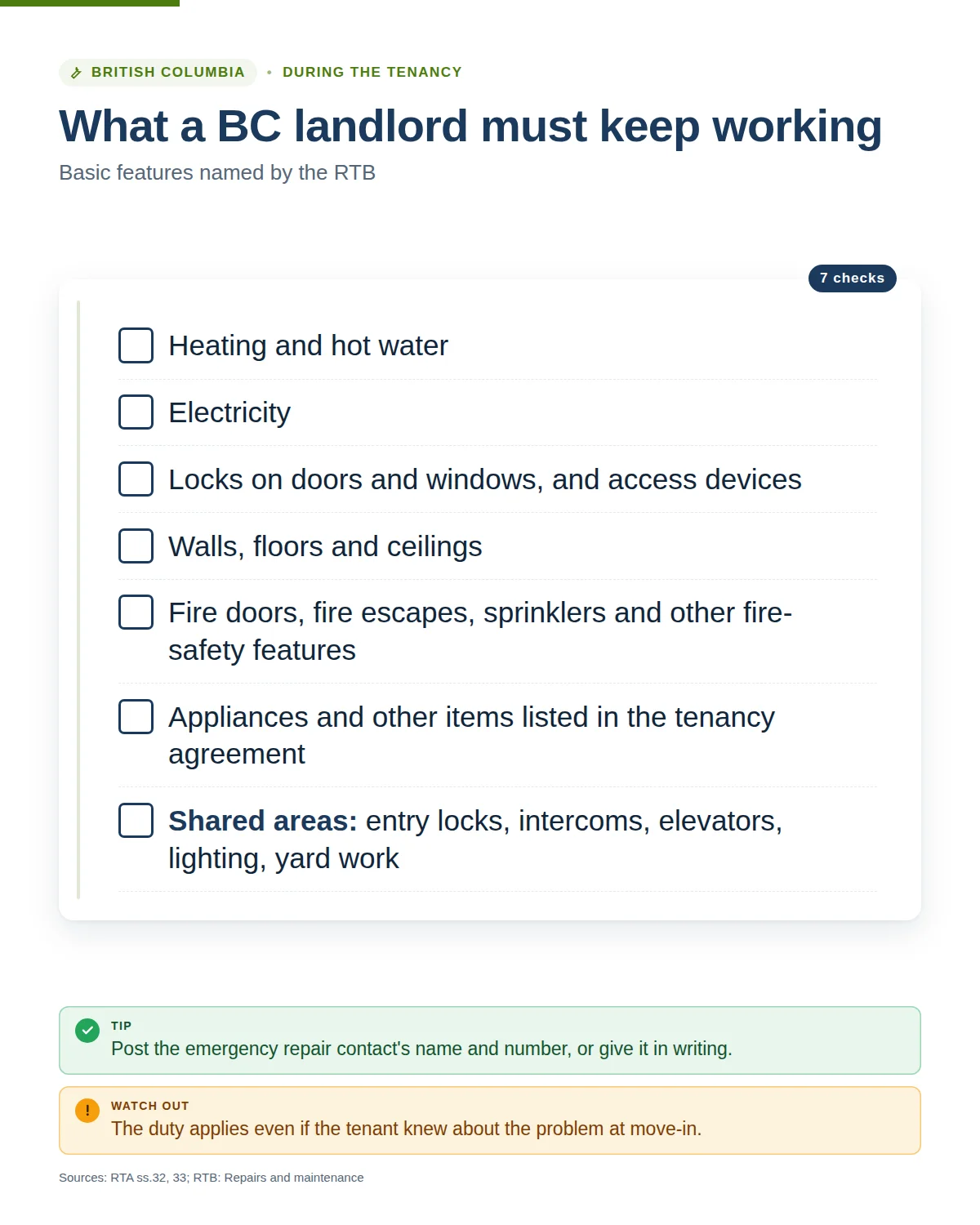
The RTB's repairs and maintenance page lists the basic features a landlord must keep working so the unit stays livable:
- heating and hot water
- electricity
- locks on doors and windows, and devices that give access to the unit
- walls, floors and ceilings
- fire doors, fire escapes, sprinkler systems and other fire-safety features
It adds that landlords must fix and replace items specifically listed in the tenancy agreement, such as appliances, furniture, parking, storage and security systems. In multi-unit buildings they maintain shared areas: entry locks and fobs, intercoms, elevators, lighting, and yard work. Landlords are generally responsible for insect infestations such as bedbugs, while municipal standards of maintenance bylaws decide who handles other pests such as rodents.
Local bylaws set part of the standard
The RTB notes that most municipalities have standards of maintenance bylaws covering topics like hot water, heating, pest control and the building exterior. Those bylaws are part of the "standards required by law" in section 32(1)(a), so check your city's rules.
The tenant's share
Section 32 also sets the tenant's duties:
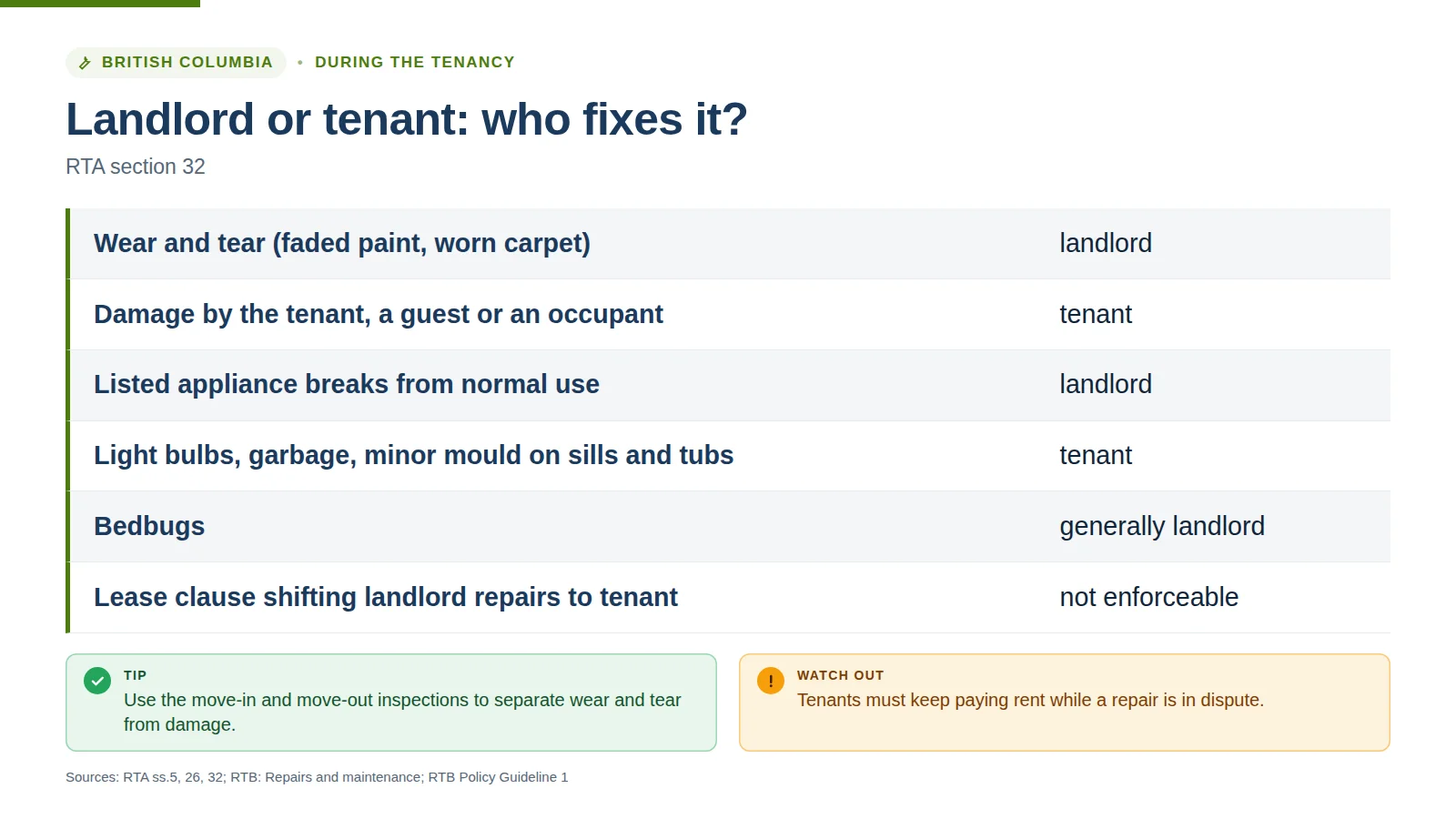
| Tenant must | Tenant does not have to |
|---|---|
| Keep reasonable health, cleanliness and sanitary standards in the unit and other areas they can use (s.32(2)) | Repair reasonable wear and tear (s.32(4)) |
| Repair damage caused by their actions or neglect, or by their guests or occupants (s.32(3)) | Make the landlord's repairs, even if the lease says so (s.5) |
| Report problems to the landlord | Pay for faded paint, minor scuffs or worn carpet from normal use |
The RTB's examples of tenant upkeep include taking out garbage and recycling, dealing with minor mould on windowsills, tubs and showers, keeping carpets reasonably clean and changing light bulbs. A tenant with exclusive use of a yard handles routine yard work such as mowing and snow clearing.
Services and facilities
Section 27 protects services and facilities. A landlord must not end or restrict one that is essential to using the unit as a home, or that is a material term of the tenancy agreement. Others can be ended or restricted only with 30 days' written notice on the approved form and a rent reduction equal to the loss in value.
How a repair request should work
- The tenant reports it in writing. The RTB says repair requests must be in writing, by email, letter or text, describing the problem and allowing a reasonable time. The tenant should keep a copy.
- The landlord arranges entry. Entering for a repair needs 24 hours' written notice under section 29, unless the tenant gives permission or it is an emergency.
- The landlord fixes it within a reasonable time. The RTB says only an arbitrator can decide whether the time taken was reasonable.
- If it is not fixed, the tenant can apply to the RTB for dispute resolution.
A tenant cannot simply hire someone and send you the bill. The RTB says a tenant needs the landlord's written agreement to make repairs and charge for them. The exception is an emergency repair under section 33, which has its own strict conditions.
What the RTB can order
If a landlord has not complied with the Act or the tenancy agreement, section 65 lets the director order, among other things:
- that rent be paid to the RTB and held in trust for the cost of the repairs,
- that the tenant deduct an amount from rent to spend on the repair,
- that past or future rent be reduced to reflect the lost value of the tenancy.
Section 67 adds compensation for any loss caused by the breach. Repair decisions have a short review window: section 80 gives a party 5 days after receiving the decision to apply for a review.
Common mistakes
- Landlords: "You knew when you moved in." Section 32(5) says that does not remove the duty to meet health, safety and housing standards.
- Landlords: removing a listed appliance instead of fixing it. Ending a service or facility has its own rules under section 27.
- Tenants: verbal requests only. Without a written request there is little evidence of when the landlord was told.
- Both: asking for upgrades. The RTB says it is unlikely to order repairs that only make a unit more modern or better looking.
- Both: ignoring the duty to minimize loss. Section 7(2) and Policy Guideline 5 expect each side to take reasonable steps, such as moving belongings away from a leak and reporting it right away.
Doing it at scale
Across a portfolio, repair duties become a tracking problem. A simple system covers most of it:
- Give every tenant the emergency contact name and number in writing at move-in, and post it in each building.
- Log each request with the date received, the unit and a description.
- Schedule entry with a proper written notice, and log the notice too.
- Record completion with the date, the contractor and photos.
- Review open requests weekly, oldest first, and flag anything about heat, water, power, locks or fire safety.
- Use the move-in and move-out condition inspections to separate wear and tear from damage.
How Tenon10 helps
Tenon10 provides a fillable RTB-27 Condition Inspection Report with a room-by-room grid, which is the baseline for telling wear and tear from damage at the end of a tenancy. Tenants can submit repair requests with photos and an emergency priority, and you can track every request from the web or the mobile app.
Lease, notice and payment records stay together for each tenancy, giving you an evidence record if a repair dispute reaches the RTB.
Frequently asked questions
Does my landlord have to replace an old but working appliance?
Not just because it is old. The duty is to keep listed appliances working and the unit up to legal standards. The RTB is unlikely to order a replacement only to modernize.
Who pays if a tenant's guest broke the window?
The tenant. Section 32(3) makes the tenant repair damage caused by their own actions or neglect, or by people they let onto the property.
Can a lease make the tenant responsible for all repairs?
No. Section 5 says landlords and tenants cannot contract out of the Act, and Policy Guideline 1 says a tenant may be required to paint or repair only where the work is needed because of damage the tenant is responsible for.
How long does a landlord have to make a repair?
The Act says a reasonable time, which depends on the problem. Only an RTB arbitrator can decide whether a repair took too long.
BC Landlord Repairs and Maintenance Checklist
A landlord checklist for BC repair duties: the features you must keep working, the tenant's share, the request process and the records that settle disputes.
Get Free PDF →Document the condition, settle repairs faster
Use Tenon10's fillable RTB-27 and keep each tenancy's lease, notices and payments together as your evidence record.
Built for Canadian landlords and property managers.
Related BC guides
- What You Can and Can't Add to a BC Tenancy Agreement
- The BC Residential Tenancy Agreement (RTB-1): The Complete Landlord Guide
Sources: Residential Tenancy Act; RTB: Repairs and maintenance; RTB Policy Guideline 1; RTB Policy Guideline 5. This article is a summary of British Columbia rules as of October 2026, not legal advice. Check the Residential Tenancy Branch for your situation.