A tenant says they are moving out next week. A landlord wants a unit back. Two people agree over coffee that the lease is "done." In British Columbia none of these, on its own, ends a tenancy.
The Residential Tenancy Act (RTA) sets out a closed list of ways a tenancy can end. If what happened is not on the list, the tenancy carries on, with rent owed and the rules still in force. Landlords who treat a conversation as an ending risk an illegal eviction. Tenants who treat it as an ending risk owing rent for a unit they have left.
This guide covers every way a BC tenancy can end, for landlords, property managers and tenants: who can use each route, which form applies, and what happens on the last day.
BC Ending a Tenancy Checklist
A checklist for landlords and tenants: confirm the tenancy has really ended under section 44, check the notice, and handle the last day, the inspection and the 15-day deposit rule.
Get Free PDF →The seven ways a tenancy ends
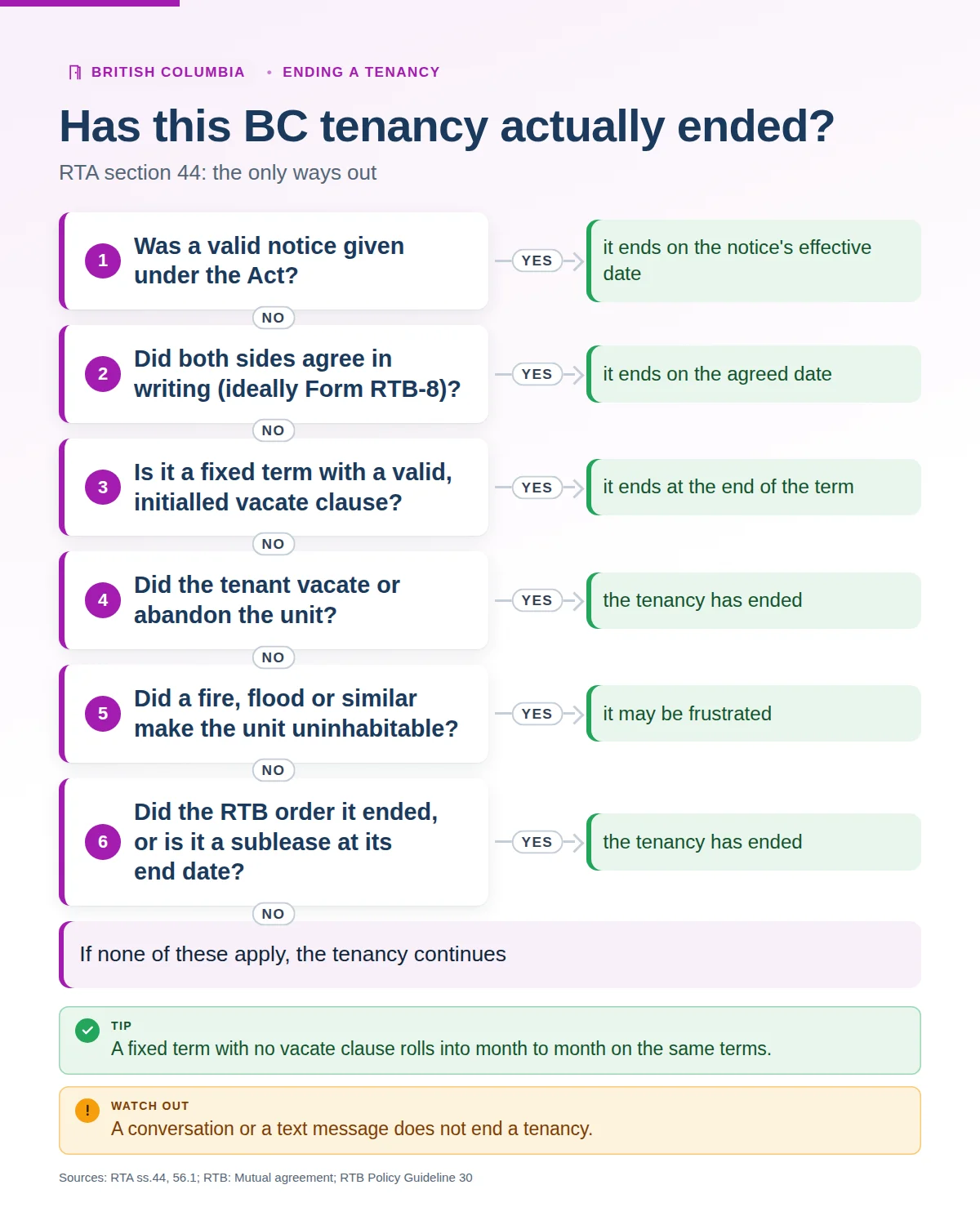
Section 44(1) of the Residential Tenancy Act says a tenancy ends only if one or more of these applies:
- A notice to end tenancy given by the tenant or the landlord under one of the sections the Act lists.
- A fixed term ends with a valid vacate clause, in the circumstances the Regulation prescribes.
- The landlord and tenant agree in writing to end it.
- The tenant vacates or abandons the unit.
- The tenancy agreement is frustrated, for example when a fire or flood makes the unit uninhabitable.
- The RTB director orders that the tenancy is ended.
- The agreement is a sublease, which ends on its own end date.
Section 44(3) adds the rule that surprises most newcomers: when a fixed term ends without a valid vacate clause and no new agreement is signed, the tenancy is deemed renewed month to month on the same terms. The end date alone ends nothing.
Notices: who can give which one
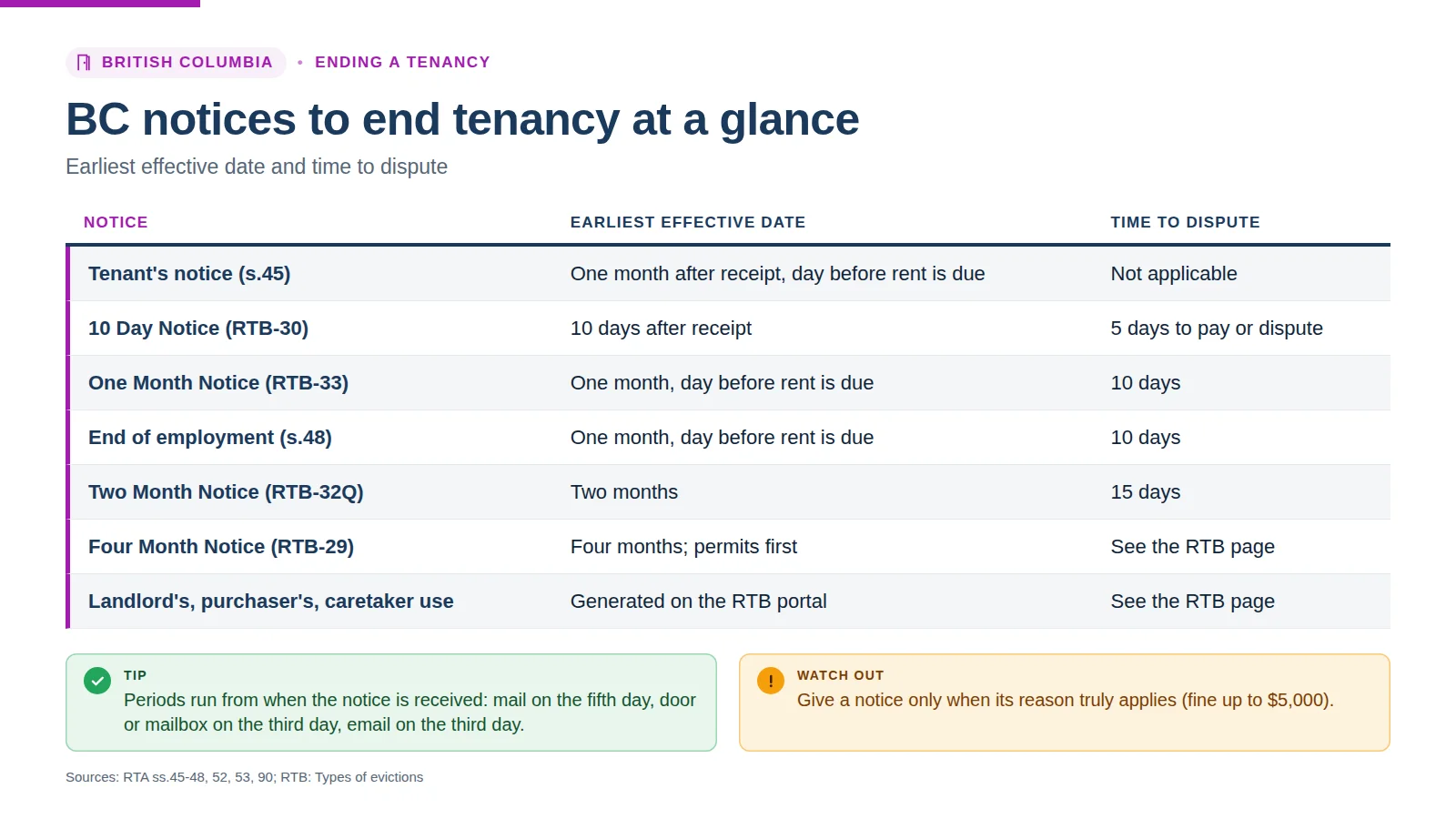
Every notice must meet section 52: it must be in writing, signed and dated, give the unit's address and the effective date and, for most notices, state the grounds. A landlord's notice must be on the approved RTB form. A tenant's ordinary notice does not have to state a reason.
| Notice | Who gives it | Earliest effective date | Time to dispute |
|---|---|---|---|
| Tenant's notice (s.45) | Tenant | At least one month after the landlord receives it, on the day before rent is due (and not before a fixed term ends) | Not applicable |
| 10 Day Notice for unpaid rent or utilities (RTB-30, s.46) | Landlord | At least 10 days after the tenant receives it | 5 days (paying in full within 5 days cancels it) |
| One Month Notice for Cause (RTB-33, s.47) | Landlord | At least one month after receipt, on the day before rent is due | 10 days |
| End of employment (s.48) | Landlord or employer | At least one month after receipt, not before employment ends, on the day before rent is due | 10 days |
| Two Month Notice, tenant no longer qualifies for subsidized housing (RTB-32Q, s.49.1) | Public housing landlord | Two months, per the RTB | 15 days, per the RTB |
| Four Month Notice for demolition or conversion (RTB-29, s.49) | Landlord with permits in place | Four months, per the RTB | See the RTB page |
| Landlord's use, purchaser's use and caretaker use (RTB-32L, 32P, 29C) | Landlord | Must be generated through the RTB's online portal. See the RTB's types of evictions page. | |
If a notice states an effective date that is too early or falls on the wrong day, section 53 does not cancel it. The date is automatically pushed to the earliest date that complies. The part of the rule that moves a date to the day before rent is due does not apply to a 10 Day Notice or to a tenant's notice for a landlord's material breach.
The tenant's special notices
A tenant has two further routes. Under section 45(3), if the landlord breaches a material term and does not fix it within a reasonable time after the tenant's written notice of the problem, the tenant may end the tenancy. Under section 45.1, a tenant may end a fixed term with one month's notice because of family or household violence, an assessment for long-term care, or admission to a long-term care facility. The RTB's special circumstances page says this needs the Ending Fixed-Term Tenancy Confirmation Statement (Form RTB-49), signed by an authorized professional.
Renovations need an order first
A landlord cannot end a tenancy for major renovations with a notice. Under section 49.2 the landlord must apply to the RTB for an order, with permits in hand, and an arbitrator decides.
Endings without a notice
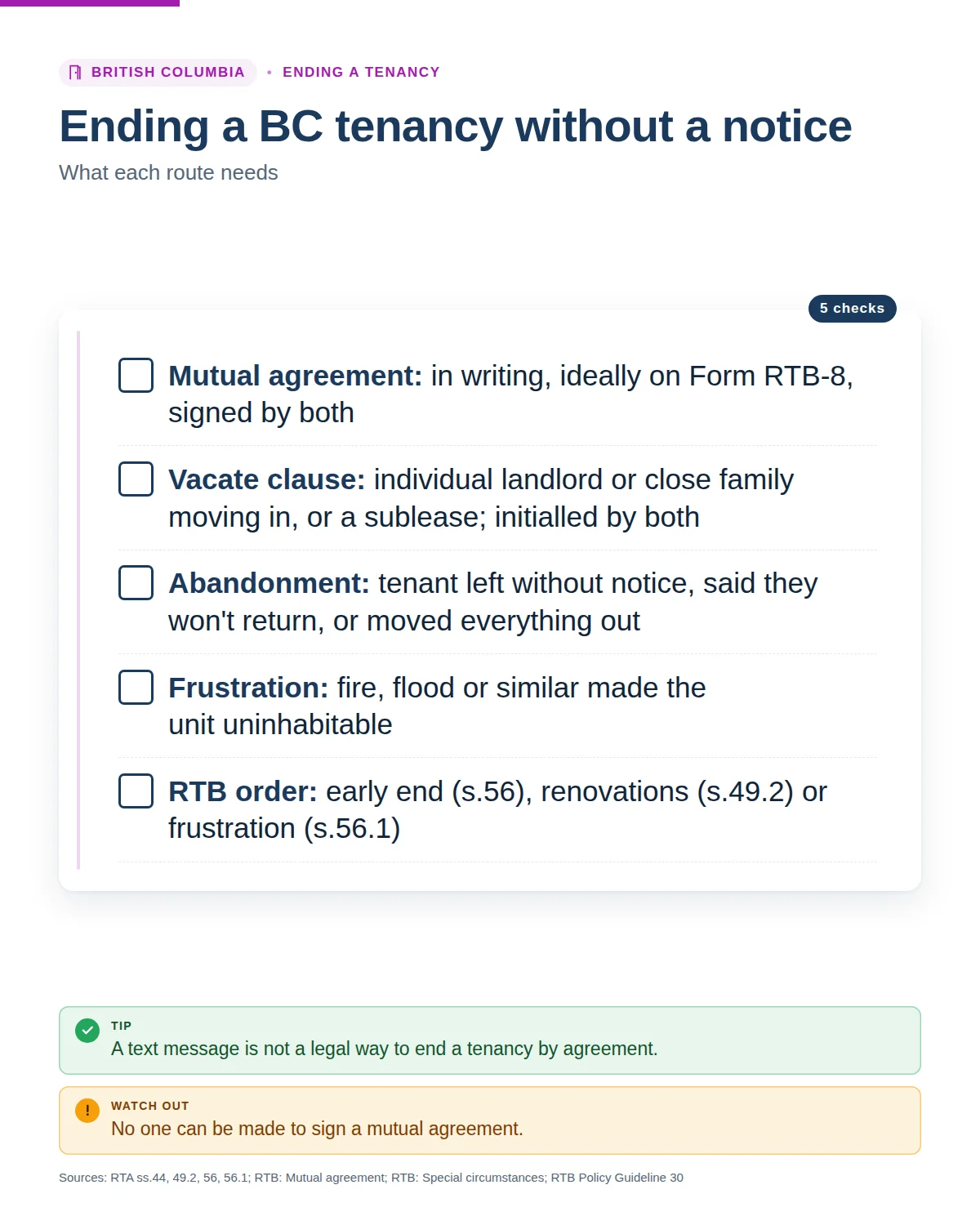
Mutual agreement
Both sides can agree in writing to end a tenancy at any time. The RTB says to document it on the Mutual Agreement to End a Tenancy, Form RTB-8. Neither side can be made to sign. The form itself warns that a tenant who signs may give up compensation they would have received under a landlord's notice. A text message is not a legal way to end a tenancy by agreement.
Vacate clauses and subleases
A fixed term ends with the tenant moving out only if the agreement contains a valid vacate clause. Policy Guideline 30 limits it to an individual landlord, or a close family member, who will occupy the unit at the end of the term, or to a sublease. Both parties must initial it.
Abandonment
The RTB treats a unit as abandoned when the tenant leaves without notice, has said they are not coming back, or has moved everything out. The landlord can then apply for compensation for unpaid rent, utilities or cleaning. Belongings left behind must be handled under the abandoned-property rules in the Regulation.
Frustration
If an unforeseen event such as a flood, fire or earthquake makes the unit uninhabitable, the RTB says neither side has to give notice and rent stops after the event. If they disagree about whether the tenancy was frustrated, either can apply for dispute resolution. A landlord can also apply for an order under section 56.1.
An RTB order
Besides the renovation order, a landlord can apply under section 56 for an early end to a tenancy without a notice in serious cases, such as significant interference, serious risk to health or safety, illegal activity or extraordinary damage, where waiting for a One Month Notice would be unreasonable or unfair. The RTB tries to schedule these expedited hearings within 12 days.
The last day

Section 37 says the tenant must be out by 1 p.m. on the day the tenancy ends unless the parties agree otherwise, leave the unit reasonably clean and undamaged except for reasonable wear and tear, and return all keys. Then:
- Move-out inspection. The landlord offers times for the condition inspection, and both should take part.
- Deposits. Within 15 days after the later of the end of the tenancy and receiving the tenant's forwarding address in writing, the landlord must return the deposits with any interest or apply for dispute resolution to claim against them. Missing the deadline can mean paying double.
- A tenant who stays. A tenant who stays after the tenancy ends is an overholding tenant. The landlord must get an order of possession from the RTB and, if needed, a Writ of Possession from the BC Supreme Court, enforced by a court bailiff. The landlord can never change the locks or remove the tenant on their own.
Common mistakes
- Treating a fixed-term end date as a move-out date. Without a valid vacate clause, the tenancy rolls to month to month.
- Counting "one month" as 30 days. The RTB stresses that a tenant's notice must give a complete rental month, ending the day before rent is due.
- Agreeing by text. A mutual agreement needs to be in writing, and the RTB says a text message is not a legal way to do it.
- Using a generic eviction letter. A landlord's notice must be on the approved form, and some must come from the RTB's portal.
- Keeping a deposit "because the tenant left early." The 15-day rule still applies. Without the tenant's written agreement or an RTB order, apply for dispute resolution rather than just keeping it.
Doing it at scale
Across a portfolio, endings overlap: a tenant's notice in one unit, a 10 Day Notice in another, a fixed term rolling over in a third. A consistent routine helps:
- Log every notice with the date it was received, the service method and the effective date, recalculated under section 53 if needed.
- For each landlord's notice, diarize the tenant's dispute deadline and check for an RTB application before acting.
- Schedule the move-out inspection and the 15-day deposit deadline as soon as an ending date is fixed.
- Keep a signed RTB-8 for every mutual agreement, with both parties' copies noted.
- Review fixed-term end dates every month so a lapse to month to month is a decision, not a surprise.
How Tenon10 helps
Tenon10 generates the tenant's notice to end tenancy, the 10 Day Notice (RTB-30), the One Month Notice for Cause (RTB-33) and the Four Month Notice (RTB-29). The Mutual Agreement (RTB-8) is an RTB form: Tenon10 links to it rather than generating it. Notices for landlord's or purchaser's use are generated through the government portal, and Tenon10 can record one once it is issued.
Lease, notice and payment records stay together for each tenancy, along with deposit tracking that follows the 15-day return clock. That gives you an evidence record if the ending is disputed.
Frequently asked questions
Can a tenancy end just because the landlord sold the building?
No. A sale is not on the section 44 list, so a sale alone does not end the tenancy. Ending it for a purchaser's use requires a notice generated through the RTB portal.
Does a tenant need a reason to end a month-to-month tenancy?
No. A tenant's ordinary notice under section 45 does not have to state grounds. It must be in writing, signed and dated, with the address and the effective date.
Can a landlord refuse to accept a tenant's notice?
A valid notice ends the tenancy whether or not the landlord agrees. If the date is too early, section 53 moves it to the earliest valid date.
What if a fire makes the unit unlivable?
The tenancy may be frustrated. The RTB says neither side has to give notice, and rent is not payable after the event. If you disagree about it, apply for dispute resolution.
BC Ending a Tenancy Checklist
A checklist for landlords and tenants: confirm the tenancy has really ended under section 44, check the notice, and handle the last day, the inspection and the 15-day deposit rule.
Get Free PDF →End tenancies on the right form
Tenon10 generates the tenant's notice, RTB-30, RTB-33 and RTB-29, and keeps each tenancy's notices, lease and payments together.
Built for Canadian landlords and property managers.
Related BC guides
- Fixed-Term vs Month-to-Month in BC: What Happens When the Term Ends
- How to Give a 10 Day Notice to End Tenancy for Unpaid Rent in BC (RTB-30)
- The 15-Day Rule: Returning a Deposit at the End of a BC Tenancy
- Serving Documents in BC: Every Method the RTA Allows
Sources: Residential Tenancy Act; Residential Tenancy Regulation; RTB: Types of evictions; RTB: Options for a tenant to end tenancy; RTB: Mutual agreement to end a tenancy; RTB: Special circumstances to end a tenancy; RTB Policy Guideline 30. This article is a summary of British Columbia rules as of October 2026, not legal advice. Check the Residential Tenancy Branch for your situation.