Your tenant has told you they want out of their fixed-term lease early, and you are happy to let them go. Or you would like the unit back, and the tenant says they would be open to moving if the timing works. Either way, you both want the same thing. The question is how to make it binding.
In British Columbia, a tenancy can end by agreement, but only if the agreement is in writing. A handshake or a text exchange does not end anything. The Residential Tenancy Branch (RTB) has a one-page form for this, the Mutual Agreement to End a Tenancy (RTB-8), and using it properly protects both sides.
This guide explains what the law says, what the form contains, what a mutual agreement cannot do, and how to handle these agreements across many units.
BC Mutual Agreement (RTB-8) Checklist
A landlord checklist for ending a BC tenancy by mutual agreement on Form RTB-8: what to fill in, what the agreement cannot do, and the steps after it is signed.
Get Free PDF →The rule
Section 44(1)(c) of the Residential Tenancy Act (RTA) says a tenancy ends if the landlord and tenant agree in writing to end it. The standard terms in every BC tenancy agreement repeat this: the parties may mutually agree in writing to end the tenancy at any time. That includes the middle of a fixed term.
The RTB's mutual agreement page adds these points:
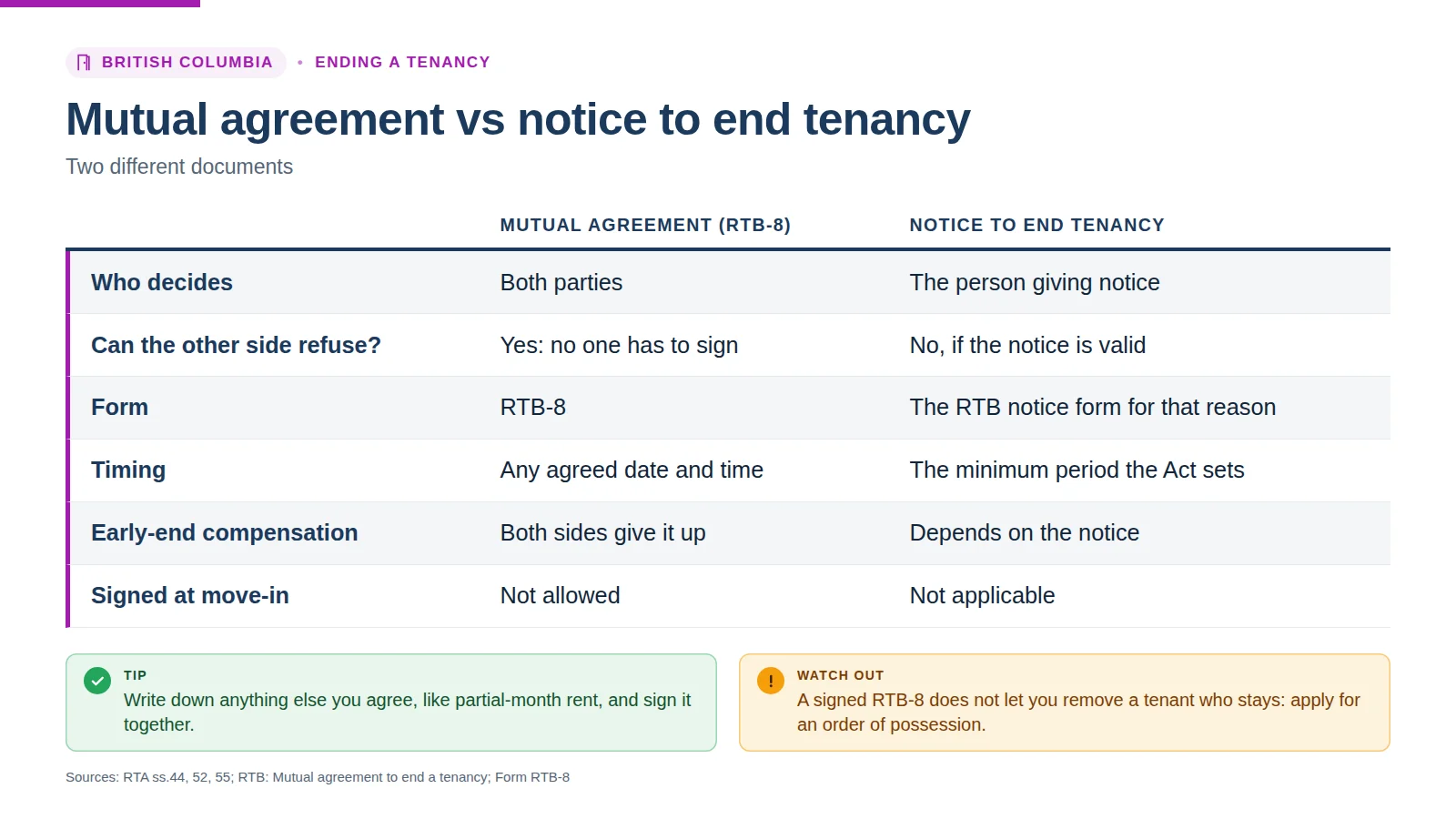
- A mutual agreement is different from a notice to end tenancy.
- Landlords and tenants cannot require each other to sign one.
- It should be documented on Form RTB-8, and both sides should keep a copy.
- If you confirm it by email, both parties need to attach and digitally sign the PDF version of the form.
- A text message is not a legal way to end a tenancy by mutual agreement.
What the RTB-8 contains
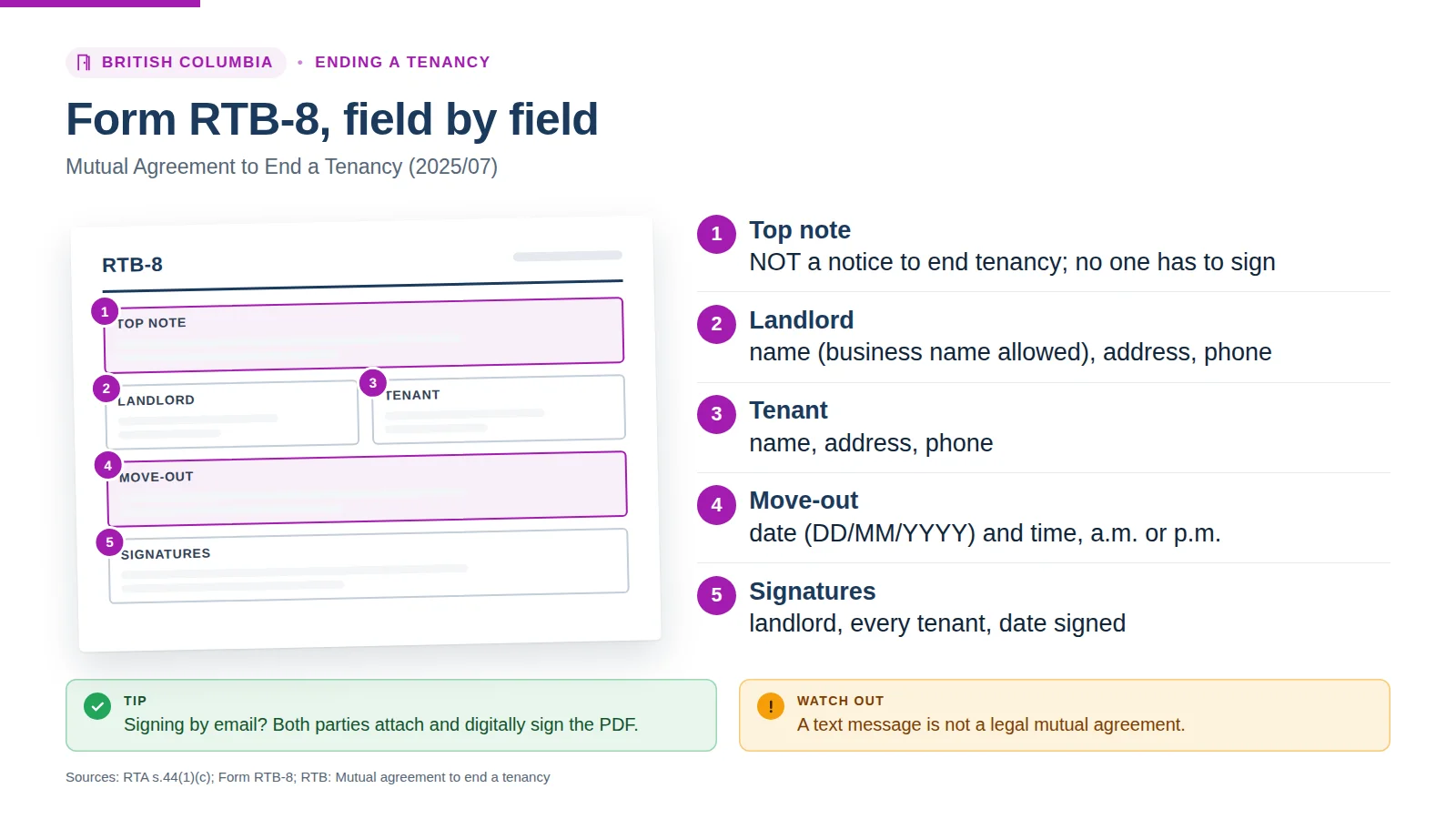
| Section of the form | What goes in it |
|---|---|
| Landlord information | Name (a business name can go in the last-name field), address and phone numbers |
| Tenant information | Name, address and phone numbers |
| Move-out | The date (DD/MM/YYYY) and the time, a.m. or p.m., when the tenant agrees to vacate |
| Signatures | Landlord's and tenant's signatures and the date signed |
The form opens with a note: it is NOT a notice to end tenancy, and neither party is under any obligation to sign it. By signing, both understand the tenancy will end with no further obligation between them, and a tenant may be giving up compensation they would have received if served a notice to end tenancy.
What a mutual agreement cannot do
The RTB sets out two things a mutual agreement cannot do, and one consequence of signing it:
- It cannot increase the rent unless all parties agree.
- It cannot set a move-out date at the beginning of the tenancy. An RTB-8 signed with the lease, dated for the end of the term, is not how a tenancy ends. Section 5 of the RTA also says landlords and tenants cannot contract out of the Act.
- It ends both sides' claims tied to ending early. The RTB says tenants will not get the compensation they might have been due under a landlord's notice, and landlords cannot apply for the compensation they might have been due if the tenant had ended a fixed term early.
Worked example
| Date | Step |
|---|---|
| Monday, October 26, 2026 | Tenant on a lease ending March 31, 2027 asks to leave early. You agree and both sign the RTB-8 for Sunday, November 15, 2026 at 1:00 p.m. |
| Before November 15 | You offer the tenant times for the move-out condition inspection and ask for a forwarding address in writing. |
| Sunday, November 15, 2026 | The tenancy ends at the agreed time. Keys are returned. |
| Within 15 days after the later of November 15 and receiving the forwarding address | Return the deposits with any interest, or apply to the RTB to claim against them. |
Common mistakes
- Relying on a text or a verbal "yes." It does not end the tenancy, and you cannot get an order of possession on it.
- Signing the RTB-8 at move-in. The RTB says a mutual agreement cannot set a move-out date at the start of a tenancy.
- Pressuring the tenant. The form says neither side is obliged to sign. If the tenant will not agree, end the tenancy only by a notice the Act allows. For a landlord's own use, that notice must be generated through the RTB's online portal; see the RTB's types of evictions page.
- Leaving the time blank. The form asks for both a date and a time.
- Forgetting the deposit. A mutual agreement does not change the 15-day deposit rule in section 38.
- Losing your copy. If the tenant stays past the date, the signed agreement is your evidence.
Doing it at scale

For a property manager, mutual agreements tend to come in clusters, such as tenants relocating for work or units being consolidated. A repeatable process avoids the gaps:
- Use the current RTB-8. The form in use is the 2025/07 version; download it from the RTB rather than reusing an old copy.
- Fill in names exactly as on the lease, including every co-tenant, and get each tenant's signature.
- Record the agreed date and time against the unit as soon as it is signed, and file both parties' copies.
- Trigger the end-of-tenancy steps from that date: move-out inspection, forwarding address, the 15-day deposit deadline and re-listing.
- If anyone changes their mind, the RTB says the tenancy can continue on the same terms only if both sides agree in writing. File that document with the RTB-8.
How Tenon10 helps
The RTB-8 is an RTB form, so Tenon10 links to the official version rather than generating its own. Tenon10 does generate the tenant's notice to end tenancy and the BC landlord notices RTB-30, RTB-33 and RTB-29.
Lease, notice and payment records stay together for each tenancy, and deposit tracking follows the 15-day return clock once the tenancy ends, so the agreed end date flows into the steps that come after it.
Frequently asked questions
Do I have to use Form RTB-8?
The Act requires the agreement to be in writing. The RTB says mutual agreements must be documented on Form RTB-8, so use it to avoid any argument about what was agreed.
Can a mutual agreement end a fixed-term lease early?
Yes. The standard terms allow a mutual agreement at any time. The RTB notes that the landlord then cannot apply for the compensation that might have been due for an early end.
Can we sign the RTB-8 by email?
Yes, if both parties attach and digitally sign the PDF version. A text message does not work.
What if the tenant changes their mind after signing?
The tenancy ends on the agreed date unless you both agree in writing that it will continue. If the tenant stays without that agreement, you can apply for an order of possession.
BC Mutual Agreement (RTB-8) Checklist
A landlord checklist for ending a BC tenancy by mutual agreement on Form RTB-8: what to fill in, what the agreement cannot do, and the steps after it is signed.
Get Free PDF →Keep every ending on record
Tenon10 keeps lease, notice and payment records together and tracks the 15-day deposit clock, with a link to the official RTB-8.
Built for Canadian landlords and property managers.
Related BC guides
- Fixed-Term vs Month-to-Month in BC: What Happens When the Term Ends
- The 15-Day Rule: Returning a Deposit at the End of a BC Tenancy
- Direct Request for an Order of Possession in BC
Sources: Residential Tenancy Act; Residential Tenancy Regulation; RTB: Mutual agreement to end a tenancy; Form RTB-8; RTB: Moving out of rental units; RTB: Evictions. This article is a summary of British Columbia rules as of October 2026, not legal advice. Check the Residential Tenancy Branch for your situation.