You have a good applicant, a move-in date and a set of keys ready. What you need now is a written agreement that will hold up if anything goes wrong. In British Columbia, that usually means the Residential Tenancy Agreement, form RTB-1.
Many small landlords reuse an old lease from a friend, a template from another province or a document their previous property manager wrote. Some of those clauses are fine. Others quietly cost you money later, because the Residential Tenancy Branch (RTB) will not enforce them at a hearing.
This guide walks through what a BC tenancy agreement must contain, what the standard terms do, how fixed terms really work, and how to keep agreements consistent when you manage more than a handful of units.
BC RTB-1 Tenancy Agreement Checklist
A landlord checklist for the BC Residential Tenancy Agreement (RTB-1): the basic details, deposits and fees, fixed terms and vacate clauses, and the 21-day copy rule.
Get Free PDF →What the law requires
A written agreement for every tenancy
The RTB says landlords must prepare a written agreement for every tenancy. If you skip it, the standard terms still apply to the tenancy anyway. You just lose the chance to record the details that protect you, such as the rent amount, what rent includes and any additional terms you rely on.
You do not have to use the government form. The RTB allows landlords to write their own agreement, as long as it includes all of the standard terms. The RTB-1 form already contains them, which is why most landlords start there.
The basic details
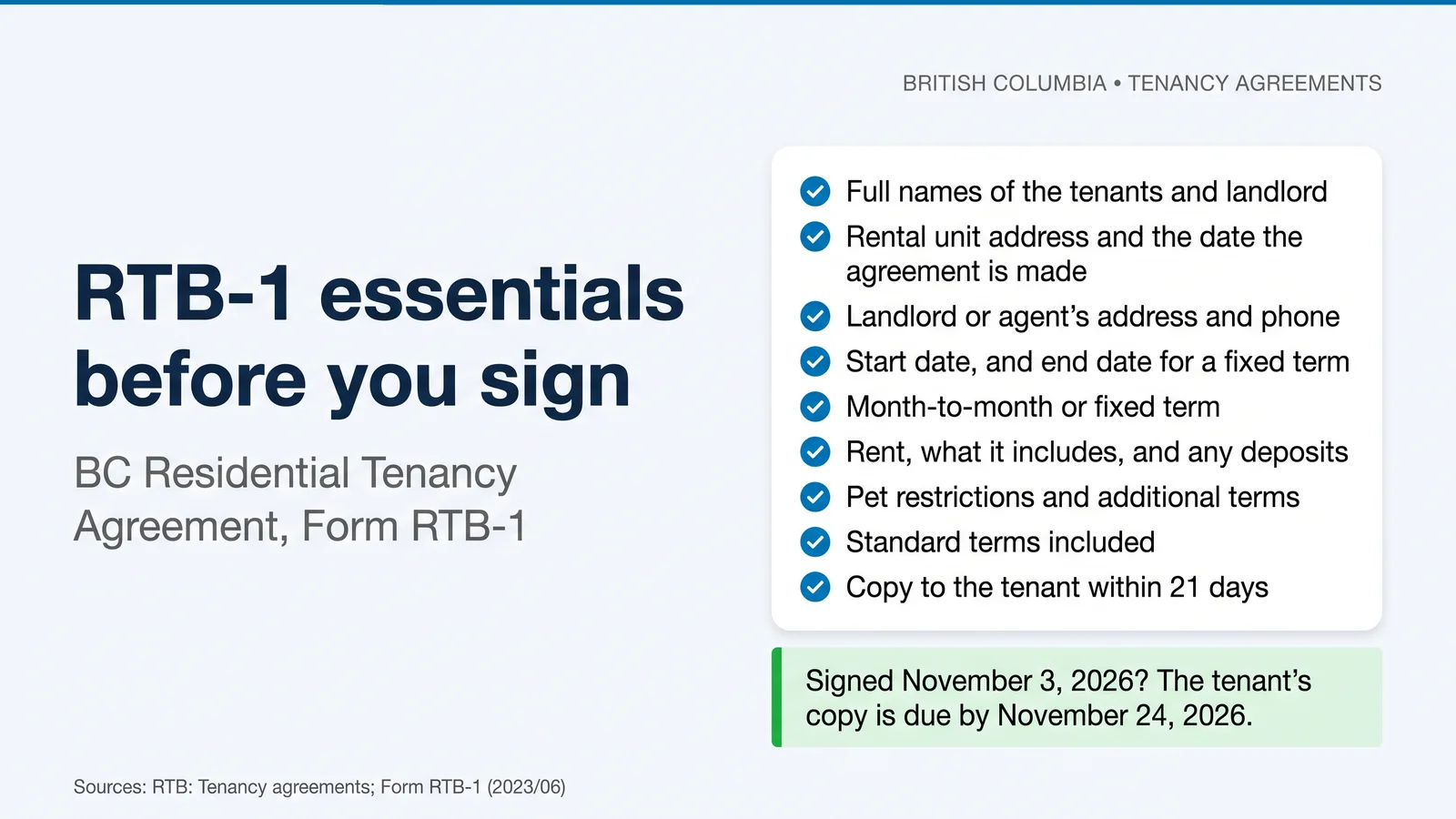
According to the RTB's tenancy agreements page, the agreement should record:
- the full names of the tenants and the landlord
- the address of the rental unit
- the date the agreement is made
- an address and phone number for the landlord or the landlord's agent
- the start date and, for a fixed term, the end date
- whether the tenancy is month-to-month or fixed-term
- the rent, what it covers (for example utilities or fees), and the deposits
- any pet restrictions
The RTB-1 has a checklist of what is included in the rent, from water, heat and electricity to parking, laundry and appliances. Tick the boxes carefully. A vague "utilities included" line is a common source of disputes.
The standard terms
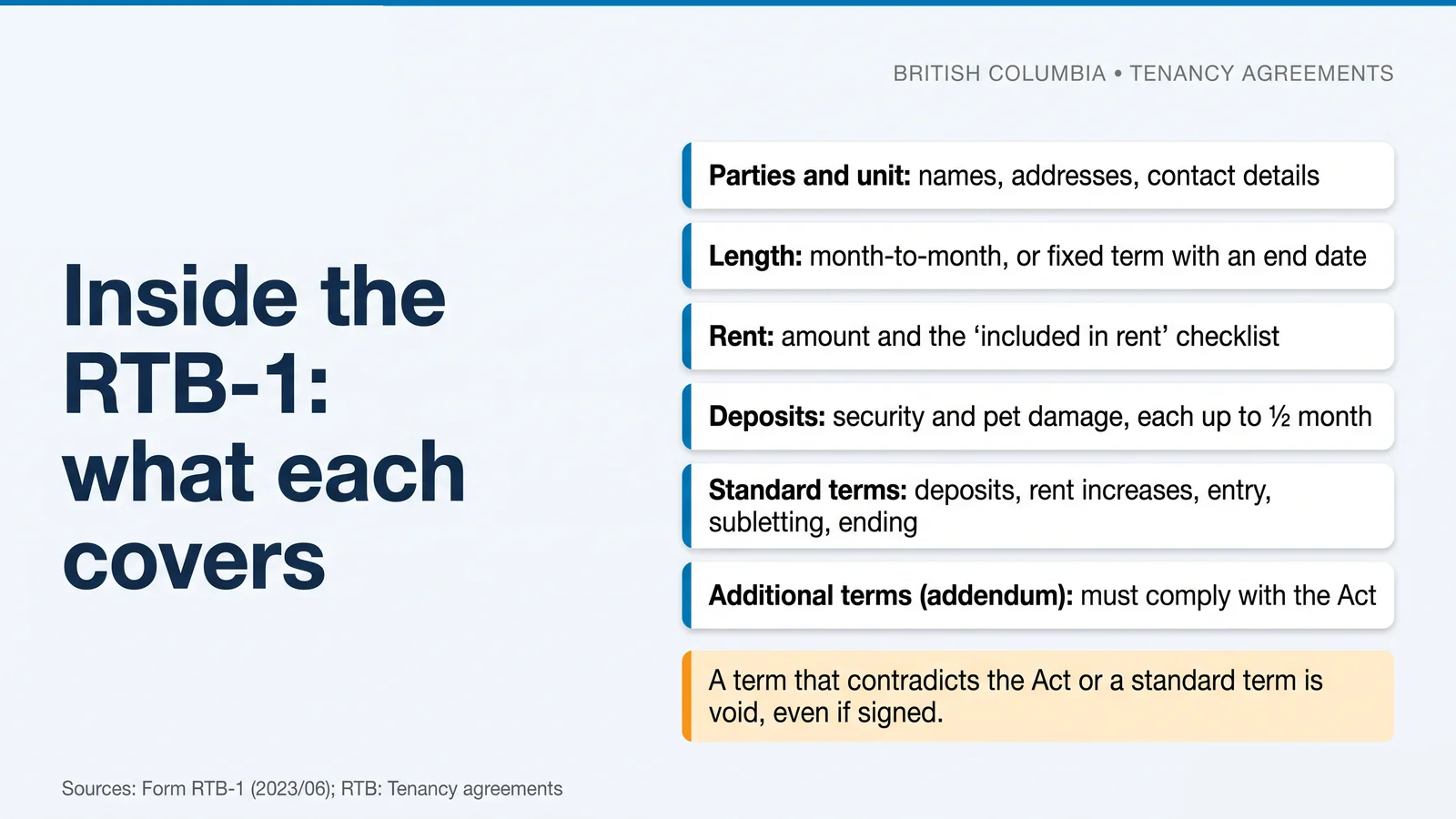
Standard terms set out the core rights and duties of both sides and must be part of every BC tenancy agreement. On the RTB-1 they appear as numbered sections covering, among other things:
| Topic on the RTB-1 | What it says in short |
|---|---|
| Security and pet damage deposits | Each deposit can be no more than half of one month's rent. Return within 15 days after the later of the tenancy ending and receiving the tenant's forwarding address in writing, or risk paying double. |
| Rent increase | Once a year at most, with three full months' written notice. |
| Assign or sublet | Needs the landlord's written consent. For a fixed term with six or more months left, consent cannot be unreasonably withheld. |
| Landlord's entry | At least 24 hours' and no more than 30 days' written notice, with entry between 8 a.m. and 9 p.m. unless the tenant agrees otherwise. |
| Ending the tenancy | A tenant ends a periodic tenancy with at least one month's written notice. A landlord can end it only for the reasons and in the way the Act allows. |
| Giving the agreement to the tenant | The landlord must give the tenant a copy within 21 days of entering into the agreement. |
| Additional terms | Must comply with the Act and regulations. A term that does not, or that is unconscionable, is not enforceable. |
The RTB-1 also states that a term which contradicts or changes a right or obligation under the Act is void. In other words, you cannot sign your way around the standard terms, even if the tenant agrees.
Fixed-term or month-to-month
The RTB-1 gives you a choice of length. A month-to-month (periodic) tenancy has no end date. A fixed-term tenancy, often one year, has an end date written into the agreement.
What happens at that end date is where many landlords get caught. Under the RTB-1 and RTB Policy Guideline 30, a fixed-term tenancy automatically continues as a month-to-month tenancy on the same terms, unless the agreement validly requires the tenant to move out. That requirement, called a vacate clause, is only allowed in two situations:
- the landlord is an individual who, or whose close family member, will occupy the rental unit at the end of the term (a circumstance prescribed under section 13.1 of the Residential Tenancy Regulation), or
- the agreement is a sublease agreement.
The reason must be written on the agreement, and both the landlord and the tenant must initial the clause for it to be enforceable. If you have no valid vacate clause and want the tenancy to end, you need a legal reason and the correct notice under the Act, not just the end date.
Changing the agreement later
Both sides must agree to changes. The RTB-1 says a change must be agreed to in writing and initialled by both the landlord and the tenant, or it is not enforceable. Legal rent increases are the exception: they follow the notice process on form RTB-7 and do not need the tenant's agreement.
Common mistakes
- Using an out-of-province lease. Ontario's standard lease or an Alberta template will not contain BC's standard terms, and clauses written for another province's rules can be void here.
- Writing a vacate clause "just in case". If you are not an individual landlord planning to move yourself or a close family member in, and it is not a sublease, the RTB's guidance is that the tenancy simply carries on month-to-month at the end of the term.
- Adding fees the law does not allow. The RTB says landlords cannot charge rental application fees, monthly pet fees or a fee for returning a deposit. A late rent fee is allowed only up to $25 and only if the agreement clearly provides for it.
- Clauses that override entry rules. The RTB gives the example of a clause allowing inspections without notice. It cannot be enforced, because written notice of at least 24 hours is required.
- Collecting too much deposit. The security deposit and the pet damage deposit are each capped at half a month's rent. Only one pet damage deposit is allowed, however many pets are approved.
- Forgetting the copy. Missing the 21-day deadline weakens your position when the tenant later says they never saw a term.
Doing it at scale
With two or three units you can keep leases in a folder. Past ten, inconsistency becomes the real risk. One unit has an old late-fee clause, another has a vacate clause that was never valid, a third has no record of what the rent includes.
- Use one master agreement. Start every tenancy from the RTB-1, then attach the same reviewed set of additional terms. Change the master, not individual copies.
- Review your additional terms once a year. Check each against the RTB's current guidance on fees, deposits and unconscionable terms.
- Record the key dates per unit. Start date, fixed-term end date, the date the copy was given, and the last rent increase date. Rent can only go up once every 12 months, with three full months' notice.
- Keep signed changes with the lease. Every initialled amendment should sit next to the agreement it changes, so you can produce both at a hearing.
- Do a move-in inspection. The RTB-1 refers to condition inspections, and a signed condition report is your best evidence on a later deposit claim.
How Tenon10 helps
Tenon10 generates the BC Residential Tenancy Agreement (RTB-1) with its standard terms, along with the Notice of Rent Increase (RTB-7), the 10 Day Notice (RTB-30), the One Month Notice for Cause (RTB-33) and the RTB-29 notice. The RTB-27 Condition Inspection Report is fillable, with a room-by-room grid.
Leases, notices and payment records are kept together, which gives you an evidence record if a dispute reaches the RTB. Deposit tracking follows the 15-day return clock and flags the double-penalty risk. See all supported documents on our forms page.
Frequently asked questions
Do I have to use the RTB-1 form?
No. The RTB says you can create your own agreement, but it must include all of the standard terms. The RTB-1 already does, which makes it the safer starting point.
What if there is no written agreement at all?
The standard terms still apply. You will, however, have a harder time proving the rent, what it includes, or any additional term you rely on.
Can I make the tenant sign a new one-year lease when the first one ends?
Not if they would rather go month-to-month. The RTB says a landlord cannot make a tenant who wants to rent month-to-month sign another fixed-term agreement.
Can I add my own rules, like no smoking?
Yes. The RTB lists smoking restrictions as an example of an additional term. Every additional term must comply with the Act and must not be unconscionable.
How much deposit can I take?
Up to half of one month's rent as a security deposit, and up to half of one month's rent as a pet damage deposit if you allow pets. For a $2,400 rent, that is $1,200 each, or $2,400 in total.
BC RTB-1 Tenancy Agreement Checklist
A landlord checklist for the BC Residential Tenancy Agreement (RTB-1): the basic details, deposits and fees, fixed terms and vacate clauses, and the 21-day copy rule.
Get Free PDF →Create your BC lease (RTB-1) in Tenon10
Generate the RTB-1 with its standard terms and keep it with your notices, inspections and payment records in one place.
Built for Canadian landlords and property managers.
Related BC guides
- What You Can and Can't Add to a BC Tenancy Agreement
- Fixed-Term vs Month-to-Month in BC: What Happens When the Term Ends
Sources: RTB: Tenancy agreements; Residential Tenancy Agreement (RTB-1); RTB Policy Guideline 30: Fixed Term Tenancies; RTB: Tenancy deposits and fees; RTB: Rent increases. This article is a summary of British Columbia rules as of October 2026, not legal advice. Check the Residential Tenancy Branch for your situation.