The RTB-1 covers the basics, but every building has its own rules. Maybe you want a no-smoking clause, a parking charge, a late fee or a rule about the shared laundry room. The question is which of these will actually hold up if a tenant pushes back.
In British Columbia, extra clauses go into the agreement as additional terms, often on an addendum page. Some are perfectly fine. Others are void from the day they are signed, and a few can expose you to penalties on top of being unenforceable.
This guide sets out the test the Residential Tenancy Branch (RTB) applies, lists the clauses that commonly fail, and gives you a simple process for keeping an addendum clean across your units.
BC Additional Terms Checklist
A landlord checklist for additional terms in a BC tenancy agreement: the three-part test, which fees and clauses are allowed, and how to keep an addendum clean.
Get Free PDF →The rule: what an additional term must do
It cannot change the Act or the standard terms
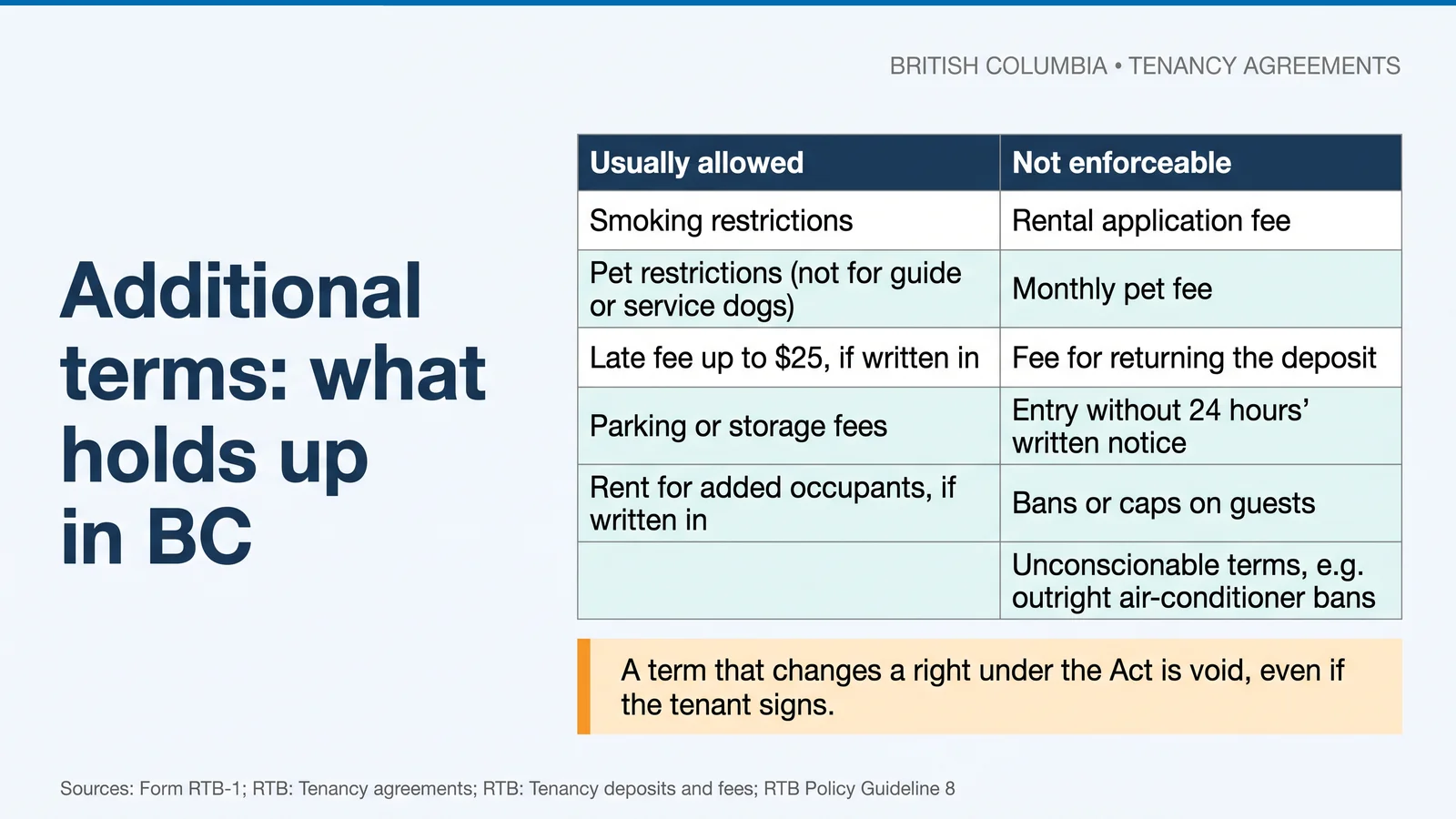
The RTB-1 states that a term which contradicts or changes a right or obligation under the Residential Tenancy Act, or a standard term, is void. Its additional-terms section says added terms must comply with the Act and regulations. A tenant's signature does not fix this. The RTB says every tenant has rights protected by law no matter what the agreement says.
It cannot be unconscionable
Even a term that does not break a specific rule can fail. RTB Policy Guideline 8 describes an unconscionable term as one that is oppressive or grossly unfair to one party. Unconscionable terms are not enforceable. The party claiming a term is unconscionable has to prove it.
It should be clear
The RTB warns that additional terms which are unclear or unfair might not be enforceable. Write each term so a stranger could read it and know exactly what is required.
The mechanics
- The RTB-1 has a box to say whether there is an addendum, and fields for the number of addendum pages and the number of additional terms. Fill them in, so nobody can argue later that a page was slipped in.
- Terms added after signing are changes to the agreement. The RTB-1 says a change must be agreed to in writing and initialled by both the landlord and the tenant, or it is not enforceable.
- Give the tenant a copy of the full agreement, addendum included, within 21 days of entering into it.
What you can usually add, and what you can't
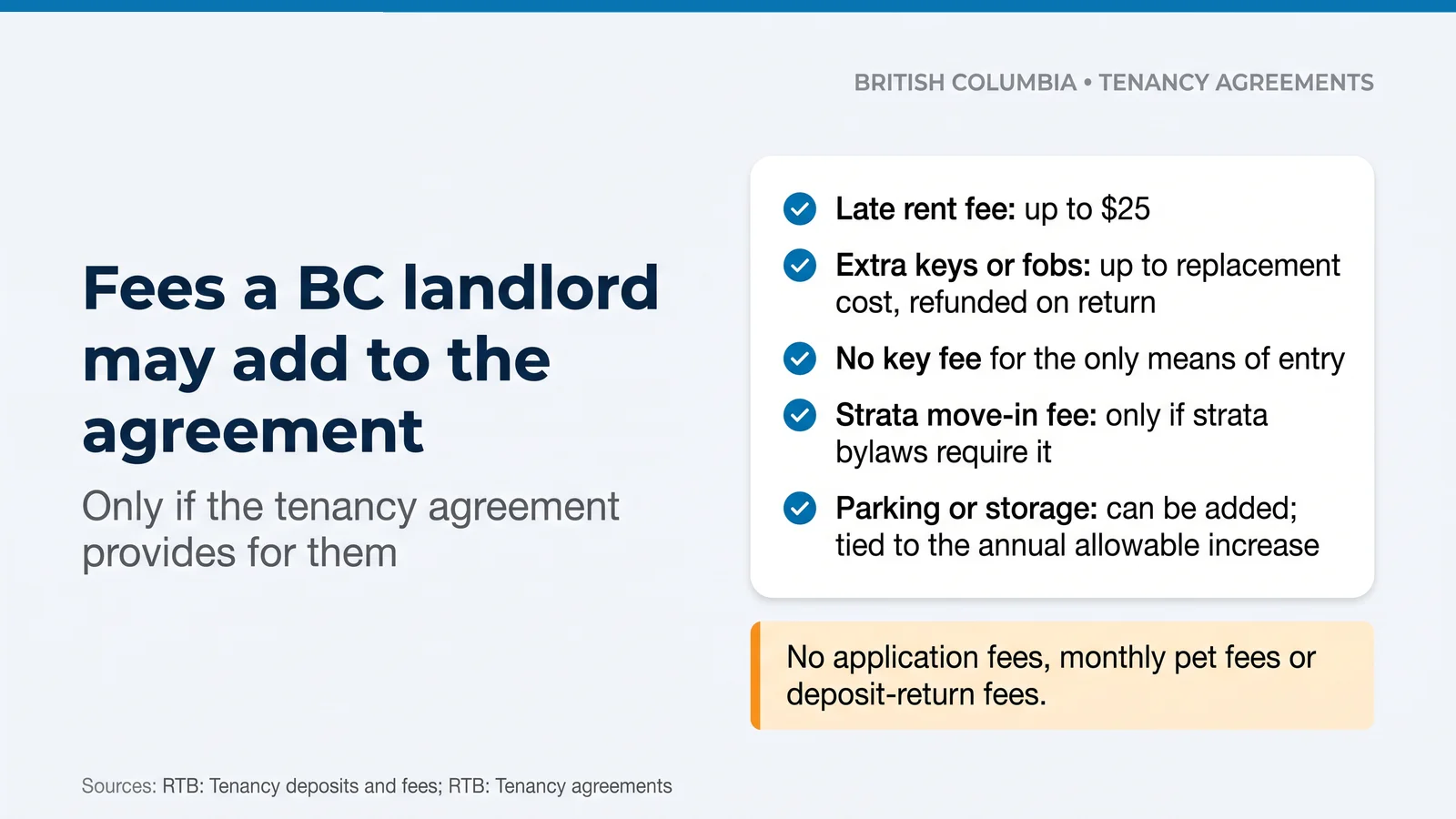
The table below is based on the RTB's own examples and its deposits and fees page.
| Clause | Allowed? | Conditions |
|---|---|---|
| Smoking restrictions | Yes | The RTB lists these as an example of an additional term. |
| Pet restrictions | Yes | The RTB-1 says pet terms are subject to the Guide Dog and Service Dog Act. No pet damage deposit for certified guide or service dogs. |
| Late rent fee | Yes | Non-refundable, no more than $25, and the agreement must clearly provide for it. |
| Fee for moving between units in a multi-unit building | Yes | Only if the tenant asked to move, and no more than the greater of $15 or 3% of the monthly rent; the fee must be in the agreement. |
| Strata move-in fee | Yes | Only if strata bylaws require it. |
| Extra keys or fobs | Yes | Fee must not exceed replacement cost and must be refunded when returned. No charge for the only means of entry. |
| Parking or storage fee | Yes | Can be added to the agreement. The RTB ties these fees to the annual allowable rent increase, so check its deposits and fees page before changing one. |
| Rent increase for added occupants | Only if written in | The RTB says rent can rise for an additional occupant only if the agreement has a specific provision for it, or the parties sign a new agreement. |
| Rental application fee | No | Landlords can't charge to accept, review or process an application. |
| Monthly pet fee | No | The pet damage deposit is the only pet charge allowed. |
| Fee for returning the deposit | No | Not permitted. |
| Entry or inspections without notice | No | Written notice of at least 24 hours is required, with entry between 8 a.m. and 9 p.m. |
| Ban or cap on overnight guests | Generally no | The RTB-1 says the landlord must not impose restrictions on guests. Guideline 8 gives a cap of 14 overnight guests a year as an unconscionable example. |
Common mistakes
Penalty clauses dressed up as damages
Many leases include a flat sum the tenant pays for breaking a fixed term early. That is a liquidated damages clause, and the RTB accepts them in principle. Policy Guideline 4 says the amount must be a genuine pre-estimate of your loss at the time the agreement is signed. If it is extravagant compared with the greatest loss that could follow, it is a penalty and is unenforceable. A clause that automatically forfeits the security deposit on any breach is treated as a penalty unless you can show it is a genuine pre-estimate.
Blanket bans that affect health or comfort
Guideline 8 gives examples of unconscionable terms: an outright ban on air conditioners without a rational basis, blanket bans on passive cooling such as awnings or reflective window coverings, and clauses that excuse the landlord from liability for losses caused by the landlord's own negligence.
Shifting costs that aren't the tenant's
The RTB gives the example of putting another unit's utilities in the tenant's name as an unfair term. If units share a meter, sort out the billing properly instead of passing it to one tenant.
Labelling everything "material"
A material term is one both parties agree is so important that even a trivial breach lets the other end the agreement. Guideline 8 says writing "material" next to a term is not decisive. An arbitrator looks at how important the term really is in the overall agreement. Keep that label for the few terms that genuinely matter.
Sneaking in a vacate clause
A clause requiring the tenant to move out at the end of a fixed term is not an ordinary additional term. It is only allowed if the landlord is an individual who, or whose close family member, will occupy the unit at the end of the term, or if the agreement is a sublease. The reason must be stated on the agreement and both parties must initial it.
Doing it at scale
An addendum that grew one clause at a time across ten years and twenty units is hard to defend. Use this process instead:
- Build one approved addendum. Write it once, check each term against the table above, and use it for every new tenancy.
- Version it. Put a version date in the footer, for example "Addendum v2026-11". You will always know which tenants signed which version.
- Keep building-specific terms separate. Strata bylaws, parking and storage differ by building. Put them in a short schedule rather than editing the core addendum.
- Audit old leases. When you take over a portfolio, list every additional term in every lease. Flag fees and bans that fail the table above, and stop relying on them.
- Change existing leases only by written, initialled agreement. You can't add a new term to a signed lease on your own.
How Tenon10 helps
Tenon10 generates the BC Residential Tenancy Agreement (RTB-1) with its standard terms, so your additional terms always sit on top of the required wording rather than replacing it.
The signed lease, notices and payment records are stored together for each unit. If a clause is ever challenged, you have the agreement and the history in one evidence record for an RTB hearing. See the supported documents on our forms page.
Frequently asked questions
Can I charge a late fee in BC?
Yes, up to $25, but only if the tenancy agreement clearly says a late rent fee applies.
Can I ban pets completely?
You can include pet restrictions in the agreement. The RTB-1 makes those terms subject to the Guide Dog and Service Dog Act, so they cannot be used against a certified guide or service dog.
Can I add a term after the lease is signed?
Only if the tenant agrees. The RTB-1 says changes must be in writing and initialled by both of you.
If one term is unenforceable, does the whole lease fail?
The RTB-1 treats a non-compliant or unconscionable term as not enforceable. The rest of the agreement, including the standard terms, still applies.
BC Additional Terms Checklist
A landlord checklist for additional terms in a BC tenancy agreement: the three-part test, which fees and clauses are allowed, and how to keep an addendum clean.
Get Free PDF →Start every BC lease from the RTB-1
Tenon10 generates the BC Residential Tenancy Agreement with its standard terms and keeps it with your notices and payment records.
Built for Canadian landlords and property managers.
Related BC guides
- The BC Residential Tenancy Agreement (RTB-1): The Complete Landlord Guide
- Fixed-Term vs Month-to-Month in BC: What Happens When the Term Ends
Sources: RTB: Tenancy agreements; Residential Tenancy Agreement (RTB-1); RTB: Tenancy deposits and fees; RTB Policy Guideline 8; RTB Policy Guideline 4. This article is a summary of British Columbia rules as of October 2026, not legal advice. Check the Residential Tenancy Branch for your situation.