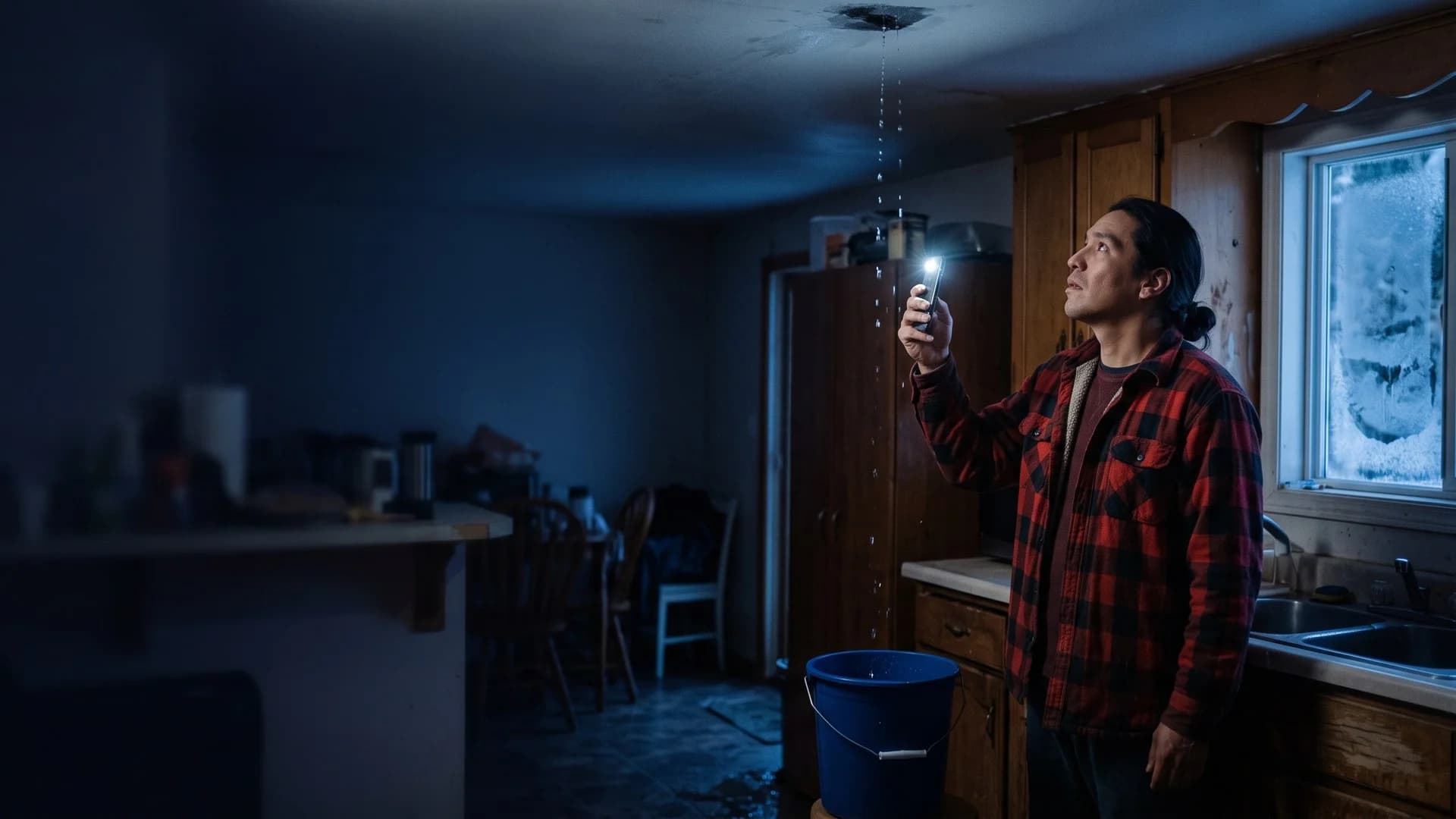
Mould on rental windows in BC is split by cause: the tenant cleans condensation and mould off the inside of windows and tracks (RTB Policy Guideline 1), while the landlord repairs what causes the moisture, such as leaks, failed seals, rot or exhaust fans that do not work (Residential Tenancy Act s.32(1)).
Every BC winter brings the same photos: water running down the inside of the glass, black spots along the sill, a damp curtain that smells musty. Condensation and mould sit right on the line between the landlord's duty to repair and the tenant's duty to keep the unit clean, which is why they cause so many arguments. This guide sets out what the Residential Tenancy Act and the Residential Tenancy Branch (RTB) say, and how to work out which side of the line a particular window is on. For the general repair duty, see our guide to repairs and maintenance in BC.
Who is responsible for mould on rental windows in BC: the landlord or the tenant?

In BC, routine cleaning of the inside of windows and tracks, including wiping off mould, is the tenant's job during and at the end of the tenancy, according to RTB Policy Guideline 1. The landlord repairs leaks, failed seals, rot and ventilation that does not work under section 32(1) of the Residential Tenancy Act, and mould that is spreading, returning after cleaning or tied to water getting in is a repair problem, not just a cleaning problem.
| Window task or problem in a BC rental | Responsible | Source |
|---|---|---|
| Cleaning the inside windows and tracks, including removing mould, during and at the end of the tenancy | Tenant | RTB Policy Guideline 1 |
| Cleaning the inside and outside of balcony doors, windows and tracks | Tenant | RTB Policy Guideline 1 |
| Cleaning the outside of windows at reasonable intervals | Landlord | RTB Policy Guideline 1 |
| Leaking frames, failed seals, rotted sills, bathroom and kitchen exhaust fans | Landlord | RTA s.32(1) |
| Water stains on window coverings caused by inadequate windows | Not the tenant | RTB Policy Guideline 1 |
| Damage caused by the tenant's actions or neglect | Tenant | RTA s.32(3) |
Why do rental windows get condensation in BC winters?
Windows in BC rentals sweat because warm, moist indoor air meets cold glass: HealthLink BC's file on indoor air quality and mould (File 65b) explains that large differences between inside and outside temperatures can cause water to condense on windows, and that the key to controlling mould is controlling moisture. The same file names cooking, bathing, washing clothes, humidifiers and bathrooms without proper ventilation among the sources of indoor moisture.
Cold glass, especially single-pane glass, metal frames and failed double-glazed units, gives that vapour a place to condense. So the same habits can produce a dry window in one unit and a dripping one in another.
What does the Residential Tenancy Act say about window mould in BC?
BC's Residential Tenancy Act gives the tenant the cleaning duty and the landlord the repair duty. Section 32(2) requires the tenant to maintain reasonable health, cleanliness and sanitary standards, and section 32(1) requires the landlord to keep the property in a state of repair that meets health, safety and housing standards and makes it suitable for occupation.
The tenant's side
Section 32(2) requires a tenant to maintain reasonable health, cleanliness and sanitary standards throughout the unit. Section 32(3) makes the tenant repair damage caused by their actions or neglect. Policy Guideline 1 applies that to windows directly: the tenant is responsible for cleaning the inside windows and tracks during and at the end of the tenancy, including removing mould, and for cleaning the inside and outside of balcony doors, windows and tracks. The landlord is responsible for cleaning the outside of windows at reasonable intervals.
The landlord's side
The landlord's section 32(1) duty covers leaking frames, failed seals, rotted sills, and the systems that control moisture, such as bathroom and kitchen exhaust fans. Policy Guideline 1 also says a tenant is not responsible for water stains on window coverings that are caused by inadequate windows: a small but telling acknowledgement that a poor window, not the tenant, can be the source of the water.
The RTB's repairs and maintenance page adds that tenants should report water damage to the landlord immediately and that landlords should fix water damage quickly to avoid more serious problems such as mould.
How can you tell whether window mould is a building problem or a use problem?
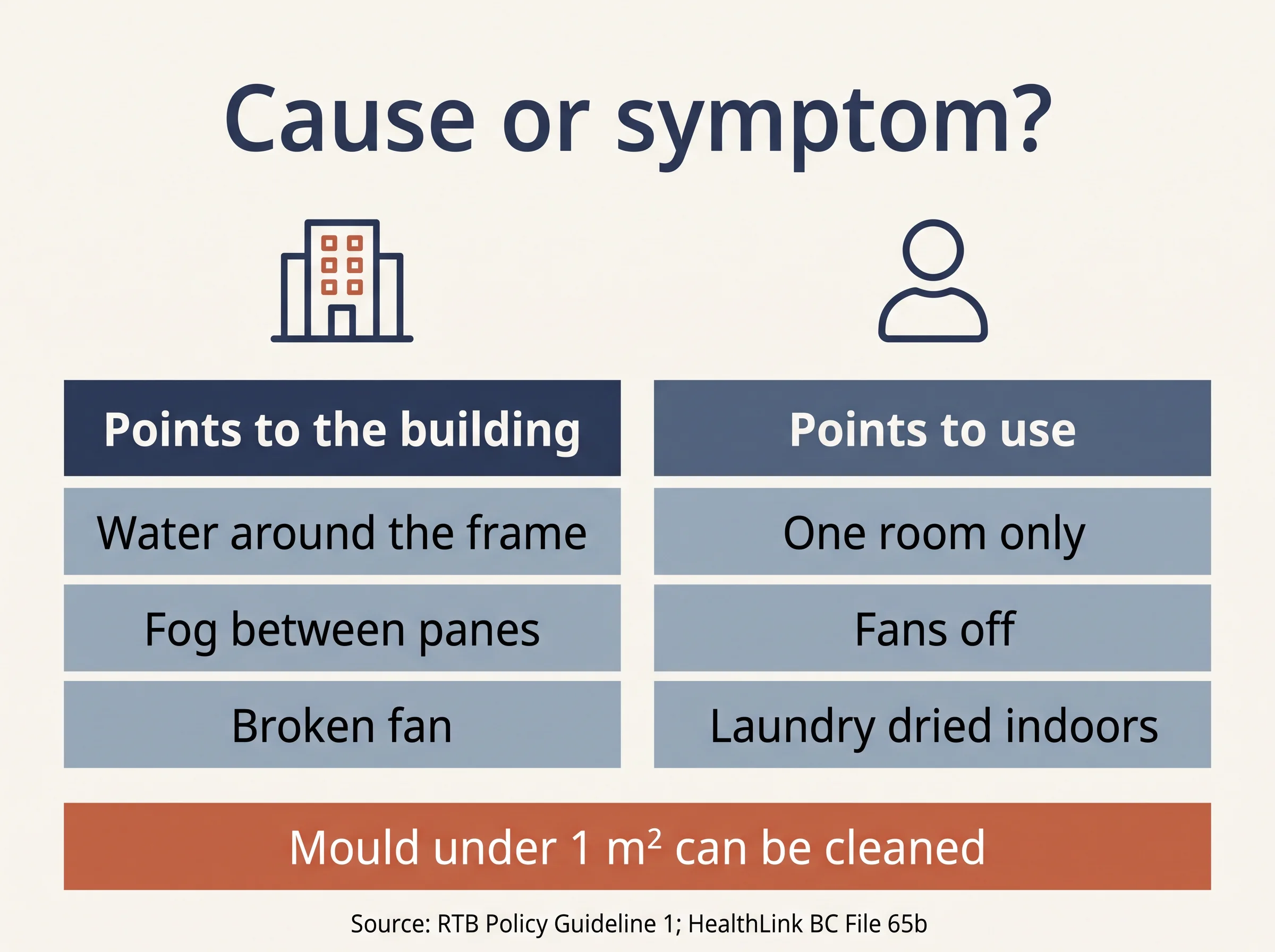
In a BC rental, the pattern of the water usually shows the cause: water around the frame or between the panes points to the building, while condensation on the glass in one unit, worst after cooking or overnight, points to how the unit is used. Before anyone points a finger, look at the signs:
| What you see | Points to |
|---|---|
| Water below or around the frame rather than on the glass; fog between the two panes of a sealed unit; mould inside the wall or under paint near the window; a fan that does not run or does not vent outside; the problem in several units on one side of the building | The building (landlord repair) |
| Condensation on the glass in one unit only, worst in the bedroom overnight or the kitchen after cooking; fans present and working but switched off; laundry dried on racks indoors; blinds and furniture pressed against the glass so it never warms | How the unit is used (tenant) |
| Old single-pane or aluminum windows combined with heavy indoor moisture | Both: the tenant manages humidity and cleans, the landlord fixes ventilation and, over time, the windows |
An RTB arbitrator decides these disputes on evidence. Photos with dates, humidity readings, fan maintenance records and repair invoices carry more weight than anyone's opinion of the other side's housekeeping.
When is cleaning window mould not enough in a BC rental?
Cleaning is not enough when window mould keeps coming back in the same place, spreads beyond the window, or sits on drywall or wood that stays damp; in a BC rental that is the signal to report it to the landlord in writing as a repair. HealthLink BC says that a small area of mould, less than one square metre, can be cleaned by the occupant, and that larger areas may need special training or commercial cleaners.
For smooth surfaces, HealthLink BC recommends detergent and water, without soaking the surface so it can dry completely, and says water-damaged materials should be cleaned and dried within 24 to 48 hours or thrown out. So a tenant wiping black spots off a vinyl sill every week is doing their part.
What can a BC tenant do if the landlord will not fix a mould problem?
A BC tenant asks for the repair in writing with photos, gives a reasonable time, and, if a repair that affects health, safety or usability is not done, applies to the RTB for an order requiring the repair and for compensation. Under section 65 the director can reduce past or future rent by the amount the problem reduced the value of the tenancy, and under section 67 can order compensation for loss, such as damaged belongings.
The RTB's Policy Guideline 16 says the person claiming must also have acted reasonably to minimize their own loss, which for a tenant means cleaning what they reasonably can and reporting promptly. Our guide to filing a dispute resolution application walks through it.
A tenant who withholds rent over mould without an RTB order risks a notice to end the tenancy for unpaid rent; the Act gives no general right to deduct for regular repairs. Our overview of tenant rights in BC covers the other limits on both sides.
Can a BC landlord charge a tenant for mould damage?
Yes, but only with proof: where mould has damaged finishes because a BC tenant never ventilated or cleaned, the landlord can claim the repair cost at the end of the tenancy or through dispute resolution, and must prove the tenant caused it. The condition inspection reports at move-in and move-out, plus any written warnings given during the tenancy, are the core evidence.
The RTB's useful life guideline may reduce the award where the damaged item was already old.
How do you choose a licensed window contractor for a moisture problem in BC?
When windows are part of a moisture problem, the diagnosis matters more than the glass. Ask whoever inspects to:
- Look at the whole opening: flashing, sill slope, caulking, weep holes and drainage, not only the pane.
- Say in writing whether the water is condensation on the glass, a failed sealed unit, or a leak through or around the frame.
- Check the ventilation that serves the room, or tell you who should.
- Quote repair and replacement separately, so you can compare a fix with a new unit.
- Show proof of a valid business licence and liability insurance before working in an occupied unit.
Frequently asked questions
Does a BC tenant have to clean mould off rental windows?
Yes, for routine cleaning. RTB Policy Guideline 1 makes a BC tenant responsible for cleaning the inside windows and tracks during and at the end of the tenancy, including removing mould. Mould that keeps returning or comes from a leak or failed seal is a repair for the landlord.
How much window mould can a tenant safely clean in BC?
HealthLink BC says a small area of mould, less than one square metre, can be cleaned by the occupant. Larger areas may need special training or commercial cleaners, and mould that keeps returning should be reported to the landlord in writing as a repair.
Can a BC tenant withhold rent because of mould on the windows?
No. BC's Residential Tenancy Act gives no general right to deduct rent for regular repairs, and a tenant who withholds rent without an RTB order risks a notice to end the tenancy for unpaid rent. The route is a written repair request and, if needed, an RTB application for a repair order and compensation.
Who pays for curtains stained by water from a leaky window in a BC rental?
Not the tenant, if the window is to blame. RTB Policy Guideline 1 says a tenant is not responsible for water stains on window coverings caused by inadequate windows. A tenant whose belongings were damaged by a landlord's failure to repair can claim compensation under section 67 of the Residential Tenancy Act.
Should a landlord paint over window mould or seal a drafty window shut?
No. Painting over mould hides the evidence of a leak, and a window that no longer opens cannot be used to get out in an emergency. Fix the cause and keep the window operable.
Turn a mould complaint into a clear record
With Tenon10, the tenant reports the problem as a maintenance request, and you can follow it through a work order and a scheduled visit, with your own vendors on file.
Built for Canadian landlords and property managers.