It is a Saturday night in January when the furnace in one of your rentals quits. Your tenant calls your emergency number twice and gets no answer. By Sunday morning they have hired a heating technician, and on Monday a receipt lands in your inbox with a request to be paid back.
In British Columbia that can be entirely lawful. Section 33 of the Residential Tenancy Act lets a tenant arrange emergency repairs and recover the cost from the landlord, or deduct it from rent if the landlord does not pay. It also sets firm conditions, and a tenant who skips them may end up paying the bill.
This guide explains what counts as an emergency repair, the steps a tenant must take before acting, what you must reimburse, and when you can refuse.
BC Emergency Repairs Checklist
A landlord checklist for BC emergency repairs: what counts, your emergency contact duty, the tenant's conditions and when you must reimburse.
Get Free PDF →What counts as an emergency repair
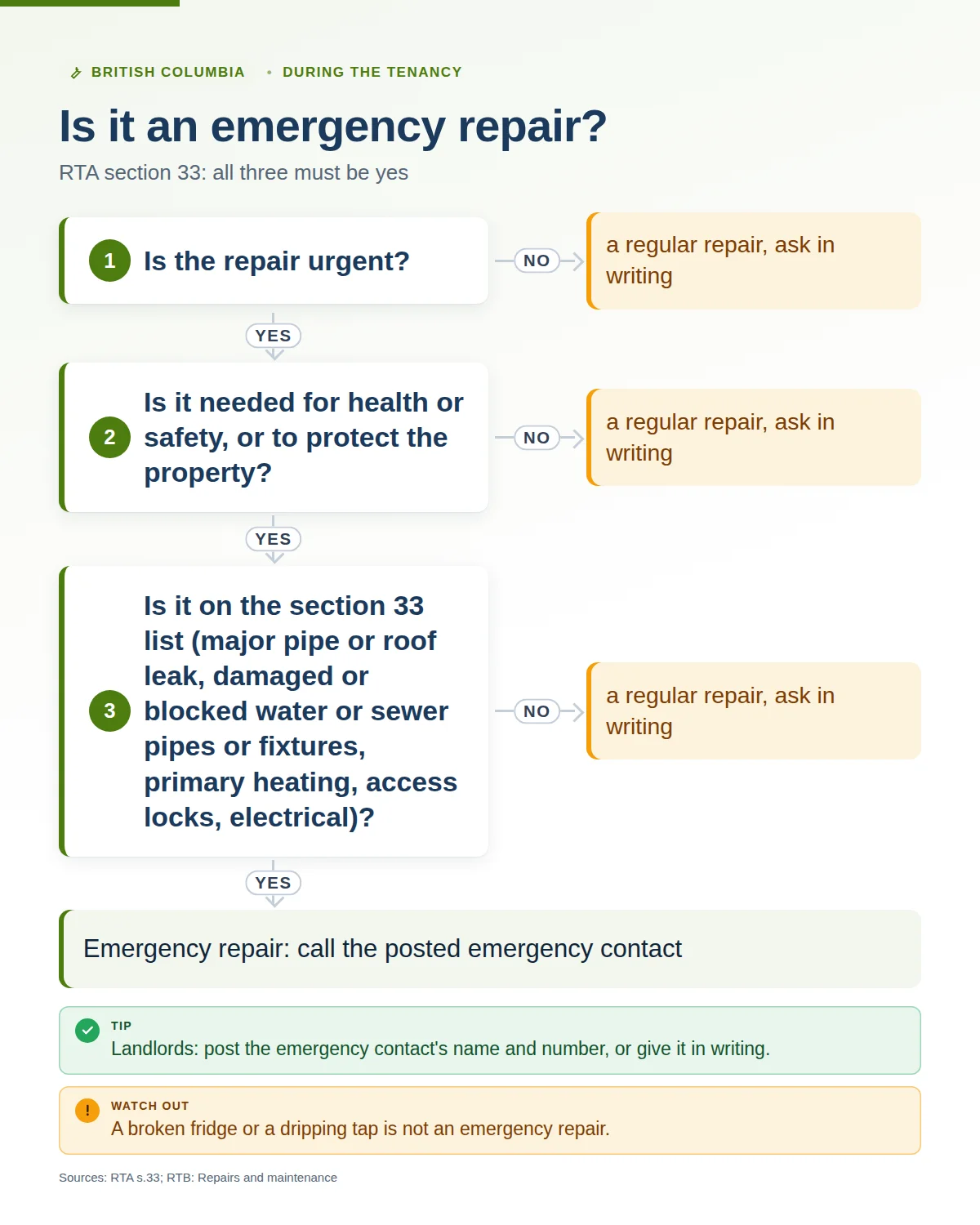
Section 33(1) of the Residential Tenancy Act (RTA) defines emergency repairs as repairs that are all three of these:
- urgent,
- necessary for the health or safety of anyone, or for the preservation or use of residential property, and
- made to repair one of these:
- major leaks in pipes or the roof
- damaged or blocked water or sewer pipes or plumbing fixtures
- the primary heating system
- damaged or defective locks that give access to a rental unit
- the electrical systems
- a rental unit or residential property in circumstances the regulations prescribe
The RTB's repairs page is blunt: repairs that do not meet all three criteria are not emergencies. A broken dishwasher, a dripping tap or a stuck window is a regular repair, handled by written request.
Your duty to name a contact
Section 33(2) requires you to post in a conspicuous place on the property, or give each tenant in writing, the name and telephone number of the person to contact for emergency repairs. The whole process depends on that number.
When a tenant may arrange the repair
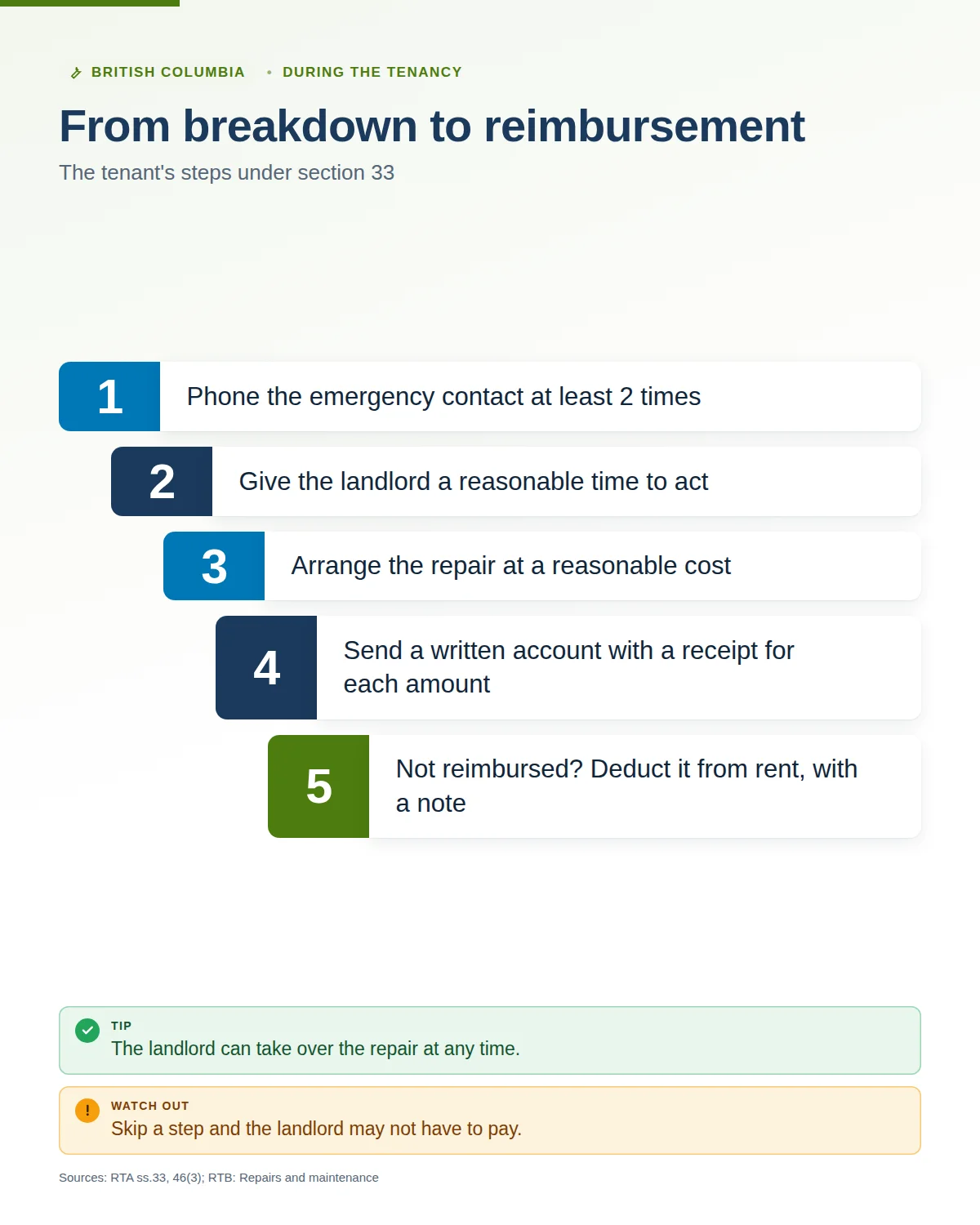
Section 33(3) lets a tenant have emergency repairs made only when all of these are met:
- emergency repairs are needed,
- the tenant has made at least 2 attempts to telephone the emergency contact at the number provided, and
- after those attempts, the tenant has given the landlord a reasonable time to make the repairs.
The Act does not define a reasonable time, and it will depend on the problem. A burst pipe flooding the suite calls for a shorter wait than a furnace on a mild night. The RTB says that once these steps are done, the tenant can arrange the repairs at a reasonable cost.
Section 33(4) lets you take over the repair at any time. The RTB says that if the work is under way, you can either take it over and pay for the work done so far, or let it continue and reimburse the full cost.
Paying the tenant back
Under section 33(5) you must reimburse the tenant if they claim reimbursement and give you a written account of the repairs, with a receipt for each amount claimed. If you do not, section 33(7) lets the tenant deduct the amount from rent or recover it another way. The RTB suggests the tenant include a note with the reduced rent explaining why.
Worked example
| When | What happens |
|---|---|
| Saturday, January 9, 2027, 7:00 p.m. | The primary heating system fails. |
| 7:05 p.m. and 7:35 p.m. | The tenant calls the posted emergency number twice. No answer. |
| Sunday, January 10, morning | After waiting overnight, the tenant hires a technician, who fixes the furnace for $480. |
| Monday, January 11 | The tenant emails you a written account and the receipt, asking to be reimbursed. |
| Monday, February 1 | Not reimbursed, the tenant pays February's rent less $480, with a note explaining the deduction. |
If the tenant met the conditions, the $480 was a reasonable cost and the tenant did not cause the breakdown, you owe it. A 10 Day Notice for the $480 would have no effect: section 46(3) says a notice for unpaid rent has no effect if the unpaid amount is one the tenant was allowed to deduct.
When you do not have to pay

Section 33(6) says the duty to reimburse does not apply to amounts where the RTB, on application, finds that:
- the tenant made the repairs before meeting the conditions (for example, no phone calls, or no reasonable wait),
- the tenant did not provide the written account and receipts,
- the amounts are more than a reasonable cost for the repairs, or
- the repairs were for damage caused mainly by the actions or neglect of the tenant, their guests or occupants.
Note the words "on application": you need the RTB to decide it. The RTB says that if a tenant deducts repair costs and you believe they were too high, unnecessary, or caused by the tenant, you can apply for a monetary order or serve a 10 Day Notice for unpaid rent. If you serve the notice, section 66(2)(b) lets the RTB extend the tenant's 5 days to pay where the tenant deducted the amount believing the emergency repair rules allowed it.
Common mistakes
- Landlords: no posted emergency contact. That breaks section 33(2), and it leaves the tenant with no number to call, so you lose your chance to arrange the repair yourself.
- Landlords: ignoring the receipt. Section 33(7) lets the tenant deduct the amount from rent.
- Tenants: one call, then a contractor. The Act requires at least 2 phone attempts and a reasonable wait.
- Tenants: texting instead of calling. Section 33(3) speaks of attempts to telephone the number provided.
- Tenants: no receipts. Without a written account and a receipt for each amount, the landlord does not have to pay.
- Both: expecting a fast-track hearing for mould. The RTB says mould does not qualify for an expedited hearing on repairs.
Doing it at scale
Across many units, emergency repairs are a phone-coverage and paperwork problem:
- Post the emergency contact in every building and put it in writing in every move-in package.
- Keep an on-call schedule, and have calls to the posted number reach whoever is on call.
- Log every emergency call with the time, unit and outcome.
- Keep approved contractors on call for heating, plumbing, electrical and lock emergencies.
- When a tenant sends a reimbursement claim, check it against the section 33 conditions within days, and either pay or apply to the RTB.
How Tenon10 helps
Tenon10 keeps lease, notice and payment records together for each tenancy. When a tenant deducts an emergency repair from rent, the reduced payment and the related records sit in one place, which is your evidence record if the deduction is disputed. Tenants can submit repair requests with photos and an emergency priority, and you can track every request from the web or the mobile app.
The fillable RTB-27 Condition Inspection Report, with its room-by-room grid, also helps show whether damage existed at move-in or was caused during the tenancy.
Frequently asked questions
Is a broken fridge an emergency repair?
No. It is not on the section 33 list. The tenant should request the repair in writing, and the landlord should fix a listed appliance within a reasonable time.
Can a tenant replace a broken door lock and bill the landlord?
Damaged or defective locks that give access to a rental unit are on the section 33 list, so the emergency process can apply if the other conditions are met. Separately, section 31(3) says a tenant must not change a lock to the unit without the landlord's written agreement or an RTB order. Tell the landlord in writing what was done, and check with the RTB if you are unsure.
What if the tenant cannot afford to pay for the repair?
The RTB says the tenant can apply for dispute resolution for a repair order, and can ask for an expedited hearing where safety and security are at stake. The RTB tries to schedule expedited hearings within 12 days.
Can the landlord refuse to pay because the contractor was expensive?
Only for the part that is more than a reasonable cost, and only if the RTB agrees on an application.
BC Emergency Repairs Checklist
A landlord checklist for BC emergency repairs: what counts, your emergency contact duty, the tenant's conditions and when you must reimburse.
Get Free PDF →Keep the paper trail in one place
Tenon10 keeps each tenancy's lease, notices and payments together as your evidence record, with a fillable RTB-27 for inspections.
Built for Canadian landlords and property managers.
Related BC guides
- How to Give a 10 Day Notice to End Tenancy for Unpaid Rent in BC (RTB-30)
- Five Days to Pay or Dispute: What Happens After a BC 10 Day Notice
Sources: Residential Tenancy Act; RTB: Repairs and maintenance; RTB: Expedited dispute resolution hearings. This article is a summary of British Columbia rules as of October 2026, not legal advice. Check the Residential Tenancy Branch for your situation.