Every dollar of rent and every deposit you collect for an owner belongs to someone else. In British Columbia, the Real Estate Services Act treats that money as trust money and sets out, in detail, where it goes, how it comes out, and what records prove it.
Trust problems rarely start with theft. They start with a management fee taken before the agreement allows it, a bank charge debited from the pooled account, an owner ledger allowed to dip below zero for a day, or deposit interest sent to the wrong place. BCFSA's trust guidelines warn against each of these, and two of them appear in its published discipline cases.
This guide sets out the trust rules for a BC brokerage providing rental property management services, the most common errors, and how to run the books cleanly as your portfolio grows.
BC Rental Trust Accounting Checklist
A checklist for BC rental property management brokerages: trust account set-up, money in and out, negative balances, interest, records and annual reporting.
Get Free PDF →The rules: where trust money goes and how it comes out
The account
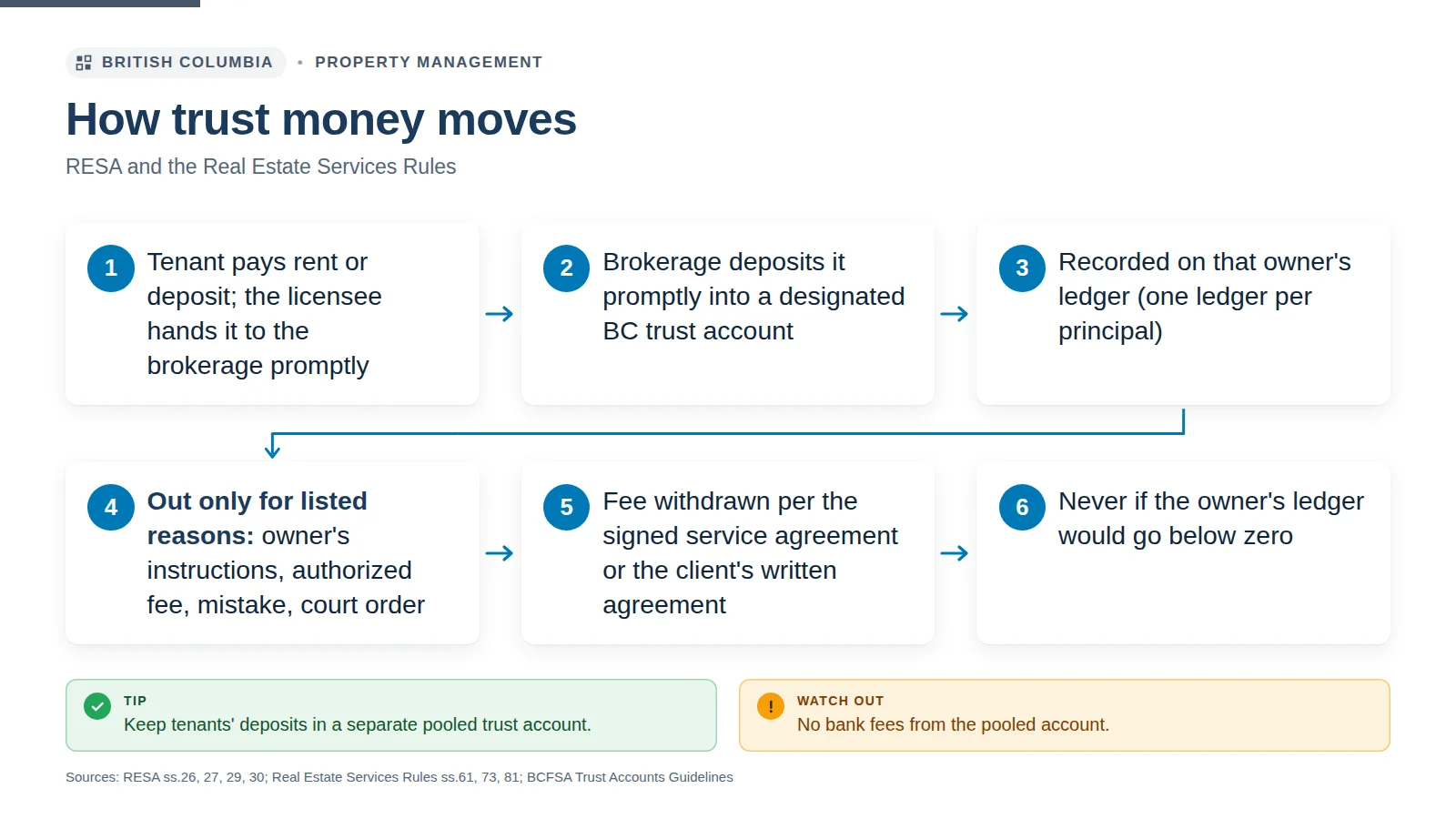
Section 26 of the Real Estate Services Act (RESA) requires a brokerage to keep one or more interest-bearing trust accounts with savings institutions in British Columbia. Each must be designated as a trust account both in the brokerage's records and at the institution. Rule 72 of the Real Estate Services Rules requires at least one managing broker as a signing authority on every trust account, and every cheque, statement and deposit slip must show it is a trust account.
BCFSA's Trust Accounts Guidelines describe two types. A pooled trust account holds money for more than one client. A designated trust account is opened for one client, in a name such as "Brokerage in trust for" that client.
Money in
Under RESA section 27, a licensee must promptly hand the brokerage all money received for a principal, and the brokerage must promptly deposit it into a trust account. Section 27(5) says, subject to the Rules, no other money may go into a brokerage trust account. Your operating money stays out.
Interest
Section 29 generally requires interest on brokerage trust accounts to be paid to the Real Estate Foundation. There are two exceptions that matter for rentals:
- Money held under a Residential Tenancy Act duty to pay interest to a tenant, such as security and pet damage deposits. BCFSA's trust guidelines pass on the Foundation's strong recommendation to keep a separate pooled trust account just for these deposits, so their interest is not paid to the Foundation.
- Money in a separate trust account for one principal, where interest follows that principal's instructions.
The RTB's prescribed deposit interest rate for 2026 is 0%, but earlier years were higher, so deposits held across several years still carry interest owed to tenants.
Money out
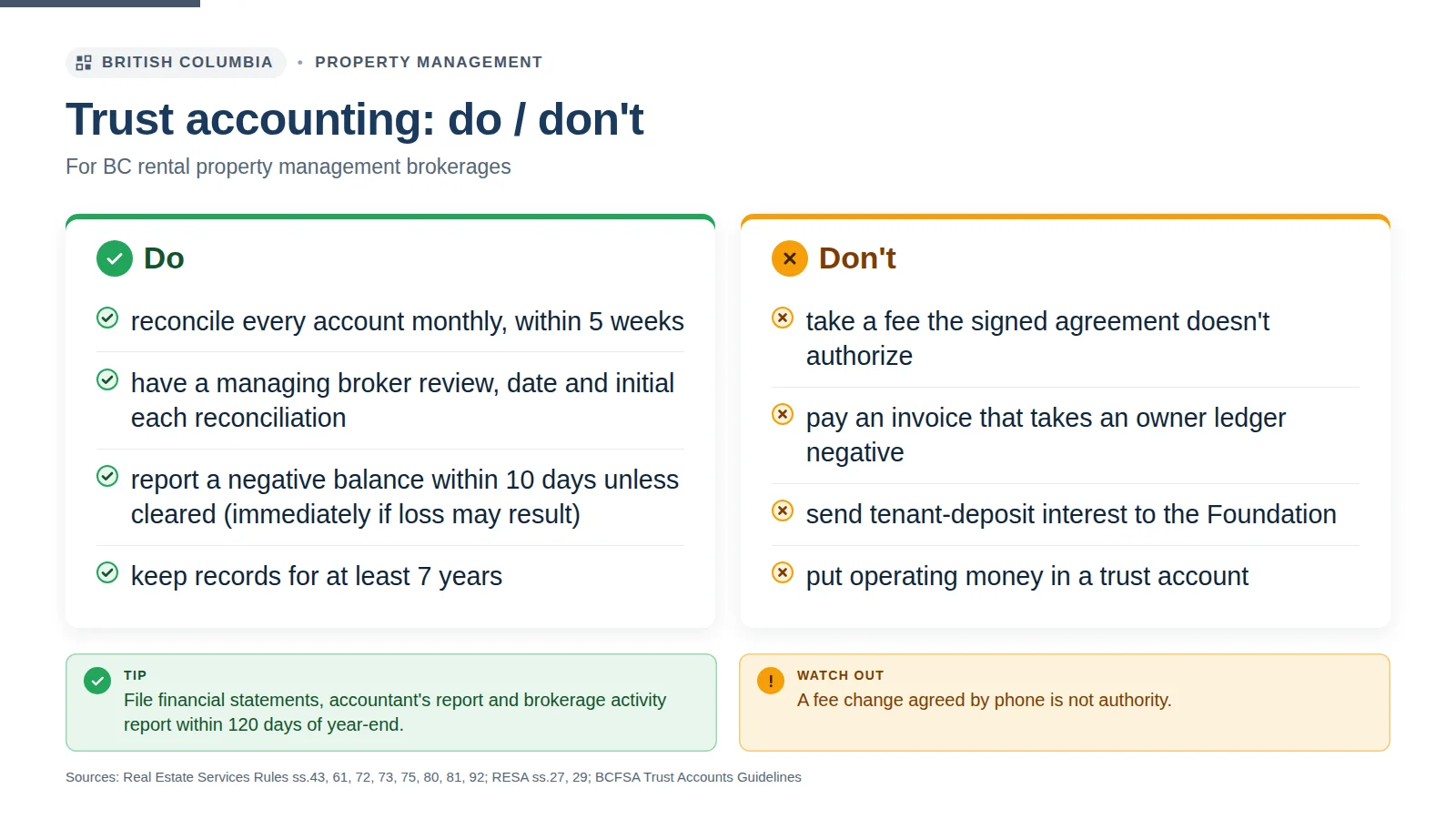
Section 30 lists the only reasons money may leave a trust account, including payments to or on the instructions of the principal, remuneration authorized under section 31, money deposited by mistake, and court orders. For rental management, Rule 61(4) says your fee may be withdrawn in accordance with the service agreement, or at a time the client agrees to in writing. BCFSA adds that bank service fees and credit card charges must not come out of a pooled trust account.
Never below zero
Rule 73 bars any payment that would take a trust account record or a trust ledger negative, or that relates to a ledger already negative. If a negative balance happens, you must act immediately to clear it and notify the superintendent:
- immediately, if a managing broker thinks it may lead to a claim for compensable loss;
- otherwise within 10 days after it arose, unless you clear it within that time.
BCFSA's guidelines stress that this applies to each owner's ledger, not just the account total.
The records
| Record | Rule | What it requires |
|---|---|---|
| Banking records | 80(a) | Keep statements, cancelled cheques and other source documents for each account |
| Trust account record | 80(b) | Amounts received and paid out, the reason for each, and the balance |
| Bank reconciliation | 80(c) | Monthly, prepared no later than 5 weeks after month-end |
| Owner trust ledgers | 81(a)(ii) | A separate ledger for each principal in a pooled account |
| Trust liability and asset reconciliation | 81(b) | Monthly, within 5 weeks: each person's balance, tied to the money in the account |
| Tenant and deposit record | 87(2) | Tenants at each property and the deposits each paid |
| Retention | 92 | At least 7 years |
Rule 72 requires each reconciliation to be reviewed, dated and initialled by a managing broker or their designate. Rule 90 requires all these records to be kept up to date.
Annual reporting
Rule 75 requires a brokerage, within 120 days after each fiscal year-end, to file financial statements, an accountant's report and a brokerage activity report with the superintendent. BCFSA's form for that third item is called the Brokerage Financial Information Filing. BCFSA's Regulatory Statement RESA 25-003 says you must give the accountant the monthly reconciliations for every month-end in the year, plus any month-ends after year-end before the accountant finishes the field work.
Common mistakes
- Fees without written authority. One of BCFSA's published cases involved a strata management brokerage withdrawing management fees with no valid service agreement or written permission, and taking increased fees without amending the agreement. The same written-authority rule applies to rental management fees.
- Deposit interest sent to the Foundation. Another published case: a brokerage let interest on a pooled rental trust account go to the Real Estate Foundation when it should have followed the Residential Tenancy Act.
- Bank fees from the pooled account. These belong in the operating account.
- Depositing your own money "to cover" a shortfall without recording why. Rule 76 lets the superintendent require you to cover a negative balance, but every movement needs a recorded reason.
- Owner draws before deposits clear. BCFSA suggests paying out only after an uncertified cheque has cleared.
Running trust accounting at scale
- Split the accounts. Keep one pooled account for rent and owner funds, and consider a separate pooled account for tenants' security and pet damage deposits.
- One ledger per owner, one line per transaction. Each entry names the property, the tenant or payee, and the reason.
- Tie the fee to the agreement. Record each owner's fee terms from the signed Rule 43 agreement and withdraw only on those terms.
- Close each month on a calendar. For September 2026, reconciliations are due no later than Wednesday, November 4, 2026, five weeks (35 days) after the September 30 month-end. Build in time for the managing broker's review and initials.
- Keep deposit records per tenancy. Note the amount, date received and the tenant, so returns and interest can be worked out at move-out.
- Prepare for the accountant all year. Twelve signed reconciliations and their supporting statements are the core of the annual accountant's report.
How Tenon10 helps
Tenon10 keeps lease, notice and payment records together for every unit you manage, so each tenant's rent and deposit can be traced back to its tenancy.
Property managers on the PM plan get a ledger for each owner, owner statements, and a check that stops an owner payout larger than that owner's balance. The monthly reconciliations, the trust liability listing and the managing broker's review stay your own routine; see pricing for the PM plan.
FAQ
Can I keep tenant deposits in my operating account?
No. Money received for a principal must go promptly into a brokerage trust account, and nothing else may go into that account.
Who gets the interest on a pooled trust account?
Generally the Real Estate Foundation, except for money held under a Residential Tenancy Act duty to pay interest to tenants, and money in a separate account for one principal.
When can I take my management fee?
In accordance with the service agreement, or at a time the client agrees to in writing.
How fast must I report a negative balance?
Immediately if a loss claim may result; otherwise within 10 days, unless you clear it first.
BC Rental Trust Accounting Checklist
A checklist for BC rental property management brokerages: trust account set-up, money in and out, negative balances, interest, records and annual reporting.
Get Free PDF →Owner ledgers that hold up
On the PM plan, Tenon10 gives you a ledger and a statement for each owner, and stops an owner payout larger than that owner's balance.
Built for Canadian landlords and property managers.
Related BC guides
- BC Security and Pet Damage Deposits: The Complete Landlord Guide
- The 15-Day Rule: Returning a Deposit at the End of a BC Tenancy
- When a BC Landlord Must Pay Back Double the Deposit
Sources: Real Estate Services Act; Real Estate Services Rules; BCFSA: Trust Accounts Guidelines; BCFSA: Brokerage Reporting Requirements; RTB: Deposits and fees. This article is a summary of British Columbia rules as of October 2026, not legal advice. Check BCFSA for your situation.