Collecting rent for an owner, signing a contractor, handling a tenant's complaint: in British Columbia, doing any of these for someone else for pay is a licensed activity. The regulator is the BC Financial Services Authority (BCFSA), and the law is the Real Estate Services Act and its Rules.
Many people drift into property management. A realtor helps an investor client find tenants and is then asked to "just collect the rent". A relative manages a few units for a fee. A small firm grows from two buildings to twenty. Each step can cross a line that BC draws clearly in legislation, with real consequences, including the loss of the right to sue for unpaid fees.
This guide explains what counts as rental property management, who needs a licence and at what level, the exemptions, how licensing works, and the business and record rules that apply once you are licensed.
BC Property Management Licensing Checklist
A checklist for BC property managers: when RESA s.3 requires a licence, the exemptions, licensing and renewal, and the service agreement and trust rules that follow.
Get Free PDF →The rule: what needs a licence
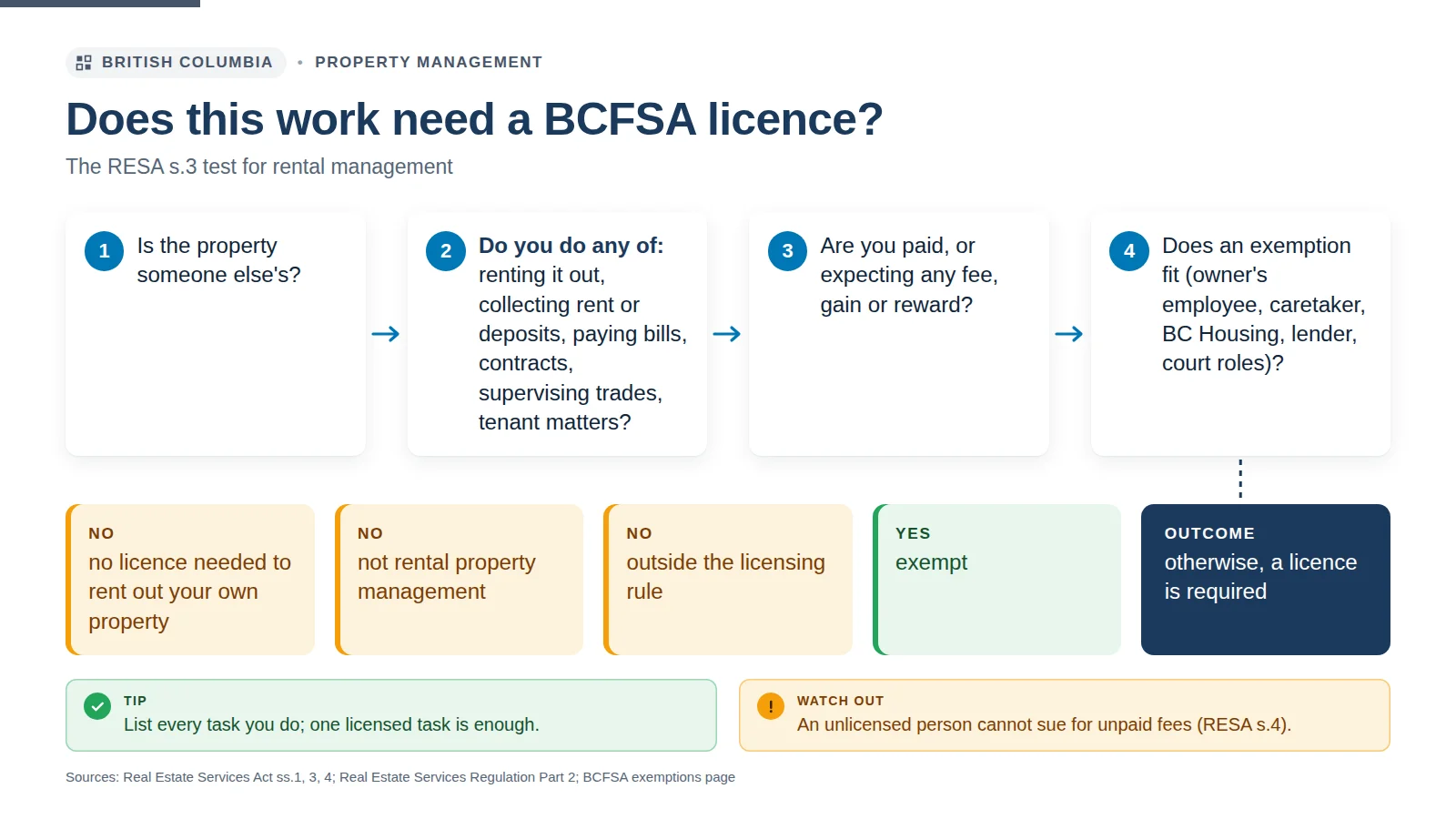
Section 3 of the Real Estate Services Act (RESA) says a person must not provide real estate services to or on behalf of another, for or in expectation of remuneration, unless they are licensed for those services or exempt. "Real estate services" includes rental property management services, which the Act defines as any of these, provided to or on behalf of an owner of rental real estate:
- trading services in relation to renting the property;
- collecting rents or security deposits;
- managing the property for the owner by making payments to third parties, negotiating or entering into contracts, supervising employees or contractors hired by the owner, or managing landlord and tenant matters.
"Remuneration" is broad. It includes any commission, fee, gain or reward, received directly or indirectly. BCFSA's licensing exemptions page is clear that you do not need a licence to rent out your own property. The licence question starts when you act for someone else.
Why it matters financially
Section 4 of RESA says no action may be brought for remuneration for real estate services unless the person claiming it was licensed or exempt when the services were provided. An unlicensed manager may be unable to sue an owner for unpaid fees. And under Rule 66 of the Real Estate Services Rules, a licensee must not pay remuneration to a person who needs a licence for the services but does not have one.
Licence levels and categories
RESA section 5 sets four licence levels, and Rule 2 sets the categories of service within each level.
| Licence level | What it authorizes |
|---|---|
| Brokerage | The business. It provides services through its managing broker, associate brokers and representatives. A corporation or partnership can only be licensed at this level unless the regulations allow otherwise. |
| Managing broker | Acts for the brokerage for all purposes under the Act and is responsible for its conduct, including supervising licensees. |
| Associate broker | Provides services under a managing broker's supervision; must meet managing broker education and experience requirements. |
| Representative | Provides services under a managing broker's supervision. |
The categories are trading services, rental property management services and strata management services, alone or in combination. A brokerage may only provide the services its managing broker's licence permits. A managing broker, associate broker or representative must be licensed to, and engaged by, a brokerage, and must not provide real estate services except on that brokerage's behalf.
Trading licence or rental property management licence?
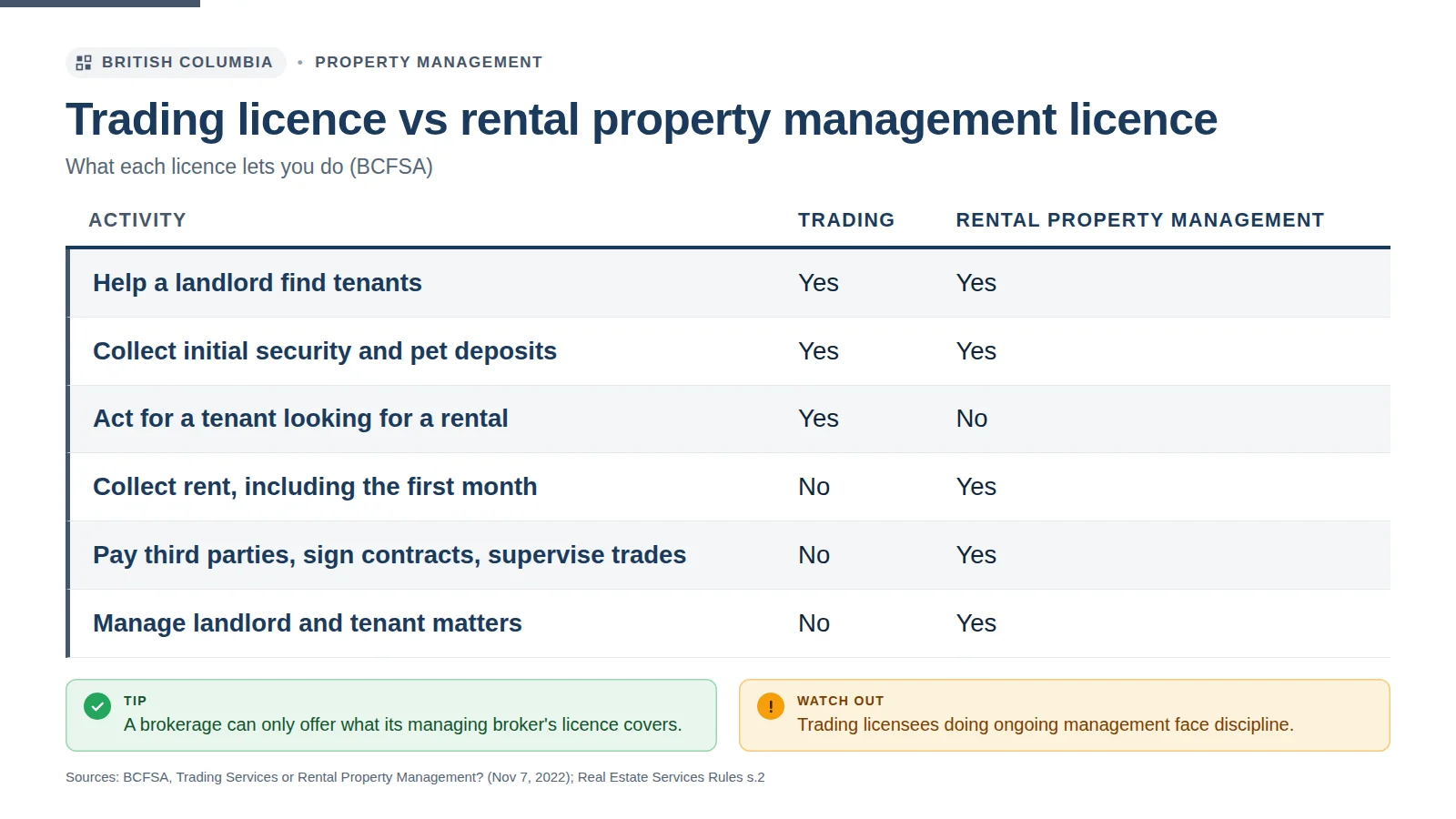
BCFSA has addressed the question directly. Both trading and rental property management licensees can help an owner find tenants and collect the initial security and pet damage deposits. Any ongoing management, including collecting the first month's rent, needs a rental property management licence. A licensee with only a rental property management licence cannot act for prospective tenants looking for a place to rent.
Exemptions: who does not need a licence
RESA section 3(3) and Part 2 of the Real Estate Services Regulation list exemptions. The ones that touch rentals:
- Employees of the owner. An individual employed by the principal, providing services only to that principal, is exempt. BCFSA says independent contractors and third-party companies are not employees for this purpose.
- Caretakers for several owners. A caretaker or manager employed by each of several owners, who have agreed among themselves, is exempt, but must promptly deliver all rent and deposits to the owner concerned.
- Caretakers employed by a licensed brokerage. Exempt for collecting money (delivered promptly to the brokerage), showing units, taking applications, supervising contractors and communicating between landlords and tenants. Not for negotiating or entering into contracts. BCFSA adds that the excluded activities include move-in and move-out inspections.
- Certain BC Housing units rented on an income basis, and non-profits with an agreement with BC Housing for those units.
- Lenders with an assignment of rents, such as a savings institution or registered mortgage broker.
- Court-appointed and similar roles: people acting under court authority, trustees in bankruptcy and receivers, executors for the estate's property, trustees under a will or trust, trust companies with a trust business authorization, and practising lawyers in their practice.
Rules 94 and 95 also let a licensee manage their own rental property, or manage without pay for a spouse, child or parent, outside the Act, if they do it in their own name, keep their brokerage off the advertising, tell each prospective tenant they are not acting as a licensee, and make the written disclosures the Rules require (to their managing broker, and for family, to the relative too).
Getting licensed
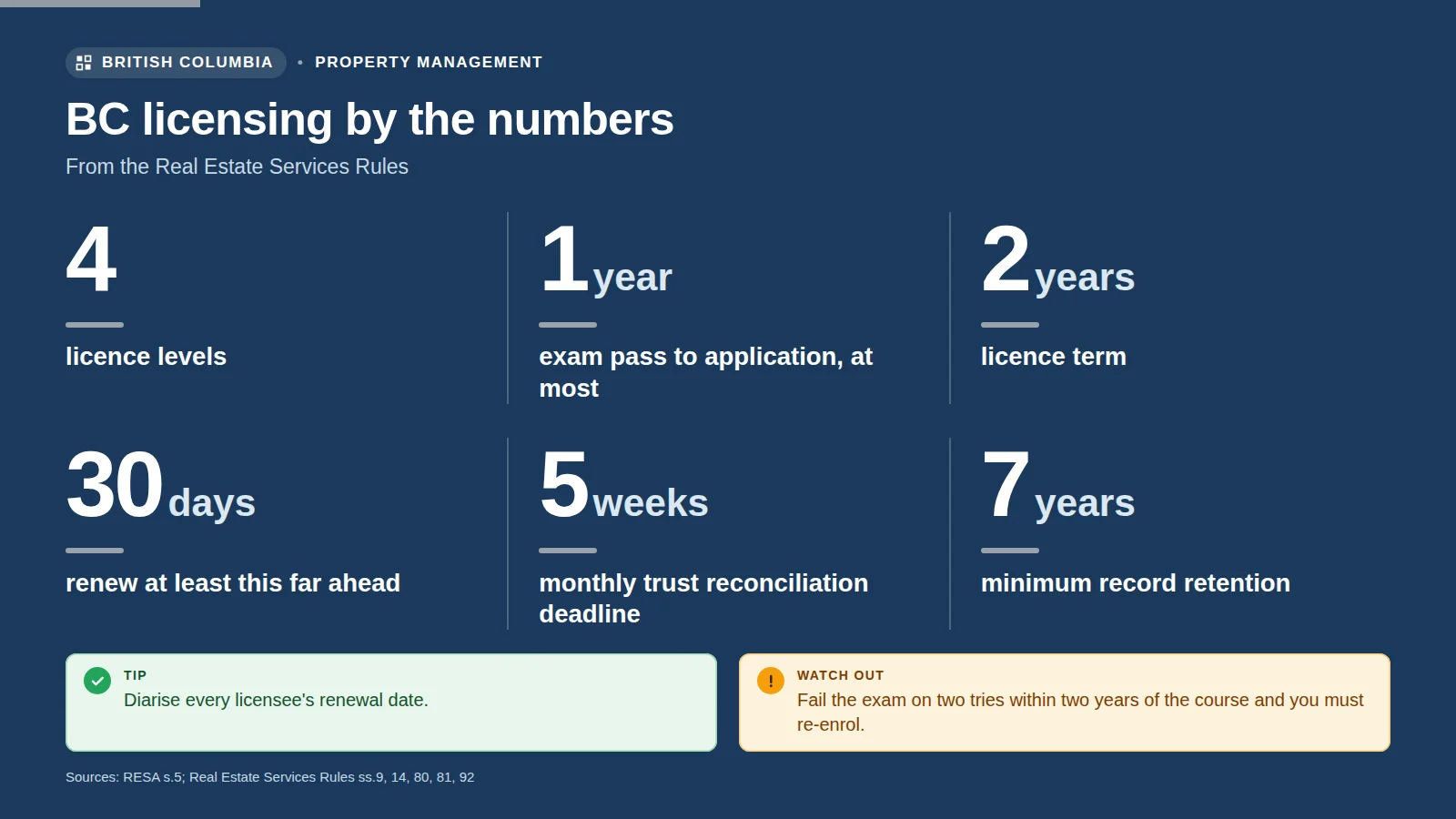
Under Rule 9, an individual applying for a new licence must take the licensing courses the superintendent specifies, complete the assignments, and pass the examination no more than one year before applying. BCFSA says UBC offers the mandatory licensing courses on its behalf. BCFSA's education FAQs add that a student who does not pass the licensing exam on the first or second attempt within two years of finishing the course must re-enrol in the course.
Managing brokers and associate brokers must also complete the managing broker courses the superintendent specifies. A licence runs for two years, and Rule 14 requires you to apply to renew at least 30 days before it ends.
Rules that apply once you are licensed
A written service agreement first
Rule 43 requires a brokerage to have a written service agreement with the owner before providing rental property management services, unless the client waives it. It must be signed by the client and an authorized brokerage signatory and include the parties, property address, effective date and duration, a description of services and the remuneration. For rental management it must also cover termination, the brokerage's authority to sign cheques and contracts, the timing and nature of accounting statements, how deposits are handled, and the records kept. Changes must be in writing and signed by both. A copy goes to the client immediately on signing.
Duties and disclosure
Rule 30 requires a brokerage to act in the client's best interests, within the client's authority, and to avoid and disclose conflicts. Rule 45 requires written authorization before signing a contract for a client. Rule 58 requires disclosure, before acceptance, of any benefit the licensee expects from spending the owner's money, such as a supplier rebate.
Trust money and records
Rent and deposits collected for owners are trust money. RESA requires them to go promptly into an interest-bearing brokerage trust account at a BC savings institution, designated as a trust account. Rules 79 to 92 require detailed ledgers, monthly reconciliations within 5 weeks of month-end, records of tenants and deposits for each property, and retention for at least 7 years.
Common mistakes
- "I'm only doing it for family." RESA and its Regulation contain no general exemption for managing a relative's property for pay. If you are paid or expect any reward, the section 3 test applies.
- Calling a contractor an employee. The employee exemptions need a genuine employment relationship. BCFSA points to common law tests, such as a T4 or WorkSafeBC coverage.
- A trading licensee collecting monthly rent. BCFSA warns that trading licensees providing ongoing management without the right licence face disciplinary action.
- Starting before the agreement is signed. Rule 43 requires the agreement before any rental management services are provided.
- Fee changes by email. An increased fee needs a written amendment signed by both sides.
Building a compliant operation as you grow
- Confirm the licence category for every service you sell, and that your managing broker's licence covers it.
- Standardize the service agreement so every Rule 43 item is present, and track each owner's signed version and amendments.
- Separate trust money from operating money from day one, with one ledger per owner.
- Diarise licence renewals for every licensee at least 30 days before expiry.
- Plan for handovers. Under Rule 87, if a former client asks, you must provide their trust records, tenancy agreements, invoices and tenant and deposit records by the later of 2 weeks after the request and 4 weeks after services end.
How Tenon10 helps
For each tenancy you manage, Tenon10 keeps the lease, notices and payment records together, generates a BC tenancy agreement with every detail the Act requires and the standard terms copied word for word from the current Regulation, and generates the RTB notices managers serve most, such as the Notice of Rent Increase (RTB-7) and the 10 Day Notice (RTB-30). Those are the RTA-side duties a licensed manager carries for every owner.
Property managers on the PM plan get a ledger for each owner, owner statements, and a check that stops an owner payout larger than that owner's balance; the trust reconciliations and the managing broker's review stay your brokerage's own routine. Property management firms (and landlords with 21 or more units) can invite team members and property owners with role-based permissions. See pricing for the PM plan.
FAQ
Do I need a licence to manage my own rentals?
No. BCFSA says a person does not need a licence to rent out their own property.
Can a realtor collect rent for an investor client?
Only with a rental property management licence. A trading licence covers finding tenants and initial deposits, not ongoing management or the first month's rent.
Can a company hold the licence?
A corporation or partnership can be licensed only as a brokerage, which must have a licensed managing broker.
Is a building caretaker required to be licensed?
Not if they fit an exemption, such as an employee of the owner or of a licensed brokerage, and stay within its limits.
How long is a licence valid?
Two years. Apply to renew at least 30 days before the term ends.
BC Property Management Licensing Checklist
A checklist for BC property managers: when RESA s.3 requires a licence, the exemptions, licensing and renewal, and the service agreement and trust rules that follow.
Get Free PDF →Keep every tenancy file complete
Tenon10 generates a BC tenancy agreement with the current standard terms and the RTB notices you serve most, keeps lease, notice and payment records together, and on the PM plan gives you a ledger and a statement for each owner.
Built for Canadian landlords and property managers.
Related BC guides
- BC Security and Pet Damage Deposits: The Complete Landlord Guide
- The BC Residential Tenancy Agreement (RTB-1): The Complete Landlord Guide
- Serving 2027 BC Rent Increases Across a Portfolio in Tenon10
Sources: Real Estate Services Act; Real Estate Services Rules; Real Estate Services Regulation; BCFSA: Licensing Exemptions Information; BCFSA: Trading Services or Rental Property Management?; BCFSA: Licensing Education; BCFSA: Education and Licensing FAQs; Residential Tenancy Act. This article is a summary of British Columbia rules as of October 2026, not legal advice. Check BCFSA and the Residential Tenancy Branch for your situation.