Your parents own a condo in Kelowna and spend winters abroad. Your best friend is posted overseas for two years and asks you to keep an eye on her rented townhouse. Your uncle offers you a few hundred dollars a month to collect rent from his basement tenant. In British Columbia, whether any of these needs a real estate licence depends less on the relationship and more on two facts: whose property it is, and whether you get anything back.
Family and friends do this all the time, and most assume a favour is outside the rules. Often it is. But the Real Estate Services Act counts indirect and in-kind rewards, and BC has no family exemption for paid help. This guide looks only at the family-and-friends question. For licence levels, brokerages and how to get licensed, see our guide to BCFSA licensing for rental property management.
Family or Friend Rental Help: BC Licence Checklist
Get Free PDF →The two questions that decide it
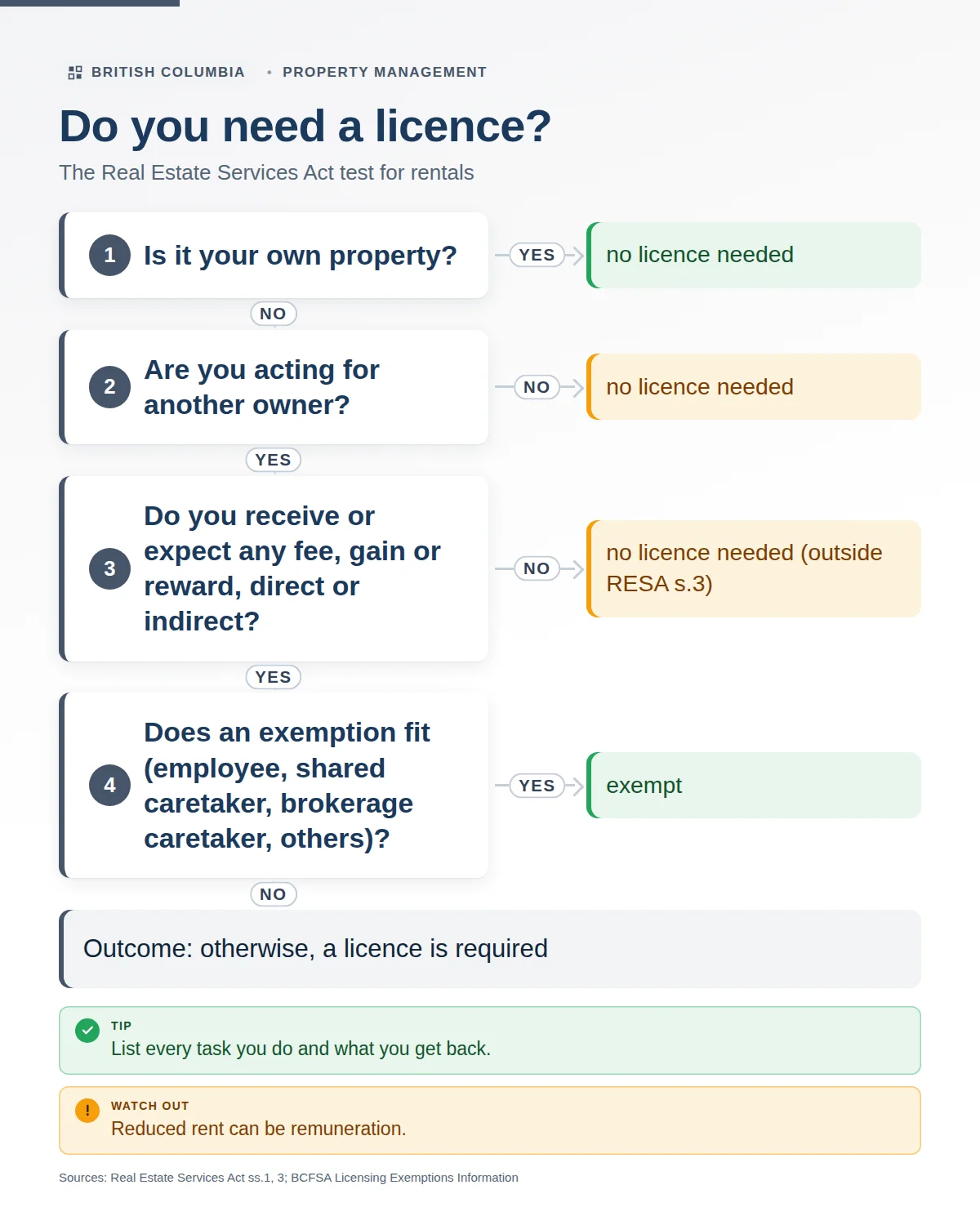
Section 3 of the Real Estate Services Act says a person must not provide real estate services to or on behalf of another, for or in expectation of remuneration, unless licensed for those services or exempt. Real estate services include rental property management services, which the Act defines to cover:
- finding and placing tenants and other trading services in relation to renting;
- collecting rents or security deposits;
- managing the property for the owner: paying third parties, negotiating or entering into contracts, supervising the owner's employees or contractors, and managing landlord and tenant matters.
So the test for a relative or friend comes down to two questions.
1. Is it someone else's property?
BCFSA's licensing exemptions page says you do not need a licence to provide real estate services to yourself, such as renting out your own property. If you co-own the rental with your parent or spouse, you are managing property you own. If your name is not on title, you are acting for another, even if the owner is your mother.
2. Do you receive, or expect, anything in return?
The Act defines remuneration as any form of remuneration, including any commission, fee, gain or reward, whether received or to be received, directly or indirectly. Help that is genuinely free is outside section 3. Help that earns something, in cash or otherwise, is inside it.
What counts as being paid

This is where most family arrangements go wrong. BCFSA's regulatory statement on indirect remuneration (RESA 23-016) says no licence is required for services provided without remuneration, but that indirect remuneration includes in-kind benefits and payment for ancillary services. Where a commercial or business relationship exists, BCFSA says the remuneration cannot be separated from the real estate services, so a licence is required.
Arrangements that can be remuneration even though no "management fee" changes hands:
- Reduced or free rent. Your cousin lives upstairs at a discount in exchange for collecting rent from the downstairs suite.
- A bundled job. A friend paid to do the property's repairs or cleaning who also finds the tenants "for no additional charge". BCFSA's statement uses this kind of example.
- Use of the property. Free use of a cabin, parking or storage in return for looking after the tenants.
- A share of the rent or the sale. A promise of a cut later is remuneration "to be received".
Covering your out-of-pocket costs is different from a reward, but keep it to receipts. A flat monthly "expenses" amount starts to look like a fee.
When a paid relative or friend can still be exempt
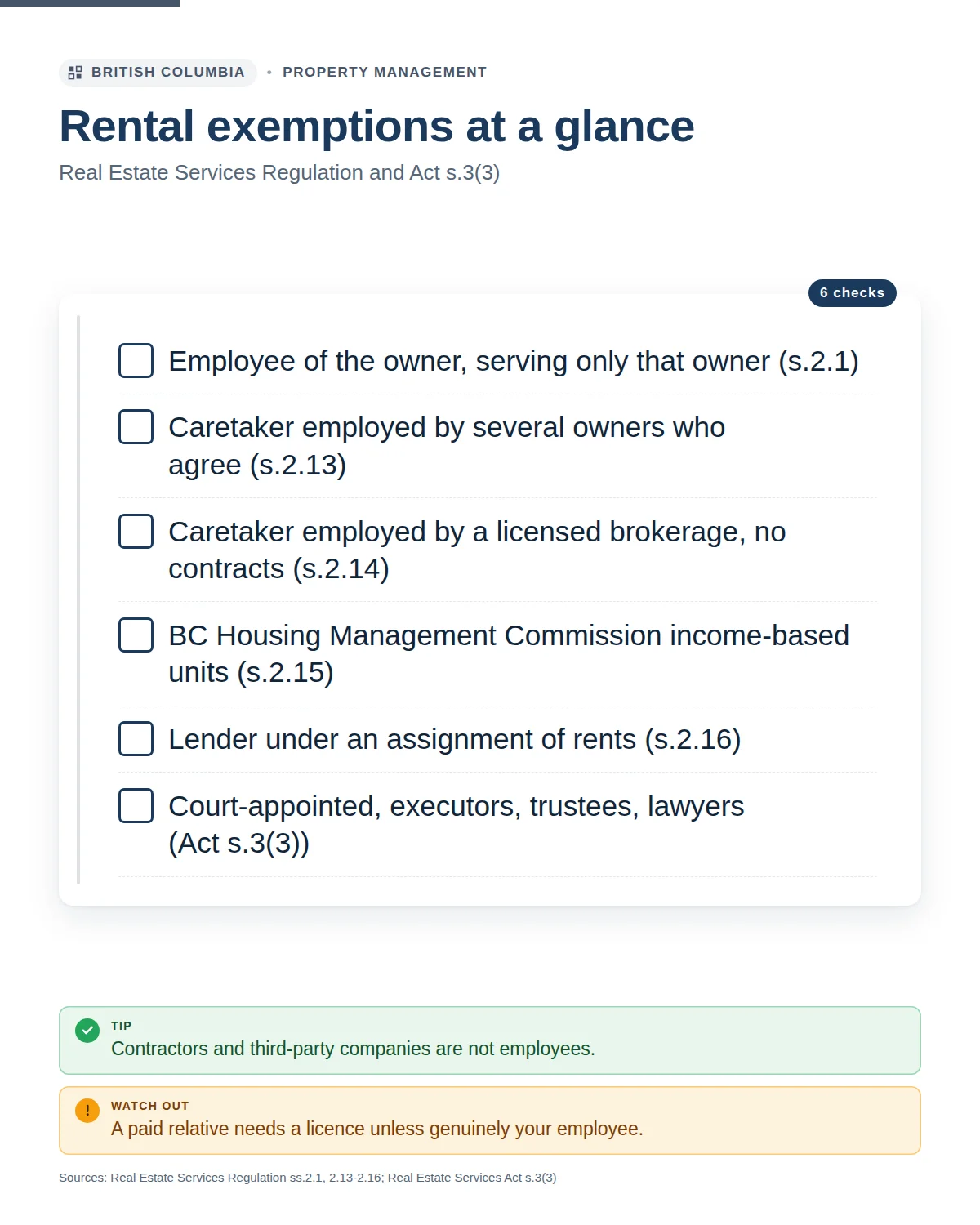
They are genuinely the owner's employee
Section 2.1 of the Real Estate Services Regulation exempts an employee who provides real estate services to their employer, the principal, and to no one else. BCFSA says this means an employee, not an independent contractor or a third-party company. The Act does not define "employee", so the usual employment tests apply; BCFSA points to signs such as a T4 or coverage through the employer's WorkSafeBC program.
In practice, a relative who is paid by cheque each month with no payroll, sends the owner an invoice, or helps several unrelated owners is unlikely to qualify. A relative on the owner's payroll who manages only that owner's rental can.
They are a caretaker shared by family owners
Section 2.13 of the Regulation exempts an individual employed as a caretaker or manager by the owners of different residential properties, if the individual is an employee of each owner, the owners have agreed among themselves to the arrangement, and the individual serves no one else. Money collected must be delivered promptly to the owner concerned. Two siblings who each own a rental can share one employed caretaker this way.
They are the executor or a trustee
Section 3(3) of the Act exempts an executor or administrator of an estate for real estate owned or held by the estate, and a trustee acting under a will, marriage settlement or deed of trust. If a parent has died and you are managing their rental as executor, this exemption covers you while you act in that role. It does not cover managing a living parent's rental under a power of attorney, which the Act does not list.
They are already a licensee and help for free
Rule 95 of the Real Estate Services Rules lets a licensed managing broker, associate broker or representative manage a rental for their spouse, child or parent, or for a partnership or corporation made up only of those family members and the licensee, outside the Act and Rules. The help must not be for or in expectation of remuneration, and the licensee must act in their own name, keep their brokerage off the advertising, tell each potential tenant before a tenancy agreement that they are not acting as a licensee, and disclose in writing to the family member and their managing broker. A licensed sibling, cousin or friend does not fall under Rule 95.
What is at stake
- The helper cannot sue for the fee. Section 4 of the Act says no action may be brought or continued for remuneration for real estate services unless the person was licensed or exempt when they provided them.
- Penalties for unlicensed activity. Under section 49, BCFSA can order an unlicensed individual to pay a penalty of up to $250,000 (up to $500,000 for a corporation or partnership), plus an additional penalty up to the remuneration accepted.
- The owner is still the landlord. The Residential Tenancy Act defines "landlord" to include the owner and the owner's agent or another person who acts on the landlord's behalf. Your relative takes on landlord duties to the tenant, and the tenant's rights do not shrink because the helper was family.
Your options
- Keep it a genuine favour. No money, no reduced rent, no bundled paid work. Keep receipts for any costs you repay.
- Put them on payroll. Make the relative your employee, working only for you, with the usual payroll and WorkSafeBC steps.
- Add them to title. A co-owner manages property they own. This has tax and legal consequences of its own, so weigh it carefully.
- Hire a licensed brokerage. The family member can stay the owner's contact while a licensee does the regulated work.
- The helper gets licensed. If they want to do this for pay, for you and others, see the licensing guide.
How Tenon10 helps
When a relative or friend helps with your rental, it is easier when the records live in one place. Tenon10 keeps each tenancy's lease, notices and payment records together. It generates a BC tenancy agreement with every detail the Act requires and the standard terms copied word for word from the current Regulation, and BC forms such as the Notice of Rent Increase (RTB-7) and the 10 Day Notice to End Tenancy for Unpaid Rent or Utilities (RTB-30). Tenants can send maintenance requests, with emergency priority for urgent repairs.
Tenon10 does not decide whether an arrangement needs a licence, and does not file RTB applications. Disputes are filed directly with the Residential Tenancy Branch.
FAQ
Can I manage my parents' rental for free in BC?
Yes. If you receive nothing in return, directly or indirectly, section 3's licence requirement does not apply. Watch for indirect benefits such as reduced rent.
My brother lives in the upstairs unit at a discount and deals with the basement tenant. Is that a problem?
It can be. The discount can be remuneration, because the Act counts any gain or reward received directly or indirectly. Either remove the link between the discount and the work, or use an exemption such as making him your employee.
Does a power of attorney let me manage my mother's rental for pay?
The Act's exemptions list executors, administrators and trustees, not attorneys under a power of attorney. Paid management under a power of attorney needs a licence or another exemption.
My friend is a licensed realtor. Can she manage my rental as a favour?
Rule 95 only covers a licensee's spouse, child or parent. For a friend, a licensee would normally provide the services through their brokerage, under the Act and Rules.
What if I paid a relative last year without knowing this?
Stop the paid arrangement or move it onto an exempt footing now. Section 4 means an unlicensed helper may be unable to recover unpaid fees, and BCFSA can penalize unlicensed activity.
Family or Friend Rental Help: BC Licence Checklist
Get Free PDF →Sharing the work on a family rental?
Tenon10 keeps the lease, notices and payment records in one place and generates the BC forms you serve most.
Built for Canadian landlords and property managers.