Most property management software demos look the same: a dashboard, a rent roll, an online payment button. For a BC brokerage, the differences that matter sit underneath. Does it hold the RTB's forms and deadlines correctly? Can it produce the trust records the Real Estate Services Rules require, month after month, without a spreadsheet on the side?
Choosing on features alone is how managers end up with a system that collects rent nicely and leaves the trust reconciliation to someone working late in week five. This guide sets out what BC law requires of a rental property management brokerage, turns that into an evaluation checklist, and lists the questions to ask any vendor.
BC Property Management Software Checklist
A checklist for BC rental property managers comparing software: BC forms and calculations, deposit clocks, per-owner trust ledgers, monthly reconciliations and a clean switch-over.
Get Free PDF →What BC rules your software has to support

Two bodies of law shape the job. The Residential Tenancy Act governs every tenancy you manage. The Real Estate Services Act and the Real Estate Services Rules govern you as a brokerage, and the BC Financial Services Authority (BCFSA) enforces them.
Tenancy side
- Approved forms and required content: a rent increase notice must be in the approved form, the RTB-7 (s.42(3)), and a landlord's notice to end tenancy must be in the approved form (s.52(e)). The tenancy agreement must contain the Regulation's standard terms, and a condition inspection report must contain the information the Regulation lists.
- Rent increase limits: 2.2% for increases taking effect in 2027, once every 12 months, with three full months' notice.
- Deposit limits and clocks: security and pet damage deposits each up to half a month's rent; repayment or a claim within 15 days after the later of the tenancy ending and the forwarding address in writing, or the landlord may owe double.
- Deemed receipt: a mailed notice is deemed received on the fifth day; email to an address given for service, on the third.
Brokerage side
| Requirement | Source |
|---|---|
| Promptly pay money held for a principal into a brokerage trust account | RESA s.27(2) |
| A record of every receipt and disbursement, with the reason and unexpended balance, for each account | Rules s.80(b) |
| Monthly bank reconciliation, no later than 5 weeks after month-end | Rules s.80(c) |
| A separate trust ledger for each rental property management principal in a pooled account | Rules s.81(a)(ii) |
| Monthly trust liability and asset reconciliation, no later than 5 weeks after month-end | Rules s.81(b) |
| Reconciliations reviewed, dated and initialled by a related managing broker or designate | Rules s.72(2) |
| No payment that would take a trust record or ledger negative | Rules s.73(1) |
| Records of tenants and of every deposit paid by each tenant | Rules s.87(2) |
| Records kept at least 7 years | Rules s.92 |
| Records to a former client within the later of 2 weeks after the request or 4 weeks after services end | Rules s.87(4) |
| Financial statements, accountant's report and activity report within 120 days of fiscal year-end | Rules s.75(1) |
BCFSA's trust account guidelines add a practical point: interest on an account held under the Residential Tenancy Act, where the interest is to be paid to a tenant, is not held for the Real Estate Foundation, and the guidelines pass on the Foundation's strong recommendation to keep a separate pooled trust account for security and pet deposits only.
An evaluation checklist for BC managers
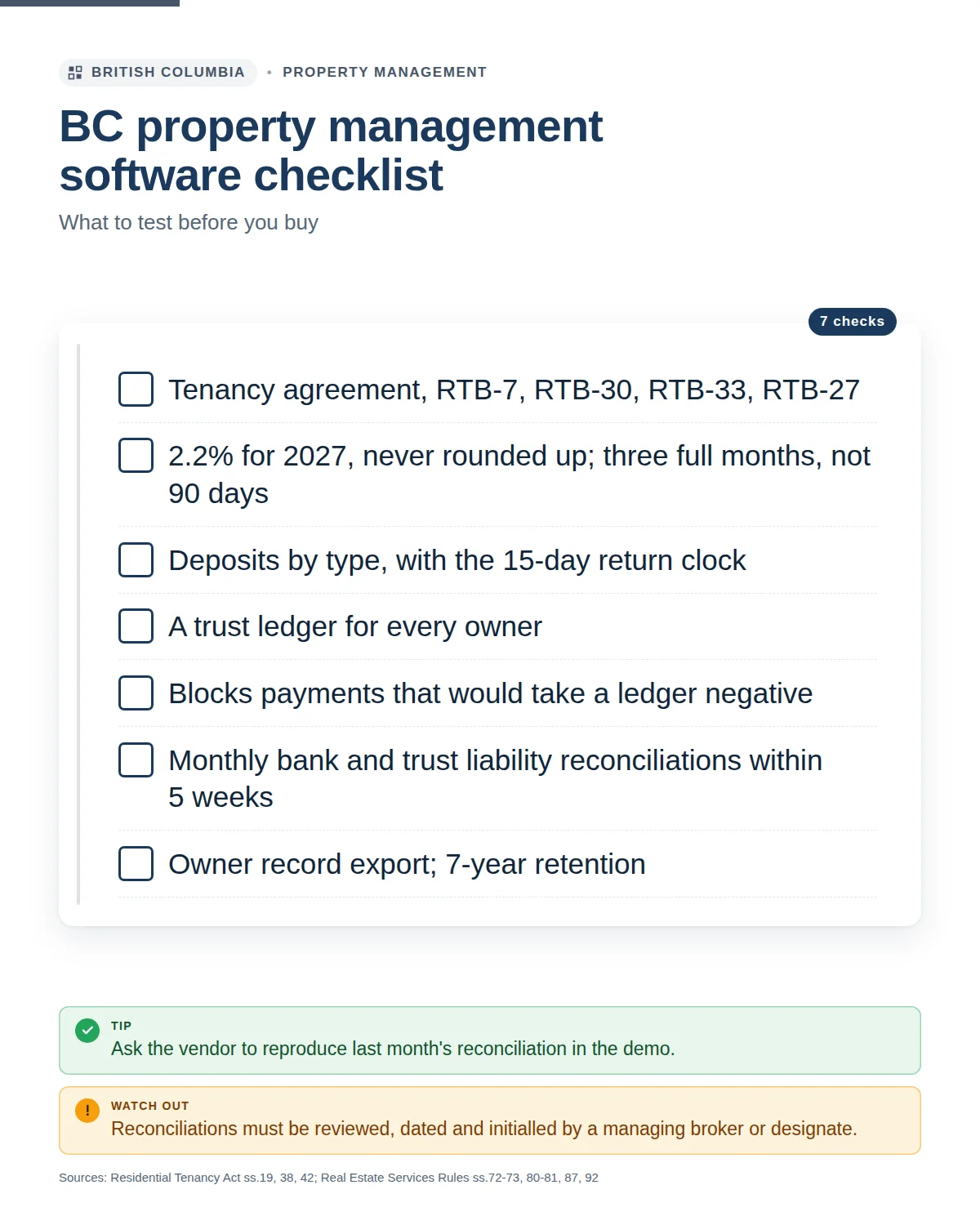
- BC forms, not generic notices. Does it produce a BC tenancy agreement with the current standard terms, and the RTB's own forms (RTB-7, RTB-30, RTB-33, RTB-27) filled from tenancy data?
- BC calculations. Does it apply 2.2% for 2027 without rounding up, and count three full months, not 90 days?
- Deposit tracking. Does it record each deposit by type and run the 15-day return clock from the later of the two trigger dates?
- Per-owner trust ledgers. Does every receipt and payment post to a ledger for the owner it belongs to?
- Negative-balance block. Does it stop, or at least warn on, a payment that would take an owner's ledger below zero?
- Monthly reconciliations. Does it produce both the bank reconciliation and the trust liability listing, dated, with space for the managing broker's review?
- Records and export. Can you export everything for one owner when they leave, inside the 2-week and 4-week windows, and keep it for 7 years?
- Evidence record. Are leases, notices with proof of service, inspection reports and payments kept together per tenancy for an RTB hearing?
Common mistakes when choosing
- Buying for the owner portal, not the trust account. Owners see statements; BCFSA sees reconciliations.
- Accepting "configurable" for BC forms. A notice you configure yourself is one you are responsible for keeping current.
- Assuming Ontario-built logic travels. Ontario requires at least 90 days' written notice of a rent increase; BC requires three full months, a different count.
- Pooling tenants' deposits with operating rent without checking how deposit interest will be handled.
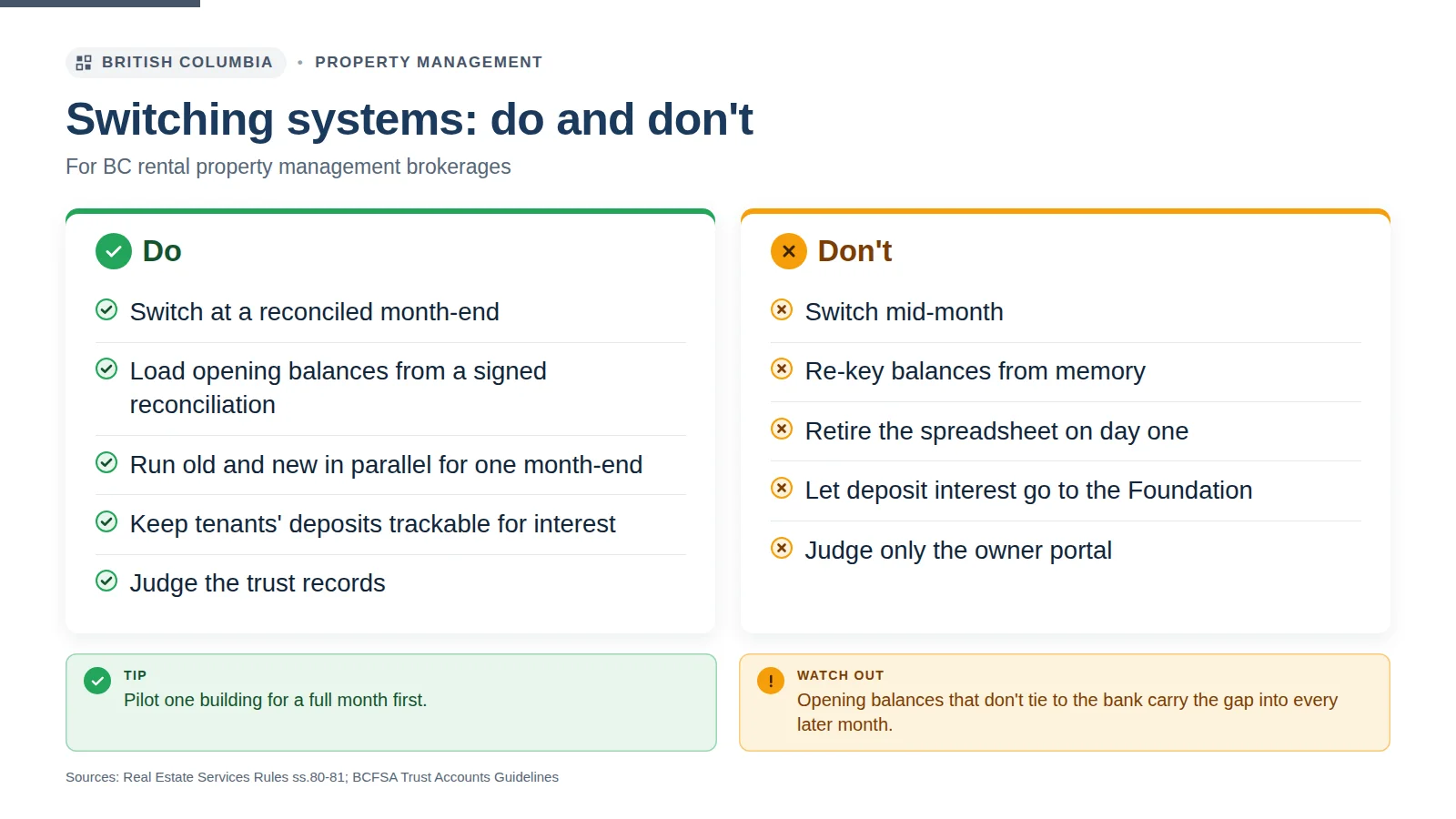
- Skipping the migration plan. Opening balances per owner must tie to the trust bank balance on day one, or every later reconciliation inherits the gap.
Rolling out across a portfolio
- Pilot one building for a full month, including a reconciliation.
- Load owners and opening balances from your last signed reconciliation.
- Load tenancies: rent, due day, last increase date, deposits and the forwarding-address status of any ended tenancy.
- Run old and new in parallel for one month-end and compare the trust liability listings line by line.
- Retire the spreadsheet only when both agree to the cent.
How Tenon10 helps
On the tenancy side, Tenon10 generates a BC tenancy agreement with every detail the Act requires and the standard terms copied word for word from the current Regulation, plus the RTB-7, RTB-30, RTB-33, RTB-29 and the fillable RTB-27. Deposit tracking follows the 15-day return clock and flags the double-penalty risk.
For the brokerage side, property managers on the PM plan get a ledger for each owner, owner statements, and a check that stops an owner payout larger than that owner's balance (see pricing). The monthly reconciliations stay your own routine, so hold any system, ours included, to one test: its owner balances should agree with your last signed reconciliation.
FAQ
Does BC require a particular software for trust accounting?
No. The Rules set the records and reconciliations you must keep, not the tool. Many brokerages use accounting software; what matters is that the records meet ss.80 and 81.
How fast must a month be reconciled?
No later than 5 weeks after the end of the month, for both the bank reconciliation and the trust liability and asset reconciliation.
Who signs off the reconciliation?
A related managing broker, or a person they designate, must review, date and initial it.
How long must records be kept?
At least 7 years under s.92, unless the superintendent authorizes a shorter period in writing.
BC Property Management Software Checklist
A checklist for BC rental property managers comparing software: BC forms and calculations, deposit clocks, per-owner trust ledgers, monthly reconciliations and a clean switch-over.
Get Free PDF →See Tenon10 against your BC checklist
Tenon10 generates a BC tenancy agreement with the current standard terms and the RTB-7, RTB-30, RTB-33 and a fillable RTB-27, and tracks the 15-day deposit clock.
Built for Canadian landlords and property managers.
Related BC guides
- Serving 2027 BC Rent Increases Across a Portfolio in Tenon10
- The 15-Day Rule: Returning a Deposit at the End of a BC Tenancy
- Automating BC Rent Reminders and 10 Day Notices in Tenon10
Sources: Real Estate Services Act; Real Estate Services Rules; BCFSA: Trust Accounts Guidelines; Residential Tenancy Act; RTB: Rent increases; RTB Policy Guideline 12. This article is a summary of British Columbia rules as of October 2026, not legal advice. Check the Residential Tenancy Branch for your situation.