On the second day of every month, someone at your firm opens a spreadsheet, checks which tenants paid, and starts chasing the rest. If you manage 60 or 120 units across several BC buildings, that morning can turn into a week of phone calls, form filling and trips to the door with a witness.
The legal steps for unpaid rent in British Columbia are fixed. What you control is how fast and how consistently your team moves through them. A missed signature or a lost proof of service on one unit can cost a month of rent while you start over.
This article sets out a repeatable arrears workflow for property managers, the rules each step has to respect, and where Tenon10 fits in.
BC Monthly Arrears Workflow Checklist
A property manager's monthly checklist for BC rent arrears: reminders, reconciling payments, serving the RTB-30, the five-day window and the arrears file.
Get Free PDF →The rules your workflow has to follow

Any rent collection process in BC is built around section 46 of the Residential Tenancy Act and the RTB-30 form:
| Step | Rule | Source |
|---|---|---|
| Rent due | Tenant must pay when due under the agreement, whether or not the landlord has complied with the Act, unless the Act allows a deduction | RTA s.26 |
| Late fee | Up to $25, only if the tenancy agreement provides for it | RTB paying rent page |
| 10 Day Notice | Can be given on any day after the day rent is due | RTA s.46(1) |
| Effective date | At least 10 days after the tenant receives the notice | RTA s.46(1) |
| Tenant response | Pay in full or dispute within 5 days of receipt | RTA s.46(4) |
| No response | Tenant presumed to accept the end of tenancy; landlord may apply by Direct Request ($100 fee) | RTA s.46(5); RTB |
| Utilities | Treated as rent only if unpaid more than 30 days after a written demand | RTA s.46(6) |
| Repeated lateness | At least 3 late payments can support a One Month Notice for Cause | RTB paying rent page |
The notice must also meet section 52: in writing, signed and dated, with the unit address, the effective date and the grounds, on the approved form.
Deemed receipt drives your calendar
Every deadline after service depends on when the tenant receives the notice. Handed over in person: same day. Mailbox, mail slot, door or email to an address for service: 3 days later. Mail: 5 days later. A portfolio that mixes methods ends up with several different deadlines for the same month.
A repeatable monthly workflow
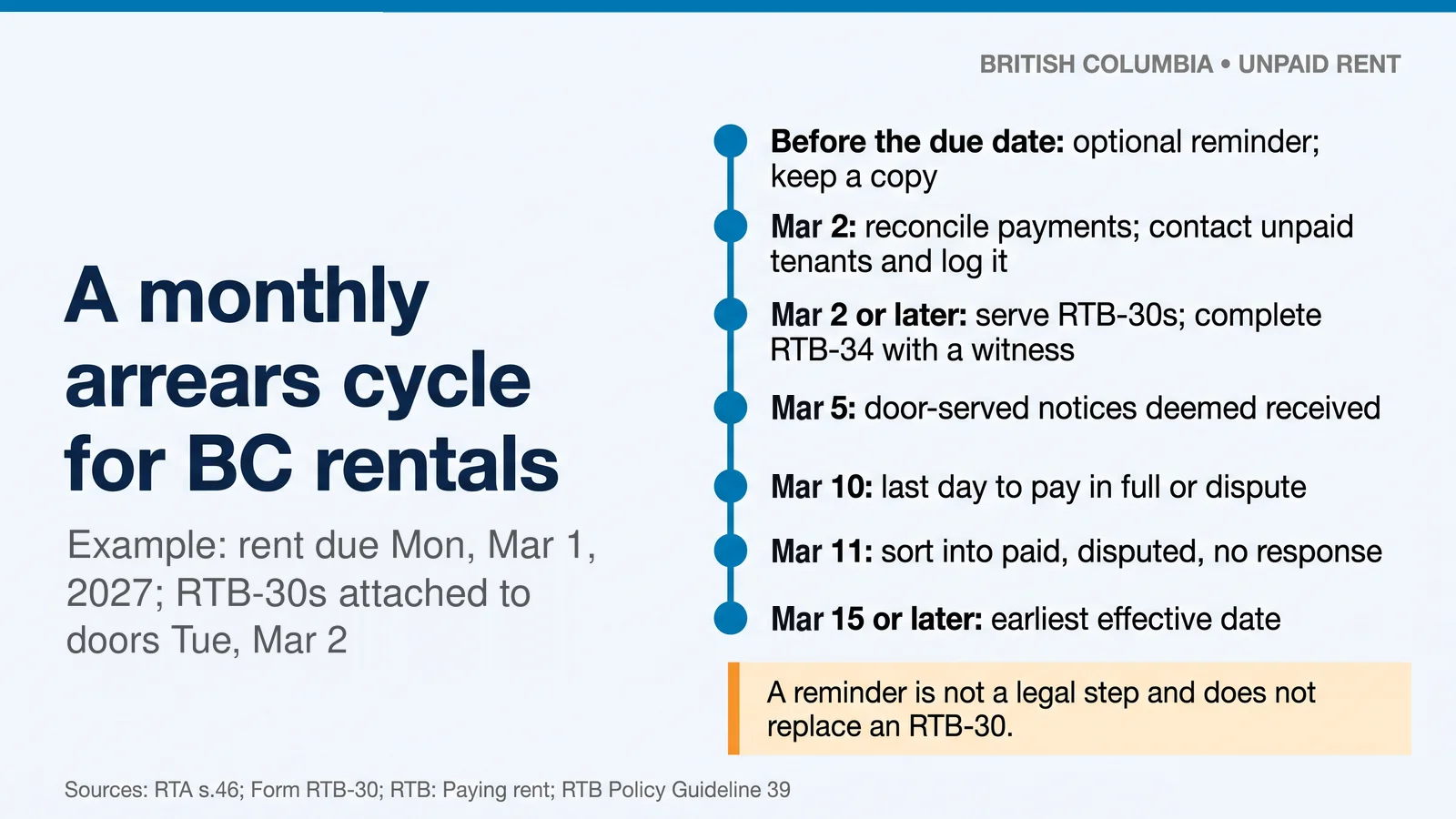
Here is a schedule for rent due Monday, March 1, 2027, with notices attached to doors on Tuesday, March 2. When you build your own calendar, watch for a due date or deadline that lands on a Sunday or statutory holiday: BC's Interpretation Act moves it to the next day that is not a holiday, which shifts every step after it.
- Before the due date: send friendly reminders to tenants with a history of late payment. Keep the tone neutral and keep a copy.
- March 2 (first day after due date): reconcile payments. List every unit with an unpaid or short balance and the exact amount.
- March 2: contact each tenant on the list and log the outcome. The RTB suggests discussing unpaid rent first and documenting the result.
- March 2 or later: prepare and serve RTB-30s for units still unpaid. Complete the RTB-34 proof of service with a witness the same day.
- March 5: door-served notices are deemed received.
- March 10: last day for those tenants to pay in full or dispute.
- March 11: sort units into paid in full, disputed, and no response. Check with the RTB that no dispute was filed before preparing Direct Requests.
- March 15 or later: earliest effective date for those notices.
Reminders: what helps and what does not
A reminder before the due date is a courtesy, not a legal step. No reminder is required before a 10 Day Notice, and a reminder does not replace one. Keep reminders factual: amount, due date, how to pay. Avoid anything that reads like a threat or misstates the law, because it may end up in front of an arbitrator.
Whether you send reminders by email, text or a portal, keep a record of what was sent and when. If the tenant later says they did not know rent was late, that record helps.
Common mistakes at scale
- Batch-printing notices with the same effective date for every unit regardless of service method. Section 53 will correct an early date, but a correct date avoids argument.
- Serving on the due date. The notice can only be given after the day rent is due.
- Unsigned notices. When a stack is signed in a hurry, one gets missed. Section 52 requires a signature and a date.
- Proof of service filed in a drawer. A Direct Request is decided on paper, and RTB Policy Guideline 39 calls substantive proof of service essential.
- Using a 10 Day Notice for utilities without a written demand served at least 30 days earlier.
- Serving the Direct Request package late. It must be served within 3 days of being made available.
- Taking matters into your own hands. Only a BC Supreme Court Writ of Possession, carried out by an authorized court bailiff, can remove a tenant.
Running it across the portfolio
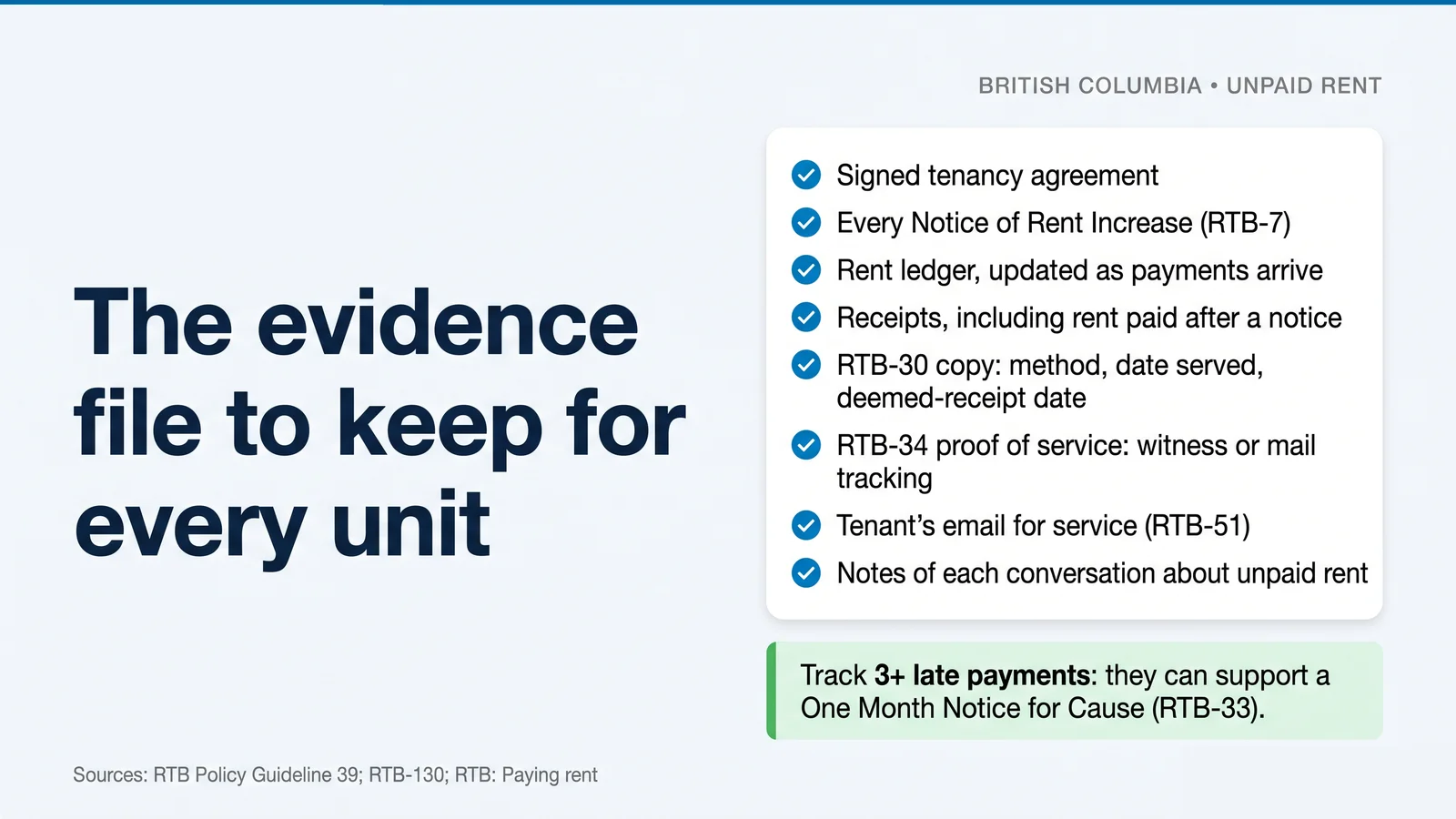
For a firm managing 30 to 150 units, the goal is that any team member can pick up any unit's file and see where it stands. That means:
- One ledger per tenancy, updated as payments arrive.
- One notice record per tenancy, with the RTB-30, service method, date served and deemed-receipt date.
- Every Notice of Rent Increase for the tenancy stored with the lease, because a Direct Request needs them to show the current rent.
- Any email address the tenant gave for service, ideally on an RTB-51.
- A weekly review of open arrears files and their next deadline.
How Tenon10 helps
Tenon10 generates the BC 10 Day Notice to End Tenancy for Unpaid Rent or Utilities (RTB-30) on the approved form. How you prompt tenants before the due date is up to your process.
Rent, payment and notice records stay together with the lease for each unit. That combined record is your evidence file when you apply for a Direct Request or attend an RTB hearing.
FAQ
Can software serve the notice for me?
Service is a legal act under the Act. Whatever tools you use, make sure the method is one the Act allows, such as email only to an address the tenant provided for service, and keep proof.
Should I send a reminder before serving an RTB-30?
It is good practice, not a requirement. The notice can be given on any day after rent is due.
Can I add a late fee to the amount on the notice?
The notice is for unpaid rent. A late fee of up to $25 is only allowed if your tenancy agreement provides for it. Ask the RTB if you are unsure how to show it.
What if the tenant pays half?
A partial payment does not cancel the notice. Give a receipt and keep it; the RTB asks for receipts for rent received after the notice in a Direct Request.
BC Monthly Arrears Workflow Checklist
A property manager's monthly checklist for BC rent arrears: reminders, reconciling payments, serving the RTB-30, the five-day window and the arrears file.
Get Free PDF →Bring arrears files into one place
Tenon10 generates the BC RTB-30 and keeps rent, payment and notice records together as your evidence record.
Built for Canadian landlords and property managers.
Related BC guides
- How to Give a 10 Day Notice to End Tenancy for Unpaid Rent in BC (RTB-30)
- Direct Request for an Order of Possession in BC
- Serving Documents in BC: Every Method the RTA Allows
Sources: Residential Tenancy Act, SBC 2002 c.78; RTB: Paying rent; RTB-30 10 Day Notice to End Tenancy; RTB: The direct request process; RTB Policy Guideline 39; RTB: Order of possession. This article is a summary of British Columbia rules as of October 2026, not legal advice. Check the Residential Tenancy Branch for your situation.