Your hearing is in three weeks. You have photos on your phone, a stack of emails, the lease, a move-out report and a contractor's invoice. You assume you'll walk the arbitrator through it all on the call.
That's not how the Residential Tenancy Branch (RTB) works. Evidence has to reach the RTB and the other party before the hearing, by a fixed date, in an accepted format, labelled the same way in both copies. Evidence that misses the deadline, can't be opened, or can't be matched to the other side's copy may simply not be considered.
This guide covers the deadlines, how to count them, the formats and file limits, and how to organize and serve an evidence package that an arbitrator can actually use.
RTB Hearing Evidence Checklist
A checklist for preparing BC RTB hearing evidence: the 14-day and 7-day deadlines, accepted formats and file limits, labelling, the RTB-43 and serving the package.
Get Free PDF →The deadlines: 14 days for applicants, 7 for respondents
The RTB Rules of Procedure set the deadlines:
| Who | Deadline | Rule |
|---|---|---|
| Applicant | Evidence received by the respondent and the RTB not less than 14 days before the hearing | 3.14 |
| Respondent | Evidence received by the applicant and the RTB not less than 7 days before the hearing | 3.15 |
| Cross-applicant | Evidence submitted with the cross-application and received not less than 14 days before the hearing | 3.3 |
| Applicant on a 10 Day Notice (RTB-30) application | Evidence submitted at the time of application | RTB evidence page |
Rule 2.5 also asks applicants to submit their evidence with the application, as far as possible, and Rule 3.13 says an applicant submitting evidence later must be ready to explain why. Rule 3.11 lets the arbitrator refuse evidence a party unreasonably delayed, even if it technically arrived in time.
How to count back from the hearing
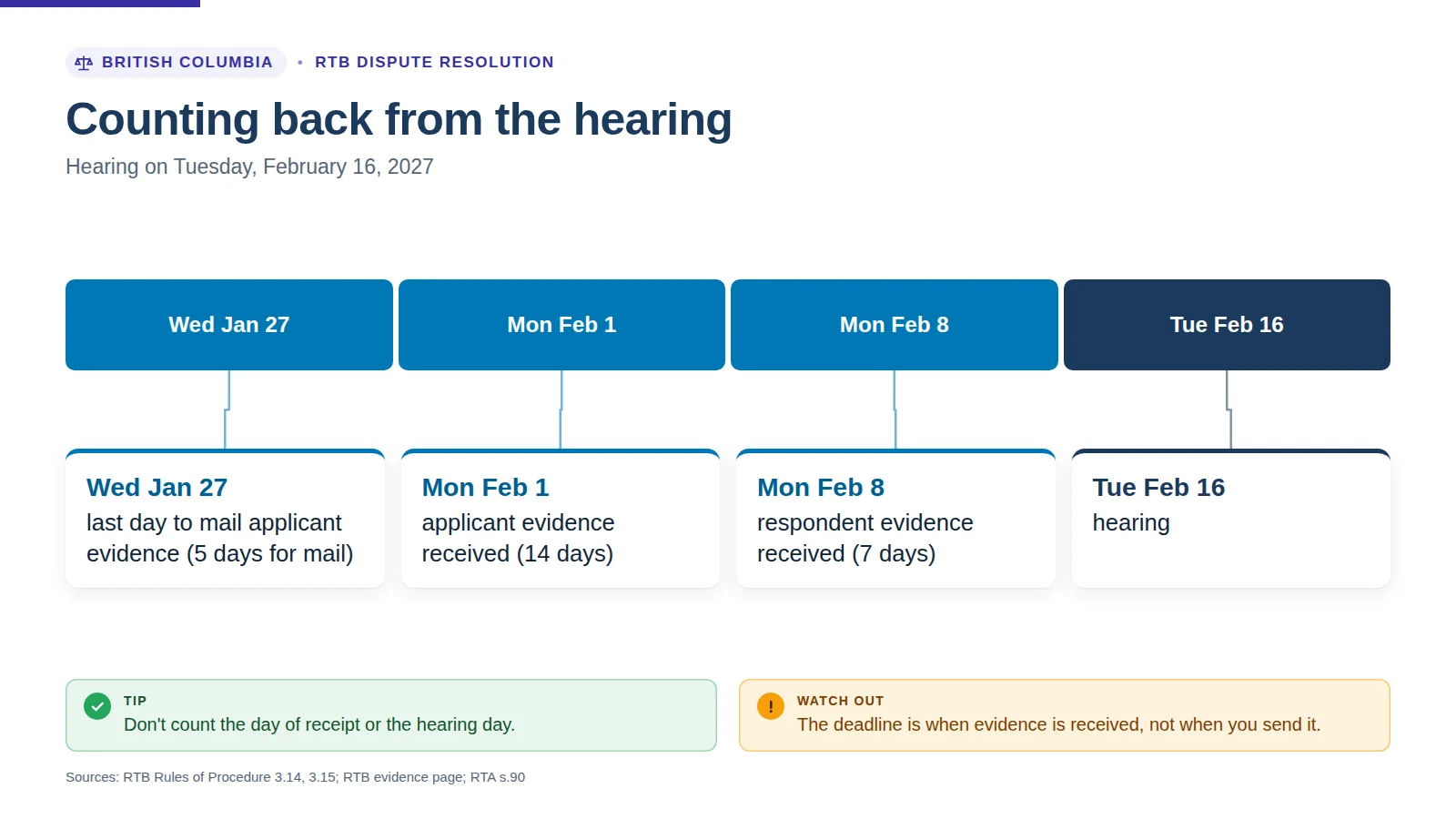
The RTB's evidence page says not to count the day the documents are received or the date of the hearing. Its own example: for a hearing on April 15, applicant evidence must be received by March 31, and respondent evidence by April 7.
The key word is received. If you serve by mail, the other party is deemed to receive it 5 days after mailing under section 90 of the Residential Tenancy Act (RTA), so you have to send it earlier.
| Hearing | Applicant's evidence received by | If mailing, mail by | Respondent's evidence received by |
|---|---|---|---|
| Tuesday, February 16, 2027 | Monday, February 1, 2027 | Wednesday, January 27, 2027 | Monday, February 8, 2027 |
If the other party is a business that is closed on the last day, the RTB says the deadline moves to its next open day. Don't plan around that; aim to deliver well before the date.
Formats, file sizes and what isn't accepted
The RTB's evidence page lists the accepted formats:
| Type | Accepted formats | Upload limit |
|---|---|---|
| Documents | PDF, DOC, DOCX, TXT, RTF, ODT, XLSX, CSV, PPT | 10MB per file |
| Photographs | JPG, JPEG, PNG, TIF, TIFF, BMP | 10MB per file |
| Video | MP4, MOV, AVI, M4V, WMV | 200MB per file |
| Audio | M4A, MP3, WMA, AAC | 10MB per file |
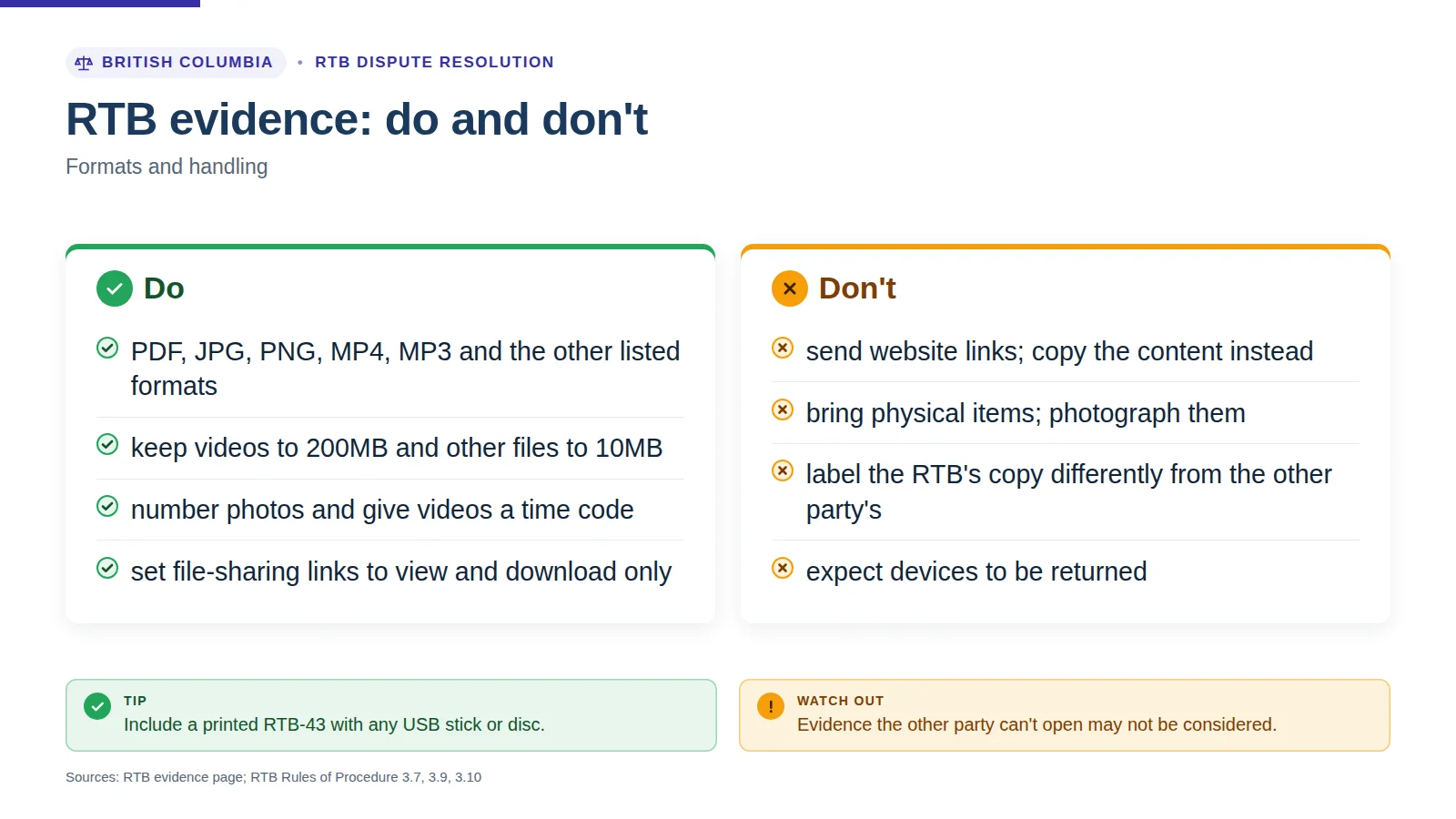
- No website links. Copy the information from the website into your evidence instead.
- No physical evidence. Rule 3.9: no physical items are accepted. Photograph the broken part instead.
- Devices aren't returned. If you submit a USB stick or disc, the RTB won't give it back, and you must include a printed Digital Evidence Details form (RTB-43) listing and describing each file.
- Files too large? The RTB suggests converting to a smaller format or splitting the file.
Describing digital evidence
Rule 3.10.1 requires, with digital evidence, a description of each file, a logical numbering system for photographs, a time code for the key point in any audio or video, and a statement of why each file matters. Online, that goes in the description field for each upload. The RTB's example: "Video at time code 2:02 water leaking after turning off kitchen faucet, recorded on December 12, 2022."
Organizing the package
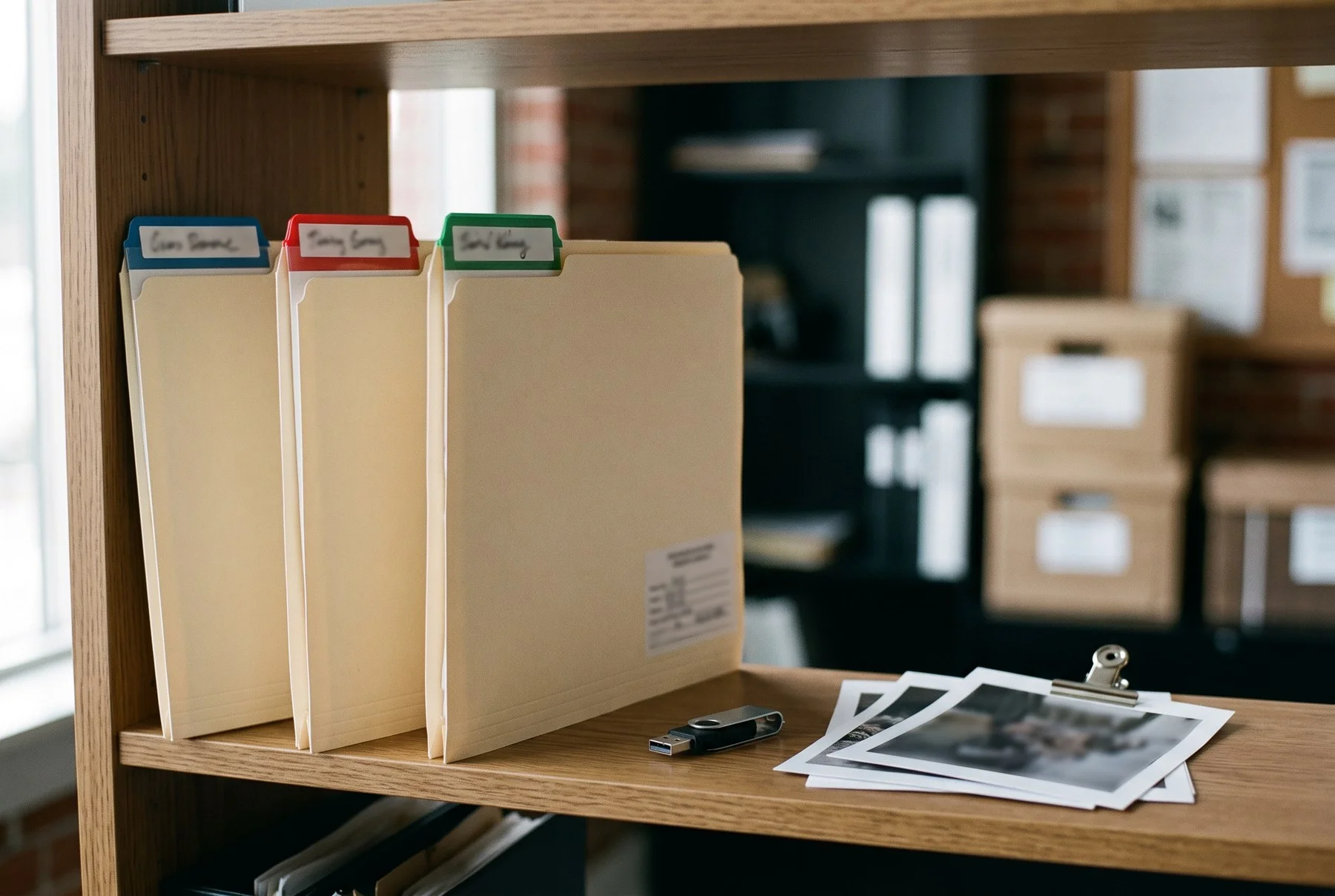
The RTB says good evidence is relevant, reliable, authentic, complete and legible, and suggests presenting it in chronological order with file names that say what each file is, such as "Living-room-carpet-stain-2023-02-02.JPEG".
Rule 3.7 is the one that catches people out: the copy the RTB gets and the copy the other party gets must be identical, with documents and photographs identified the same way and in the same order. If you redact something irrelevant, such as unrelated items on a receipt, Rule 3.7.1 says make the same redaction on both copies.
- Start with the core documents: the tenancy agreement, any notice, the condition inspection reports, and the payment ledger.
- Add the story in date order: letters, emails and texts, with dates visible.
- Add proof of loss: invoices, receipts and quotes, matched to the Monetary Order Worksheet (RTB-37) if you are claiming money.
- Add photos and video, numbered and described.
- Add witness statements, written and signed. The RTB accepts sworn or unsworn written statements.
Submit it in one complete package where you can (Rules 3.13 and 3.15), and keep an exact copy of everything you submit for at least two years after the proceeding ends (Rule 3.0.4). The RTB won't return copies, and once uploaded you can't access your evidence again.
Serving evidence on the other party
Evidence must be served under section 88 of the Act, the same methods that apply to most records. Rule 3.10.4 lets you serve digital evidence on a memory stick, CD or DVD, by email if the other party gave an email address for service, or by a link to a file hosting service such as Dropbox, OneDrive or Google Drive, with the RTB-43.
- Confirm they can open it. Rule 3.10.5 requires you to confirm before the hearing that the other party, and the RTB if you submitted to it directly, can play or open your digital evidence. If they can't, the arbitrator may not consider it.
- Lock the link. Rule 3.10.6 says a file-hosting link must be view and download only, not edit.
- Keep proof. Registered-mail receipts and tracking, or a witness to in-person delivery.
Common mistakes
- Counting the 14 days from the date you mail, not the date it's received.
- Sending the RTB a PDF bundle and the other side loose photos in a different order.
- Videos with no time code or description.
- A Google Drive link set to "anyone can edit".
- Bringing new documents to the hearing. Rule 3.17 admits late evidence only in limited cases, such as new and relevant evidence that wasn't available earlier, and Rule 3.19 bars evidence after the hearing starts unless the arbitrator directs it.
For property managers handling many files
Standardize your naming convention and index template across the team. Keep each tenancy's lease, notices, inspection reports and payment history in one place, so building the package is assembly rather than a search. Calendar the evidence dates the day each hearing notice arrives, and assign one person to confirm the other side can open every digital file.
How Tenon10 helps
Tenon10 keeps the lease, notices and payment records for each tenancy together, along with the RTB-27 condition inspection reports you complete in it. When a dispute starts, that record is the backbone of your evidence package: what was agreed, what was served and when, and what was paid.
Tenon10 doesn't file applications or upload evidence for you. Both go to the RTB directly.
Frequently asked questions
Does the 14 days include weekends?
Yes. The RTB says not to count the day the evidence is received or the hearing date, and every other day counts: in its example, a hearing on April 15 means applicant evidence received by March 31.
Can I bring new evidence to the hearing?
Generally not. Late evidence is considered only in limited cases under Rule 3.17, such as new and relevant evidence that wasn't available when the deadline passed.
Can I just send photos by text message?
No. Evidence must be served under section 88 of the Act, and the RTB lists text message as a method that isn't usually allowed.
How long are hearings?
The RTB says most hearings are one hour, so choose the evidence that supports your main points.
RTB Hearing Evidence Checklist
A checklist for preparing BC RTB hearing evidence: the 14-day and 7-day deadlines, accepted formats and file limits, labelling, the RTB-43 and serving the package.
Get Free PDF →Your evidence, already organized
Tenon10 keeps the lease, notices, inspection reports and payment history for each tenancy together, ready when a dispute starts.
Built for Canadian landlords and property managers.
Related BC guides
- Serving Documents in BC: Every Method the RTA Allows
- Direct Request for an Order of Possession in BC
- When a BC Landlord Must Pay Back Double the Deposit
Sources: RTB Rules of Procedure; RTB: Prepare and serve evidence; RTB: Serve notice for dispute resolution; Residential Tenancy Act. This article is a summary of British Columbia rules as of October 2026, not legal advice. Check the Residential Tenancy Branch for your situation.